naphthalene
journal or
publication title
福井大学工学部研究報告
volume 25
number 2
page range 147‑152
year 1977‑09
URL http://hdl.handle.net/10098/4517
Spectrophotometric determination of iron(lll)
byextraction of its TTA complex with molten naphthalene
Masatada SATAKE and Masaaki SHIMIZU *
(Received Jun. 15, 1977)
The reaction of TTA with iron(lll) has been studied to determine the optimum conditions for the extraction and determination of this metal. Iron(lll) forms a red water-insoluble complex when the sample solution of the reagent and iron(lll) ion buffered at pH4.0 is heated for 10 min on a boiling water bath. This complex can be extracted into molten naphthalene. The extracted naphthalene crystals are dis- solved in dimethylformamide. The spectra of the solution shows ab- sorbance maximum at 480 nm. The molar absorptivity is estimated to be 4.0 xl03 l.mol-l.cm- l , the sensitivity being 0.014 ~g of ironClll) for the absorbance of 0.001. The other factors such as pH, amounts of reagent and naphthalene, digestion time and standing time are studied.
The procedure has been successfully applied to the analysis of iron (Ill) with TTA. The proposed method is compared with liquid-liquid extraction method.
Introduction
2-thenoyltrifluoroacetoneCTTA) has been extensively used as the most useful complexing reagent for the extraction and spectrophotome- tric determination of Po, Bi, Tl(l,lll), Pb, Ac, Ra, Zr, U, Fe(lll), etc.'. Of these metals, it has already been shown that Fe(lll) reacts with this reagent to form a red water-insoluble complex. The ex- traction rate of this complex into benzene is very slow, whereas the complex can be easily extracted into molten naphthalene by vigorous shaking for several seconds. The extracted mixture of the complex and naphthalene is separated from the aqueous phase, dried on a filter paper and dissolved in dimethylformamide. The absorbance of the so- lution is measured at 480 nm and the trace amounts of Fe(lll) are de- termined from a calibration curve. The method is cbaracterized by the fact that the extraction rate of the complex into molten naphthalene is very fast, and the complex is extracted merely by contact with molten
by using naphthalene~
2 Experimental method Apparatus and reagents
Standard Fe(lll) solution, 10 ppm,was prepared by diluting standard Fe(lll) solution(lOOO ppm, Wako Pure Chemical Industries, LTD) to 1000 ml with water.
TTA(Dojin Chemicals Co. Kumamoto, Japan) was used without purifi- cation. A O.lM solution was prepared by dissolving this reagent in 1000 ml of ethanol.
Buffer solutions were acetate buffers for pH 3-6 and ammonia buffers for pH 8-11.
All other reagents were reagent-grade and were not purified further.
The water used was deionized water.
A Hitachi 200-20 spectrophotometer, with matched 10 mm glass cells, and a Toa Dempa HM-6A pH meter with a combined glass-calomel electrode were used.
Procedure
To 25 ml of sample solution containing 1-13 ml of 10 ppm Fe(lll) solution, in a tightly stoppered Erlenmeyer flask, add 2.0 ml of O.lM TTA solution and 2.0 ml of the acetate buffer solution(pH4.0). Mix the solution well, and warm it on a water bath at the temperature above 90
°C. Add 2.0 g of naphthalene and warm the mixture in the water bath to melt the naphthalene completely. Shake it vigorously t i l l naphthalene
solidifies, forming many fine crystals, and-allow to cool to room
temperature. Again warm to melt the very fine crystals slowly, and let them grow to give a coarser deposit. Cool to room temperature, collect the solidified deposit on a filter paper, wash with water, and remove the surplus water with a dry filter paper. Spread the crystals on a filter paper and allow to dry. Then dissolve them in dimethylformamide and dilute to 10 ml. Measure the absorbance in 10 mm glass cell a- gainst a reagent blank prepared similarly. Calculate the amount of Fe(lll) from a calibration curve.
3.1 Absorption spectra
Figure 1 shows absorption spectra for the reagent blank and
Fe(lll)-TTA complex in naphthalene-dimethylformamide solution, measured
against water, at various wavelengths in the range of
390
to600
nm.The. curve of the complex has a plateau at 470-490 nm, whereas the ab- sorption of the reagent blank is almost negligible above 420 nm.
Therefore, 480 nm was adopted as the optimum wavelength throughout this experiments.
3.2 Effect of pH
The effect of pH on the absorbance of the complex was investigated at 480 nm with about 30 ml of sample solution containing 50 ug of Fe(lll)
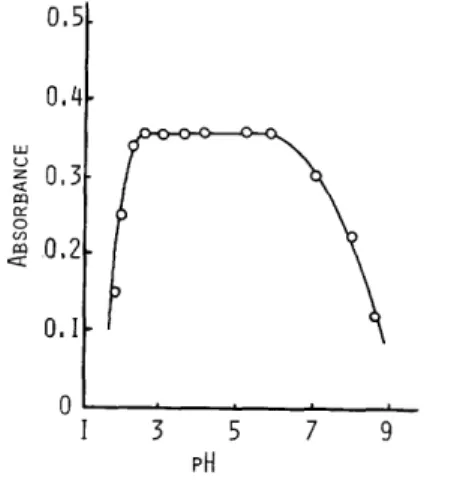
(5.0 ml of 10 ppm solution), 2.0 ml of 0.1% TTA solution and 2.0 ml of the buffer solution(pH4.0). A graph was plotted of the absorbance a- gainst pH , as shown in Fig.2. It showed that the absorbance of the complex is dependent on pH, the maximum absorbance being obtained be- tween pH 2.0 and 6.0 and decreased rapidly on either side of these limits. Therefore, a pH of 4.0 was chosen for all further experiments.
L.U U
1.0
~ ~ 0.5
a:::
o
C/)
c::J: ~
o~-=~==~======~
400 500
60Q
WAVELENGTHJ NM
FIG. 1 ABSORPTION SPECTRA OF TTA AND FE-TTA COMPLEX IN NAPHTHALENE-DMF SOLUTION
(1) 0.1% TTA:2.0 ML j pH:4.0 j BUFFER SOLUTION:
2.0 ML ; NAPHTHALENE:2.0 G
(2) FE:50 ~G j 0.1% TTA:2.0 ML j pH:4.0 JBUFFER SOLUTION~2.0 ML j NAPHTHALENE:2.0 G
REFERENCE: Water
0.5
0.4
u L.U
z 0.3
« CQ a:::
0 C/)
0.2
~ c::J:
0.1
0
1 3 5 7 9
pH
FIG. 2 EFFECT OF pH ON ABSORBANCE FE:50 ~G j 0.1% TTA:2.0 ML j WAVELENGTH:
480 NM j NAPHTHALENE:2.0 G REFERENCE: REAGENT BLANK
3.3 Effect of reagent concentration
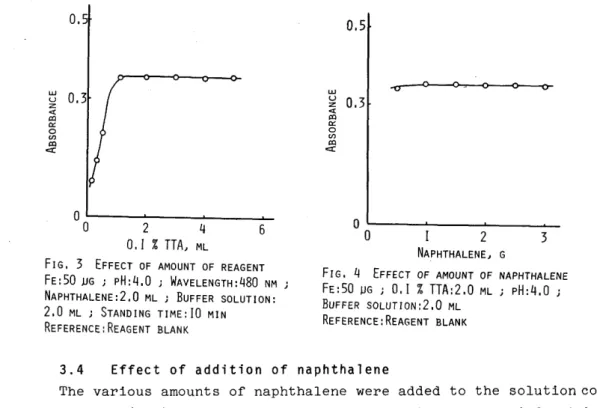
Varying amounts of TTA were added to the sample solution con- taining 50 ug of Fe(lll) and 2.0 ml of the acetate buffer solution(pH 4.0), and the variation in the absorbance of the complex with the re- agent concentration was investigated. The result obtained is shown in Fig.3. From the experimental data, the absorbance of the complex increased with the increasing amounts of the reagent up to 1.0 ml of
reagent solution were sufficie~t for all further experiments.
w u z «
trl 0:::
o en co
<C
0.5
0 - - -... - -... _ _ _ ...
o
2 4 60.1
%
TTAJ MLFIG. 3 EFFECT OF AMOUNT OF REAGENT FE:50 ~G ; pH:4.0 ; WAVELENGTH:480 NM NAPHTHALENE:2.0 ML ; BUFFER SOLUTION:
2.0 ML ; STANDING TIME:IO MIN REFERENCE: REAGENT BLANK
0.5
w
~ 0.3
« trl 0:::
o en
<C trl
o - - -... o
--~---~ 2 3 NAPHTHALENEJ GFIG. 4 EFFECT OF AMOUNT OF NAPHTHALENE FE:50 ~G ;
O.
I% TTA:2.0
ML ; pH:4.0 BUFFER SOLUTION:2.0 MLREFERENCE:REAGENT BLANK
3.4 Effect of addition of naphthalene
The various amounts of naphthalene were added to the solution con- taining the Fe(lll)-TTA complex, and the extraction was carried out by the optimum conditions. The result is shown in Fig.4. The amounts exceeding 0.5 g did not affect the absorbance.
3.5 Effect of buffer solution
The effect of the addition of the buffer solution on the ab-
sorbance was investigated, and Fig.5 showed that the absorbance was no change by addition of the buffer solution of up to 5.0 mI. There- fore, 2.0 ml of the buffer solution(pH4.0) were used for all further experiments.
3.6 Effect of digestion time
The Fe(lll)-TTA complex in the solution containing 50 ug of Fe (Ill) was warmed on a water bath at the temperature above 90°C and the effect of digestion time on the absorbance was investigated between 1 and 50 min. The variation in the absorbance was not seen for this period of digestion time. Therefore, 10 min of the digestion time were selected for all further experiments.
3.7 Effect of shaking time
0.5
w ~ 0.3
~
~ 0:: o
II)
~
<C
o~----~----~----~-
a 2
4 6BUFFER SOLUTION) ML FIC. 5 EFFECT OF BUFFER SOLUTION FE:50 ~G ; 0.1
%
TTA:2.0 ML ; pH:4,O WAVELENGTH:480 NMREFERENCE: REAGENT BLANK
0.5
w u
~ 0.3
~ 0:::
o
(/)
~
<C
SHAKING TIME) MIN FIG. 6 EFFECT OF SHAKING TIME FE:50 ~G j 0,1
%
TTA:2,O ML j pH:4,O ; BUFFER SOLUTION:2,O ML j NAPHTHALENE:2.0 G REFERENCE:REAGENT BLANKThe sample solution containing the Fe(lll)-TTA com~lex and 2.0 g of naphthalene was warmed on a water bath for 10 min at the temperature above 90°C and the extraction was carried out by vigorous shaking of up to 25 min. The result is shown in Fig.6. From the experimental data, the shaking time for 1 min was sufficient for the complete ex- traction of the complex.
3.8 Effect of standing time
The mixture of the Fe(lll)-TTA complex and naphthalene was dis- solved in dimethylformamide and the absorbance of the solution was measured at 480 nm. From the experimental data, the complex in di- methylformamide solution was very stable and the standing time of 2 hours had no effect in the absorbance. Therefore, 10 min of standing time were selected for all further experiments.
3.9 Calibration curve
Under the optimum conditions described above, calibration curve for Fe(lll) determination was established at 480 nm against the reagent blank. The absorbance of the complex showed a linear relationship to the concentration of Fe(lll) in the range of 10-130 ~g per 10 ml of di- methylformamide solution. The calculated molar absorptivity under the conditions described above was 4.0 x 10 3 l.mol-l.cm-l, the sensi- tivity being 0.016 pg per cm2, corresponding to the absorbance of 0.001.
The precision of this method was estimated with 10 samples con- taining 50 ~g of Fe(lll). The mean absorbance at 480 nm was 0.356with
1.7
%.
3.10 Choice of solvent
The attempt was made to dissolve the mixture of the Fe(lll)-TTA complex and naphthalene by the organic solvents such as chloroform, benzene, dimethylformamide, dioxane, etc.. Of these solvents, di- methylformamide was found to be the most suitable solvent for the complex after extraction into molten naphthalene.
3.11 Comparison of naphthalene and other methods
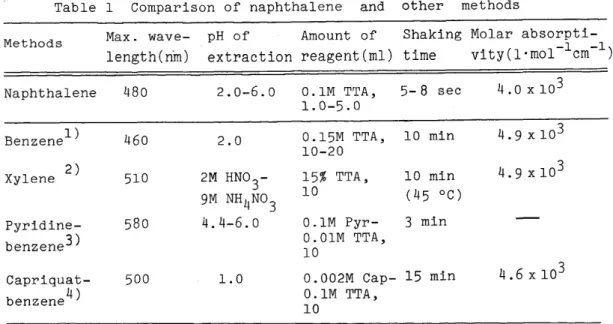
The proposed method was compared with other extraction methods and the result is shown in Table 1. The various factors of this method,
Table 1 Comparison of naphthalene and other methods
Methods Max. wave- pH of Amount of Shaking Molar absorpti- length(nin) extraction reagent (ml) time vitY(1'mol-1
cm-1 ) Naphthalene 480 2.0-6.0 O.lM TTA, 5- 8 sec 4.
a
x 1031.0-5.0 Benzenel
) 460 2.0 0.15M TTA, 10 min 4.9xl03 10-20
Xylene 2)
510 2M HN0
3- 15% TTA, 10 min 4.9xl03 9M NH
4N0 3
10 (45 OC)
Pyridine- 580 4.4-6.0 O.lM Pyr- 3 min
benzene
3)
O.OlM TTA,10
Capriquat- 500 1.0 0.002M Cap- 15 min 4.6 x 10³
benzene 4 ) O.lM TTA,
10
such as pH range, amount of reagent, shaking time or extraction rate, are much better than those of the benzene, xylene, pyridine-benzene, capriquat-benzene methods, although the molar absorptivity is slightly lower.
References
1)