Spectrophotometric determination of copper(II)
after separation by coprecipitation of its
5,7-dichlorooxine complex using naphthalene as
an organic coprecipitant
journal or
publication title
福井大学工学部研究報告
volume
26
number
2
page range
247-252
year
1978-09
URL
http://hdl.handle.net/10098/4456
VOL.26 No.2 1978
Spectrophotometric determination of copper(II) after separation by coprecipitation of its 5,7-dichlorooxine complex using naphthalene as an organic coprecipitant
*
Masatada SATAKE
Received Jun. 30, 1978 )
A spectrophotometric method for the determination of micro amounts of copper(II) after coprecipitation of its 5,7-dichlorooxine complex with naphthalene is described. Copper(II) reacts with 5,7-dichlorooxine to form water-insoluble stable complex. This complex is completely coprecipitated with microfine naphthalene. The co-precipitated mixture of the complex and naphthalene is separated from the aqueous solution by aspiration, dried in a dryer at 60°C and dissolved in DMF. The absorbance of the solution is measured at 420 nm against a reagent blank and micro amounts of copper(II) are de-termined spectrophotometrically. Beer's law was obeyed for 5-100 ~g
of copper(II) in 10 ml of DMF. The molar absorptivity was calculated to be 6.4xI03 l·mol-l.cm- l at 420 nm, and the sensitivity being 0.010 pg of copper(II) per cm2 for the absorbance of 0.001. The relative
standard deviation for the present analysis of copper(II) was 0.84
%
for ten determinations. 1 Introduction
5,7-dichlorooxine reacts with various metal ions to form water-insoluble colored complexes. Among these complexes, copper complex is completely coprecipitated with microfine naphthalene in the aqueous solution at pH 4-10.5 by vigorous shaking. After coprecipitation, the mixture of the complex and naphthalene was aspirated through a funnel with a disc shaped teflon filter, washed with water, dried in a dryer and dissolved in DMF. The absorbance of the solution was measured at 420 nm and the micro amounts of copper(II) was determined from a cali-bration curve. The coprecipitation of the complex with naphthalene was very easily completed by vigorous shaking for several seconds as
us
well as naphthalene extraction method. The amount of naphthalene for complete coprecipitation of the complex is very small compared with the naphthalene extraction method. The complex is almost completely coprecipitated and concentrated from the larger volume of aqueous solution with only 0.4 g of naphthalene. In the present paper, the spectrophotometric determination of copper(II) is reported in detail.
2 . Experimental method Reagents and apparatus
Standard copper(ll) solution. Prepared by diluting 10 ml of 1000 ppm copper(II) standard solution (Analytical-reagent grade, Wako Pure Chemical Industries LTD, Osaka, Japan) to 1000 ml with water.
Reagent. Use 0.05% 5,7-dichlorooxine solution in ethanol(w/v) and 20% naphthalene solution in acetone(w/v).
The buffer solutions were prepared by mixing 1M acetic acid and 1M ammonium acetate, or 1M ammonia water and 1M ammonium acetate.
All other reagents were reagent-grade and were not purified. Deionized water was used.
A Hitachi Model 200-20 double beam spectrophotometer was used for the absorbance measurements with 10 mm glass cell.
The pH measurements were made with a Toa Dempa HM-6A pH meter, equipped with combined glass-calomel electrodes.
Procedure
To about 40 ml of a sample solution containing 1-10 ml of 10 ppm copper solution, in a tightly stoppered Erlenmeyer flask, add 2.0 ml of 0.05% 5,7-dichlorooxine solution and 2.0 ml of the buffer solution
(pH 9.0). Mix the solution well, and digest for ten minutes. Add 2.5 ml of 20% naphthalene-acetone solution and shake it vigorously for 1 min. Collect the colored naphthalene mixture on a funnel with disc shaped filter( filter paper, No. 5C). Wash with water and dry in a dryer at about 60°C. Then dissolve i t in DMF and dilute to 10 mI. Measure the absorbance of the solution in 10 mm glass cell against a reagent blank prepared similarly. Calculate the amounts of copper(II) from a calibration curve.
3 Results and discussion
3.1 Absorption spectra
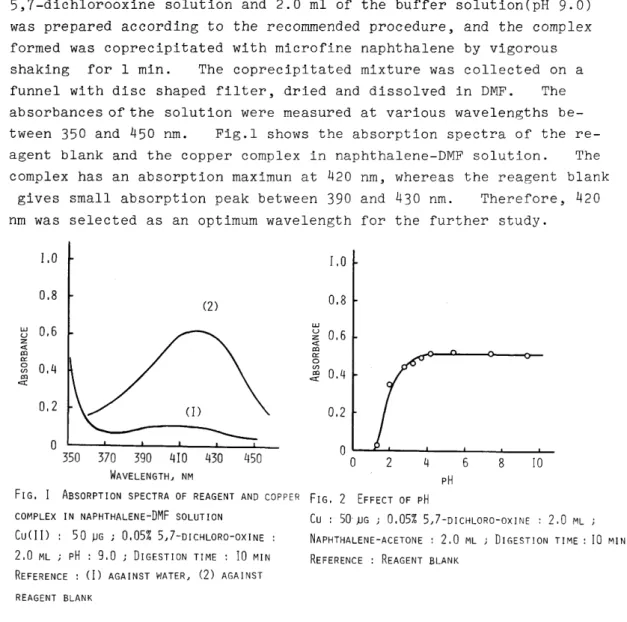
5,7-dichlorooxine solution and 2.0 ml of the buffer solution(pH 9.0) was prepared according to the recommended procedure, and the complex formed was coprecipitated with microfine naphthalene by vigorous shaking for 1 min. The coprecipitated mixture was collected on a funnel with disc shaped filter, dried and dissolved in DMF. The absorbances of the solution were measured at various wavelengths be-tween 350 and 450 nm. Fig.l shows the absorption spectra of the re-agent blank and the copper complex in naphthalene-DMF solution. The complex has an absorption maximun at 420 nm~ whereas the reagent blank
gives small absorption peak between 390 and 430 nm. Therefore, 420 nm was selected as an optimum wavelength for the further study.
1.0 1.0 0.8 0.8 (2) w 0.6 w u 0.6 u z Z <t: <t: I'Q I'Q a::: a::: 0 0 0.4 U) U) I'Q 0.4 I'Q c:r c:r 0.2 0.2
°
350 370 390 4IO 430 450°
0 2 4 6 8 10 WAVELENGTH) NMpH
FIG.
I
ABSORPTION SPECTRA OF REAGENT AND COPPER FIG.2
EFFECT OFpH
COMPLEX IN NAPHTHALENE-DMF SOLUTION Cu : 50-~G ; 0.05% 5,7-DICHLORO-OXINE : 2.0 ML ;
Cu(II) : 50)JG; 0.05% 5,7-DICHLORO-OXINE :
2.0 ML ;
pH :
9.0 ; DIGESTION TIME: 10 MINREFERENCE: (I) AGAINST \'IATER, (2) AGAINST
REAGENT BLANK
3.2 Effect of pH
NAPHTHALENE-ACETONE: 2.0 ML ; DIGESTION TIME: 10 MIN
REFERENCE : REAGENT BLANK
The pH of the sample solution containing 50 Vg of copper(II) and 2.0 ml of 0.05% 5,7-dichlorooxine solution was adjusted to I -10 with various buffer solution, and the complex was coprecipitated with naphthalene according to the recommended procedure. The pH measurements were made after coprecipitation at room temperature. Fig.2 shows the effect of the pH on the absorbance of the complex in naphthalene-DMF solution. The pH range at which maximal coprecipitation occurs was found to be 4.5 - 10. Therefore, a pH of the solution was adjusted to 9.0 throughout the further study.
250
3.3 Effect of reagent concentration
The varying amounts of 0.05% 5,7-dichlorooxine solution were added to the sample solution containing 50 pg of copper(II) and 2.0 ml of the buffer solution(pH 9.0), and the coprecipitation was carried out according to the recommended procedure. Fig.3 shows the effect of the reagent concentration on the absorbance of the complex. It can be seen that the absorbance of the complex increased with increasing amounts of the; reagent with up to 1.5 ml of this reagent and then remained almost constant. Therefore, 2.0 ml of 0.05% 5,7-dichloro-oxine solution were used for the further study.
3.4 Effect of buffer solution
The varying volume of the buffer solution (pH 9.0) was added to the solution containing 50 pg of copper(II) and 2.0 ml of 0.05% 5,7-dichlorooxine solution, and the coprecipitation was carried out according to the recommended procedure.From the experimental result, a range of 0.5-5.0 ml of the buffer solution was practically without effect on the absorbance. Therefore, 2.0 ml of the buffer solution were added for the further study.
1.0 0,8 UJ 0,6 u z <t p:) e::: 0 0,4 (/J p:) cI: 0,2 0,05% 5}7-DICHLORO-OXINE} ML
FIG, 3 EFFECT OF REAGENT CONCENTRATION
Cu :
50 ~G ; WAVELENGTH: 420 NM ;pH
g,O
20% NAPHTHALENE-ACETONE: 2,5 ML REFERENCE : REAGENT BLANK
I.O
0,8 UJ 0,6 u z <C p:) e::: ~ 0 (/J 0,4 p:) cI: 0,2 0°
2 3 4 5 1M BUFFER SOLUTION} MLFIG, 4 EFFECT OF ADDITION OF BUFFER SOLUTION
Cu :
50 ~G ; WAVELENGTH: 420 NM ;pH : g,O ;
0,05% 5}7-DICHLORO-OXINE : 2,0 ML ; DIGESTION TIME10 MIN ; SHAKING TIME : I MIN
REFERENCE : REAGE~T BLANK
3.5 Effect of digestion time
and the effect of digestion time on the absorbance was examined. From the experimental result, the absorbance did not change by di-gestion for 30 min. Therefore, 10 min of digestion time were selected for the further study.
3.6 Effect of naphthalene-acetone solution
Varying amounts of naphthalene-acetone solutiGn was added to the solution containing the copper complex. Fig.5 shows the effect of addition of naphthalene-acetone solution on the absrbance of the
complex. The absorbance increased with increasing amounts of naphtha-lene-acetone solution up to 1.0 ml of 20% solution, and the ad-dition of 1.0 - 5.0 ml did not give the change in the absorbance. Therefore, 2.5 ml of 20% naphthalene-acetone solution were added for the further study.
3.7 Effect of shaking time
The mixture of the copper complex and naphthalene in the so-lution was vigorously shaked between 3 seconds and 2 minutes. This period of shaking time was demonstrated to be quite sufficient for the complete coprecipitation of the complex.
3.8 Effect of standing time
The mixture of the copper complex and naphthalene was dissolved
1.0 0.8 L.LJ u z 0.6 c:( al 0::: 0 (f) al 0.4 c:t: 0.2 0 0 2 3 4 5 20% NAPHTHALENE-ACETONE, ML
FIG.
5
EFFECT OF ADDITION OF NAPHTHALENECu : 50 PG ; WAVELENGTH : 420 NM ; pH : 9.0
BUFFER SOLUTION: 2.0 ML j SHAKING TIME: I MIN
DIGESTION TIME: 10 MIN
REFERENCE : REAGENT BLANK
L.LJ U 1.0 0.8 ~ 0.6 al 0::: o (f) ~ 0.4 0.2 20 40 60 80 100 COPPER(II), ~G/IO ML DMF
FIG. 6 CALIBRATION CURVE FOR COPPER
WAVELENGTH : 420 NM j pH : 9.0 j 0.05%
5,7-DICHLORO-OXINE : 2.0 ML j BUFFER SOLUTION: 2.0 ML
20% NAPHTHALENE-ACETONE: 2.5 ML j SHAKING TIME:
I MIN j STANDING TIME : 10 MIN
252
in DMF and the effect of standing time on the absorbance was examined between
5
minutes and 2 hours. The color of the complex in DMF so-lution was very stable and this period of standing time did not give the marked change in the absorbance.3.9 Calibration curve
Under the optimum conditions described above, the calibration curve for the copper determination was constructed. Beer's law was obeyed over the range of 5 - 100 pg of copper(II) in 10 ml of DMF. The molar absorptivity was calculated to be