Analysis of nickel by solid-liquid separation
after liquid-liquid extraction.
-Spectrophotometric determination of nickel
after extraction of its nioxime complex with
molten
naphthalene-journal or
publication title
福井大学工学部研究報告
volume
25
number
2
page range
113-118
year
1977-09
URL
http://hdl.handle.net/10098/4497
Analysis of nickel by solid-liquid separation after
liquid-liquid extraction.
--Spectrophotometric determination of nickel after
extraction of its nioxime complex with molten
naphthalene--*
Masatada SATAKE
(Received Jun. 15, 1977)
Nioxime reacts with nickel to form a water-insoluble red complex. This complex is quantitatively extracted into molten naphthalene at temperature above 81 aC. The solidified mixture of the complex and naphthalene is dissolved in chloroform at 50 - 60 aC, and the small amounts of nickel in the solution are determined spectrophotometrically. The factors such as pH, amounts of nioxime and naphthalene are studied, and the molar absorptivity, sensitivity and relative standard deviation are evaluated. The extracted complex is stable in both naphthalene and naphthalene-chloroform solution. The extraction of this complex into molten naphthalene is rapidly completed by contact with molten naphthalene or by slight shaking. This complex is mostly insoluble in chloroform, benzene, etc., but soluble in molten naphthalene. The mixture of the complex and naphthalene is insoluble in dimethylformamide, dimethylsulfoxide, acetonitrile, dioxane, isoamylacetate, chlorobenzene, etc., at 50 - 60
ac.
1.
Introduction
Nioxime(1,2-cyclohexanedionedioxime) forms water-insoluble complexes with nickel and palladium and is used for the detection and gravimetric determination of these metals. These complexes formed cannot be almost extracted into organic solvents such as chloroform, benzene, etc., but done easily into molten naphthalene at high temperature above 81 aC.
After extraction, the solidified crystals of the complex and naphthalene are separated from the solution and dissolved in chloroform at 50 - 6 0 aC.
By measuring the absorbance of the solution, the trace amounts of metals are determined from the calibration curve.
In this paper, nioxime was recommended as a new analytical
ex-traction reagent for the spectrophotometric determination of nickel
with naphthalene.
Compared with the chloroform extraction method,
the present method is characterized by the higher extraction rate and
the higher solubility of the complex into molten naphthalene.
2.
Experimental result
2.1
Apparatus
A Hitachi Model 200-20 double beam spectrophotometer was used for
the absorbance measurement with a 10 mm glass cell.
The measurements of pH were made with a Toa-Dempa pH meter
equipped with combined calomel and glass electrodes, Model HM-5A.
2.2
Reagents
Satndard nickel solution, 10 ppm.
Prepared by diluting standard
nickel stock solution(lOOO ppm) to 1000 ml with doubly distilled water.
Nioxime solution, 0.5
%.
Prepared by dissolving 0.5 g ofnioxime
in 100 ml of ethanol.
Buffer solution.
Prepared from 1M acetic acid and 1M ammonium
acetate solution, or 1M ammonia water and 1M ammonium acetate solution
All other solutions were prepared with analytical reagent grade
chemicals by using doubly distilled water.
2.3 Procedure
To 30 ml of the sample solution containing 1-7 ml of 10 ppm
standard nickel solution, in a 80 ml tightly stoppered Erlenmeyer flask,
add 2.0 ml of acetic acid-ammonium acetate buffer solution and 1.5 ml
of 0.5
%
nioxime solution, and adjust the pH to about 4.6.
Mix the
solution well, and warm it on a steam-bath at around 90°C.
Add 2.0 g
of naphthalene and warm the mixture in the steam-bath at 90°C to melt
naphthalene completely.
Shake it vigorously till the naphthalene layer
solidifies.
Again warm and melt the very fine crystals slowly, and let
them grow to give a coaser crystalline deposit.
Collect the solidified
deposit on a filter paper, wash with water, and blot the surplus water
with a dry filter paper.
Spread the crystals on a filter paper for
air-drying.
Then dissolve them with chloroform at 50-60°C by vigorous
shaking.
After cooling, dilute to 10 mI.
Dry the solution by addition
of about 2 g of anhydrous sodium sulfate, transfer a portion into a 10
mm cell and measure its absorbance at 384 nm against a reagent blank
prepared similarly. Calculate the amount of nickel from the calibration
curve.
3.
Result and discussion
3.1
Absorption spectra
According to the recommended procedure, nickel in the sample solution containing 50 pg of nickel and 1.5 ml of 0.5
%
nioxime so-lution was extracted into molten naphthalene as nickel-nioxime complex at pH ca. 5.5. The extracted naphthalene mixture was dissolved in chloroform at 50 - 60°e.
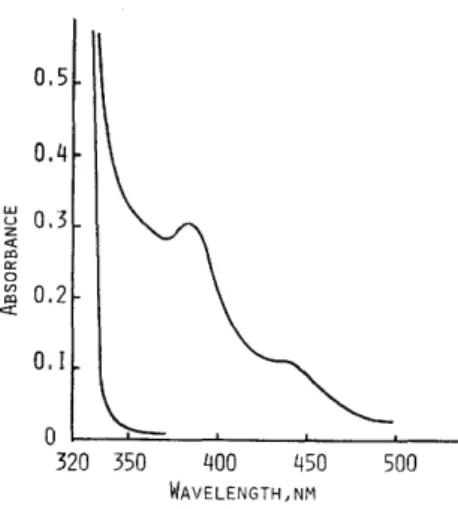
The absorption spectra of the solution was measured at various wavelengths in the range of 340 to 500 nm. Fig.l shows absorption spectra for the reagent and the nickel complex in naphthalene-chloroform solution, measured against water. The nickel complex has the absorbance maximum at 384 and 440 nm. The reagent blank shows strong absorption below 360 nm. Beyond this wavelength, there is practically a negligible absorption due to the reagent blank. Therefore, all the absorbance measurements were performed at 384 nm throughout this experiment.0.5 0.4 UJ 0.3 u z ..: m 0:: ~ 0.2 m <z: O. I WAVELENGTH,NM
FIG. I ABSORPTION SPECTRA OF NIOXIME AND NICKEL COMPLEX IN NAPHTHALENE-CHLOROFORM SOLUTION (I) 0.5 % NIOXIME : 1.5 ML ; pH : 4.6 (2) NI : 50 )JG ; 0.5 % NIOXIME : 1.5 ML pH : 4.6 REFERENCE : WATER
3.2
Effect of pH on absorbance
0.5 0.4 w u 0.3 z « m 0:: 0 0.2 Vl m <z: O. I 0 _ _ _ ~_-L...._~ .... 0 2 4 6 8 10 pHI FIG. 2 EFFECT OF pH ON ABSORB~CE NI : 50 JJG ; 0.5 % NIOXIME : 1.5 ML ; WAVELENGTH : 384 NM ; DIGESTION TIME 10 MIN REFERENCE : REAGENT BLANK
The sample solution was prepared that contained 50 pg of nickel, 2.0 ml of the respective buffer solution and 1.5 ml of 0.5
%
nioxime solution in total volume of approximately 34 mI. The extraction was carried according to the recommended procedure. The pH values of the solution after extraction were measured at room temperature. Fig.2 shows the effect of pH on the absorbance of the nickel complex innaphthalene-chloroform solution. The extraction of the cc~plex starts from pH 2.0~ increases sharply with the increase of pH at pH 2.0 to 3.2~
and becomes constant and maximum at pH 3.2 to 11.2. Therefore, The pH of the solution was adjusted to 4.6 throughout further experiment.
3.3
Effect of reagent concentration on absorbance: .
To the sample solution containing 50 Vg of nickel and 2.0 ml of the acetate buffer solution(pH4.6) in total volume of approximately 32 ml, 0.01 - 5.0 ml of 0.5
%
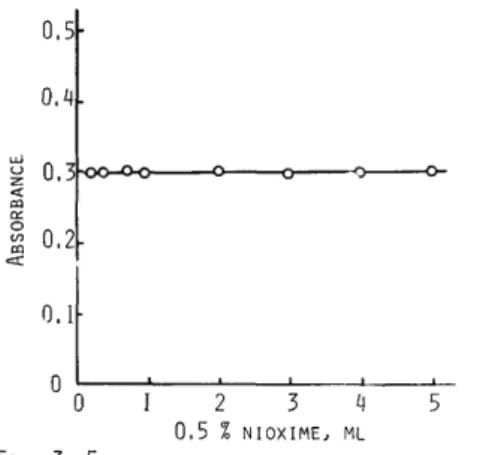
nioxime solution was added, and the ex-traction was carried out according to the recommended procedure. Fig. 3shows the effect of addition of nioxime solution on the absorbance of the complex. From this, the absorbance increased with increasing amounts of nioxime up to 0.06 ml of 0.5
%
nioxime solution, whereas addition of 0.06 - 5.0 ml of it gave definite absorbance. Therefore, 2.0 ml of 0.5%
nioxime solution were taken throughout this experiment.0.5 0.4 uJ 0.3 u z « III a:: ~ III 0,2 c::r::
oj
-L~ 0 2 3 4 5 0,5 % NIOXIME, MLFIG, 3 EFFECT OF REAGENT CONCENTRATION O!i ABSORBII.NCE
NI : 50 )JG j WAVELENGTH : 384 NM j pH : 4.6
DIGESTION TIME: 10 ~mi j STANDlfiG Trr~E : JO r1]!!
REFERENCE : REAGEIlT BLANK
0,5 0,4 O. I
o
~--~--~--~----~--~-o
I 2 3 4 5 1M BUFFER SOLUTION, ML FIG. 4 EFFECT OF BUFFER SOLUTION ON ABSORBANCENl : 50 )JG j WAVELENGTH: 384 NM j pH :4.6;
0.5 % NIOXIME : 1.5 ML ; STANDING TIME: 10 MI,l; SOLVENT : CHLOROFORM(50 0c)
REFERENCE : REAGENT BLANK
3.4
Effect of buffer solution on absorbance
Fig. 4 shows the effect of addition of the acetate buffer solution (pH4.6) on the absorbance of complex. The addition of 0.5 - 5.0 ml of buffer solution gave no effect on the absorbance at 384 nm. Therefore, 2.0 ml of the buffer solution were taken throughout this experiment.
3.5
Effect of digestion time on absorbance
The nickel complex in the solution containing 50 ~g of nickel was digested on a steam-bath at
go
DC, and the extraction was performedaccording to the recommended procedure. Fig.
5
shows the effect of digestion time on the absorbance. From this, the ~ormation o~ the complex was very fast owing to high temperature and the digestion was found to be unnecessary.3.6
Effect of naphthalene on absorbance
The varying amounts of naphthalene were added to the solution containing 50 ug of nickel, 2.0 ml of the acetate buffer solution and 2.0 ml of 0.5
%
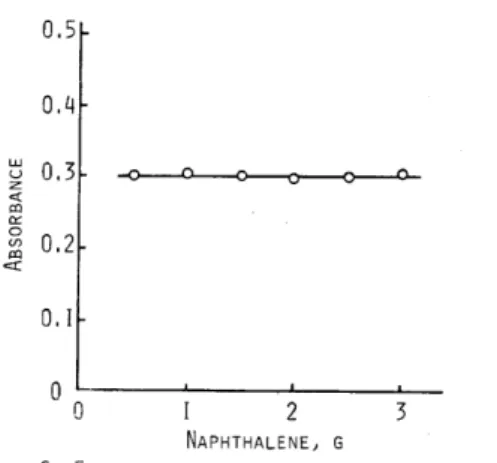
nioxime solution and the extraction of the nickel complex was carried out according to the recommended procedure. Fig.6
shows the effect of addition of naphthalene on the absorbance. The addition of 0.5 to 3.0 ml of naphthalene gave little effect on the absorbance. Therefore, 2.0 g of naphthalene were taken throughout this experiment. 0.5 0.4 ~ O. 3 ... O-O-O--O-O-O-{)-<)-~').--4-z <:( ~ 5; 0.2 co cI: O. I
o
o
IO 20 30 40 DIGESTION TIME) MIN FIG. 5 EFFECT OF DIGESTION TIME ON ABSORBANCE50
NI : 50}JG ; 0.5 % NIOXIME : 1.5 ML ; pH : 4.6
BUFFER SOLUTION: 2.0 ML ; NAPHTHALENE: 2.0 G
; STANDING TIME: 10 ML REFERENCE : REAGENT BLANK
0.5 0.4 UJ 0.3 0 u ~ 0 0 0---0-z <:( co 0:: 5; 0.2 co cI: O. I 0 0 2 3 NAPHTHALENE) G
FIG. 6 EFFECT OF NAPHTHALENE ON ABSORBANCE NI : 50 UG j WAVELENGTH: 384 NM j pH : 4.6
D I GE STI O:J T I ME : 10M IN; SOLVENT : CHLOROFORM REFERENCE : REAGENT BLANK
3.7
Effect of standing time on absorbance
The mixture of the nickel complex and naphthalene was dissolved in chloroform at 50 - 60 °C,and the stability of color of the complex in naphthalene-chloroform solution was investigated. Fig. 7 shows the effect of the stability of color of the complex on the absorbance. The complex was very stable in both naphthalene and naphthalene-chloroform solution for a long time.
3.8
Calibration curve,sensitivity and reproducibility
Based on the optimum conditions obtained from the experimental results described above, the calibration curve for nickel determir.ation
was established at the wavelength of 384 nm against the reagent blank. It was linear over the range of 8 - 70 ~g of nickel in 10 ml of chloro-form. The molar absorptivity was estimated to be 3.7 x 10 3 l·mol-l . cm-l, the sensitivity 0.016
~g
of nickel per cm 2 for the absorbance of 0.001. An average of ten determinations on 50 ~g of nickel gave a mean absorbance of 0.309 with standard deviation~f
1.25 x 10⁻³(relative standard deviation, 0.58%).
0.5 0.4 O. Io
~--~--~----~--~~~o
20 40 60 80 120STANDING TIME~ MIN
FIG. 7 EFFECT OF STANDING TIME ON ABSORBANCE NI : 50 ~G ; 0.5 % NIOXIME : 1.5 ML ; WAVELENGTH : 384 NM ; DIGESTION TIME
10 MIN; NAPHTHALENE: 2.0 G
REFERENCE : REAGENT BLANK
3.9
Choice of solvent
0.5
JO 20 30 40 50 60 70
NICKEL~ ijG/IO ML CHCL3
FIG. 8 CALIBRATION CURVE FOR NICKEL
WAVELENGTH: 384 NM ; 0.5 % NIOXIME : 1.5 ML ; pH : 4.6 ; BUFFER SOLUTION: 2.0 ML ; DIGESTION TIME : JO MIN i STANDING TIME : JO MIN
REFERENCE : REAGENT BLANK
An examination was made of various solvents to dissolve the mixture of the nickel complex and naphthalene. as a result, chloroform was found to be a suitable solvent for this complex containing up to 50 ~g
of nickel at room temperature and 70 ug at 50 - 60°C. However, this complex is insoluble in most organic solvents such as benzene, dioxane, dimethylformamide, dimethylsulfoxide, acetonitrile, chlorobenzene, etc. at 50 - 60°C.