by extraction of its chinoform complex with
molten naphthalene
journal or
publication title
福井大学工学部研究報告
volume
25
number
2
page range
141-146
year
1977-09
URL
http://hdl.handle.net/10098/4516
Spectrophotometric determination of palladium
byextraction of its chinoform complex with molten
naphthalene
*
Masatada SATAKE
(Received Jun. 15, 1977)
A new method is proposed for naphthalene extraction and spectro-photometric determination of palladium at the ppm level with chinoform. The method is based on the formation of a yellow complex which is ex-tractable by molten naphthalene and on the dissolution of the extract in dioxane. The yellow solution follows Beer's law at 462 nm over ~he range of
7
to 140 ~g of palladium per 10 ml of dioxane.· The colour of the complex is stable for 80 min. The method is accurate and repro-ducible to within 1.3%,
and it has more high sensitivity than chloro-form method. The molar absorptivity is calculated to be 1.3 x 10³-1 -1 2
mol·l ·cm ,the sensitivity being 0.014 Mg cm- of palladium for the absorbance of 0.001. The other factors such as optimum wavelength, pH, amounts of reagent and naphthalene, digestion time, etc. are studied.
Introduction
In recent years, chinoform widely used for an intestinal steri-lizer has been known to cause
SMON DISEASE
as a secondary effect.Chinoform(5-chloro-7-iodo-8-hydroxyquinoline), which is a derivative of oxine·C8-hydroxyquinoline), forms water-insoluble complexes with various metal ions such as zinc, iron, magnesium, cobalt, nickel, copper, man-ganese, etc. existing in the interior of the human body, and these complexes are excreted out of the body in the form of urine and feces.
Kidani and othersl )-2) have already reported that the mass spec-trophotometric method gives a useful information about the fate of chinoform in the body of
SMON PATIENTS
by detecting metal linkages di-rectly in the biological specimens, such as feces, urine, body fluid, blood, and tongue fur.In this communication, a chinoform was chosen as a significant complexing reagent for the determination of trace palladium. Thi~
reagent reacts with palladium in acidic solution with the formation of a water-insoluble complex, which is quantitatively extracted into molten naphthalene at the temperature above SloC. The extracted naphthalene mixture is dissolved in dioxane and the absorbance of the solution is measured at 462 nm. This method is about three times as sensitive as the chloroform method.
2
Experimental method
Apparatus and reagents
An Hitachi 200-20 spectrophotometer, with 10 mm glass cells, was used for the absorbance measurements.
All the pH measurements were done with a Toa Dempa pH meter, equipped with combined calomel and glass electrodes.
The chemicals used were either chemically pure or reagent-grade materials unless otherwise mentioned.
A stock solution of palladium was prepared by dissolving 10 ml of standard palladium solution(lOOO ppm solution, Wako Pure Chemical
Industries, LTD) to 1000 mI.
Chino form solution, 0.1% was prepared by dissolving 0.1 g of chino form in 100 ml of ethanol.
Buffer solutions of different pH were prepared by mixing 1M acetic acid and 1M ammonium acetate solution for pH 3-6, or 1M ammonia water and 1M ammonium acetate solution for pH 8-11.
Deionized water was used.
Procedure
To about 25 ml of each sample containing 1-13 ml of 1.0 x 10⁻⁴M pd, in 80-ml tightly stoppered Erlenmeyer flask, is added 2.0 ml of the acetate buffer solution and 5.0 ml of 0.1% chinoform solution, and the solution is mixed well and heated on a water bath for about 60 min. After digestion, 2.0 g of naphthalene is added. Shake it vigorously t i l l naphthalene solidifies forming fine crystalline deposit. After extraction, two phases is separated through a filter paper, and the surplus water attached to a filter paper is removed. Spread the
crystal~on a filter paper and allow to dry. Then dissolve them in
dioxane and dilute to 10 mI. Measure the a:bsorbance of the solution in 10 rom cell against the reagent blank. Calculate the amounts of palladium from a calibration curve.
3
Results and discussion
3.1 Absorption spectra
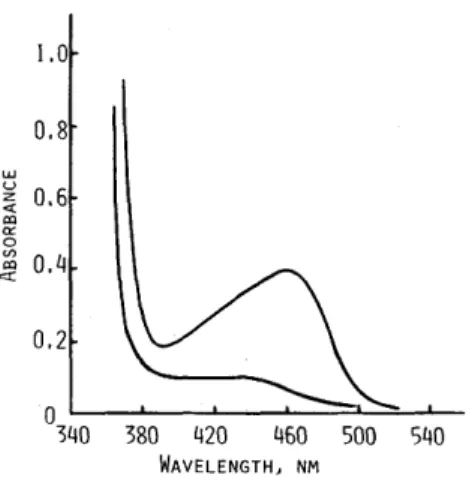
The absorption spectra of the dioxane solution of palladium-chinoform complex and reagent blank, extracted as above at pH 4.1, are shown in Fig. 1 against water. The curve of the complex shows a ab-sorption maximum at 462 nm, and after that the absorbance sharply decreases and becomes insignificant beyond 520 nm. The reagent blank shows strong absorption below 375 nm. For absorbance measurements ab-sorption maximum(462 nm) was chosen throughout subsequent study.
3.2 Effect of pH
The variation in the absorbance of the palladium complex with pH has been studied with dif'ferent buffer solutions. The extraction curve in Fig. 2 shows that the extremely high absorbance is obtained in the pH range 2.8-4.9, and below and above this pH range the absorbance decreases sharply. From these experimental data, a pH range of 2.8 to 4.9 is suitable for the quantitative extraction. The pH measure-ments of the solution after extraction was made at room· temperature. Therefore, pH4.1 was chosen for the extraction of the complex through-out this experiments.
1.0 0.8 UJ u 0.6 z « Q:I et:: 0 U) 0.4 Q:I c::( 0.2
o
~--~--~----~--~-=~~ 340 380 420 460 500 540 WAVELENGTH, NMFIG. I ABSORPTION SPECTRA OF CHINOFORM AND
PALLADIUM COMPLEX IN NAPHTHALENE-OIOXANE SOLUTION
PD:53 ~G j 0.1% CHINOFORM:5.0 ML j pH:4.1 j
BUFFER SOLUTION:2.0 ML ; NAPHTHALENE:2.0 G ; DIGESTION TIME:60 MIN; STANDING TIME:I5 MIN REFERENCE:WATER 0.8 UJ 0.6 u z « Q:I
g
0.4 Q:I c:t: 0.2o
0 2 4 8 pHFIG. 2 EFFECT OF pH ON ~BSORBANrE
Po:53 ~G ;
0.1%
CHINOFORM:5.0 ML ; DIGESTIONTIME:60 MIN; WAVELENGfH:462 NM ; RIIFFFR
SOLUTION:2.0 ML ; STANDING TIME: IS MIN
SOLVENT:DIOXANE; NAPIHHALENF:?O r,
REFERENCE:REAGENT BLANK
3.3
Effect of reagent concentrationVarying amounts of chinoform were added to the sample solution containing fixed palladium and reagent at pH 4.1 and the variation in the absorbance of the complex with reagent concentration was studied.
The result is shown in Fig. 3. From these experimental results, the absorbance increasd with increasing amounts of reagent up to 2.0 ml of 0.1% solution. When more than 2.0 ml of this solution were used, the absorbances were reasonably constant. Therefore, 5.0 ml of the so-lution were sufficient throughout this experiments.
3.4
Effect of buffer solution
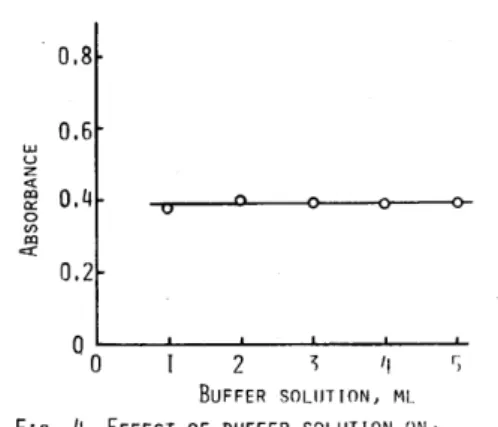
To the sample solution containing 53 Ug of palladium and 5.0 mlof 0.1% chinoform solution were added varying amounts of the buffer so-lution(pH4.1) and the effect of the buffer solution on the absorbance was investigated between 0.5 and 5.0 mI. The result is shown in Fig.4. From these data, the absorbance was no change by addition of up to 5.0 ml of the buffer solution. Therefore, 2.0 ml of the buffer solution( pH4.1) were used throughout this experiments.
n.R
o
~--~--~--~--~----~o
2 3 4 50,1% CHINOFORM, ML
FIG, 3 EFFECT OF REAGENT CONCENTRATION ON
ABSORBANCE
PD:53 ~G ; WAVELENGTH:462 NM ; pH:4,1 ; NAPHTHALENE:2,0 G ; DIGESTION TIME:60 MIN REFERENCE:REAGENT BLANK
3.5
Effect of digestion time
0,8 0,6 lJJ u Z ct: Q:l 0,4 a:: 0 en Q:l c:( 0,2 0 0 2 'I BUFFER SOLIJTION, ML FIG, 4 EFFECT OF BUFFER SOl UT I ON ON· ABSORBANCE
PD:53 pG ; 0,1% CHINOFORM:S.O ML ; pH:4.1 WAVELENGTH:4fi2 NM ; DIGESTION TIME:F)O MIN REFERENCE:REAGENT BLANK
The effect of variation of digestion time on the absorbance was investigated and the results obtained is shown in Fig.5. The reaction of palladium with chinoform to form a water-insoluble complex is practi.· cally slow even at high temperature and the digestion of long time is necessary. As shown in Fig.5, the absorbance increases with increasing digestion time in the range of
5
to 50 min and becomes almost constant after about 50 min when the sample solution was heated on a water bath.On d~gesting the sample solution for an additional 60 min, a 15 %
in-crease in the absorbance was apparent. Therefore, 60 min of digestion time were used throughout this experiments.
3.6
Effect of naphthalene
The errect or the amounts or naphthalene on the extraction by molten naphthalene from the solution containing the palladium complex was investigated and some of the results obtained are shown in Fig.6. As seen in Fig.6, the absorbance is independent of the amounts of naph-thalene in the range of 0.5 to 3.0 g. Therefore, 2.0 g of naphthalene were used throughout this experiments.
0,8 w 0,6 u z <t: 1'0 ~0,4~K> 1'0 c::x:: 0,2
o
01..--[.L.. 0- -2-'-0 - - 3 ... 0--4...L0- - - - I .50- l70
DIGESTION TIME, MINFIG, 5 EFFECT OF DIGESTION TIME ON ABSORBANCE
PD:53 ~G ; 0,[% CHINOFORM:5,0 ML ; pH:4,[
WAVELENGTH:462 NM ; NAPHTHALENE:2,0 G ; STANDING TIME: 15 MIN; SOLVENT:DIOXANE kEFERENCE:REAGENT BLANK
3.7
Effect of standing time
0,8 w 0,6 u z <t: 1'0 0:: 0,4 -<> 0 0 If) 0-0 a a C>-<r 1'0 c::x:: 0,2
o
0 2 3 NAPH fHALENE, (;FIG, 6 EFFE(T OF NAPHTHALENE ON ARSORBAN('F
PD:53 ~G ; 0,1% CHINOFORM:5,Q ML ; pH:q, I ;
WAVELENGTH:462 NM ; STANDING riME: 15 MIN DIGESTION TIME:60 MIN; SOLVENr:OIOXANF REFERENCE:REAGENT BLANK
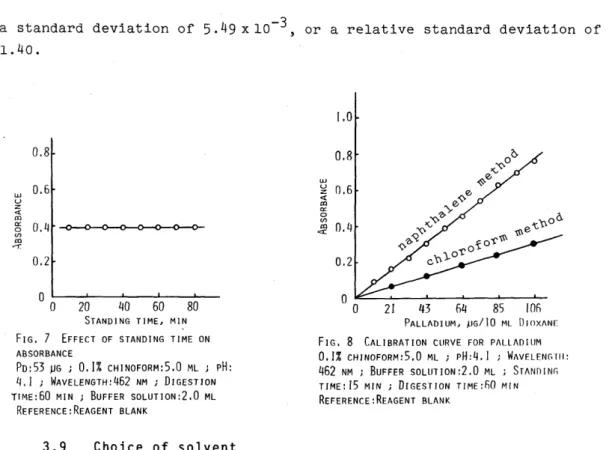
The palladium complex was extracted into molten naphthalene ac-cording to the optimum conditions. The extract is dissolved in dioxane and the absorbance of the solution was measured after varying lengths of time from the dissolution of the mixture. The results obtained are shown in Fig.7. From these experimental data, there was no change of the absorbance over a period of So min. Therefore, 15 min of standing time were taken for further study.
3.8
Calibration curve, molar absorptivity, sensitivity and
precission
The calibration curves for the palladium determination were pre-pred by the optimum conditions. Beer's law was obeyed over the range of 7-140 ~g of palladium in 10 ml of dioxane. The molar absorptivity was 7.8 x 1031·mol-l·cm-l at 462 nm, and the sensitivity of the complex as expressed by Sandell's notation was 0.014
~g
of palladium per cm2 The results are shown in Fig.S.The precission of this method was estimated with 10 samples con-taining 53 Mg of palladium. A mean absorbance at 462 nm was 0.391with
a standard deviation of 5.49 x 10⁻³ , or a relative standard deviation of 1.40. 0.8 UJ 0.6 u z <! III ex: g III .-r: 0.2
o
~--~--~----~--~--a
20 LJO 60 80STANDING TIME, MIN
FIG. 7 EFFECT OF STANDING TIME ON
ABSORBANCE
Po:53 ~G ; 0.1% CHINOFORM:5.0 ML ; pH:
4.! j WAVELENGTH:462 NM j DIGESTION
TIME:60 MIN; BUFFER SOLUTION:2.0 ML REFERENCE:REAGENT BLANK
3.9
Choice of solvent
1.00.8
UJ ~ 0.6 <! III ex: o VJ ~ 21 43 fiLJ 85 I Of)PALLADIUM, pG/]O ML DIOXANE
FIG. 8 CALIBRATION CURVE FOR PALLADIUM
D.I%
CHINOFORM:5.0 ML j pH:4.! ; WAVELENGTII:462
NM ; BUFFER SOLUTION:2.0 ML ; STANDINGTIME: IS MIN j DIGESTION TIME:fiO MIN
REFERENCE:REAGENT BLANK
After testing various organic solvents such as chloroform, benzene, dimethylformamide, dimethylsulfoxide, dioxane,chlorobenzene, aceto-nitrile, etc., dioxane was found to be the most suitable solvent of the complex. The sensitivity for the complex in dioxane was 2.5 times as high as that in chloroform,as well as chloroform extraction method.
The method was compared with the chloroform method. The results obtained are shown in Table 1.
Table 1 Methods
Naphthalene Chloroform
References
Comparison of this method with chloroform method Molar absorptivity ( l·mol - 1 - 1 . cm ) Sensitivity -2 (}lg.cm ) 0.014 0.035 Relative standard
C%)
deviation 1.20.8
1) Y. Kidani, S. Naga and H. Koike Bunseki Kagaku, 1974, 23, 1375. 2) M. Yoshioka and Z. Tamura: Ikagu no ayumi, 1970, 74, 320.