Extraction
journal or
publication title
福井大学工学部研究報告
volume 25
number 2
page range 95‑100
year 1977‑09
URL http://hdl.handle.net/10098/4494
Solid-Liquid Separation after Liquid-Liquid Extraction.
--Spectrophotometric Determination of Palladium(II}
after Extraction of Its a-furildioxime Complex with Molten Naphthalene--
* *
Masatada SATAKE and Takeshi YAMAUCHI (Received Jun. 15, 1977)
A method of liquid-liquid extraction of palladium-a-furildioximate with molten naphthalene followed by solid-liquid separation was suc- cessfully applied to the determination of small amounts of palladium.
The complex formed between palladium and a-furildioxime was easily extracted into molten naphthalene. After extraction, the very fine naphthalene crystals were dissolved in chloroform, and the absorbance of the solution was measured at 378 nm against the reagent blank. Beer's law was obeyed for 3 - 50 pg of palladium in 10 ml of chloroform, and
4
- 1 - 1 the molar absorptivity was calculated to be 2.03 x 10 l·mol ·cm at 378 nm, the sensitivity being 0.0052~g
of palladium per cm2 for the absorbance of 0.001. The relative standard deviation for the present analysis of palladium was 0.12 %(for ten times determinations).1. Introduction
a-furildioxime,
a
generally used complexing reagent, has been used for the gravimetric and spectrophotometric determination of nickel and palladium. This reagent reacts with nickel and palladium in aqueous solution, producing water-insoluble complexes. These complexes are extracted with organic solvents such as chloroform or benzene, and small amounts of these metals are determined spectrophotometrically.Since several years authors have developed "solid-liquid separation after liquid-liquid extraction. Spectrophotometric determination of metals by extraction of metal complexes with molten naphthalene", and
have already reported the methods of new original determination of metals
*
Divis~on of Applied Sciencetrophotometric determination of palladium with a-furildioxime using naphthalene extraction method.
2. Experimental method 2.1 Reagents
Standard palladium stock solution, 5 x 10-
3
M. Prepare a stock solution of palladium by dissolving 0.44328 g of palladium chloride in 20 ml of concentrated hydrochloric acid and diluting to 500 ml withwate~Prepare more dilute solutions by a appropriate dilution.
a-furildioxime reagent solution, 0.1
%.
Prepare by dissolving 0.1 g of a-furildioxime in 100 ml of ethanol.Buffer solutions. They were prepared from 1M acetic acid and 1M ammonium acetate or 1M ammonia water and 1M ammonium acetate
by
mixingand pH
meter control.Naphthalene, chloroform, ethanol and all other reagents were of analytical reagent grade, and were used without furthp.r purification.
The water used was double-distilled water.
2.2 Apparatus
Absorption measurements were made with matched 10 mm glass cells on a Hitachi Model 200-20 spectrophotometer, with a tungsten lamp as the light source.
pH measurements were made with a Toa-Dempa HM-5A pH meter.
2.3 Procedure
Transfer 1 - 10 ml of 5xlO- 5M standard palladium chloride solution to a tightly stoppered 80 ml Erlenmeyer flask and dilute to about 30 ml with water. Add 1.0 ml of 0.1
%
a-furildioxime alcohol solution and 2.0 ml of buffer solution to adjust the pH of the solution to 4.5. Mix the solution well and allow it to stand for 10 min and then warm gently on a water bath at 60°C until a precipitate of the palladium complex appears. Pdd 2.0 g of naphthalene and heat the mixture above 81°C.Shake it vigorously t i l l naphthalene solidifies forming very fine crystals. Warm it again and slowly melt the very fine solidified crystals suspended in the solution, letting them grow up to a larger crystalline deposit. After cooling it at room temperature, separate the solidified deposit on a filter paper, wash with water and blot the
surplus water with a dry filter paper. Dissolve the deposit with chloroform. Transfer the ~olution to 20 ml stoppered flask containing 2.0 g of anhydrous sodium sulfate and measure the absorbance of the solution in a 10 mm cell against the reagent blank. The amount of
palladium can be determined using calibration.
3. Result and discussion 3.1 Absorption spectra
Palladium in the test solution containing
27
Mg of palladium was extracted with molten naphthalene as palladium-a-furildioximate at pH ca.4.5.
The mixture of the complex and naphthalene was dissolved in chloroform, and the absorbance of the solution was measured at various wavelengths between320
and420
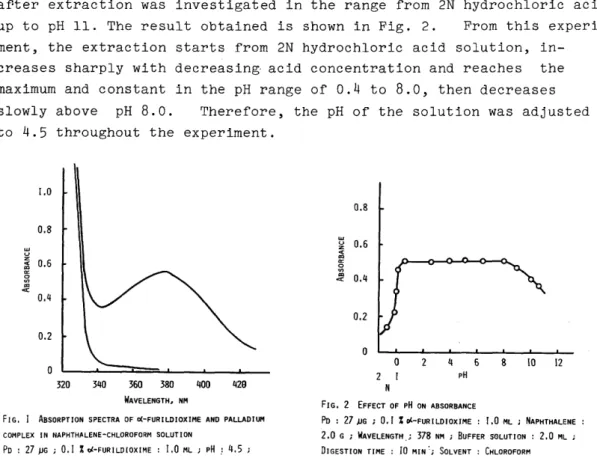
nm. Fig.l shows the absorption spectra of the reagent and its palladium complex in naphthalene-chloroform so- lution. The absorption maximum of the complex occurs at378
nm, at which wavelength there is a relatively small absorption due to the re- agent. There was no shift in this maximum absorption wavelength used for the determination of palladium, when the pH value of the solution was varied from0.4
to8.0.
Therefore,378
nm was chosen for the measurement.3.2 Effect of pH on absorbance
The relationship between the absorbance and the pH of the solution af-ter extraction was investigated in the range from 2N hydrochloric acid up to pH 11. The result obtained is shown in Fig. 2. From this experi- ment, the extraction starts from 2N hydrochloric acid solution, in- creases sharply with decreasing acid concentration and reaches the maximum and constant in the pH range of
0.4
to8.0,
then decreases slowly above pH8.0.
Therefore, the pH of the solution was adjusted to4.5
throughout the experiment.1.0
0.8
UJ u z 0.6
I
<t:
0.4
0.2
320 340 360 380 400 429
WAVELENGTH, NM
FIG. I ABSORPTION SPECTRA OF c(-FURILDIOXIME AND PALLADIUM COMPLEX IN NAPHTHIILENE-CHLOROFORM SOLUTION
Po : 27 JlG ; 0.1 % o£-FURILDIOXIME : 1.0 ML ; pH ; 4.5 ;
REFERENCE : WATER
0.8
w 0.6
u z
'"
'"
<r 0 (/)
'" 0.4
<t:
0.2
0
0 4 6 8 10 12
2 I pH
N
FIG. 2 EFFECT OF pH ON ABSORBANCE
Po : 27 )JG ; O. I % ol-FURILDIOXIME : 1.0 ML ; NAPHTHALENE:
2.0 G ; WAVELENGTH, ,: 378 NM ; BUFFER SOLUTI ON : 2.0 ML ; DIGESTION TIME : 10 MIN '; SOLVENT: CHLOROFORM REFERENCE : REAGENT BLANK
The effect· of a-furildioxime concentration on the absorbance was similarly investigated and the result obtained is shown in Fig. 3.
From the experiment, it was found that 0.3 - 5.0 ml of 0.1
%
a-furil-dioxime solution gave the constant absorbance for- the solution containing 27 ~g of palladium. Therefore, 1.0 ml of 0.1
%
a-furildioxime solution was added throughout the experiment.3.4 Effect of buffer solution on absorbance
To 27 ug of palladium and 1.0 ml of 0.1
%
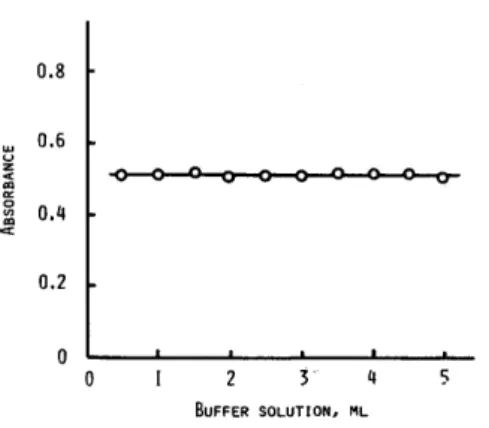
a-furildioxime solution, different volume of acetate buffer solution(pH4.5) were added between 0.5 and 5. Oml,and the extractlon was carried out according to the recom- mended procedure. The result is shown in FIg.4.
From the experi- merit, no change in the absorbance was produced with addition of 0.5 to 5.0 ml of the buffer solution. Therefore, 2.0 ml of the buffer solution were added throughout the experiment.0.8
w 0.6
u z
<[
a: CD
<C ~ 0.4 0.2
o
4O. I % ol-FURILDIOXIME. ML FIG. 3 EFFECT OF REAGENT CONCENTRATION ON ABSORBANCE PD : 27 )JG ; pH : 4.5 ; WAVELENGTH : 378 NM ; NAPHTHALENE :
2.0 G ; BUFFER SOLUTION: 2.0 ML ; SOLVENT: CHLOROFORM REFERENCE : REAGENT BLANK
0.8
w 0.6
u z
<[
CD ~ 0 0 0 0 0 0 0 cr
a:
0 en 0.4
<C CD
0.2
o
BUFFER SOLUTION. ML
FIG. 4 EFFECT OF ADDITION OF BUFFER SOLUTION ON ABSORBANCE PD : 27 )JG ; O. I % c«.-FURILDIOXIME : 1.0 ML ; pH : 4.5 ;
DIGESTION TIME: 10 MIN; NAPHTHALENE : 2.0 G ; SOLVENT : CHLOROFORM
REFERENCE : REAGENT BLANK
3.5 Effect of digestion time on absorbance
The palladium complex in the solution was warmed on a water bath at
go °c
and the effect of digestion time on the absorbance was investi- gated between 2 and 50 min. The result is shown in Fig. 5. The ab- sorbance of the complex was almost constant independently of the di- gestion time. The complex was very stable at high temperature. There- fore, 10 min were chosen as the digestion time.3.6 Effect of naphthalene on absorbance
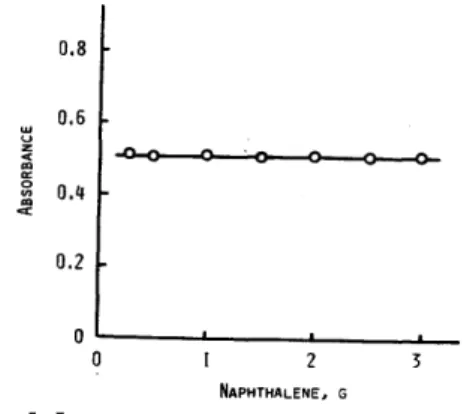
The effect of amount of naphthalene on extraction by molten
naphthalene from the solution containing palladium complex was
investi~gated. The result is shown in Fig.6, which indicates that the ab- sorbance become almost constant by addition of 0.5 - 3.0 g of naphthalene Therefore, 2.0 g of naphthalene were used for further experiment.
0.8
w 0.6
u z:
<C
'"
""
~ 0.4 cc
0.2
10 20 30 40
DIGESTION TIME, MIN FIG. 5 EFFECT OF DIGESTION TIME ON ABSORBANCE
50
Po: 27 jJG; 0.1 %o'-FURILDIOXIME : 1.0 ML; pH: 4.5;
WAVELENGTH : 378 NM ; BUFFER SOLUTION : 2.0 ML ; SOLVENT : CHLOROFORM
REFERENCE : REAGENT BLANK
0.8
w 0.6 u z:
-0-0 0 ' 0 0
<C 0 CP
'"
'"
~ 0.4
cc
0.2
o """'---'-_ _ - - I _ _ _ ...&...._
o
NAPHTHALENE, G
FIG. 6 EFFECT OF AMOUNT OF NAPHTHALENE ON ABSORBANCE
Po: 27)JG; 0.1 %o(-FURILDIOXIME: 1.0 ML; pH : 4.5;
WAVELENGTH : 378 NM ; BUFFER SOLUTION : 2.0 ML ; SOLVENT : CHLOROFORM; DIGESTION TIME: 10 MIN
REFERENCE : REAGENT BLANK
3.7 Effect of standing time on absorbance
The effect of standing time of palladium complex in naphthalene- chloroform solution was investigated. The result is shown in Fig. 7.
There was no variation in the .absorbance of the colored complex over the range from 3 to 120 min.
3.8 Calibration curve
The linear relationship between the absorbance of the palladium complex and palladium concentration was examined by varying palladium concentration. The palladium complex was found to follow Beer's law in the concentration range of 3 - 50 Ug palladium per 10 ml of chloroform.
The molar absorptivity was 2.03 x 10 4 l·mol-l.cm-lat the wavelength of
378nm, the sensitivity being estimated to be 0.0052 Ug per cm 2 , corre- sponding to log
10/1= 0.001.
3.9 Choice of solvent
We examined various solvents to dissolve the palladium complex.
This complex was very stable in chloroform, but unstable in dimethyl-
[,0
w 0.6
u z
«
CD <r
0 0.4
V>
cC CD
0.2
20 40 60 100
STANDING TIME. MIN FIG; 7 EFFECT OF STANDING TIME ON ABSORBANCE
120
Pn : 27 pG ; D.! .% o(-FURILDIOXIME : [.0 ML ; pH : 4.5 ;
WAVELENGTH : 378 NM ; BUFFER SOLUTION : 2.0 ML ; DIGESTION TIME : 10 ML ; SOLVENT : CHLOROFORM
REFERENCE : REAGENT BLANK
formamide.
1.0
0.8
w U z
« 0.6
~
CD cC0.4
0.2
a
0 [[ 21 32 43
PALLADIUM, PG/IO ML CHCL3
F16. g CALIBRATION CURVE FOR PALLADIUM
53
0.1 % ,*FURILDIOXIME : 1.0 ML ; pH : 4.5 ; NAPHTHALEN :2.0 G WAVELENGTH: 378 NM ; BUFFER SOLUTION : 2.0 ML ; DIGESTION TIME: 10 ML
REFERENCE : REAGENT BLANK