Spectrophotometric determination of iron(III)
by extraction of its chinoform complex with
molten naphthalene
journal or
publication title
福井大学工学部研究報告
volume
26
number
2
page range
239-245
year
1978-09
URL
http://hdl.handle.net/10098/4455
MEMOIRS OF THE FACULTY OF ENGINEERING FUKUI UNIVERSITY
VOL.26 No.2 1978
Spectrophotometric determination of iron(III) by extraction of its chinoform complex with molten I)aphthalene
*
Masatada SATAKE
( Received jun. 15, 1978)
A method of liquid-liquid extraction of iron(lll) chinoform complex with molten naphthalene followed by solid-liquid separation was successfully applied to the determination of the trace amounts of iron(III). The complex formed between iron(III) and chinoform was quantitatively extracted into molten naphthalene. After extraction, the solidified crystals of the complex and naphthalene were dissolved in DMF, and the absorbance of the solution was measured at 480 or 620
~9
nm against the reagent blank. The amounts of iron(III) were calculated from the calibration. The method was compared with the chloroform method.
1 Introduction
Chinoform(5-chloro-7-iodo-8-hydroxyquinoline) reacts with various metal ions to form the stable complexes, and these complexes have been used for the determination of metals using organic solvents such as chloroform or benzene as extractant. We developed a new method " analysis by solid-liquid separation after liquid-liquid extraction" and applied to the spectrophotometric determination of metals using organic compound with appropriate degree of melting point as extractant, e.g., naphthalene(mp:8l0C), diphenyl(mp:7l0C), etc .. By standing the
~o
molten layer at room temperature, it changes to solidified crystals. These crystals are washed with water by decantation, dissolved and
diluted with proper solvents. Then the absorbance of the solution is
measured at a definite wavelength to determine the amounts of metals. We have already reported on the determination of metals using
naphtha-lene as extractant l )- 2 ). In the present paper, naphthalene was chosen
as extractant of ironelII) chinoform complex. The distribution
equi-librium was attained very rapidly under the optimum conditions.
Spec-trophotometric determination of iron(III) using this method was studied
in details. The method was compared with the chloroform extraction
method.
2 Experimental method
Reagents and apparatus
Standard iron(III) solution(lO ppm) was prepared by diluting 10 ml of standard iron(llI) solution(lOOO ppm, Wako Pure Chemical Company, Osaka, Japan) to 1000 mI.
Chinoform(Tokyo Kasei Company, Tokyo, Japan) was used without
purification. A 0.2% solution was prepared by dissolving 0.2g of this
reagent in 100 ml of ethanol.
Buffer solution was prepared by mixing 1M acetic acid and 1M am-monium acetate solution, or 1M ammonia water and 1M amam-monium acetate solution.
All other reagents were of analytical-reagent grade. Deionized water was used.
The absorbance measurements were made on a Hitachi 200-20
spec-trophotometer, in matched 10 mm glass cells. The pH values of the
solution were measured with a Toa-Dempa, HM-5A, equipped with combined glass and calomel electrodes.
2U
A sample solution(about 40 ml) containing 1-10 ml of 10 ppm iron (III) solution, 2.0 ml of the buffer solution(pH 5.2) and 3.0 ml of 0.2% chinoform solution was placed into a tightly stoppered Erlenmeyer flask and warmed on a water bath at the temperature above 81°C for 15 min. After addition of 2.0g of naphthalene, the mixed solution was warmed in
a water bath. Shake it vigorously till naphthalene solidifies forming
fine crystals. Warm it again and slowly melt the very fine solidified
crystals suspended in the solution, letting them grow to a larger
crystalline deposit. Separate the solidified deposit on a filter paper,
wash with water and blot the surplus water with a dry filter paper.
Dissolve the deposit with DMF and dilute to 10 mI. Measure the
ab-sorbance of the solution in a cell against the reagent blank.
4 Results and discussion
4.1 Absorption spectra
The absorption spectra of iron(III) chinoform complex in naphtba-lene-DMF solution had two absorption maxima at 480 and 620 nm, as shown
in curve 2 of Fig. 1. At wavelengths greater than 480 nm, there were
negligible absorption due to the reagent blank(curve 1).
4.2 Effect of pH
The relationship between the absorbance and the pH of the aqueous solution containing ironCIII) chinoform complex was studied in the pH
range of 0.5-10.5, and the results obtained are shown in Fig. 2. A
definite and maximum absorbance was obtained in the pH range of
1.5-10.5. The pH values of the solution were measured at room temperature
after extraction.
4.3 Effect of reagent concentration
The effect of the chinoform solution in the solution containing
50 pg of iron(lll) at pH5.2 on extraction was investigated, and the
U2
of 0.2% chino form solution was added, the absorbances became almost
constant. Therefore, 3.0 ml of 0.2% chinoform solution were taken
throughout this experiment.
1.0 w 0.8 u z < ~ 0.6 ~ 0 ~ ~ ~ 0.4 0.2 0 400 500 600 700 WAVELENGTH, NM
FIG. I ABSORPTION SPECTRA OF CHINOFORM AND IRONCIII) IN NAPHTHALENE-DMF SOLUTION
IRONCIII) : 50 pG ; pH : 5.2 ; 0.2% CHINOFORM
3.0 ML ; DIGESTION TIME : 10 MIN
REFERENCE : WATER
Cl) REAGENT BLANK; (2) IRONCIII) COMPLEX
4.4 Effect of buffer solution
0.8 480 NM w 0.6 u z < ~ ~ 0.4 0 ~ ~ 620 NM ~ 0.2 0 0 2 4 6 8 10 pH FIG. 2 EFFECT OF pH IRONCIII) : 50 PG ; 0.2% CHINOFORM : 3.0 ML ;
DIGESTION TIME: 10 MIN; NAPHTHALENE: 2.0 G
REFERENCE : REAGENT BLANK
The effect of addition of the buffer solution(pH8.5) on the
ab-sorbance was investigated. As seen in Fig. 4, the addition of 0.5-5.0
ml of the buffer solution was practically without variation on the
ab-sorbance at 480 and 620 nM. For further study, 2.0 ml of the buffer
solution(pH8.5) were added.
4.5 Effect of digestion time
The iron(III) complex in the solution containing 50 pg of iron(III) was digested on a water bath at the temperature above 81°C and the
ex-traction was carried out according to the recommended procedure. Fig. 5
shows the effect of the digestion time on the absorbance. From these
results, the complex was very stable at high temperature and the digestion for about 50 min had no effect on the absorbance of the complex.
0.8 480 NM w 0.6 u z <:( III c:: 0.4 0 en III c:r 620 NM 0.2 2 3 4 5 6 7 0.2% CHINOFORM, ML FIG. 3 EFFECT OF REAGENT CONCENTRATION IRON(III) : 50 PG ; pH : 5.2 ; NAPHTHALENE
2.0 G ; BUFFER SOLUTION: 2.0 ML
REFERENCE : REAGENT BLANK
243 0.8 480 NM w u 0.6 4 ) 0 0 0 0 0-<:( z III c:: -0 0 0 0 0 ~ 0 0.4 en 620 NM III c:r 0.2 0 0 2 3 4 5 6 1M BUFFER SOLUTION, ML FIG.4 EFFECT OF ADDITION OF BUFFER SOLUTION IRON(III) : 50 pG ; pH : 5.2 ; 0.2% CHINOFORM 3.0 ML ; NAPHTHALENE: 2.0 G
REFERENCE : REAGENT BLANK
The effect of the addition of naphthalene on extraction was
investi-gated, and the results are shown in Fig. 6. It indicated that the
ab-sorbance was almost constant by addition of 0.5-3.0 g of naphthalene.
0.8 w 0.6 u <:( 480 NM Z III c:: 0 en 0.4 III c:r 620 NM 0.2 0 0 IO 20 30 40
DIGESTION TIME, MIN FIG. 5 EFFECT OF DIGESTION TIME
I RON (! 11 ) : 50 JjG ; pH : 5.2 ;
50
0.2% CHINOFORM : 3.0 ML ; STANDING TIME 20 MIN; NAPHTHALENE: 2.0 G
REFERENCE : REAGENT BLANK
4.7 Effect of standing time
0.8 480 NM w u 0.6 ~ 0 0 0 0 0 <:( Z III c:: -0-0--0--00 0 0 0.4 en III 620 NM c:r 0.2
o
o
1.0 2.0 NAPHTHALENE, G FIG. 6 EFFECT OF NAPHTHALENE0 0-3.0 IRON(III) : 50 ~G ; 0.2% CHINOFORM 3.0 ML pH : 5.2 ; BUFFER SOLUTION: 2.0 ML REFERENCE : REAGENT BLANK
The mixture of the iron(III) complex and naphthalene was dissolved in DMF and the effect of standing time on the absorbance was examined
244
between 13 and 200 min. As shown in Fig.
7,
the color of the complexin DMF solution was very stable and this period of standing did not give the marked changes on the absorbance.
0.8 480 NM w 0.6 u z .a: p:j -0--<>-0 0 0 0:: 0.4 0 620 NM (f) p:j <C 0.2 0 0 40 80 120 160
STANDING TIME, MIN FIG. 7 EFFECT OF STANDING TIME
0 cr
200
IRON(III) : 50 ~G ; 0.2% CHINOFORM 3.0 ML ;
pH : 5.2 ; NAPHTHALENE : 2.0 G
REFERENCE : REAGENT BLANK
4.8 Calibration curve 1.0 0.8 UJ u 0.6 z <t p:j 0:: 0 (fJ 0.4 p:j <C 0.2 IRONCIII), ~G/IO ML DMF FIG. 8 CALIBRATION CURVE FOR IRONCIII)
pH : 5.2 ; 0.2% CHINOFORM : 3.0 ML j
BUFFER SOLUTION : 2.0 ML j DIGESTION TIME 10 MIN ; STANDING TIME : 20 MIN
REFERENCE : REAGENT BLANK
Under the optimum conditions described above, the calibration curves were constructed at the wavelengths of 480 and 620 nm against
the reagent blank. The results obtained are shown in Fig.
8.
It waslinear over the range 4-87 ).1g of iron (III) at 480 nm and 6 - 113 ug at 620
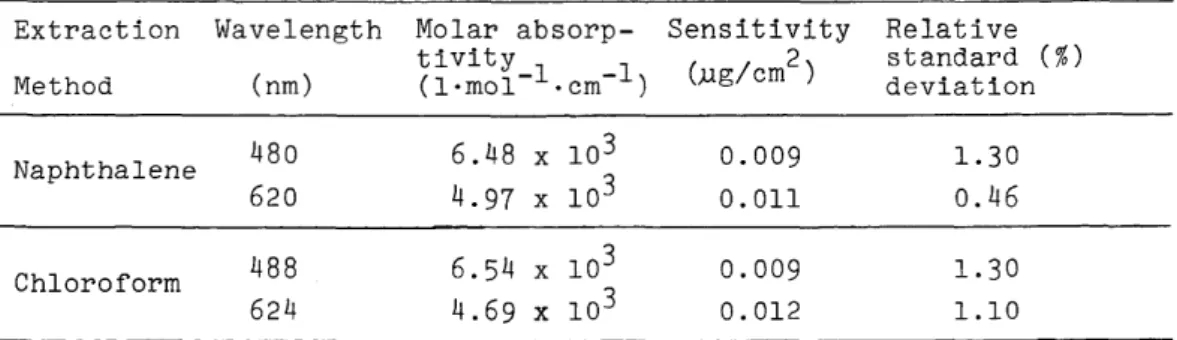
nm in 10 ml of DMF solution. Table 1 shows the molar absorptivities,
sensitivities, relative standard deviations and comparison of the method with the chloroform method.
4.9 Choice of solvent
Various organic solvents were used in an attempt to dissolve the
mixture of the iron(III) complex and naphthalene. From the experimental
results, the complex was soluble in chloroform at room temperature, soluble in DMF on standing for 30 min at room temperature or for 5-7 min at 50-60°C, soluble in dioxane, benzene, chlorobenzene,
o-dichloro-245
Table 1 Comparison of naphthalene with chloroform method
Extraction Wavelength Molar absorp- Sensitivity Relative
tivity 2 standard (%)
Method (nm) (l.mol-l.cm- l ) tug/cm ) deviation
Naphthalene 480 6.48 x 10 3 0.009 1.30
620 4.97 x 10 3 0.011 0.46
Chloroform 488 6.54 x 10 3 0.009 1.30
624 4.69 x 10 3 0.012 1.10
benzene, dichloroethane at 50-60
cc,
and insoluble in DMSO, isoamyl-acetate, MIBK, propyren carbonate, acetonitrile, etc. even at 50-60 CC. In the experimental results, DMF was found to be the most suitable solvent to dissolve the iron(rII) complex, since it is miscible with water. The iron(III) complex in naphthalene-DMF solution was very stable at room temperature and 50-60 CC.1) M. Satake 2) M. Satake
References
Memoirs Fac. Eng. Fukui Univ., 25, 141(1977). Memoirs Fac. Eng. Fukui Univ., 25, 135(1977).