Spectrophotometric Determination of Iron(III) after Separation by Adsorption of its
N‑benzoyl‑N‑phenylhydroxylamine Complex on Naphthalene
journal or
publication title
福井大学工学部研究報告
volume 27
number 2
page range 271‑278
year 1979‑09
URL http://hdl.handle.net/10098/4427
VOL.27 No. 2 1979
Spectrophotometric Determination of Iron(III) after Separation by Adsorption of its N-benzoyl-N-phenyl- hydroxylamine Complex on Naphthalene
Masatada SATAKE, Toshihiko YOKOTA and Nobusute YOSHIDA
*
(Received Jul. 31, 1979)
The method is presented for the spectrophotometric determination of trace amounts of iron(III) after separation by adsorption of the complex on microcrystalline naphthalene. Iron(III) reacts with BPA to form a water-insoluble complex, which is easily adsorbed on microcrystalline naphthalene at room temperature. The mixture of complex and naphthalene is separated from aqueous solution and dissolved in dimethylformamide.
The absorbance of the solution is measured at 437 nm against the reagent blank. Effects of pH, amounts of BPA and naphthalene, digestion time, standing time, shaking time and diverse foreign ions are studied. The molar absorptivity was 4.47 x 10 3 l.mol-l.cm-l , the sensitivity of the complex as expressed by the Sandell's notation being 1.25 x 10⁻²pg of copper per cm2• Sample solution containing 50 ~g of iron(III) was ana- lyzed ten times by the recommended procedure. The mean absorbance was 0.400 with relative standard deviation of 1.25%.
1 Introduction
"
We have already developed a new original adsorption method spec- trophotometric determination of metals after separation by adsorption
"
of their complexes on microcrystalline naphthalene , and this method was applied for the analysis of trace amounts of metals.
In the present study, N-benzoyl-N-phenylhydroxylamine(abbreviated as BPA) was chosen as a complexing reagent for the determination of iron(III). BPA forms a water-insoluble red complex with iron(III) at pH 3.2-8.3. This complex is adsorbed with microcrystalline naphthalene in aqueous solution. After adsorption, the resulting mixture of the complex and naphthalene is separated, dried and dissolved in dimethyl- formamide. The absorbance of the solution is measured at 437 nmagainst the reagent blank similarly prepared. The red color of this complex in naphthalene-dimethylformamide solution is very stable for a long time.
*
Division of Applied Science272
2 Experimental method 2.1 Reagents
Standard iron(III) solution, 5 ppm. Prepared by diluting 5 ml of Standard iron solution(lOOO ppm, Wako Pure Chemical Industries Ltd., Osaka, Japan) to 1000 ml with water.
BPA solution, 0.2%. Prepared by dissolving 0.2 g of BPA in 100ml of ethanol.
Buffer solutions were prepared from 1M acetic acid and 1M ammonium acetate solution for pH 3-6, and from 1M aqueous ammonia and 1M ammonium acetate solution for pH 8-11.
Naphthalene solution, 20%. Prepared by dissolving 20 g of naphtha- lene in 100 ml of acetone.
Naphthalene, acetone, dimethylformamide and all other reagents were of analytical-reagent grade, and were used without further purification.
Deionized water was used.
2.2 Apparatus
Absorption measurements were made with matched 10 mm glass cells on a Hitachi Model 200-20 spectrophotometer.
pH measurements were made with a Toa Dempa HM-5A pH meter.
The naphthalene was dried with a Tabai Model K-2 drier(Tabai Mfg.
Co. Ltd. Japan).
2.3 Procedure
A series of sample solutions was prepared containing 1-12 ml of 10 ppm standard iron solution, 2.0 ml of the buffer solution(pH 5.0) and 2.0 ml of 0.2% BPA solution in about 50 ml of total volume. Mix well, and stand for 15 min at room temperature. After 3.0 ml of 20% naphtha- lene solution were added, the mixing solutions were shaken for 1 min vigorously. Filter them through a filter paper(Toyo Roshi Co., No 5C) placed on a filter plate in a funnel or a glass filter(No 2 or 3) when necessary. Wash with water and dry in a dryer. Then dissolve them in dimethylformamide and make up to 10 mI. Measure the absorbances of the solutions in 10 mm glass cells against the reagent blank prepared! similar- ly.
3 Results and discussion 3.1 Absorption spectra
Figure 1 shows the absorption spectra of the reagent blank and of the iron complex in naphthalene-dimethylformamide solution resulting from taking 50 pg of iron through the procedure. The iron complex has one absorption maximum at 437 nm. At this wavelength, there is practically
no absorption due to the reagent blank, and 437 nrn was therefore chosen as the most suitable wavelength.
2.2 Effect of pH
The effect of pH on the adsorption of the iron(III) complex is shown in Fig. 2. The pH measurements on the aqueous solution after adsorption were made at room temperature. The adsorption of the complex started from pH 1.8, increased sharply with increasing pH, became almost constant in the pH range 3.2-8.3 and decreased rapidly above pH 8.3. Therefore, The pH range 3.2-8.3 would seem to be most suitable.
I.O
0,8
LlJ u
z 0,6 (2) I RON COMPLEX
« I'Q
cr: g 0,4
« I'Q
0,2
°
320 360 WAVELENGTH, NM 400 440 480 520 FIG,I ABSORPTION SPECTRA OF BPA AND IRON COMPLEX IN NAPHTHALENE-DMF SOLUTION IRON<III) : 50 fJG ; pH : 5,0 ; 0.2% BPA 2,OML ; DIGESTION TIME: 15 MIN;20% NAPHTHALENE : 3,0 ML
REFERENCE : WATER ; (I) REAGENT BLANK, (2) IRON(III) COMPLEX
0,8
0,6
LlJ u z «
0,4
I'Q cr:
0 (/)
« I'Q
0,2
° °
2 4 pH 6 8 IOFIG. 2 EFFECT OF pH
IRONClII) : 50pG; WAVELENGTH: 437 NM;
0,2% BPA : 2,0 ML ; SHAKING TIME: 1,5 MIN STANDING TIME : 10 MIN
REFERENCE : REAGENT BLANK
3.3 Effect of BPA concentration and of addition of buffer solution Various amounts of the ethanolic 0.2% BPA solution were added to the solution containing 50 ~g of iron(III) and 2.0 ml of the buffer solution
(pH 5.0), and the procedure was followed as given above. Figure 3 shows the variation in the measured absorbance with the reagent concentration.
when volumes between 0.8 and 5.0 ml of reagent solution were used, the absorbance was effectively constant. Therefore, 2.0 ml of 0.2% solution were added. Varying the volume of the buffer solution from 0.7 to 5.0 ml at pH 5.0 did not affect the absorbance.
2.0 ml of 1M buffer solution were added.
3.4 Effect of digestion time
In the present experiment,
The iron(III) complex in the solution was stood and digested at room
274
temperature, and the effect of digestion time on the absorbance was studied. The result is shown in Table 1. The digestion for up to 30 min gave no effect on the absorbance. Therefore, the digestion time for 15 min were selected for the absorbance measurements.
Table 1 Effect of digestion time Digestion time Absorbance
min 437 nm
0.5 0.397
I 0.395
2 0.398
5 0.402
10 0.403
20 0.400
30 0.405
I ron ( I I I) : 50 pg ; pH : 5. 0 3.5 Effect of addition of naphthalene
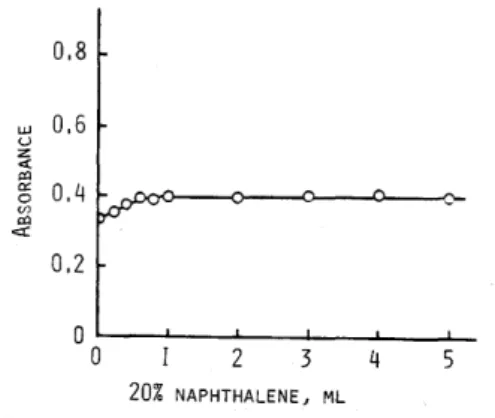
Varying volumes of 20% naphthalene solution in acetone were added to the solutions containing SO ~g of iron(III) and 2.0 ml of 0.2% BPA so- lution at pH 5.0, and the procedure was followed. The result is shown in Fig.4. The absorbance increased slowly with increasing amount of naphthalene up to 0.6 ml, and became almost constant in the range 0.6- 5.0 mI. Therefore, 3.0 m~ of 20% naphthalene solution were chosen as the most suitable amount.
0.8 0.6
w
<J z <
0.4
PO a::
0 If) PO
~ 0.2
I 2 3 4 5 0.2% BPA, ML
FIG. 3 EFFECT OF BPA CONCENTRATION
IRON(J I J) : 50)JG j pH : 5.0; DIGESTION TIME 15 MIN j SHAKING TIME :1.5 MIN
REFERENCE : REAGENT BLANK
0.8
w 0.6
<J
z <
PO c:: 0.4
0 U) PO
~
0.2
0 0 2 3 4 5
20% NAPHTHALENE, ML
FIG. 4 EFFECT OF NAPHTHALENE CONCENTRATION IRON(IID : 50)JG j WAVELENGTH: 437 NM j
pH : 5.0 ; 20% NAPHTHALENE : 3.0 ML j SHAKING TIME : 1.5 MIN j STANDING TIME : 10 MIN REFERENCE : REAGENT BLANK
3.6 Effect of shaking time and standing time
Three ml of 20% naphthalene solution in acetone were added to the solutions containing the iron(III) complex, and the mixed solutions were shaken vigorously for times ranging from 0 to 300 seconds. The result is shown in Table 2. The complex was adsorbed quantitatively on micro- crystalline naphthalene by vigorous shaking for 30 seconds.
The color of the complex in naphthalene-dimethylformamide solution was very stable even after standing for 50 min.
Table 3.
Table 2 Effect of shaking time Shaking time
sec
o
25 60 100 200 300
Absorbance 437 nm 0.250 0.396 0.401 0.402 0.398 0.407 Iron(III) : 50 ~g ; pH 5.0
Table 3 Effect of standing time Standing time Absorbance
min 437 nm
3 0.398
10 0.400
20 0.403
30 0.400
40 0.402
50 0.402
I ron ( I I I ) : 50 pg ; pH : 5. 0 3.7 Effect of volume of aqueous phase
'rhe re su 1 t i s shown in
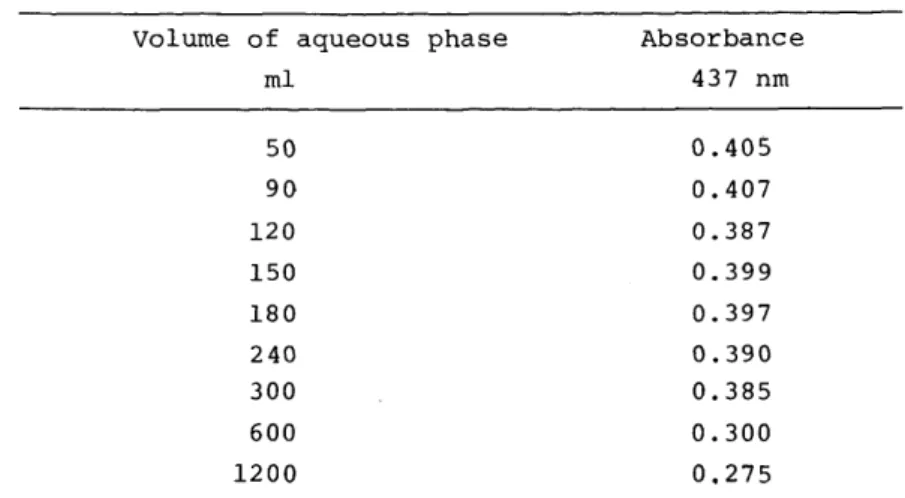
The volume of the aqueous phase was varied between 50 and 1800 ml while other factors were kept constant. The result is shown in Table 4.
Though the volume of the aqueous phase does not affect the adsorption of the complex for smaller volumes,allowance must be made for larger volumes by shaking for a long time and using a larger volume of reagent solution.
In this series of tests, 3.0 ml of reagent solution were taken, and the
276
mixed solutions were shaken for 10 minutes.
3.8 Calibration cueve
The optimum conditions described above were used and the absorbances for varying concentrations of iron(lll) were measured at 437 nm against the reagent blank. The absorbances showed a linear relationship to the concentration of iron(lll) in the range 6-125 pg per 10 m1 of dimethy1- formamide. The molar absorptivity was 4.47 x 10³ l.mol-l·cm-l
, the sensitivity being 1.25 x 10⁻²
pg of iron(lll) for the absorbance of 0.001.
Ten replicate determinations of the sample solution containing 50 pg of iron(lll) gave a mean absorbance of 0.400 with a relative standard devi- ation of 1.25%.
3.9 Choice of solvent
Tests were made with various solvents to dissolve the mixture of the complex and the naphthalene. The complex is soluble in many organic solvents such as acetonitrile, benzene, chlorobenzene, chloroform, acetone, dioxane, toluene, xylene, etc ..
3.10 Effect of diverse ions
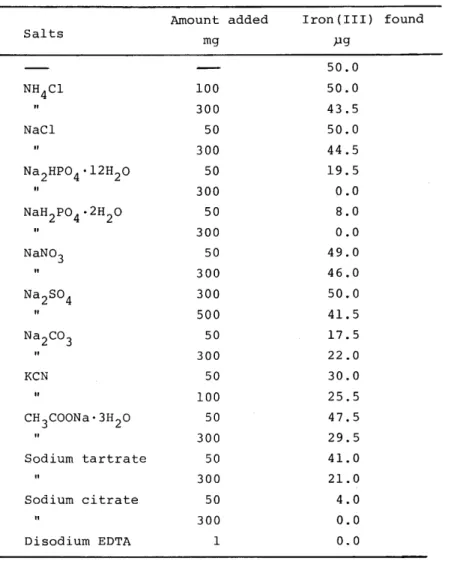
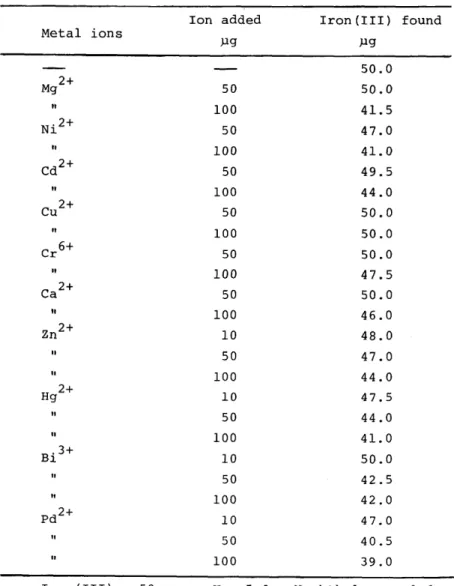
Possible interferences were looked for by taking 50 pg of iron(lll) through the procedure in the presence of various amounts of alkali metal salts and metal ions. The following species interfered: NH4Cl(300 mg), NaCl(300 mg), Na
2S04(500 mg), CH
3COONa(300 mg), sodium tartrate(50 mg),
2+ .2+ 2+ 2+ 2+
Mg (100 pg), Nl (100 pg), Cd (100 pg), Zn (100 pg), Hg (50 pg) , Bi3+(50 pg), Pd2+(50 pg). Na
2HP0 4·l2H
20, NaH 2P0
4·2H 20, Na
2C0
3, KCN, sodium citrate and EDTA gave serious interferences. The result is shown in Tables 5 and 6.
Table 4 Effect of volume of aqueous phase Volume of aqueous phase Absorbance
ml 437 nm
50 0.405
90 0.407
120 0.387
150 0.399
180 0.397
240 0.390
300 0.385
600 0.300
1200 0.275
1800 0.205 Iron(III) 50 J.1g pH 5.0 Naphthalene : 0.6 g
Table 5 Effect of foreign alkali salts Amount added Iron(III) found Salts
mg pg
50.0
NH4Cl 100 50.0
300 43.5
NaCl 50 50.0
II 300 44.5
Na2HP04·l2H20 50 19.5
II 300 0.0
NaH2P0 4·2H
2O 50 8.0
" 300 0.0
NaN03 50 49.0
300 46.0
Na2S04 300 50.0
II 500 41.5
Na2C0
3 50 17.5
300 22.0
KCN 50 30.0
II 100 25.5
CH3COONa'3H2o 50 47.5
300 29.5
Sodium tartrate 50 41.0
300 21.0
Sodium citrate 50 4.0
300 0.0
Disodium EDTA 1 0.0
Iron(III) : 50 }lg pH :5.0 Naphthalene 0.6 g
278
Table 6 Effect of foreign metal ions Ion added Iron(III) found Metal ions
}lg ).lg
50.0
Mg2+ 50 50.0
"
100 41.5Ni 2+ 50 47.0
"
100 41.0Cd 2 + 50 49.5
"
100 44.0Cu 2+ 50 50.0
" 100 50.0
Cr 6+ 50 50.0
"
100 47.5ca
2+ 50 50.0"
100 46.0zn 2 + 10 48.0
" 50 47.0
..
100 44.0Hg 2+
10 47.5
..
50 44.0" 100 41.0
Bi 3+ 10 50.0
" 50 42.5
..
100 42.0Pd 2+ 10 47.0
50 40.5
100 39.0
Iron(III) 50 ).lg pH : 5.0 Naphthalene : 0.6 g