Spectrophotometric Determination of Palladium after Separation by Adsorption of its
2‑mercaptobenzothiazole Complex on Microcrystalline Naphthalene
journal or
publication title
福井大学工学部研究報告
volume 27
number 2
page range 245‑251
year 1979‑09
URL http://hdl.handle.net/10098/4424
FUKUI UNIVERSITY
VOL.27 No. 2 1979
Spectrophotometric Determination of Palladium after Separation by Adsorption of its 2-mercaptobenzo- thiazole Complex on Microcrystalline Naphthalene
Masatada SATAKE and Nobusute YOSHIDA
*
(Received Jul. 31, 1979)
The spectrophotometric determination of trace palladium with 2-mercaptobenzothiazole is described. A stable water-insoluble complex formed from palladium and 2-mercaptobenzothiazole is
rapidly and quantitatively adsorbed on microcrystalline naphthalene at pH 4.5. The adsorbed naphthalene crystals are separated from aqueous solution by aspiration, dried in a dryer at about 60°C and dissolved in dimethylformamide. The absorbance of the solution is measured at 435 nm. The various factors such as wavelength, pH, amounts of reagent and naphthalene, shaking time , standing time and choice of solvents are studied.
1. Introduction
2-mercaptobenzothiazole forms a water-insoluble colored complexes with various metals such as copper (orange yellow), cadmium (white) , lead
(white), zinc (white) , iridium (yellow) , bismuth (yellow) , nickel(brown), gold (yellow white), cobalt (green) , thallium(yellow green), mercury
(yellow white). Of these, the palladium complex is easily adsorbed on microcrystalline naphthalene and trace palladium is determined spectrophotometrically.
We have already reported on the determination of trace metals, using a new method called Analysis of metals by solid-liquid sepa-
"
ration after liquid-liquid extraction. In the present paper, palladium was chosen as a metal to be examined, and its 2-mercapto- benzothiazole complex was adsorbed on naphthalene in aqueous so- lution by vigorous shaking for a few seconds. The adsorbed mixture of the complex and naphthalene was separaetd, dried and dissolved in dimethylformamide. The absorbance of the solution was measured at
435 nm and trace palladium was determined.
*
Division of Applied Science246
2. Experimental method 2.1 Reagents
Standard palladium solution, 40 ppm. A palladium solution was made by diluting 40 ml of 1000 ppm standard palladium solution to 1000 ml with water.
2-mercaptobenzothiazole solution, 0.1%. Prepared by dissolving 0.1 g of 2-mercaptobenzothiazole sodium salt in 100 ml of water.
Buffer solutions were prepared by mixing 1M acetic acid and 1M ammonium acetate solution, or 1M aqueous ammonia and 1M aromonium acetate solution.
All other chemicals were of analytical-reagent grade.
Deionized water was used.
2.2 Apparatus
The absorbance measurements were performed on a Hitachi 200-20 spectrophotometer, in matched 10 rnm glass cells.
The pH values of the solution were measured a Toa Dempa, HM-SA, equipped with combined glass and calomel electrodes.
The naphthalene was dried wi th a Tabai r·1odel K-2 dryer (Tabai Mfg. Co. Ltd., Japan).
2.3 Procedure
Pipette 2-16 ml of 40 ppm standard palladium solution into 100 ml tightly stoppered Erlenmeyer flask, dilute with water to about 40 ml of total volume, and add 2.0 ml of the acetate buffer solution ( pH 4.5) and 4.0 ml of 0.1% 2-mercaptobenzothiazole solution. Mix well and digest the solution for 10 min, resulting in the precipi- tation of the complex. After digestion, add 2.0 ml of 20% naphtha- lene solution and shake i t for 1 min vigorously. Thus the complex is adsorbed on microcrystalline naphthalene. Separate the mixture of the complex and naphthalene from aqueous solution through a funnel with disc-shaped filter(filter paper, No.SC, Toyo Roshi, Osaka, Japan}
by aspiration. Wash with water and dry in a dryer at about 60 °C.
Then dissolve it in dimethylformamide and dilute to 10 mI. Measure the absorbance of the solution in 10 mm glass cell against the reagent blank prepared similarly. Calculate trace amounts of palladium from a calibration curve.
3 Results and discussion 3.1 Absorption spectra
Palladium in the solution containing 360 pg of palladium was
adsorbed on microcrystalline naphthalene as the complex of 2-mercapto- benzothiazole at pH 4.5. The mixture of the complex and naphthalene was dissolved in dimethylformamide, and the absorbance of the so- lution was measured at various wavelengths between 340 and 550 nm.
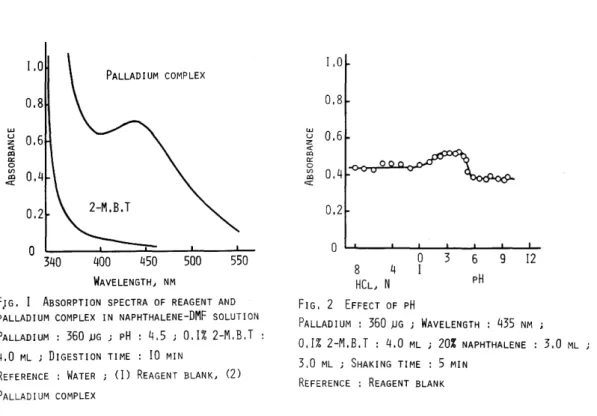
Figure 1 shows the absorption spectra of the reagent blank ~nd pal- ladium complex in naphthalene-dimethylformamide solution. The maxi- mum absorbance occures at 435 nm, at which the absorhance of the re- agent blank is very small. Wavelength 435 nm was chosen for the ab- sorbance measurements.
3.2 Effect of pH
The relationship between the absorbance of the complex and the pH of the solution was investigated in the pH range 0-10 and l-SN hydrochloric acid. The pH measurements were made after adsorption.
The result is shown in Fig.2. The maximum absorbance is obtained in the pH range 2.5-4.8, and below and above this pH range, the absorbance decreases. From the experimental result, a pH range 2.5-4.8 is suita- ble for the quantitative adsorption of the complex. Therefore, a pH 4.5 was chosen for the absorbance measurements.
1.0 PALLADIUM COMPLEX 0,8
340 400 450 500
WAVELENGTH, NM
F)G, 1 ABSORPTION SPECTRA OF REAGENT AND PALLADIUM COMPLEX IN NAPHTHALENE-DMF SOLUTION PALLADIUM: 360 ~G ; pH : 4,5 ; 0,1% 2-M,B,T 4,0 ML ; DIGESTION TIME : 10 MIN
REFERENCE : WATER j (I) REAGENT BLANK, (2) PALLADIUM COMPLEX
1.0 0,8
~ 0,6
JO.4~
cr:0,2
°
8 4o
1 3HeL, N
FIG, 2 EFFECT OF pH
6 9 12 pH
PALLADIUM : 360 ~G ; WAVELENGTH : 435 NM j
O,I% 2-M,B,T : 4,0 ML ; 20% NAPHTHALENE: 3,0 ML 3,0 ML ; SHAKING TIME: 5 MIN
REFERENCE : REAGENT BLANK
3.3 Effect of 2-mercaptobenzothiazole concentration
248
The effect of 2-mercaptobenzothiazole concentration on the ab-.
sorbance was investigated by varying the amount of 2-mercaptobenzo- thiazole in the solution containing 360 ~g of palladium at pH 4.5.
The result is shown in Fig.3. With increasing the amount of 0.1%
2-mercaptobenzothiazole solution, the absorbance increased sharply up to 1.5 ml and remained almost constant in the range 1.5-5.0.
therefore, 4.0 ml of 0.1% solution were added for the absorbance measurements.
3.4 Effect of buffer solution
The variation of the absorbance with the acetate buffer solution (pH 4.5) was investigated in the range 0.5-7.0 mI. The result is shown in Fig.4. From the experimental data, the addition of 1.0-5.0 ml of the buffer solution gave almost no difference in the absorbance.
Therefore, 2.0 ml of the buffer solution were added for the absorbance measurements.
1.0 0.8
lJJ u
0.6
z <l:
I:Q c:::
0 (/)
c:t: I:Q
0.2
2 3 4 5 O.I% 2-M.B.T, ML
FIG. 3 EFFECT OF REAGENT CONCENTRATION PALLADIUM : 360 PG ; pH : 4.5 WAVELENGTH
435 NM ; SHAKING TIME : 5 MIN j STANDING TIME : IO MIN
REFERENCE: REAGENT BLANK
3.5 Effect of digestion time
1.0 0.8
lJJ u
0.6
z
<l:
I:Q 4J 0 0 0 0
c:::
~
0 (/)
I:Q 0.4
c:t:
0.2
2 4
IM
BUFFER SOLUTION, ML FIG. 4 EFFECT OF BUFFER SOLUTION6
PALLADIUM : 360 pG ; WAVELENGTH : 435 NM ; pH : 4.5 ; DIGESTION TIME : IO MIN; 20% NAPHTHALENE
3.0 ML ; SHAKING TIME : 5 MIN REFERENCE : REAGENT BLANK
The sample solution containing the palladium complex was digested at room temperature, and the adsorption of the complex on microcrystal- line naphthalene was carried out according to the recommended procedure.
The result is shown in Fig.5. The absorbance increased with increa- sing digestion time up to 5 min and the changes in the digestion time
from 5-50 min had no marked effect on the absorbance. Therefore, 10 min of the digestion time were selected for the absorbance measure- ments.
3.6 Effect of naphthalene concentration
The palladium complex in the solution was adsorbed with the ad- dition of 0.2-3.0 ml of 20% naphthalene solution by vigorous shaking for 5 min. The result is shown in Fig.6. The absorbance decreased slowly with increasing amount of naphthalene. In the present study, 3.0 ml of 20% naphthalene solution were used for the absorbance measu- rements.
La 0.8
w 0.6
u z
~
~
~
0 ~ 0.4
~ ~
0.2
0 0 10 20 30 40
DIGESTION TIME, MIN FIG. 5 EFFECT OF DIGESTION TIME
50
PALLADIUM : 360 ~G ; WAVELENGTH : 435 NM ;
pH : 4.5 ; 0.1% 2-M.B.T : 4.0 ML ; SHAKING TIME : 5 MIN ; STANDING TIME : 10 MIN REFERENCE : REAGENT BLANK
3.7 Effect of shaking time
1.0 0.8
w u
z 0.6
~
~
~
0
~
~ 0.4
~
0.2
0
a
2 320% NAPHTHALENE-ACETONE, ML FIG. 6 EFFECT OF NAPHTHALENE CONCENTRATION PALLADIUM : 360 ~G ; WAVELENGTH : 435 NM ;
pH : 4.5 ; 0.1% 2-M.B.T : 4.0 ML ; DIGESTION TIME : 10 MIN; SHAKING TIME : 5 MIN REFERENCE : REAGENT BLANK
The effect of shaking time on the absorbance was investigated according to the recommended procedure. One minute of shaking time was sufficient to the complete adsorption of the complex. Therefore, 5 minutes of shaking time were selected for the absorbance measure- ments.
3.8 Effect of volume of aqueous phase
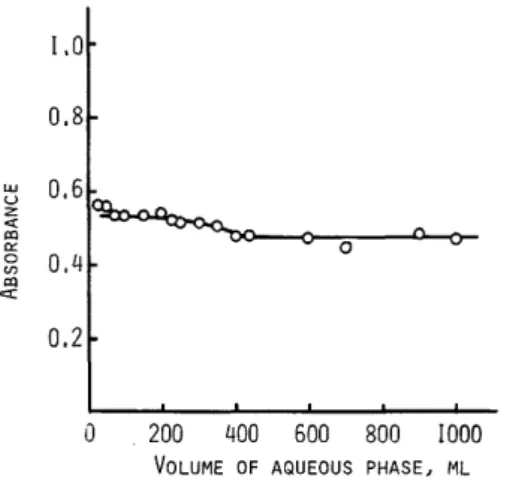
The volume in the aqueous phase containg fixed palladium and 2- mercaptobenzothiazole was varied from 30 to 1000 ml, and the adsorption of the complex on microcrystalline naphthalene was carried out ac- cording to the recommended procedure. The result is shown in Fig.8.
250
The absorbance decreased gradually with the volume in the aqueous phase and then was almost constant in the region of 400-1000 mI.
I.O
0.8
w u
0.6
z <t I:Q 0:::
0
Vl 0.4
c:::c ~
0.2
0 0 10 20 30 40 50
SHAKING TIME, MIN FIG. 7 EFFECT OF SHAKING TIME
PALLADIUM : 360 ~G j WAVELENGTH : 435 NM j pH 4.5 j 0.1% 2-M.B.T : 4,0 ML j 20% NAPHTHALENE
3,0 ML j STANDING TIME : 10 MIN REFERENCE : REAGENT BLANK
3.9 Effect of standing time
w u Z <t
~ 0:::
o
Vl
c:::c ~
I.O
o
o
200 400 600 800 1000VOLUME OF AQUEOUS PHASE, ML FIG. 8 EFFECT OF VOLUME OF AQUEOUS PHASE PALLADIUM : 360 ~G j WAVELENGTH : 435 NM j pH : 4.5 j DIGESTION TIME: 10 MIN j 0,1% 2-M,B,T : 6.0 ML j SHAKING TIME : 10 MIN
REFERENCE : REAGENT BLANK
The mixture of the palladium complex and naphthalene was dissolved in dimethylformamide and the effect of standing time on the absorbance was studied. The result is shown in Table 1. The color of the complex decreased gradually. 10 min of standing time were selected for the absorbance measurements.
Table 1 Effect of standing time
3.10
Standing time min 1 10 20 30 180
Palladium : 360 pg Calibration curve
pH
Absorbance 435 nm 0.535 0.530 0.526 0.524 0.485 4.5
I.O
0,8
UJ u 0,6
z
<C
~ a::
g 0,4
c:::r: ~
0,2
IOO 200 300 400 500 600
PALLADIUM, ~G/[O ML DMF FIG, 9 CALIBRATION CURVE FOR PALLADIUM WAVELENGTH: 435 NM ; pH : 4,5 ; 0,[% 2-M,B,T 4,0 ML ; DIGESTION TIME: IO MIN; 20% NAPHTHALENE
3,0 ML ; SHAKING TIME: 5 MIN; STANDING TIME: IO MIN REFERENCE : REAGENT BLANK
with the optimum conditions described above, the calibration curve for palladium determination was established at the wavelength of 435 nm against the reagent blank. The result is shown in Fig.9.
It was linear over the range of 40-650 pg of palladium in 10 ml of dimethylformamide. The molar absorptivity was calculated to be 1.6 x 10 3 l·mol-l.cm- l at 435 nm, and the sensitivity 0.067 pg of pal- ladium per cm 2 for the absorbance of 0.001. Ten samples containing 360 Pg of palladium, prepared by recommended procedure, gave a mean absorbance of 0.535, with a standard deviation of 6.88 x 10⁻³
or a relative standard deviation of 1.28%.
3.11 Choice of solvent
Various solvents were used to dissolve the palladium complex and naphthalene. This complex is soluble in dimethylformamide, dioxane, benzene, toluene, xylene, chlorobenzene, o-dichlorobenzene, chloroform, nitrobenzene at room temperature, but insoluble in propylene carbonate, acetonitrile, dichloroethane, methyl isobutyl ketone and acetone.
252