Solid-liquid Separation after Liquid-liquid
Extraction. Spectrophotometric Determination
of Zinc after Extraction of Its Oxinate with
Melted Naphthalene.
journal or
publication title
福井大学工学部研究報告
volume
18
number
2
page range
221-224
year
1970-09
URL
http://hdl.handle.net/10098/4795
Solid-liquid Separation after Liquid-liquid Extraction.
Spectrophotometric
Determination
of
Zinc
after
Extraction of Its Oxinate with Melted Naphthalene.
Masatada SATAKE*
(Received Apr. 9, 1970)
The method of liquid-liquid extraction of zinc oxinate with melted naphthal-ene followed by solid-liquid separation has been reported for the trace analysis of zinc. The optimum conditions on the determination of zinc were established as stated below. Zinc oxinate cannot be extracted into benzene or chloroform, but can be easily extracted into melted naphthalene, temperature being at about 90°C. It is very stable at this high temperature and can be dissolved in ethyl alcohol. The optical absorbancy of the solution against the reagent was measured at 385 nm to determine the amount of zinc. The proposed method could also be applied to the trace analysis of zinc in the presence of interfering major components which are removed by prior extraction with oxine-benzene solution.
1 Introduction
Oxine reacts with various metal ions to form very stable chelates (oxinates) which are easily extracted into organic solvent such as chloroform or benzene and are dete-rmined spectrophotometrically. However the method cannot be applied for zinc, magn-esium, cadmium, beryllium, etc., because their oxinates are mostly insoluble in organic solvents mentioned above, owing to their structure of strongly hydrated form.
Auther and others have already reported on the determination of copper,l) ,2) using a new method called "analysis by solid-liquid separation after liquid-liquid extraction". In this paper, zinc was chosen as a metal to be examined and its oxinate is extracted into melted naphthalene from aqueous solution by vigorous shaking. By standing the layer, it changes to many little crystals (melting point of naphthalene is 80.05°C). These crystals are insoluble in chloroform or benzene, but are soluble in methyl alcohol or ethyl alcohol (transparent yellow solution), and the amount of zinc in this solution is determined spectrophotometrically. This liquid-liquid extraction method is simple, conv-enient and very excellent for the spectrophotometric determination of minor amounts of zinc in the presence of major amounts of copper and iron.
2 Experimental Method
2 • 1 Reagents
All reagents were of analytical reagent grade. The water used was redistilled water
after deionization. Standard zinc solution (10-2M) Was prepared by dissolving 2.8754 g of zinc sulfate in water containing a few drops of concentrated sulfuric acid and dilu-ting to 1 litre. This solution was standardized against EDT A solution. More dilute zinc solutions were prepared as required by diluting the standard solution. Oxine solution ( 1 %) was prepared by dissolving 1 g of oxine in 2 ml of glacial acetic acid on a water bath and diluting to 100 m1 with water. Other reagents in this experiment are the same as that described in the previous paper.2l
2· 2 Apparatus
The apparatus used in this experiment are the same as that described in the previ-ous paperY
2 • 3 Precedure
To 25 m1 of sample solution containing 20-360 ,ug of zinc in a 50-m1 tightly stoppered Erlenmeyer flask, add 1 m1 of 1 % oxine solution, 2 m1 of the buffer solution and adjust the pH of the solution to 9.1 with diluted ammonia water. Shake the solution sufficiently and stand it for 15 minutes. Warm it in a water bath at around 60°C for 10 minutes. Add 1.5 g of naphthalene and keep the mixture at 90°C till naphthalene melts completely. Shake the mixture vigorously, and cool it to room temperatnre. Then once more warm it slowly till the suspended little crystals melt and grow up to larger crystals. Stand it at room temperature, Filter the mixture with a filter paper. After washing it on a filter paper with water, spread them on a dry filter paper for air-drying. Dissolve the naphthalene crystals with ethyl alcohol, and dilute the solution to 25 ml. Transfer a portion of this solution into a cell and measure the absorbance at 385 nm against the reagent blank to determine the amount of zinc.
3 Results and Discussion 3 • 1 Absorption spectra
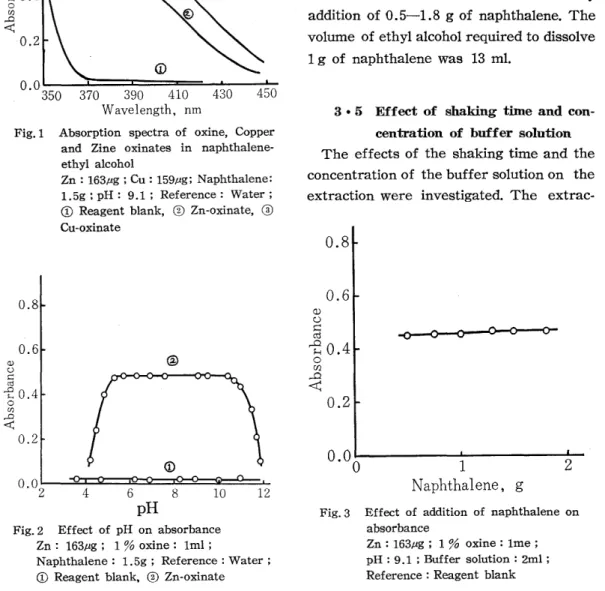
The absorption spectra of oxine and metal oxinates in naphthalene-ethyl alcohol sol-ution, measured against water, are shown in Fig.I. The absorbance curves of metal oxinates show a peak at 385 and 395 nm for zinc and copper respectively. The reagent blank shows strong absorption below 370 nm. Beyond this wavelength, there is practic-ally a negligible absorption due to the reagent blank. All the absorbance measurements were performed at 385 nm throughout this experiment.
3 • 2 Effect of pH
The relation of the absorbance and the pH of the aqueous solution containing zinc oxinate was investigated between the pH range of 4-12, and the result obtained is shown in Fig. 2. The absorbance curve shows that the extraction starts virtually from pH 4.0, increases sharply, gives a definite and maximum value in the pH range of 5.5 -10.5, and again decreases sharply beyond pH 10.5. Therefore, the pH range of 5.5 -10.5 is suitable for quantitative extraction. In this experiment, the absorbance was
measured at pH 9.1 considering the effect of diverse ions. 3 • 3 Effect of oxine concentration
The effect of oxine concentration on the extraction was investigated with the solution containing 163 /lg of zinc at pH 9.1. It indicates that 0.5-3 ml of 1% oxine solution are quite appropriate for the quantitative extraction of zinc. Therefor, 1 ml of 1% oxine solution was added as reagent throughout this experiment.
(l) <:.)
s::
cd
3 • 4 Effect of amount of naphthalene 0.8 0.6 ~OA o UJ ..n
-<
0.2 (l) <:.) s:: cdo.
0 L-.-...:::r:::=:::J::=:::::c::=.---'-_~~ 350 370 390 410 430 450 Wavelength, nmFig. 1 Absorption spectra of oxine, Copper and Zine oxinates in naphthalene-ethyl alcohol
0.8
0.6
Zn: 163,ug ; Cu : 159,ug; Naphthalene: 1.5g ; pH: 9.1 ; Reference: Water;
CD Reagent blank, ® Zn-oxinate, ®
Cu-oxinate @
-eOA
0 UJ ..n-<
0.2<D
0.0 2 4 6 8 10 12pH
Fig. 2 Effect of pH on absorbance Zn: 163,ug; 1 % oxine: 1ml;
Naphthalene: 1.5g; Reference: Water;
CD Reagent blank, ® Zn-oxinate
The effect of the amount of naphthalene on extraction by melted naphthalene from the solution containing zinc oxinate was investigated; some of the results obtained are shown in Fig. 3, which indicates that the absorbance became almost constant by addition of 0.5-1.8 g of naphthalene. The volume of ethyl alcohol required to dissolve 1 g of naphthalene was 13 ml.
3 • 5 Effect of shaking time and con-centration of buffer solution The effects of the shaking time and the concentration of the buffer solution on the extraction were investigated. The
extrac-(]) ( ) s:::: ro
0.8
0.6
~0.4
o if1 ...n ~0.2
1Naphthalene, g
2Fig. 3 Effect of addition of naphthalene on absorbance
Zn : 163,ug; 1 % oxine: 1me ; pH : 9.1 ; Buffer solution : 2ml ; Reference: Reagent blank
tion is practically very fast, no change was seen in the degree of extraction when the shaking time was varied from 10 seconds to 1 minute. The absorbance was almost constant independently of the amount of the buffer solution added between 0.5 and 5 ml.
3 • 6 CaIibra tion curve
Based on the optimum conditions obtained from the experiment described above, the absorbance was measured at 385 run against the reagent blank. Beer's law was obeyed over the wide range of the concentration, i. e. 20-360 f1.g of zinc in 25 ml of ethyl alcohol, the molar absorptivity being 4.6 X lOa.
3 • 7 Choice of solvent
The mixture of naphthalene and zinc oxinate extracted was insoluble in chloroform, benzene, ether, acetone, methyl-isobutyl ketone, etc., but was soluble in ethyl alcohol, methyl alcohol, dimethyl formamide and dimethyl sulfoxide.
3 • 8 Effect of diverse ions
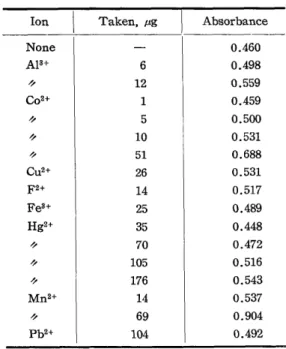
The effect of the diverse ions was examined with the solution containing 163 f1.g of zinc and various amounts of diverse ions. The pH of the solution was adjusted to 9.1.
Table I Effect of diverse ions Ion Taken, ,Ltg Absorbance
None 0.460 Al8+ 6 0.498 -'/ 12 0.559 C02+ 1 0.459 -'/ 5 0.500 -'/ 10 0.531 -'/ 51 0.688 Cu2+ 26 0.531 F2+ 14 0.517 Fe3+ 25 0.489 Hg2+ 35 0.448 -'/ 70 0.472 -'/ 105 0.516 -'/ 176 0.543 Mn2+ 14 0.537 -'/ 69 0.904 Pb2+ 104 0.492
The result obtained was shown in Table 1. The following ions did not interfer : Cl-, NOs -, S032-, F-,1-, SCN-, COa2-, C2042-, CIOa-, BrOa-, 10a-, HP042-, tartrate, citrate, Ag+, Sr2+, AS3+, B3+, W6+, Ba2+, M06+, VS+, But Hg2+, C02+, Cu2+, Pb2+, Fe2+, Fe3+, Mn2+
and AP+ interfered considerably. Large am-ounts of citrate, tartrate and even small amounts of EDT A interfered severely. AP+ was masked with 2 ml of 10 % ammonium fluoride. Fe3+and Cu2+ were eliminated by preliminary extraction with oxine-benzene solution at pH 3.9-4.0. This method is of use especially in the separation of the large amounts of major interfering elements.
Acknowledgement--The auther wishes to express his deep gratitude to Professor Taitiro Fujinaga, Faculty of Science, Uni-versity of Kyoto, and· Professor Tatsuo Yonekubo, Faculty of Engineering, University of Fukui for their kind advices.
References
1) T. Fujinaga, T. Kuwamoto, and E. Nakayama: Talanta, 1969, 16, 1225.