extraction.-Spectrophotometric determination
of palladium after extraction of its
2-mercaptobenzothiazo1e complex with molten
naphthalene-journal or
publication title
福井大学工学部研究報告
volume
25
number
2
page range
127-133
year
1977-09
URL
http://hdl.handle.net/10098/4514
Analysis of palladium by solid-liquid-separation after
liquid-liquid extraction.
--Spectrophotometric determination of palladium after
extraction of its 2-mercaptobenzothiazo1e complex with
molten
naphtha1ene--*
Masatada SATAKE
(Received Jun. 15, 1977)
The spectrophotometric determination of the trace amounts of pal-ladium with 2-mercaptobenzothiazole is described. A stable water-insoluble complex produced from palladium and 2-mercaptobenzothiazole is rapidly and quantitatively extracted into molten naphthalene from· the aqueous solution at pH 5.1. The extracted naphthalene mixture is separated from the aqueous solution, dried on a filter paper and dis-solved in dimethylformamide. The absorbance of the solution is measured at
435
nm and the trace amounts of palladium are determined from the working curve. The main advantages of the method are the high extraction rate and solubility of the complex into molten naphtha-lene and the proposed method has the higher sensitivity compared with chloroform extraction method. The various factors such as wavelength, pH, amounts of reagent and naphthalene, stability, shaking time, and choice of solvents are studied.1.
Introduction
2-mercaptobenzothiazole forms a water-insoluble colored complexes with palladium and bismuth at pH 2.0-9.0 and
4.6-6.5,
respectively. Of these the palladium complex is easily extracted into organic solvents such as chloroform or benzene and the trace amounts of these metals are determined spectrophotometrically. However, the method cannot be ap-plied for bismuth, because the bismuth complex is barely extracted into organic solvents mentioned above, owing to low solubility of the complex in such solvents.We have already reported on the determination of the trace amounts
"
liquid separation after liquid-liquid extraction In the present paper, palladium was chosen as a metal to be examined, and its 2-mer-captobenzothiazole complex was rapidly and quantitatively extracted into molten naphthalene from the aqueous solution .by vigorous shaking. The extracted mixture of the complex and naphthalene was separated, dried and then dissolved in dimethylformamide. Tpe absorbance of the solution was measured at 435 nm and the trace amount~ of palladium was determined.
In the proposed method, the separation and drying of the naphtha-lene mixture after extraction takes longer than the comparable oper-ating step in a simple chloroform extraction, but the sensitivity of naphthalene method is higher than that of chloroform method. This paper reports a method developed for determining palladium at low levels by using 2-mercaptobenzothiazole as a useful complexing reagent with naphthalene. It involves the extraction of the complex into molten naphthalene, dissolution of the naphthalene mixture in suitable organic solvents and the subsequent determination of palladium by con-ventional spectrophotometry.
2.
Experimental method
2. 1
Reagents
Standard metal solution, 5xlO-4M. A palladium solution was made by dissolving 0.44328 g of palladium chloride in 20 ml of concentrated hydrochloric acid on a hot water bath and diluting to 500 ml with water.
Reagent solution. A 0.1
%
(w/v) solution was prepared by dis-solving 0.1 g of 2-mercaptobenzothiazole in ethanol.Buffer solution was prepared by mixing suitable amounts of 1M a-cetic acid and 1M ammonium acetate for pH 3.0-6.0, or 1M ammonia water and 1M ammonium acetate for pH 8.0-11.0.
All other chemicals used were of analytical-reagent grade.
2.2
Apparatus
A Hitachi double beam spectrophotmeter, Model 200-20, with 10 mm glass cell, was used for the absorbance measurements.
A Toa-Dempa pH meter, Model HM-5A, equipped with glass and colomel electrodes was used for pH measurements.
2.3
Procedure
Transfer about 25 ml of sample solution containing 1-10 ml of 5.x 10-4M palladium chloride solution to a tightly stoppered Erlenmeyer flask, .adjust to about pH 5.1 with 2.0 ml of the acetate buffer solution
and add 5.0 ml of 0.1
%
2-mercaptobenzothiazole solution. Shake the solution well, heat it on a hot water bath at above 90°C for about 15 min. Add 2.0 g of naphthalene and keep it in a hot water bath until naphthalene melts completely. Shake the mixture vigorously t i l l the naphthalene layer solidifies to many fine crystals. Filter the mixture with a filter paper. After washing the deposit with water, spread it on a dry filter paper for air-drying. Dissolve it with dimethylform-amide and dilute the solution to 10 mI. Transfer a portion of the so-lution into a cell and measure the absorbance of the soso-lution at 435 nm against the reagent blank to determine the trace amounts of palladium.3.
Result and discussion
3.1
Absorption spectra
Sample solution containing 266 ~g of palladium, 5.0 ml of the ace-tate buffer solution (pH 5.l)and 5.0 ml of 0.1
%
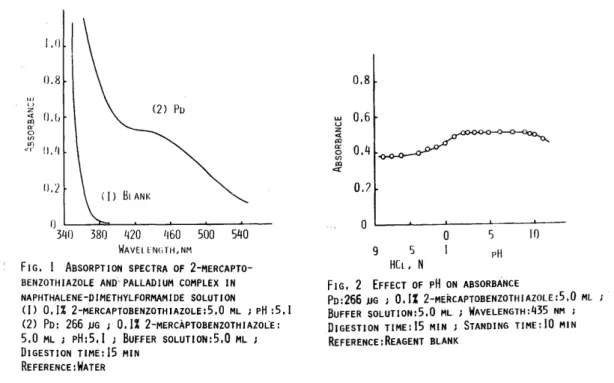
2-mercaptobenzothiazole solution was prepared and the extraction was carried out according to the procedure described above. Fig. 1 shows the absorption spectra of both the reagent blank and the palladium complex in naphthalene-dimet?y-formamide solution. It can be seen that the formation of the complex is accompanied by a marked increase in the absorbance while the sorbance of the reagent blank is small at the wavelength of plateau ab-sorption of the complex (435 nm), thus providing nearly ideal conditions for absorbance measurements. Therefore. 435 nm was chosen as a most suitable wavelength.3.2
Effect of pH on absorbance
The pH or acid concentration of the sample solution containing 266 ug of palladium and 5.0 ml of 0.1
%
2-mercaptobenzothiazole solution wasadjusted to 0-11.0 with various buffer solutions and l-9N with hydro-chloric acid and the extraction was carried out with molten naphthalene. After extraction, the phases were separated and filtered. The absorb-ance of the organic phase was measured at 435 nm and the equilibrium pH of the .aqueous phase determined at room temperature with pH meter. Fig.2 shows the effect of pH or acid concentration on the absorbance of the complex in naphthalene-dimethylformamide solution. The pH range at which maximal extraction of the complex occurs was found to be 2.0-9.0. Furthermore, the extraction of the complex occurred from strongly hydrochloric acid solution. Therefore, a pH of the solution was adjusted to 5.1 throughout further experiment.
3.3
Effect of reagent concentration on absorbance
The varying volume of 0.1
%
2-mercaptobenzothiazole solution were added to the sample solution containing 266 ug of palladium and 5.0 mlJ.f) 0.8 '" u z
n.b
« ~ ~ ~ !J.IJ <",' 1).2 380 IQO %0 500 540 WAVEl FN(iTH,NMFIG. I ABSORPTION SPECTRA OF
2-MERCAPTO-BENZOTHIAZOLE AND'PALLADIUM COMPLEX IN NAPHTHALENE-DIMETHYLFORMAMIDE SOLUTION
(I> 0.1% 2-MERCAPTOBENZOTHIAZOLE:5.0 ML ; pH :5. I
(2) Po: 266 JJG ; 0.1% 2-MERCAPTOBENZOTHIAZOLE:
5.0 ML ; pH:5.1 ; BUf~ER SOLUTION:5.Q ML ;
DIGESTION TIME:I5 MIN REFERENCE:WATER 0.8 IJ.J 0.6 u z « ttl g 0.4 (/) III c::[
D.?
o
9 5Hel, N
o
I I) pHFIG.
2
EFFECT OF pH ON ABSORBANCE10
PD:266 JJG ; 0.1% 2-MERCAPTOBENZOTHIAZOlE:5.0 ML
BUFFER SOLUTlON:5.0 ML ; WAVELENGTH:435 NM ; DIGESTION TIME:I5 MIN; STANDING TIME:IO MIN REFERENCE:REAGENT BLANK
of the acetate buffer solution, pH 5.1, and the extraction was performed according to the procedure described above. Fig. 3 shows the effect of the reagent concentration on the absorbance. It can be seen that the extraction of the complex increased with increasing amounts of added 2-mercaptobenzothiazole with up to 0.8 ml of 0.1
%
solution and hence remained almost constant between 0.8 and 10.0 mI. Therefore, 5.0 ml of 0.1%
reagent solution wer~ used for the further study.3.4
Effect of buffer solution orrabsorbance
The varying amounts of the acetate buffer solution, pH 5.1 were added to the sample solution containing 266 llg of palladium and 5.0 ml of 0.1
%
2-mercaptobenzothiazole solution and the extraction was per-formed according to the procedure described above. Fig.4
shows the effect of the buffer solution on the absorbance. It was found from the figure that the extraction increased with increasing amounts of the buffer solution by addition of up to 4.0 ml and remained almost constant with 4.0-10.0 mI. Therefore, 5.0 ml of the buffer solution were used for the further study.3.5
Efffect of digestion time on absorbance
The palladium complex in the solution was warmed, digested on a hot water bath at a temperature above
go °c
and the effect of' digestion time on. the absorbance was examined. As shown in Fig.5,
theab-sorbance increased with increasing digestion time up to
5
min and the changes in digestion time from 10 to 50 min had no marked effect on the absorbance. Therefore, 10 min of digestion time were selected for the further study. 0.8 0.6 w U Z <t <Xl 0.4 ex: ~ <Xl <I" 0.2 0 0 2 3 4 5 0.1% 2-MERCAPToBENZOrIlJAZOLEJ MLFIG. 3 EFFECT OF REAGENT CONCENTRATION ON
I\BSORBANCE
Po:266 UG ; pH:5.1 ; WAVELENGTH:435 NM j
BUFFER SOLUTION:5.0 ML ; NI\I'1I1flALfNE:2.0 G REFERENCE:REAGENT BLANK 0.8 w 0.6 u z <t <Xl ex: ~ n.4 <Xl <I" 0.2 0 0 2 () 1M RIIFFER Snll! I ION. Ml
FIG. 4 EFFEC r OF BilE FER SOl III ION ON I\IlS0lWI\NCI
Po:26n.llf;pH:S.I j 0.1% 2-MFRCfI'fORENZOfflll\lOlr:S,OMl
WI\VELENr,TH:4~S NM j OIGFSfl!H! riM!;: 15 MIN; SfI\NOINr.
IIME:IO MIN ; SOIVENf:nIM~"rYr rORMI\MlflF
R~rERENrE:REAGENf BLI\NK
3.6
Effect of addition of naphthalene on absorbance
Various amounts of naphthalene were added to the solution con-taining 266 ug of palladium, 2.0 ml of the buffer solution and 5.0 ml of 0.1
%
2-mercaptobenzothiazole solution at pH about 5.1, and the extraction was performed with molten naphthalene at high temperature. The effect of variation of naphthalene on the absorbance of the complex is shown in Fig. 6. The absorbance increased with increasing amounts of naphthalene up to 1.0 g of i t , whereas the addition of 1.0 to 2.3 g gave definite absorbance, and the absorbance decreased again when more than 2.3 g were added. Therefore, 2.0 g of naphthalene were used for the fu·rther study.3.7
Effect of shaking time and standing time on absorbance
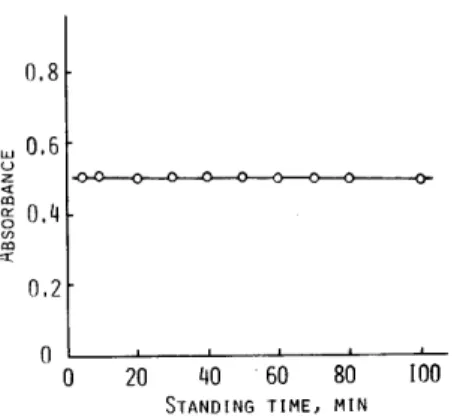
The shaking the solution containing the complex for periods up to 20 seconds with molten naphthalene showed that the absorbance of the organic phase remained almost constant between about 3 and 20 seconds. A several seconds' shaking period was selected to ensure complete for-mation and extraction of the complex. The color of the complex was stable for 80 min and the absorbance had no changes, but decreased by less than 10
%
after 120 min. The results obtained are shown Fig. 7.[j,8 III (J.f) u z ;'Jj
~---o-_ g
fl,ll~
j~~~---L-o
10 20 30 40 50DIGESTION TIME, MIN
rIG, 5 EFFECT OF DIGESTION TIME ON ABSORBANCE
r'D:266 P(; ; 0,1% 2-MERCAPTOBENZOTHIAZOLE:5,0 ML ;
pfi:5, [ ; WAVELENGTH:435 NM ; NAPHTHALENE:2.0 G ; SrANDING TIME:IO MIN
RErFRENCE:REAGENT BLANK 0.8 UJ 0,6 u z: <C !Xl a:: 0,4 0 en !Xl c::t: 0.2 0 0 2 NAPHTHALENE, G
FIG, 6 EFFECT OF NAPHTHALENE ON AKSORRANCE
PD:266 UG ; 0,1% 2-MERCAPTOBENZOTHIA10LE:S.n MI
pH:5, I j DIGESTION TIME: IS MIN
REFERENCE:REAGENT BLANK
The linear relationship between the absorbance and palladium con-centration is found to be held over the range of 27 to 532 ~g of pal-ladium in 10 ml of dimethylformamide solution. The result obtained is shown in Fig.
8.
The molar absorptivity was calculated to be 2.0xl0 3 l·mol-l.cm-l at 435 nm, the sensitivity being 0.052~g
per cm2 for an absorbance of 0.001. Ten sample solutions containing 266 ~g of pal-ladium, prepared by the recommended procedure, gave a mean absorbance of 0.500, with a standard deviation of 0.0075 (relative standard devi-ation of 1.5%).
Furthermore, the method was compared with the chlo-roform method. The results (Fig. 8 and Table 1) showed that the method is more sensitive than the chloroform method.Table 1 Comparison of naphthalene with chloroform method Extraction Molar absorp- Sensitivity Relative
tivity
2 standard
(%)
method (l·mol-l·cm- l ) (~g/cm)
deviationNaphthalene (DMF) 2.0 x 10 3 0.052 1.5 (CHC1 3) 1.3 x 10 3 0.079 1.0 Chloroform (CHC1 3' 1.4 x 10 3 0.076 0.9
3.9
Choice of solvent
We tested various organic solvents to dissolve the complex. The complex is soluble in chloroform and dimethylformamide at room temper-ature, soluble in dioxane at 50-60°C and insoluble in acetonitrile,
dimethylsulfoxide, propyren carbonate, etc. even at 50-60°C. 0.8 w 0.6 u z ~ « I'Q ~ 0.4 ell cr: 0.2
o
o
20 40 . 60 80 100STANDING TIME, MIN
FIG. 7 EFFECT OF STANDING TIME ON ABSORBANCE
PD:266 ~G i 0.1% 2-MERCAPTOBENZOTHIAZOLE:
5.0 ML i pH:5. I i DIGESTION TIME: 15 MIN;
REFERENCE:REAGENT BLANK 1.0 () (I) 0.8 (2) w u z <C 0.6 I'Q Q: 0 <f) I'Q cr: 0.4 0.2 PALLADIUM, jlGIIO ML DMF
FIG. 8 WORKING CURVE FOR PALlADlllM
WAVELENGTH:435 NM i 0.1% 2-MERCAPToRENzorHIAzOLE:
5.0 ML ; pH:5.1 ; BUFFER SOLUTION:5.0 ML ; (I)G
CHLOROFORM EXTRACTION([O ML), (2)e NArllrllAI rNF(CHCL3),
(3)0 NAPHTHALENE (DMF)