Solid‑liquid sepatation after liquid‑liquid extraction.‑Spectrophotometric determination of palladium after extraction of its
a‑benzi1dioxime complex with molten naphthalene‑
journal or
publication title
福井大学工学部研究報告
volume 25
number 2
page range 119‑125
year 1977‑09
URL http://hdl.handle.net/10098/4513
Solid-liquid sepatation after
liquid-liqu~d extracti~n.--Spectrophotometric determination of palladium after extraction of its a-benzi1dioxime complex with molten naphthalene--
* *
Masatada SATAKE and Takeshi YAMAUCHI (Received Jun. 15, 1977)
a-benzildioxime reacts with palladium to form a water-insoluble yellow complex. This complex is quantitatively extracted into molten naphthalene over the pH range 0-6.0. The extracted mixture of pal- ladium complex and naphthalene was dissolved in chloroform. The ab- sorbance of the solution was measured at 400 nm against the reagent blank and the trace amounts of palladium in the sample solution were determined spectrophotometrically. This complex was very stable in both naphthalene and naphthalene-chloroform solution. Beer's law was hold for palladium concentration range of 27-530 ~g in 10 ml of chloro- form solution. The molar absorptivity was calculated to be 2.1xl0 3 l'mol-l'cm-lat the wavelength of 400 nm, the sensitivity being 0.051 ~g of palladium per cm2 for the absorbance of 0.001. The relative standard deviation for the present analysis of palladium was 0.17
%
(for ten time determinations).1. Introduction
11
We have developed a new method solid-liquid separation after liquid-liquid extraction", and the method has been successfully applied for the spectrophotometric determination of metals by using molten organic compound with appropriate degree of melting point (namely , so- lidified at room temperature, and liquefied at high temperature below 100°C) as extractant, e.g. naphthalene(mp SlOC), biphenyl(mp700C), etc ..
In the present study, a-benzildioxime was chosen as a complexing reagent for the determination of palladium. a-benzildioxime forms a yellow water-insoluble complex with palladium over the fairly wide pH range of 0 to 6.0. This complex is extracted into molten naphthalene from the sample solution. After extraction, the solidified mixture
*
Division of Applied Scienceof the complex and naphthalene is separated from the solution, dissolved in chloroform, and the absorbance of the solution is measured at the wavelength of 400 nm against the reagent blank similarly prepared. The micro amounts of palladium is determined from the working curve. This complex is very stable in both the aqueous solution and molten naphtha- lene at high temperature. The colour of the complex in naphthalene- chloroform solution remained stable and there was no change in the ab- sorbance even after 3 days. The extracted palladium complex was solu- ble in chloroform at room temperature. It was insoluble in dimethyl- formamide, dimethylsulfoxide and dioxane at room temperature, but solu- ble at 50-60 aC.
The present paper describes a detailed investigation of the determi- nation of palladium at trace levels by extraction of the palladium-a- benzildioxime complex with molten naphthalene and subsequent dissolution in chloroform.
2. Experimental method 2.1 Apparatus
A Hitachi Model 200-20 double beam spectrophotometer was used for the absorbance measurements with a 10 mm glass cell.
The measurements of pH were made with a Toa-Dempa, Model HM-5A, pH meter equipped with combined colomel and glass electrodes.
2.2 Reagents
A satndard palladium SOlution(5xlO-4
M) was prepared by dissolving 0.44328 g of palladium chloride in 20 ml of concentrated hydrochloric acid on a water bath at 60
ac
and diluting to 500 ml with distilled water .a-benzildioxime(analytical-reagent grade, Wako pure Chemical Industries, LTD, Osaka, Japan) was used without further purification and a 0.02
%
solution was prepared by dissolving 0.02 g of the reagent in 100 ml of ethanol.Buffer solution was prepared by mixing suitable amounts of 1M acetic acid and 1M ammonium acetate at pH 3.0-6.0, or 1M ammonia water and 1M ammonium acetate at pH 8.0-11.0.
All other solutions were prepared with analytical reagent grade chemicals by using deionized water.
2.3 Procedure
A series of sample solutions was prepared containing 1-10 ml of 5xlO-4M palladium chloride solution, 2.0 ml of the acetate buffer so- lution(pH4.1) and 10 ml of 0.02
%
a-benzildioxime solution in pbout 30ml of total volume. After mixing the solutions thoroughly, they were warmed on a water bath at 90 ac. Add 2.0 g of naphthalene and melt completely. Shake the mixture vigorously t i l l naphthalene solidifies forming very fine crystals. Filter the mixture with a filter paper.
After washing with distilled water, blot the surplus water with a dry filter paper. Spread the crystals on a filter paper and allow to dry.
Then dissolve them with chloroform by shaking and dilute to 10 mI.
Dry the solution by addition of about 2 g of anhydrous sodium sulfate transfer a portion into 10 mm cell and measure its absorbance at 400 nm against the reagent blank prepared similarly. Calculate the amount of palladium from the working curve.
3. Result and discussion 3.1 Absorption spectra
Sample solution containing 106 or 265 ~g of palladium, 2.0 ml of the acetate buffer solution(pH4.1) and 10 ml of 0.02% a-benzildioxime solution was prepared according to the recommended procedure. The·
complex formed was extracted from the solution with molten naphthalene at the temperature above 81 aC. The extracted mixture of the complex and naphthalene was dissolved in chloroform and the absorbance of the solution was measured at the various wavelengths between 320 and 500 nm against the reagent blank. Fig. I shows the absorption spectra of the reagent and the complex in naphthalene-chloroform solution. The re- agent absorbed strongly below 340 nm, whereas the absorption of the complex increased continuously from 480 nm towards the ultraviolet region, a shoulder being obtained at about 400 nm. At this wavelength the absorbance due to the reagent was negligible in comparison with that of the complex. Therefore, the most suitable wavelength for the further work seemed to be 400 nm.
3.2 Effect of pH on absorbance
According to the recommended procedure, sample solution containing 265 Mg of palladium and 10 ml of 0.02 % a-benzildioxime solution was adjusted in the range of 4-lN by adding hydrochloric acid and in the pH range of 0-8 by adding buffer solution. The extraction was carried out with molten naphthalene. The extracted complex was dissolved in chloroform and the absorbance of the solution was measured. The pH values of the sample solution after extraction were measured at room temperature. Fig. 2 shows the effect of pH or acid concentration on the absorbance of the complex. The extraction starts from 4 N hydro- chloric acid solution, increases with decreasing acid concentration, reaches almost constant at pH 0-6.0, and then decreases sharply beyond
pH 6.0. Therefore, the pH of the sample solution was adjusted to 4.1 for the further work.
I.O
0.8
LJ.J
u 0.6 z
<C
~ a:
5; 0.4
~
<C
0.2
0
320 350 400 450 500 WAVELENGTH, NM
rIG. I ABSORPTION SPECTRA OF o/.-BENZILDIOXIME AND PALLADIUM COMPLEX IN NAPHTHALENE-CHLOROFORM SOLUTION
(l) 0.02%Q(-BENZIlDIOXIME : IO Ml; pH : 4.1 (2) PALLADIUM: I06).JG ; 0.02%o..-BENZILDIOXIME : 10 ML ; pH : 4. I
(3) PALLADIUM: 265).JG 0.02% ~-BENZILDIOXIME
: IO'1L j pH : 4. I REFERENCE : WATER
0.8
\
o
o
2 4 6 8 IO4 3 2 I pH
HCL, N
FIG. 2 EFFECT OF pH ON ABSORBANCE PALLADIUM: 265 PG ; 0.02% ~-BENZILDIOXIME 10 ML j WAVELENGTH : 400 NM j JIGESTION TIME 10 ~IN j SOLVENT : CHLOROFORM
REFERENCE : REAGENT BLANK
3.3 Effect of reagent concentration on absorbance
The varying voluma of 0.02
%
a-benzildioxime solution, 1.0-15.0 ml, were added to the sample solution containing 265 Mg of palladium and2.0 ml of the buffer solution(pH4.1). The extraction was carried out accorMng to the recommended procedure. Fig.
3
shows the effect of the addition of a-benzildioxime solution on the absorbance. From these experimental data, the addition of 5.0-15.0 ml of 0.02%
a-benzildioxime solution had no effect on the absorbance. Therefore, 10 ml of 0.02%
a-benzildioxime solution were used for the further work. When more than about 16 ml of 0.02
%
a-benzildioxime solution were added, the complex could not be extracted because of the dissolution of naphtha- lene in larger amounts of ethanol at high temperature.3.4 Effect of buffer solution on absorbance
The varying volume of the acetate buffer solution(pH4.l) were added to the sample solution containing 265 ~g of palladium and 10 ml of 0.02
%
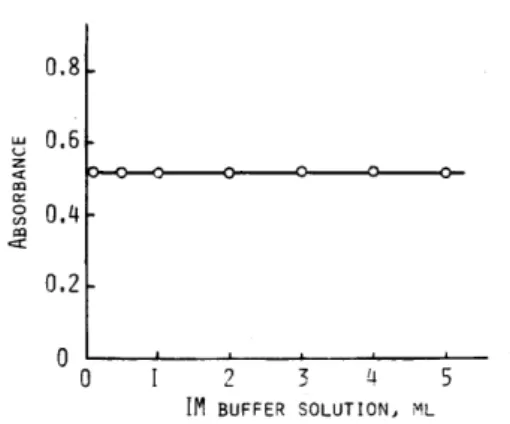
a-benzildioxime solution. Then the extraction was carried out according to the recommended procedure. Fig. 4 shows the effect of the addition of the buffer solution on the absorbance. It can beseen that a range of 0.5-5.0 ml of the buffer solution is practically without errect on the absorbance at 400 nm.
buffer solution were used for further work.
Thererore, 2.0 ml or the
w u
Z
<t
<Xl
o 0::
rJ)
<Xl
<C
0.8 0.6
8 10 12 14 0.02 % ~-BENZILDIOXIME, ML FIG. 3 EFFECT OF REAGENT CONCENTRATION ON ABSORBANCE
PALLADIUM: 265 ~G ; pH : 4.1 ; NAPHTHALENE
2.0 G ; DIGESTION TIME: 10 MIN REFERENCE : REAGENT BLANK
0.8
UJ 0.6
u z
<t
<Xl 0::
0 0.4
rJ)
<Xl
<C
0.2
0 0 2 3 L! 5 1M BUFFER SOLUTION, ML
FIG.
4
EFFECT OF BUFFER SOLUTION ON ABSORBANCE n··.LADIUM : ?fi5 )JG ; pH 4. I ; WAVELENGTH :400 NM ; ~~~ ~HALENE : 2.0 G ; JIGESTION TIME
IO MIN; STANDING TIME: 10 MIN REFERENCE : REAGENT BLAN~
3.5 Effect of digestion time on absorbance
The palladium complex in the solution containing 265 pg of pallad~
urn was warmed on a water bath at temperature above 90°C and the effect of digestion time on the absorbance of the complex was studied between 5 and 50 min. The graph depicted in Fig. 5 shows that the absorbance is constant independently of digestion time. Therefore, a 10-min di- gestion time was selected for the further work.
3.6 Effect of naphthalene on absorbance
The various amounts of naphthalene were added to the solution con- taining the palladium complex and the extraction was carried out ac- cording to the recommended procedure. Fig.
6
shows the effect of ad- dition of naphthalene on the absorbance. From these experimental data, the addition of 0.5-3.0 g of naphthalene did not cause the effect on the absorbance.further work.
Therefore, 2.0 g of naphthalene were used for the
3.7 Effect of shaking time on absorbance
The mixture of the palladium complex and naphthalene in the solution was warmed in a water bath at temperature above 81°C and the extraction
of the complex into molten naphthalene was carried out by vigorous shaking ror several seconds. This period or shaking time was demon- strated to be quite surficient ror the complete extraction or the
complex.
UJ r..;
0.8
~ 0.6
a:l gs ~
~ en 0.4
0.2
o~--~--~~--~--~----~
__
o
10 20 30 40 50 DIGESTION TIME, MINFIG. 5 EFFECT OF DIGESTION TIME ON ABSORBANCE PALLADIUM: 265 ~G ; pH : 4.I ; WAVELENGTH:
400 NM ; 0.02 % c;(-BENZILDIOXIME : IO ML ; STANDING TIME: 10 MIN; SOLVENT-: CHLOROFORM REFERENCE : REASENT BLANK
0.8
UJ 0.6
u z:
<C
a:l ~ 0.4
d: a:l
0.2
o~----~----~---~---
o
2 3NAPHTHALENE, G
FIG. 6 EFFECT OF ADDITION OF NAPHTHALENE ON ABSORBANCE
PALLADIUM: 265 ~G ; 0.02 % ~-BENZILDIOXIME : 10 ML ; pH : 4.1 ; BUFFER SOLUTION: 2.0 ML ; REFERENCE : REAGENT BLANK
3.8 Effect of standing time on absorbance
The mixture of the palladium complex and naphthalene was dissolved in chloroform and the effect of standing time on the absorbance was examined between 10 min and
3
days. As shown in Fig.7,
the colour of the complex in chloroform solution was very stable and the standing time for3
days did not give the marked changes on the absorbance.0.8
UJ 0.6
u z:
<C a:l a::
55 a:l d:
0.4
0.2
o
0 20 40 60 80rrzo
STANDING TIME, MIN
FIG.
7
EFFECT OF STANDING TIME ON ABSORBANCE PALLADIUM : 265 ~G ; 0.02 % ~-BENZILDIOXIME 10 ML ; WAVELENGTH: 400 NM ; pH : 4.1 ; DIGESTION TIME : IO MINREFERENCE : REAGENT BLANK
LO
0.8
UJ 0.6
u z:
<C a:l a::
0 en 0.4
a:l d:
0.2
106 213 319 426 532 PALLADIUM, ~G/IO ML CHCL3 FIG. 8 CALIBRATION CURVE FOR PALLADIUM WAVELENGTH: 400 NM ; pH : 4.1 ; BUFFER SOLUTI'ON : 2.0 ML ; 0.02 % cI..-BENZILDIOXIME 10 ML ; DIGESTION TIME : 10 MIN; STANDING TIME: 10 MIN; NAPHTHALENE: 2.0 G REFERENCE : REAGENT BLANK
3.9 Choice of solvent
Various organic solvents were used in an attempt to dissolve the mixture of the palladium complex and naphthalene. From the experi- mental results, the complex was soluble in chloroform, soluble in di- methylformamide, dimethylsulfoxide and dioxane at 50-60°C and insolu- ble in benzene, chlorobenzene, acetonitrile, isoamylacetate, propyrene carbonate, etc. even at 50-60 CC.
3.10 Working curve
Under the optimum conditions described above, the working curve was constructed at the wavelength of 400 nm against the reagent blank.
It was linear over the range of 27 to 530 Ug of palladium in 10 ml of chloroform solution. The molar absorptivity was calculated to be 2.1 xl0 3 l.mol-l.cm-l
, the sensitivity being 0.051 ug of palladium per cm2 . The mean absorbance of ten samples containing 265 Ug of palladium was 0.520 with a standard deviation of 8.8xlO-4
Crelative standard deviation of 0.17