Spectrophotometric determination of iron(III) after separation by adsorption of its
5‑chloro‑7‑iodo‑8‑hydroxyquinoline complex on naphthalene
journal or
publication title
福井大学工学部研究報告
volume 26
number 2
page range 253‑258
year 1978‑09
URL http://hdl.handle.net/10098/4457
FUKUI UNIVERSITY VOL.26 No.2 1978
Spectrophotometric determination of iron(III) after separation by adsorption of its 5-chloro-7-iodo-8- hydroxyquinoline complex on naphthalene
* * *
Masatada SATAKE , Tsutomu SUZUKI , Yoshikazu TANAKA and Toshihiko YOKOTA
*
( Received Jun. 30, 1978 )
A method is proposed for naphthalene adsorption and spectropho- tometric determination of ironClll) at ppm level with 5-chloro-7-iodo- 8-hydroxyquinoline. This method is based on the formation of a blue- black complex which is adsorpted by micro-crystal naphthalene and on the dissolution of the mixture in DMF. The blu-black solution follows Beer's law over the range of 5 - 88 pg of ironCIII) at 480 nm and
6 - 114 ug at 620 nm in 10 ml of DMF. The molar absorptivity was calculated to be 6.3 x 10 3 1·mol-l
·cm-l
at480 nm and 4.9 x 10³ l·mol-l .
cm-l
at 620 nm, the sensitivity being 0.009 ug/cm2 of ironCllI) at 480 nm and 0.011pg/cm2
at 620 nm for the absorbance of 0.001. The relative standard deviation was 0.72 % at 480 nm and 0.62 % at 620 nm. The other factors such as optimum wavelength, pH, amoumts of reagent and naphthalene-acetone solution, digestion time, shaking time, etc. were studied. The color of the complex was very stable for a long time.
The molar absorptivity, sensitivity and relative standard deviation in this method were almost the same as those in the naphthalene extraction method. In this method the complex was easily adsorpted by the micro- crystalline naphthalene even at room temperature, in contrast with the naphthalene extraction method , in which heating above 81°C was required
1 Introduction
5-chloro-7-iodo-8~hydrxyquinoline, which is a derivative of 8- hydroxyquinoline, forms water-insoluble colored complexes with various metal ions such as zinc, ironCllI), manganese, cobalt, nickel,cadmium, etc .. These complexes are easily extracted into chloroform or molten
*
Division of Applied Science2~
naphthalene under the optimum conditions. In this communication, 5-chloro-7-iodo-8-hydroxyquinoline was chosen as a significant complexing reagent for the spectrophotometric determination of trace
iron(III). This reagent reacts with iron(III) in the pH range 1.8 - 4.5 with the formation of a water-insoluble complex, which is quantitatively adsorpted on microcrystalli~e naphthalene at room temperature. The adsorpted naphthalene mixture is dissolved in DMF and the absorbance of the solution is measured at 480 and 620 nm.
The trace amounts of iron(III) is determined from the calibration curves.
2 Experimental method Apparatus and reagents
A Hitachi Model 200-20 double beam spectrophotometer with 10 mm glass cell was used for the absorbance measurements.
All the pH measurements were done with a Toa Dempa pH meter, equipped with combined calomel and glass electrodes.
Standard iron(III) solution. Prepared by diluting 5 ml of 1000 ppm iron (III) standard solution ( Analytical-reagent grade, Wako Pure Chemical Industries, LTD, Osaka, Japan) to 1000 ml with water.
5-chloro-7-iodo-8-hydroxyquinoline solution, 0.2% was prepared by dissolving 0.2 g of this reagent in 100 ml of ethanol.
Naphthalene solution, 20% was prepared by dissolving 20 g of naphthalene in 100 ml of acetone.
Buffer solutions of different pH values were prepared by mixing 1M acetic acid and 1M ammonium acetate solution for pH 3-6, or 1M ammonia water and 1M ammonium acetate solution for pH 8-11.
Deionized water was used.
The chemicals used were either chemically pure or reagent-grade materials unless otherwise mentioned.
Recommended procedure
Transfer about 45 ml of sample solution containing 1-10 ml of 5 ppm iron(III) solution to a tightly stoppered Erlenmeyer flask, adjust to pH 3.5 with 2.0 ml of the buffer solution and add 4.0 ml of 0.2% 5-chloro-7-iodo-8-hydroxyquinoline solution. Mix the solution well and digest for 5 min. Add 2.0 ml of 20% naphthalene-acetone solution and shake it vigorously for 1 min. Collect the colored
naphthalene mixture on a funnel with disc shaped filter ( filter paper,
No. 5C). Wash with water and dry in a dryer at about 60 cC. Then dissolve in DMF and dilute to 10 mI. Measure the absorbance of the solution in 10 mm glass cell against the reagent blank prepared similarly. Calculate the amounts of iron(III) from a calibration curve.
Results and discussion 3.1 Absorption spectra
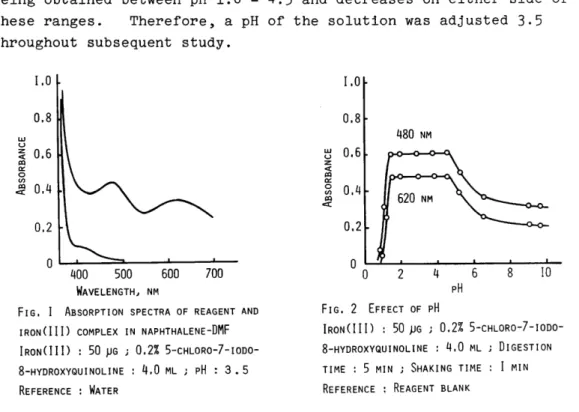
Fig. 1 shows the absorption spectra of iron(III) complex in naphthalene-DMF solution.
has two absorption peak at 480 and 620 nm. The
the reagent and the The iron(III) complex reagent blank shows strong absorption below 375 nm. For the absorbance measurements, 480 and 620 nm were chosen throughout subsequent study.
3.2 Effect of pH
The effect of pH on the absorbance of the complex was investi- gated at 480 and 620 nm. The pH measurements were made after ad- sorption of the complex on naphthalene at room temperature. Fig. 2 shows the effect of pH on the absorbance. It is evident that the ab- sorbance of the complex is dependent of pH, the maximum absorbance being obtained between pH 1.8 - 4.5 and decreases on either side of these ranges. Therefore, a pH of the solution was adjusted 3.5 throughout subsequent study.
La
0.8
w u z: 0.6
« Il:I 0::
0 III
Il:I 0.4
c::x:
0.2
OL..-.L---~--~--""""-
400 500 600 700
WAVELENGTH, NM
FIG. I ABSORPTION SPECTRA OF REAGENT AND IRON(III) COMPLEX IN NAPHTHALENE-DMF IRON(III) : 50 pG j 0.2% 5-CHLORO-7-IODO- 8-HYDROXYQUINOLINE : 4.0 ML j pH : 3.5 REFERENCE : WATER
1.0
0.8
480 NM
w 0.6
u z:
« Il:I a:::
0 0.4
III Il:I
c::x:
0.2
FIG. 2 EFFECT OF pH
IRON<IID : 50)JG j 0.2% 5-CHLORO-7-IODO- 8-HYDROXYQUINOLINE : 4.0 ML j DIGESTION TIME : 5 MIN j SHAKING TIME: I MIN REFERENCE : REAGENT BLANK
3.3 Effect of reagent concentration
256
Varying amounts of 0.2% 5-chlor07-iodo-8-hydroxyquinoline so- lution (0.1 - 7.0 ml) were added in the sample solution containing fixed iron(III) and buffer solution at pH 3.5~ and the variation in the absorbance of the complex with the reagent concentration was
investigated. The result obtained is shown in Fig.3. The absorbance increased with increasing amount of this reagent up to 1.2 ml of 0.2%
solution and when 1.2 - 7 ml of this solution were used, the absorbance were reasonably constant. Therefore, 4.0 ml of 0.2% solution were added throughout subsequent study.
3.4 Effect of buffer solution
The effect of the addition of the buffer solution on the ab- sorbance was investigated. From the experimental result, the ab- sorbance was no change by addition of the buffer solution up to 5.0 mI.
Therefore, 2.0 ml of the buffer solution(pH 3.5) were used throughout subsequent study.
3.5 Effect of digestion time
The iron(III) complex in the solution containing 50 pg of iron (III) was digested between 1 and 30 min at room temperature, and the effect of digestion time on the absorbance was investigated. The variation in the absorbance was not seen for this period of digestion time. Therefore, 10 min of digestion time were selected throughout subsequent study.
3.6 Effect of addition of naphthalene-acetone solution
1.0
0,8
480 NM
w u z
<t 1'0 0:: a
I/)
I'i\ 620 NM
<l:
0,2
0
0 2 3 4 5 6 7
0,2% 5-CHLORO-7-IODO-8-HYDROXYQUINOLINE, ML FIG. 3 EFFECT OF REAGENT CONCENTRATION
I RON (II [) : 50 ).JG j pH : 3.5 ; 20% NAPHTHALENE- ACETONE: 2.0 ML ; DIGESTION TIME: 10 MIN PEFEREIJCE : REAGENT BLANK
1.0
0,8
480 NM
UJ u 0,6 z <t I'i\
0:: a
I/)
0,4
I'i\
<l: 620 NM
0,2
0
0 2 3
20% NAPHTHALENE-ACETONE, ML FIG, 4 EFFECT OF ADDITION OF NAPHTHALENE- ACETONE SOLUTION
I RON ( I I J) : 50 )JG ; pH : 3 .5 i 0,2% 5-CHLORO- 7-IODO-8-HYDROXYQUINOLINE : 4,0 ML ; DIGESTION TIME: 10 MIN; SHAKING TIME: I MIN
REFERENCE : REAGENT BLANK
Various volume of 20% naphthalene-acetone solution was added to the sample solution containing the iron(III) complex, and the effect of addition of naphthaleneacetone solution on the absorbance was in- vestigated between 0.1 and 3.0 mI. The result obtained is shown in Fig.4. The absorbance was independent of the amount
of
naphthalene- acetone solution, as shown in Fig.4. Therefore, 2.0 ml of 20%naphthalene-acetone solution were added throughout subsequent study.
3.7 Effect of shaking time
The effect of shaking time on the absorbance of the complex was examined. The result obtained is shown in Fig.5. The adsorption of the complex on naphthalene was very fast and no change was seen in the degree of adsorption when shaking time was varied from 2 to 60 sec.
3.8 Effect of standing time
The adsorpted mixture of the complex and micro-crystalline naphthalene was separated from the aqueous solution, dried and dis- solved in DMF. The color of the complex in naphthalene-DMF solution is very stable for a long time and gave no change in the absorbance.
Therefore, 10 min of standing time were chosen throughout subsequent study.
1.0
0.8
480 NM
w u
0.6 -G-OGCO 0 0 0 -
z:
<I:
I:£l
a:: ~
0 Vl
0.4
I:£l
620 NM
<C
0.2
0
0 IO 20 30 40 50
SHAKING TIME} SEC FIG. 5 EFFECT OF SHAKING TIME
IRONO!!) : 50)JG j pH : 3.5; BUFFER SOLUTION: 2,0 ML ; STANDING TIME: IO MIN REFERENCE : REAGENT BLANK
3.9 Calibration curve
0.2
20 40 60 80 100
IRONCIII)} ~G/IO ML DMF FIG, 6 CALIBRATION CURVE FOR IRONC!II) pH : 3.5 j 0,2% 5-CHLORO-7 - I ODo-8-HYDROXY- OlilNOLINE : 4,0 ML ; DIGESTION TIME: 10 MIN
2n% NAPHTHALENE-ACETONE: 2,0 ML ;STANDING TIME : 10 MIN; SHAKING TIME : 1 MIN REFERENCE : REAGENT BLANK
Based on the optimum conditions described above, the absorbanceS of the complex for iron(III) of various concentrations were measured at
258
480 and 620 nm. The result obtained is shown in Fig.6. The ab- sorbance of the complex showed a linear relationship to the concen- tration of iron(III) over the range of 5 - 88 Ug at 480 nm and 6 - 114 pg at 620 nm per 10 ml of DMF solution. The molar absorptivity was 6.3 x 10³ l.mol-l·cm-l at 480 nm and 4.9 x 10³ l·mol-l·cm-l at 620 nm, the sensitivity being 0.009 pg/cm2 of iron(III) at 480 nm and 0.011 ~g/cm2 at 620 nm for the absorbance of 0.001. The relative standard deviation was 0.72% at 480 nm and 0.62% at 620 nm.
3.10 Choice of solvent
The tests were made with various organic solvents to dissolve the mixture of iron(III) complex and naphthalene. The mixture is easily soluble in DMF, benzene, toluene, xylene, chlorobenzene, o-di- chlorobenzene, chloroform, dioxane, acetonitrile, nitrobenzene, di-
chloroethane, etc. at room temperature.