of Bismuth after Extraction of Its
2‑mercaptobenzothiazole Complex with Molten Naphthalene‑
journal or
publication title
福井大学工学部研究報告
volume 25
number 2
page range 107‑111
year 1977‑09
URL http://hdl.handle.net/10098/4496
Solid-Liquid Separation after Liquid-Liquid Extraction.
--Spectrophotometric Determination of Bismuth after Extraction of Its 2-mercaptobenzothiazole Complex with Molten Naphthalene--
* *
Masatada SATAKE and Takeshi YAMAUCHI (Received Jun. 15, 1977)
A new reagent, 2-mercaptobenzothiazole,sodium salt is described for the spectrophotometric determination of bismuth(II) after ex- traction of bismuth complex with molten naphthalene. This
reacts with bismuth(II) to form a water-insoluble complex.
reagent The complex is insoluble in chloroform or benzene, but easily soluble in molten naphthalene. The extracted mixture of bismuth complex and naphthalene is dissolved in dimethylformamide and the trace amounts of bismuth are determined spectrophotometrically. The linearity be- tween the absorbance and bismuth concentration is held for 10 - 200pg of bismuth in 10 ml of dimethylformamide. The molar absorptivity was calculated to be 1.1 x 10
4
l.mol-l'cm-l, the sensitivity 0.020
~g
ofbismuth per cm 2 for the absorbance of 0.001 and the relative standard deviation 0.76
%
for ten times determinations.1. Introduction
2-mercaptobenzothiazole, sodium salt reacts with bismuth(II) to form a water-insoluble stable complex. This complex is not extracted into·organic solvents such as chloroform or benzene because of the low solubility, but easily extracted into molten naphthalene. The extracted mixture of the complex and naphthalene is separated from the aqueous solution, dissolved in dimethylformamide, and the trace amounts of bismuth is determined spectrophotometrically.
2. Experimental method 2.1 Apparatus
A Hitachi Model 200-20 double beam spectrophotometer was used for the absorbance measurements.
*
Division of Applied Science2 .
2 Reagents
Standard bismuth solution, 20 ppm. Prepared by diluting standard bismuth stock solution(lOOO ppm) to 1000 ml with water.
2-mercaptobenzothiazole solution, 0.5
%.
Prepared by dissolving 0.5 g of 2-mercaptobenzothiazole,sodium salt in 100 ml of water.Buffer solution. Prepared by mixing suitable amounts of 1M am- monia water and 1M ammonium acetate solution, or 1M acetic acid and 1M ammonium acetate solution.
All other reagents used were of analytical grade and were used without further purification.
2.3
Procedure
Transfer 1 - 10 ml of 20 ppm standard bismuth solution to a 80 ml stoppered Erlenmeyer flask, and dilute with water to about 25 ml. Add 2.0 ml of the acetate buffer solution(pH 5.5) and 5.0 ml of 0.5
%
2-mercaptobenzothiazole solution. Mix well and warm the flask on a water bath at about 90°C to precipitate the bismuth complex com- pletely. Add 2.0 g of naphthalene and warm the flask in the water
tillnaphthalen~ melts completely. Remove the flask from the bath and shake vigorously. Naphthalene will be solidified forming fine
crystals suspended in the solution. Warm the flask at about 81°C again and melt slowly the very fine crystals. Larger crystalline de- posits will be grow up in the solution. Filter the mixture on a filter paper and wash with water. Remove the water clinging to the filter paper with a separate piece of paper. Spread the crystals on a dry filter paper for air-drying. Transfer them to a volumetric flask and add dimethylformamide so that the final volume becomes 10 ml.
Mix well and measure the absorbance or the solution in a 10 mm cell against the reagent blank similarly prepared.
3. Result and discussion 3.1 Absorption spectra
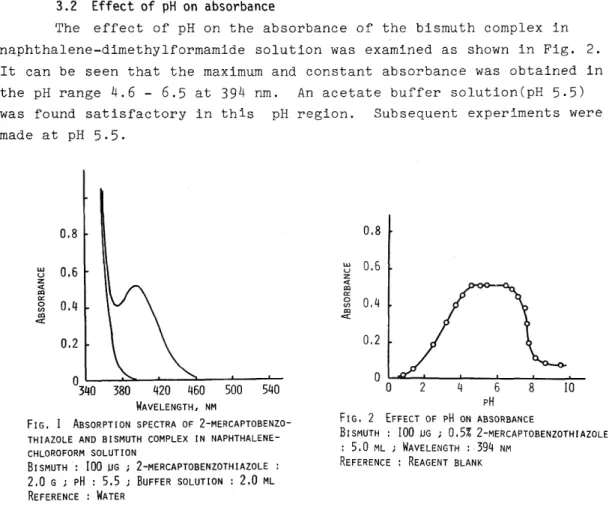
Bismuth in the sample solution containing 5.0 ml of 20 ppm standard bismuth solution was extracted with molten naphthalene as bismuth-2-mercaptobenzothiazole complex at. pH ca. 5.5. The mixture of the complex and naphthalene was dissolved in dimethylformamide, and the absorbance of the solution was measured at various wavelengths be- tween 360 and 460 nm. The absorption spectra of the bismuth complex along with that or the reagent blank in naphthalene-dimethylformamide
solution are shown in Fig.l. The maximum absorbance occurs at 394 nm, at which the absorbance or the reagent blank is very small. Subsequent studies were thererore made at 394 nm.
3.2 Effect of pH on absorbance
The effect of pH on the absorbance of the bismuth complex in naphthalene-dimethylformamide solution was examined as shown in Fig. 2.
It can be seen that the maximum and constant absorbance was obtained in the pH range 4.6 - 6.5 at 394 nm. An acetate buffer solution(pH 5.5) was found satisfactory in this pH region. Subsequent experiments were made at pH 5.5.
0.8
w 0.6
u z oct ,:Q 0:::
0.4
0 (/) ,:Q
c:::t
0.2
o
L -_ _ ~ _ _ ~ _ _ ~ _ _ ~ _ _ ~_340 380 420 460 500 540 WAVELENGTH, NM
FIG. I ABSORPTION SPECTRA OF 2-MERCAPTOBENZO- THIAZOLE AND BISMUTH COMPLEX IN NAPHTHALENE- CHLOROFORM SOLUTION
BISMUTH: 100 UG j 2-MERCAPTOBENZOTHIAZOLE : 2.0 G j
pH :
5.5 j BUFFER SOLUTION: 2.0 ML REFERENCE : WATER0.8
w u 0.6 z oct ,:Q 0:::
0 0.4
(/) ,:Q
c:::t
0.2
pH
FIG. 2 EFFECT OF
pH
ON ABSORBANCEBISMUTH : 100 UG ; 0.5% 2-MERCAPTOBENZOTHIAZOLE : 5.0 ML ; WAVELENGTH : 394 NM
REFERENCE : REAGENT BLANK
3.3 Effect of reagent concentration on absorbance
The effect of changes in the concentration of 2-mercaptobenzo- thiazole on the absorbance of the complex at pH 5.5 was examined at 394 nm. Fig. 3 shows that the absorbance increases by an increasing in the reagent concentration up to 2.0 ml of 0.5
%
2-mercaptobenzothiazole so- lution and becomes maximum with addition of 2.0 - 6.0 ml of it.3.4 Effect of buffer solution on absorbance
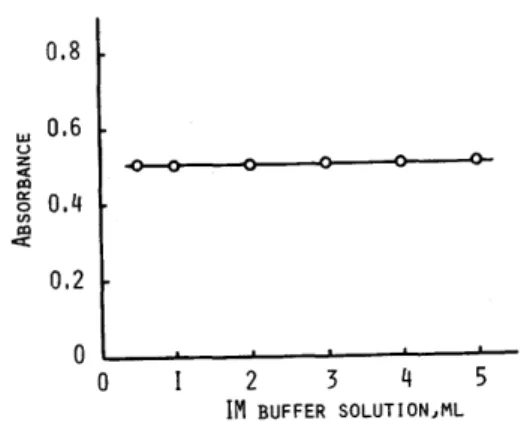
The effect of addition of the acetate buffer solution(pH 5.5) on the absorbance was examined. As seen from Fig. 4, the addition of 0.5 - 5.0 ml of the buffer solution was practically without variation on the absorbance at 394 nm. For further study, 2.0 ml of the buffer solution were added.
UJ 0.6
u z
<C I'll
a:: 0
en 0.4
I'll
c:x::
0.2
2 4 6
0.5% 2-MBT,
MLFIG. 3 EFFECT OF REAGENT CONCENTRATION ON ABSORBANCE
BISMUTH : 100 ~G j WAVELENGTH : 394 NM j
pH : 5.5 j DIGESTION TIME : 15 MIN REFERENCE : REAGENT BLANK
UJ 0.6
u z ~
<C o o o 0-
I'll
a:: 0.4
0 en
I'll
c:x::
0.2
a
0 2 3 4 5
1M BUFFER SOLUTION,ML FIG. 4 EFFECT OF BUFFER SOLUTION ON ABSORBANCE BI : 100 VG ; WAVELENGTH : 394 NM ; pH : 5.5 ;
STANDING TIME : IO MIN; DIGESTION TIME : IS MIN REFERENCE : REAGENT BLANK
3.5 Effect of digestion time on absorbance
The bismuth complex in the solution containing 27 ug of bismuth was digested on a water bath at 90°C and the extraction was carried out according to the recommended procedure. Fig.5 shows the effect of the digestion time on the absorbance. From these results, the complex was very stable at high temperature and the digestion for about
60
minhad no effect on the absorbance of the complex.
3.6 Effect of naphthalene on absorbance
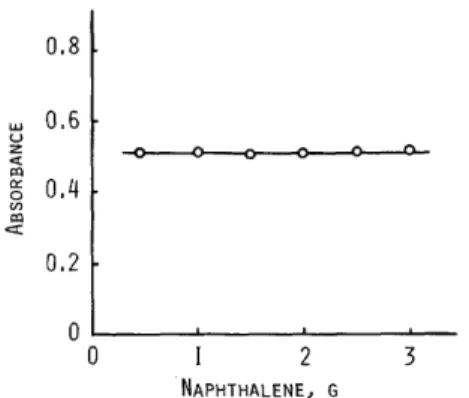
The bismuth complex was extracted from the solution with 0.5 -3.0 g of naphthalene under the optimum conditions and effect of the addition of naphthalene on the absorbance was tested. The result is shown in Fig. 6. This complex was very stable in molten naphthalene and almost completely extracted with the addition of 0.5 g of naphthalene. The rate of extraction of the complex into molten naphthalene was very
rapidly because of high temperature. The extraction was completed with several times shaking.
3.7 Effect of standing time on absorbance
The effect of standing time of .the complex in naphthalene-di- methylformamide solution was examined. The result is shown in Fig. 7.
The color of the complex was stable and the absorbance remained constant.
3.8 Calibration curve
The bismuth complex obeyed Beer's law over the range 10 - 200 Ug.
4
-1 -14
The molar absorptivity was 1.1 x 10 l·mol 'cm at 39 nm and the sen-
sitivity was 0.020
~g
Bi cm-2for the absorbance of 0.001.0.8
UJ 0.6
u z
<C (:Q 0::
0.4
0 til (:Q
<:(
0.2
0
0 20 40 60
DIGESTION TIME, MIN FIG. 5 EFFECT OF DIGESTION ON ABSORBANCE BI : 100 ~G i pH : 5.5 i BUFFER SOLUTION 2.0 ML ; DIGESTION TIME: IS MIN REFERENCE : REAGENT BLANK
0.8
UJ 0.6
u z
<C (:Q 0:: o
til I'Q
<:(
0.4
0.2
o
~____
~______
L -_ _ _ _ ~ _ _o
20 40 60STANDING TIME, MIN
FIG. 7 EFFECT OF STANDING TIME ON ABSORBANCE BI : 100)JG ; 0.5% 2-MERCAPTOBENZOTHIAZOLE 5.0 ML i WAVELENGTH: 394 NM ; pH : 5.5 REFERENCE : REAGENT BLANK
0.8
UJ 0.6
u z -0 0 0
<C 0 0 0
(:Q
0:: 0.4
0 til I'Q
<:(
0.2
o~----~----~----~-
o
2 3NAPHTHALENE, G
FIG. 6 EFFECT OF NAPHTHALENE ON ABSORBANCE BISMUTH: 100)JG ; 0.5% 2-MERCAPTOBENZOTHIA- ZOLE : 5.0 ML ; pH : 5.5
REFERENCE : REAGENT BLANK
UJ U z
<C I'Q cr:
o
til
~
LO 0.8
0.6
10 20 30 40 50
BISMUTH, jJG/IO ML DMF FIG.8 CALIBRATION CURVE FOR BISMUTH WAVELENGTH: 394 NM ; pH : 5.5 ; 0.5%
2-MERCAPTOBENZOTHIAZOLE : 5.0 ML ; DIGESTION TIME : 15 rHN ; STANDING TIME : 10 MIN REFERENCE : REAGENT BLANK
The precision of t>e method was tested by the measuring the ab- sorbance of ten samples, each containing 27 ~g of bismuth. The mean absorbance was 0.511 with a standard deviation of 3.90 x 10⁻³ (relative standard deviation 0.76