• 検索結果がありません。

- 15 - IEEE Workshop on Nonlinear Circuit NetworksDecember 7-8, 2018

N/A
N/A
Protected

Academic year: 2021

シェア "- 15 - IEEE Workshop on Nonlinear Circuit NetworksDecember 7-8, 2018"

Copied!
4
0
0

読み込み中.... (全文を見る)

全文

(1)

Artificial Bee Colony Algorithm for Time-Varying Function Using Normal Distribution

Ken Kamiyotsumoto , Yoko Uwate , Thomas Ott and Yoshifumi Nishio Department of Electrical and Electronic Engineering, Tokushima University

2-1 Minami-Josanjima, Tokushima, 770-8506, Japan , Zurich University of Applied Sciences E-mail: { kamiyotsumoto, uwate, nishio } @ee.tokushima-u.ac.jp ,

[email protected]

Abstract—Recently, nature-inspired metaheuristic optimiza- tion algorithms such as Artificial Bee Colony Algorithm (ABC) is developed. ABC is based on the feeding behavior of bee herds.

ABC can not solve for time-varying function.

In this study, we offer a new ABC for time-varying function.

We propose ABC in which the scout bee is improved prob- ability by normal distribution. We compare the best solution with ABC, previous method and the proposed method. Object function which optimal solution moves circle of shape is used.

We investigate characteristic of proposed method according to variance of normal distribution. Best value and orbit of solutions for proposed method are better than those of other method.

I. I NTRODUCTION

Optimization is to search optimal solution under condition.

Benefit of optimization is high efficiency. Optimization is needed in various scenes. Combinatorial optimization problem is often solved by metaheuristic optimization algorithms.

Many combinatorial optimization problems often results in local optima. Metaheuristic optimization algorithms are solved high performance in these problems. These algorithms are developed to solve more efficiency and larger problems. Meta- heuristic optimization algorithms have Evolutionary Algorithm (EA), Swarm Intelligence (SI) algorithm, local search, etc. In our study, we choose the SI.

SI is one of the artificial intelligence techniques. SI was born from swarm of insect. Examples existing in nature are ant, bee and firefly, etc. In insect colonies, each insect has its the group in total appears to be highly organized. The applications of SI technique are a self-driving car and data mining. The good points of this technique are smaller control system and multi control by simple systems. SI algorithms have Artificial Bee Colony Algorithm (ABC), Ant Colony Optimization (ACO), Particle Swarm Optimization (PSO), Firefly Algorithm (FA), etc [1]. The ABC is used by our propose method.

ABC is idealized the social behavior of bees based on their feeding characteristics. ABC was proposed by Karaboga Dervis in 2005 [2]. Artificial intelligence algorithms have been demonstrated to show effectiveness and efficiency to solve difficult optimization problems [3]. ABC performs higher ability in high dimensional optimization problem than other SI algorithms. However, demerit of ABC is that it can not search time-varying function.

In previous study, we modified ABC for time-varying

function (ABCTV) [4]. However, we can not find accurate solution.

In this study, we propose ABCTV in which the scout bee is improved by normal distribution. We compare the best value and the orbit of the solution with ABC, ABCTV and the proposed method.

II. A RTIFICIAL B EE C OLONY A LGORITHM

Karaboga has proposed an Artificial Bee Colony (ABC) algorithm in 2005. The ABC algorithm is based on real bee behavior and consist of 3 kinds of honeybee, employed bee, onlooker bee and scout bee. It is suitable when the object function is high dimension [5]. The procedure for solving an optimization problem in the ABC algorithm is shown below.

Step0. Initialize each total number of employed bees n e and onlooker bee n o , the colony size N = n e + n o and the total number of iterations t max .

Step1. (1) Set the locations of the x i . i is the number of the employed bee.

(2) Calculate the fitness f i in the initial arrangement by Eq. (1). The best f i and initial arrangement are stored.

Step2. (1) New locations v i is generated and calculated the fitness function value.

(2) Based on the fitness, the best location and fitness update.

step3. (1) Based on the fitness, the probability p i is calcu- lated by Eq. (2).

(2) Select the number of employed bee i based on p i , and Step1 is applied. When this procedure has been repeated n o times.

step4. If function value of each i is better than function value of all bees, the solution and the function best value are updated.

step5. The employed bee which has not been generated the new location.

Step6. Repeat steps 1 to 4 and output the solution.

Fitness function f i and probability p i are given by following equations:

f i =

 

 1

1 + g(x i ) if g(x i ) 0 1 + | g(x i ) | otherwise

(1)

- 15 -

IEEE Workshop on Nonlinear Circuit Networks

December 7-8, 2018

(2)

p i = f i /

n

e

i=1

f n , (2)

where, g(x i ) expresses the objective function. Figure 1 shows flowchart of ABC.

Fig. 1. flowchart of ABC.

III. PREVIOUS METHOD

The most of algorithms exclude time-varying solution. How- ever, when we search optimal solution, we need to apply the both solutions (time-varying and not time-varying). In case of ABC, it can not be adapt fitness function to changing object function. The artificial bee colony algorithm for time- varying solution (ABCTV) is proposed. ABCTV was modified 2 points. First, when employed bee compares fitness function values between 2 locations, previous location is reevaluated for each simulation count. Second, we calculate best fit- ness function value for each simulation count. According to these modification, ABCTV can search time-varying solution.

However, ABCTV can not search accurate solution than the standard ABC. Figure 2 shows flowchart of ABCTV.

Fig. 2. Flowchart of ABCTV.

IV. PROPOSED METHOD

We propose ABCTV in which the scout bee improves by normal distribution. The scout bee searches a new location randomly in the standard ABC. However, ABC has problem

point that the employed bee which was able to search along the orbit is repositioned outside the orbit. Therefore, we modify that the scout bee searches new location by normal distribution. From the beginning of the simulation scout bee searches new location by using Eq. (3).

f (x) = 1

2πσ 2 exp (

(x µ) 22

)

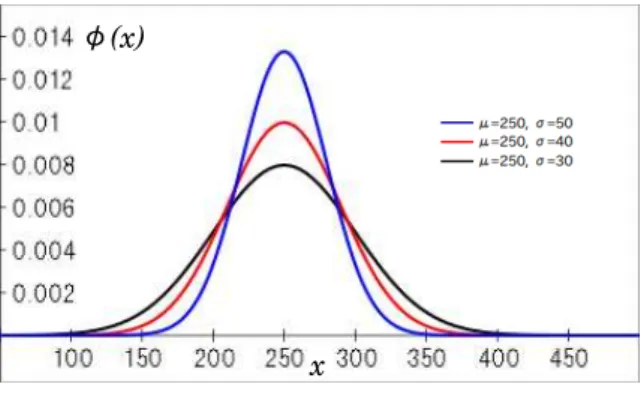
(3) where σ 2 corresponds to the variance of normal distribution and µ denotes the mean of normal distribution. Figure 1 shows some examples of probability density functions of normal distribution. From Fig. 1, variance of normal distribution σ 2 means range of probability and mean of normal distribution expresses the position with the highest probability. In this simulation, we set µ as position of employed bee which has the best fitness value. According to this modification, we expect that proposed method can search more accurate best solution and orbit. We compare 6 kinds of variance by changing the parameter σ 22 =1.0, 10.0, 30.0, 50.0 and 100.0). We investigate best value and orbit of solutions by variance of normal distribution.

φ(x)

x

Fig. 3. Normal distribution.

V. S IMULATION RESULT

In order to evaluate the performance of the propose method, we compare the result of Eq. (4).

g(x 1 , x 2 , k) = 1 exp[ (x 1 250 125 sin αk) 2 2 · 40 2

(x 2 250 + 125 sin αk) 2 2 · 40 2 ].

(4) Equation (4) simulates a visual tracking problem. The optimal function value is 0, and position along a circle of radius 125 centered at (x 1 , x 2 ) = (250, 250), then return its original position in (2π/α) steps. k means time that is approximated by similaition count. We express the constant value to use for simulation in Eq. (5).

n e = n o = 50, t max = 100000, α = 0.01 (5)

First, we investigate the orbit of each algorithm. The results of orbit are summarized in Fig. 4 to Fig. 10.

- 16 -

(3)

Fig. 4. Orbit of ABC.

Fig. 5. Orbit of ABCTV.

Fig. 6. Orbit of propose method (σ

2

= 1.0).

Fig. 7. Orbit of propose method (σ

2

= 10.0).

Fig. 8. Orbit of propose method (σ

2

= 30.0).

Fig. 9. Orbit of propose method (σ

2

= 50.0).

Fig. 10. Orbit of propose method (σ

2

= 100.0).

Figure 4 shows that ABC can not search optimal orbit.

However, ABCTV and proposed method can search optimal orbit. From Fig. 5, ABCTV can search to rough out optimal orbit. From Fig. 6 to Fig. 10, the orbit of proposed method can search accurate optimal orbit as variance σ 2 decrease. When σ 2 is 100, dispersion of orbit is biased compared with that of ABCTV. The reason is that there is no diversity in determining the mean of the normal distribution.

- 17 -

(4)

Next, we compare best value for each method. We show best value of solution for each method by Table I. This simulation shows the best solution out of 10 times. The best solution is the smallest value in results of 10 times simulations.

TABLE I

B

EST SOLUTION OF EACH METHOD

(α = 0.01).

method best value

ABC 1.93010e-09

ABCTV 2.29477e-07

propose method (σ 2 = 1.0) 3.73631e-07 propose method (σ 2 = 10.0) 9.92083e-08 propose method (σ 2 = 30.0) 3.06453e-07 propose method (σ 2 = 50.0) 2.30944e-07 propose method (σ 2 = 100.0) 6.78707e-08

From Table I, it is clear that the best value of proposed method better than best value of ABCTV. Furthermore, pro- posed method has good effect for best value as variance σ 2 increase. However, proposed method when σ 2 = 10.0 is good performance without depending on that trend. The reason is we estimate that there is a proper range of probability for normal distribution when employed bee is initialized.

VI. C ONCLUSION

This paper shows the ABC modified that scout bee is changed probability because this algorithm don’t applied for accurate time-varying solution. We tried improvement of ABC, where scout bee searches new position by probability based on normal distribution. We set 5 kinds of variance of normal distribution and mean by position of best employed bee.

We compared the best values and orbit of proposed method, previous method and ABC. As a result, when variance of normal distribution is small, proposed method could search better orbit than other algorithms. When variance of normal distribution is large, proposed method could search better value than other algorithms. Therefore, propose method is better performance than other methods.

In the future work, we would like to investigate the mechanism of the proposed method in detail. Furthermore, we try to search high dimensional problem.

R EFERENCES

[1] X. S. Yang, “Nature-Inspired Metaheuristic Algorithms Second Edition,”

Luniver Press, 2010.

[2] D. Karaboga, “An idea based on honeybee swarm for numerical opti- mization,” Technical Report TR06, 2005.

[3] I. Iimura and S. Nakayama, “Search Performance Evaluation of Artificial Bee Colony Algorithm on High-Dimensional Function Optimization,”

Transactions of the Institute of Systems, Control and Information En- gineers, vol. 24, pp. 97-99, 2011.

[4] T. Nishida, “Modification of ABC Algorithm for Adaptation to Time‐

Varying Functions,” Electronics and Communications in Japan, vol. 96, 2013.

[5] W. Y. Szeto and Y. Wu and S. C. Ho, “An artificial bee colony algorithm for the capacitated vehicle routing problem,” European Journal of Operational Research, vol. 215, pp. 126-135, 2011.

- 18 -

Fig. 2. Flowchart of ABCTV.

参照

関連したドキュメント

In this paper, we investigate the output characteristics by using our proposed CNN and also our designed templates to image processing of gray- scale image and binary image..

We research the setting method of the connecting weight of neurogenesis. Therefor, we research the learning performance of the proposed MLPs by setting of the parameter of

We focus on the parameter mismatches, the synchronization of coupled chaotic circuits in three different network topologies obtained from the small-world network model is studied..

As a result, proposed method can detect more edge lines of indistinct portions than conventional method. Hence, the proposed method is more effective than the conventional CNN in

From Figure 6, the learning accuracy and learning loops of using Gaussian distribution (0, 0.01) are better than not using it.. From Table I, most results by using the noise are

As a result, in the case of between hubs not connected to the same node, synchronization rate is proportional the coupling strength.. Furthermore, this result shows reason

As a result, in ladder ten coupled chaotic circuits, when we increase the coupling strength from γ = 0.0055 to 0.01, three periodic attractors are propagated chaotic

We investigate the ratio of propagation when we change the value of degree in the initial chaos position according to degree distribution.. Moreover, in scale-free and random