• 検索結果がありません。

- 19 - IEEE Workshop on Nonlinear Circuit NetworksDecember 15-16, 2017

N/A
N/A
Protected

Academic year: 2021

シェア "- 19 - IEEE Workshop on Nonlinear Circuit NetworksDecember 15-16, 2017"

Copied!
4
0
0

読み込み中.... (全文を見る)

全文

(1)

Parameter Setting of K-Means Clustering with Modifying Firefly Algorithm

Masaki Takeuchi , Thomas Ott , Haruna Matsushita , Yoko Uwate and Yoshifumi Nishio

Department of Electrical and Electronic Engineering, Tokushima University 2-1 Minami-Josanjima, Tokushima, 770-8506, Japan

E-mail: { masaki, uwate, nishio } @ee.tokushima-u.ac.jp

Zurich University of Applied Sciences Einsiedlerstrasse 31a, 8820 Waedenswil, Switzerland

E-mail: [email protected]

Department of Electronics and Information Engineering, Kagawa University 2217-20 Hayashi-cho, Takamatsu, Kagawa, 761-0396, Japan

E-mail: [email protected]

Abstract—In 2011, Senthilnath et al. proposed to utilize the Firefly Algorithm for K-means clustering. The algorithm has shown better results than the standard K-means algorithm or other combinations with bio-inspired optimization heuristics. In this study, we propose a further improvement of the method, based on an improved firefly algorithm. As a key aspect, the randomization parameter in our proposed algorithm is changed when the assignment does not change. We compare the standard K-means algorithm, K-means using the conventional Firefly Algorithm and our proposed algorithm on the basis of a simple data distribution. Numerical experiments show that our proposed algorithm is more efficient than the other algorithms.

I. I NTRODUCTION

Clustering is a popular data analysis technique used for data analysis, image analysis, data mining and the other fields of science and engineering. The goal of clustering is to find homogeneous groups of data points in a data set. Each group is called a cluster and is characterized by the fact that objects that belong to the same group are more similar than objects that belong to different groups. The K-means algorithm is one of the most famous clustering methods. It is used if the number of clusters is known and the clusters tend to be spherical. The goal of the method is to find K cluster centers and assign each object to the closest cluster center such that the sum of the squared distances between the objects and the corresponding cluster centers is minimal. This means that the K-means clustering problem is an optimization problem.

Senthilnath et al. proposed an algorithm that used the firefly algorithm for K-means clustering (KMFA) [1]. Numerical experiments have indicated that this algorithm is more efficient algorithm than the standard algorithm or other optimization heuristics. The Firefly Algorithm (FA) has been proposed by Yang in 2007 and is based on the idealized behavior of the flashing characteristics of fireflies [2]. FA is an efficient opti- mization algorithm because it has a deterministic component and a random component. Almost all algorithms having only the deterministic component are local search algorithms, for which there is a risk of being trapped in a local optimum.

However, the random component makes it possible to escape from such a local optimum.

In our previous study, we proposed a new clustering algorithm that combines K-means clustering and improved Firefly Algorithm (KMIFA). In our proposed algorithm, one parameter is changed when the assignment does not change [3]. We compared the conventional K-means algorithm, KMFA and our proposed algorithm KMIFA using a 2-dimensional toy data model. These experiments indicated that our algorithm is more efficient than the other algorithms. However, for 3- dimensional toy data model this algorithm cannot obtain a better results than other algorithms. We improved the transition rule of one parameter. Our proposed algorithm has new two parameters. In the previous studies, we carried out computer simulations with fixed parameters. Therefore, in this study, we simulate a various patterns of this two parameters and intestate their effects.

II. T HE C ONVENTIONAL M ETHODS

In this section, we explain the conventional K-means algo- rithm and the Firefly Algorithm (FA).

A. K-means algorithm

The objective function of K-means clustering is defined by J =

K

k=1

N

n=1

b kn | c k o n | 2 , (1) where K is the number of cluster centers, N is the number of objects, c k is the position vector of cluster center k and o n

is the position vector of object n. Each object is assigned to its nearest center. Hence b kn = 1 if object n is assigned to center k and b kn = 0 otherwise:

b kn =

{ 1, object n is assigned to center k

0, otherwise (2)

This optimization problem is solved using the K-means algorithm which is composed of the following four steps:

- 19 -

IEEE Workshop on Nonlinear Circuit Networks

December 15-16, 2017

(2)

Algorithm 1 The conventional Firefly Algorithm Objective function f (x), x = (x 1 , ..., x d ) T

Initialize a population of fireflies x i (i = 1, 2, ..., n) while t < M axGeneration do

for i = 1 to n, all n fireflies do for j = 1 to n, all n fireflies do

Light intensity I i at x i is determined by f (x i ) if I i > I j then

Move firefly i towards j in all d dimensions end if

Attractiveness varies with distance r via exp[ γr]

Evaluate new solutions and update light intensity end forj

end fori

Rank the fireflies and find the current best end while

Postprocess results and visualization

1) Initialize all cluster centers and objects: The number of cluster centers and all objects are predefined. All cluster centers are randomly initialized in the search space.

2) Assignments: Each object is assigned to only the closest cluster center.

3) Calculates cluster centers: The places of each cluster center move to the mean of each group object.

4) Iterate steps 2 and 3 until the assignments no longer change.

B. The Conventional Firefly Algorithm (FA)

FA has been developed by Yang and it was based on the idealized behavior of the flashing characteristics of fireflies [2]. Many researchers have paid attention to FA [4], [5]. The conventional FA idealizes these flashing characteristics using the following three rules:

All fireflies are unisex so that one firefly is attracted to other fireflies regardless of their sex.

Attractiveness is proportional to brightness; thus, for any two flashing fireflies, the less brighter one will move towards the brighter one. Both the attractiveness and brightness stared above decrease as their distance increases. If no one is brighter than a particular firefly, it moves randomly.

The brightness or light intensity of a firefly is affected or determined by the landscape of the objective function to be optimized.

The attractiveness of a firefly β is defined by

β = (β 0 β min )e −γr

2ij

+ β min , (3) γ = 1

L , (4)

Algorithm 2 KMFA

Initialize a population of fireflies x i (i = 1, 2, ..., N f ) Initialize a cluster centers c k (k = 1, 2, ..., N c ) Initialize a objects o n (n = 1, 2, ..., N o ) while t < M axGeneration do

Each object is assigned the closest cluster center calculate J i (i = 1, 2, ..., N f)

Light intensity I i is determined by J i

if I i > I j then

Move firefly i towards j end if

Find the current best end while

Postprocess results and visualization

L = | X max X min |

2 , (5)

where γ is the light absorption coefficient, β min is the mini- mum value of β, β 0 is the attractiveness at r ij = 0, and r ij

is the Euclidian distance between any two fireflies i and j at x i and x j . L means the average scale for the problem. The movement of the firefly i is attracted to another more attractive firefly j, and is determined by

x i = x i + β(x j x i ) + αϵ i , (6) ϵ i = (random() 0.5)L, (7) where x i is the position vector of firefly i, random() is a uniform random number distributed in [0, 1] and α(t) is the randomization parameter. The parameter α(t) is defined by

α(t) = α(0) ( 10 −4

0.9

) t/t

max

, (8)

where t is the number of iteration.

Algorithm 1 shows the pseudo code of the conventional FA for minimum optimization problems.

III. K-M EANS C LUSTERING WITH FA (KMFA) For KMFA, the position vector x i of a firefly i corresponds to (c 1 , c 2 , ..., c K ). That is, each firefly contains the positions of all cluster centers. The attractiveness of each firefly is defined by the objective function (Eq. (7)). Numerical ex- periments have indicated that this algorithm is more efficient than the K-means algorithm and other algorithms for typical benchmark data sets [1].

Algorithm 2 shows the pseudo code of KMFA.

IV. K- MEANS C LUSTERING USING THE I MPROVED FA (KMIFA)

The K-means algorithm and KMFA sometimes converge to a local minimum. Therefore, the purpose of this study is to remove this disadvantage. In our proposed algorithm, each firefly has its own value of α(t):

α(t) = λ i ( 10 4

0.9

) t/t

max

, (9)

- 20 -

(3)

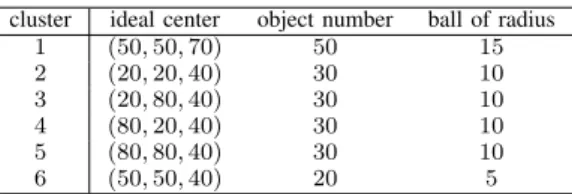
TABLE I

I

NFORMATION ABOUT DATA TOY MODEL USED

cluster ideal center object number ball of radius

1 (50, 50, 70) 50 15

2 (20, 20, 40) 30 10

3 (20, 80, 40) 30 10

4 (80, 20, 40) 30 10

5 (80, 80, 40) 30 10

6 (50, 50, 40) 20 5

where λ is a new parameter. We set all value of λ to the same certain value λ 0 when initializing the population of fireflies and define the minimum value of λ is 0. We do not define the maximum value of λ, which means λ could increase to infinity. The value of λ changes if the assignment changes or not.

λ new i = {

λ i θ 1 , the assignment doesn t change λ i + θ 2 , the assignment changes (10) where θ 1 and θ 2 are a predefined parameter. In the case of a firefly i, if the assignment of all objects does not change, the value of λ i decreases. On the other hand, if the assignment of all objects changes, the value of λ i increases. In the case of λ >> 0, a firefly moves with a relatively strong random influence. This makes the firefly easier to escape from a local minimum. In the case of λ = 0.0, a firefly does not move randomly, which leads to a faster convergence. Therefore, the concept of our proposed algorithm is at the beginning of the search, fireflies easily escape from local optima. Then, as the number of iteration increases, fireflies tend to converge.

V. N UMERICAL E XPERIMENTS

We compare the conventional K-means algorithm, KMFA our proposed method KMIFA using a simple data toy model.

Information about that model is summarized in Tab. I and that model is depicted in Fig. 1. The number of dimensions is 3, the range of each dimension is [0, 100], the number of clusters is 6 and the number of total objects is 190. The data objects were generated randomly around the ideal centers within each ball of radius. We used all the same data set in each numerical experiment. Each numerical experiment was run 500 times and we compared the success rate of each algorithm, where the success rate is defined as the fraction of objects that are assigned to the correct cluster:

Success Rate[%] = Success[times]

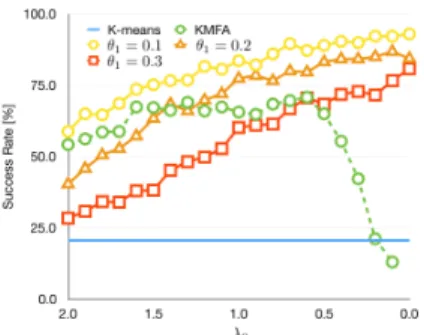
500 × 100. (11) Figure 2 shows the numerical experiment results in the case of θ 1 = 0.1 and θ 2 = 0.1. We assume that our proposed algorithm is more efficient algorithm than the other two algorithms. For our proposed algorithm, the success rates are almost same as those of KMFA when λ 0 is more than 1.5.

As λ 0 decreasing from 1.5, the success rates of our proposed algorithm are gradually increasing. On the other hand, As λ 0

decreasing from 1.5, the success rates of KMFA remind flat to 0.5, then, those rapidly decrease.

(a) x vs y.

(b) x vs z.

(c) y vs z.

Fig. 1. Toy data model.

Fig. 2. Numerical experiment result.

Next, we change the value of θ 1 and θ 2 . First, we fix the value of θ 1 at 0.1 and change θ 2 from 0.1 to 0.3 (see Fig. 3).

Figure 3 shows the value of θ 2 is suitable for our proposed algorithm. The graph of our proposed algorithms gradually increase with the same slope. However, as the value of θ 2

increasing, the success rate decreases.

Then, we fix the value of θ 2 at 0.1 and change θ 1 from 0.1 to 0.3 (see Fig. 4). We assume that the success rate does not

- 21 -

(4)

Fig. 3. Numerical experiment result changing θ

2

.

Fig. 4. Numerical experiment result changing θ

1

.

depend on the value of θ 2 .

Figure 5 shows the transition of λ when λ 0 is 0.3. Each line means the value of λ of each firefly. The transition is like a mountain. Until the number of iterations is about 30, λ of all fireflies increase. From the number of iterations is about 60, λ of all fireflies decrease. Between 30 and 60, each firefly has a different λ value.

Figure 6 shows the transition of α when λ 0 is 0.3. Each solid line means the value of α of each firefly on KMIFA and broken line means the value of α of fireflies on KMFA.

There are two difference points of the transition of α between KMFA and KMIFA. One is that the value of α increases from the beginning of the search. Another is that the value of α of each firefly is different in the middle of searching.

VI. C ONCLUSION

In this study, we have proposed a new clustering algorithm that utilizes an improved firefly algorithm for K-means cluster- ing. Our algorithm is based on the idea that the randomization parameter is changed when the assignment changes or not.

In our proposed algorithm, at the beginning of the search, all fireflies move with a relatively strong random influence. Hence

they can more easily escape from a local minimum. As the number of iterations increases, the firefly tend to converge.

Numerical experiments have indicated that our proposed algo- rithm is more efficient than the other algorithms.

The study is based on a relatively simple toy data set. In our future work, we will study more complex problems. In addition, we will study more various transition.

Fig. 5. The tradition of λ when λ

0

= 0.3.

Fig. 6. The tradition of α when λ

0

= 0.3.

R EFERENCES

[1] J. Senthilnath, S.N. Omkar and V. Mani, “Clustering using Firefly Algorithm: Performance Study”, Swarm and Evolutionary Computation 1, pp. 164–171, 2011.

[2] X.S. Yang, Nature–Inspired Metaheuristic Algorithms Second Edition, Luniver Press, 2010.

[3] M. Takeuchi, T. Ott, H. Matsushita, Y. Uwate and Y. Nishio, “K-Means Algorithm using Improved Firefly Algorithm”, Proceedings of 2017 RISP International Workshop on Nonlinear Circuits, Communication and Signal Processing (NCSP’17), pp. 225–228, 2017.

[4] S. Lukasik and S. Zak, “Firefly Algorithm for Continuous Constrained Optimization Tasks”, Computational Collective Intelligence. Semantic Web, Social Networks and Multiagent Systems, Vol. 5796 of the Series Lecture Notes in Computer Science, pp. 97–106, 2009.

[5] H. Matsushita, “Firefly Algorithm with Dynamically Changing Connec- tions”, Proceedings of International Symposium on Nonlinear Theory and its Application (NOLTA’14), pp. 906–909, 2014.

- 22 -

Fig. 1. Toy data model.
Fig. 3. Numerical experiment result changing θ 2 .

参照

関連したドキュメント

13 proposed a hybrid multiobjective evolutionary algorithm HMOEA that incorporates various heuristics for local exploitation in the evolutionary search and the concept of

5 used an improved version of particle swarm optimization algorithm in order to solve the economic emissions load dispatch problem for a test system of 6 power generators, for

To overcome the drawbacks associated with current MSVM in credit rating prediction, a novel model based on support vector domain combined with kernel-based fuzzy clustering is

First algorithm of our classifier is classif yCeq, which classifies the simple sin- gularities in characteristic p &gt; 0 with respect to the contact equivalence.. This

We present a Sobolev gradient type preconditioning for iterative methods used in solving second order semilinear elliptic systems; the n-tuple of independent Laplacians acts as

Using right instead of left singular vectors for these examples leads to the same number of blocks in the first example, although of different size and, hence, with a different

At the same time, a new multiplicative noise removal algorithm based on fourth-order PDE model is proposed for the restoration of noisy image.. To apply the proposed model for

For performance comparison of PSO-based hybrid search algorithm, that is, PSO and noising-method-based local search, using proposed encoding/decoding technique with those reported