Research on a New Structure of Three-Layer Cellular Neural Networks
Muhammad Izzat bin Mohd Idrus, Yoshihiro Kato, Yoko Uwate and Yoshifumi Nishio
Dept. Electrical and Electronic Eng, Tokushima University 2-1 Minami-Josanjima,
Tokushima, Japan
Email: izzat, kkato, uwate, [email protected]
Abstract— In this study, we research a new layer arrangement of three layer cellular neural network (CNN). In this paper, we investigate the output characteristics by using our proposed CNN and also our designed templates to image processing of gray- scale image and binary image. The simulation results show the effectiveness with our proposed CNN.
I. I
NTRODUCTIONCellular Neural Networks (CNN) were introduced by Chua and Yang in 1988 [1][2]. The idea of the CNN was inspired from the architecture of the cellular automata and the neural networks. The architecture of CNN is the combination of the simple circuit which is called cell. Each cell only communicate with each other directly in neighborhood. Each cell contain lin- ear capacitors, linear resistors, linear and nonlinear controlled sources and independent sources. The CNN has local con- nectivity property and they have been successfully developed in various image processing applications. In previous study of CNN, single-layer CNN have been introduced with many kind of templates and after that, two-layer CNN have been proposed for high performance processing [3]. Recently, to obtain high performance in color image processing, three-layer CNN have been proposed [4].
In this study, we proposed a new structure of the three- layer CNN. We investigate the output characteristic between the proposed CNN by apply to the gray-scale image which has scenery in the background to remove noise and edge detection simultaneously. Then, we analysis the effectiveness of simulation results of our proposed CNN.
In this paper, we describe about the proposed CNN in Sec.
II. In Sec. III, we show simulation results of the proposed CNN respectively. Also, in Sec. III, we analysis the simulation result. Finally, we conclude the our study in Sec. IV.
II. P
ROPOSEDCNN
In this section, we introduce a new structure of the three- layer CNN. Figure 1 shows that the output of the first layer CNN (CNN1) is delivered into the second layer CNN (CNN2) and the third layer CNN (CNN3) by through coupling template (C
1). In other way, the outputs of the CNN2 and the CNN3 are delivered into the CNN1 by through coupling templates
(C
2) and (C
3), respectively. Compare to the previous three- layer CNN [3], our proposed CNN do not have mutual connection between layer. Furthermore, our proposed CNN can be conventional CNN if all coupling templates (C
1), (C
2) and (C
3) has removed. Also, our proposed CNN can be previous structure of the two-layer CNN if coupling templates (C
2) or (C
3) has removed. From these characteristics, we can say that our proposed CNN is the independent structure.
Fig. 1.
Block diagram of the proposed CNN.
The equations of the proposed CNN are described as below:
(1) State equations of the proposed CNN:
State equation of CNN1 : C dv
x1ijdt = − 1
R v
x1ij+
∑
i+r k=i−r∑
j+r l=j−rA
1(i, j; k, l)v
y1kl(t)
+
∑
i+rk=i−r
∑
j+rl=j−r
B
1(i, j; k, l)v
u1kl(t)
+
∑
i+rk=i−r
∑
j+rl=j−r
C
2(i, j; k, l)v
y2kl(t)
+
∑
i+rk=i−r
∑
j+rl=j−r
C
3(i, j; k, l)v
y3kl(t) + I
1(|i − k| ≤ 1 , |j − l| ≤ 1). (1) State equation of CNN2 :
C dv
x2ijdt = − 1
R v
x2ij+
∑
i+rk=i−r
∑
j+rl=j−r
A
2(i, j; k, l)v
y2kl(t)
+
∑
i+rk=i−r
∑
j+rl=j−r
B
2(i, j; k, l)v
u2kl(t)
+
∑
i+rk=i−r
∑
j+rl=j−r
C
1(i, j; k, l)v
y1kl(t) + I
2- 109 -
IEEE Workshop on Nonlinear Circuit Networks December 14-15, 2012
(|i − k| ≤ 1 , |j − l| ≤ 1). (2) State equation of CNN3 :
C dv
x3ijdt = − 1
R v
x3ij+
∑
i+rk=i−r
∑
j+rl=j−r
A
3(i, j; k, l)v
y3kl(t)
+
∑
i+r k=i−r∑
j+r l=j−rB
3(i, j; k, l)v
u3kl(t)
+
∑
i+rk=i−r
∑
j+rl=j−r
C
1(i, j; k, l)v
y1kl(t) + I
3(|i − k| ≤ 1 , |j − l| ≤ 1). (3)
(2) Output equations of the proposed CNN:
Output equation of CNN1 : v
y1ij(t) = 1
2 ( | v
x1ij(t) + 1 | − | v
x1ij(t) − 1 | ). (4) Output equation of CNN2 :
v
y2ij(t) = 1
2 ( | v
x2ij(t) + 1 | − | v
x2ij(t) − 1 | ). (5) Output equation of CNN3 :
v
y3ij(t) = 1
2 (|v
x3ij(t) + 1| − |v
x3ij(t) − 1|). (6) III. S
IMULATIONR
ESULTSIn this section, we show simulation results for the the pro- posed CNN. For simulations, we use four types of templates which are “Small object remover”, “Edge detection”,
“Smoothing” and “Heat dif f usion”. All of these original templates can be found in [5]. The designed templates and simulation results are shown as follow:
T emplate of CN N 1 : A
1=
[ 0 0 0 0 1 0 0 0 0
] , B
1=
[ 0 0 0 0 0 0 0 0 0
]
, I
1= −1. (7)
T emplate of CN N 2 : A
2=
[ 0.1 0.15 0.1 0.15 0 0.15 0.1 0.15 0.1
] , B
2=
[ 0 0 0 0 0 0 0 0 0
]
, I
2= 0. (8)
T emplate of CN N 3 : A
3=
[ 0 1 0 1 2 1 0 1 0
] , B
3=
[ 0 0 0 0 0 0 0 0 0
]
, I
3= − 0.5. (9)
Coupling T emplates : C
1=
[ 1 1 1 1 2 1 1 1 1
] , C
2=
[ −1 −1 −1
−1 8 −1
−1 −1 −1 ]
,
C
3=
[ −1 −1 −1
−1 8 −1
−1 −1 −1 ]
. (10)
To get the good result, the template for the CNN1 is very important to design because CNN1 is the main operation.
For this simulation, we put “Edge detection” in CNN1 by through the coupling templates (C
2) and (C
3). We put
“Small object remover”’s template into the CNN2 and CNN3 by through (C
1). Then, we put “Heat dif f usion” and
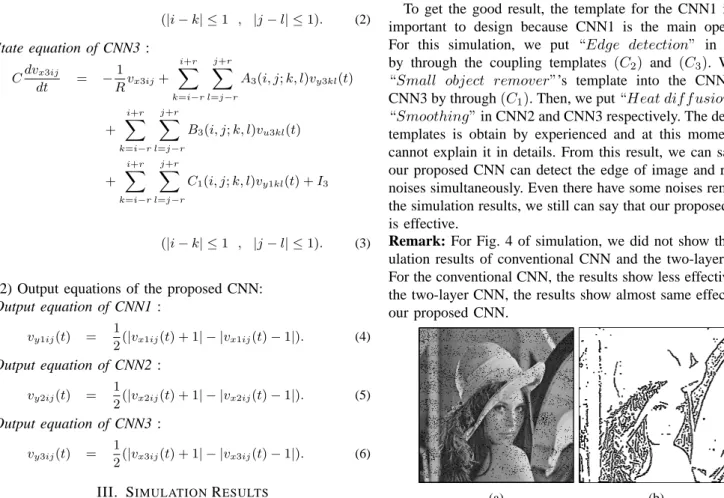
“Smoothing” in CNN2 and CNN3 respectively. The designed templates is obtain by experienced and at this moment, we cannot explain it in details. From this result, we can say that our proposed CNN can detect the edge of image and remove noises simultaneously. Even there have some noises remain in the simulation results, we still can say that our proposed CNN is effective.
Remark: For Fig. 4 of simulation, we did not show the sim- ulation results of conventional CNN and the two-layer CNN.
For the conventional CNN, the results show less effective. For the two-layer CNN, the results show almost same effective as our proposed CNN.
(a) (b)
Fig. 2.
Simulation results for gray-scale image with scenery. (a) Initial image. (b) Output image.
IV. C
ONCLUSIONIn this study, we have proposed a new structure of three- layer CNN. From the computer simulations of gray-scale image which has scenery in background, we investigated the output characteristics of the proposed CNN. We can say that the proposed CNN have potential in image processing.
However, at the moment, we do not say that our proposed CNN show excellent performance that conventional CNN and two-layer CNN. In future works, we would like to use another type of images like color image. We also would like to try other tasks in our proposed CNN.
R
EFERENCES[1] L. O. Chua and L. Yang, “Cellular Neural Networks: Theory,” IEEE Trans. Circuits Syst., vol. 32, pp. 1257-1272, Oct. 1988.
[2] L. O. Chua and L. Yang, “Cellular Neural Networks: Applications,” IEEE Trans. Circuits Syst., vol. 32, pp. 1257-1272, Oct. 1988.
[3] Z. Yang, Y. Nishio and A. Ushida, “Image Processing of Two-Layer CNNs:Applications and Their Stability,” IEICE Trans. Fundamentals, vol. E85-A, No. 9, pp. 2052-2060, Sept. 2002.
[4] T. Inoue and Y. Nishio, “Research of Three-Layer Cellular Neural Net- works Processing Color Images,” IEICE Technical Report, NLP2008-25, pp. 33-36, Jul. 2008.
[5] Cellular Sensory Wave Computers Laboratory Computer and Automation Research Institute Hungarian Academy of Sciences, “Cellular wave Computing Library (Template, Algorithm, and Programs) Version 2.1”