Research of Pattern Recognition
by Multi-Layer Perceptron with Neurogenesis
Yuta Yokoyama, Chihiro Ikuta, Yoko Uwate and Yoshifumi Nishio Department of Electrical and Electronic Engineering, Tokushima University
2-1 Minami-Josanjima, Tokushima-shi, Tokushima, 770-8506, Japan Email: { yuta, ikuta, uwate, nishio } @ee.tokushima-u.ac.jp
Abstract— It was impossible to generate the new neuron in
the adult brain. Neurogenesis is that new neurons are generated in the human brain. We focus on the characteristic of the neurogenesis with biologically. We apply the behavior of the neurogenesis to the artificial neural network. In the previous study, we have proposed artificial network model which was applied the neurogenesis to Multi-Layer Perceptron (MLP).
In this study, we investigate setting method of the connecting weight of neurogenesis. By using computer simulations, we research the learning performance of the proposed MLPs by setting of the parameter of the connecting weight of neurogenesis.
I. I
NTRODUCTIONIt is said that we have about 10 billion neurons in the brain.
The network of the brain is formed by connecting of more than one neuron. However, neurons had been considered to be lost with age until several years ago. There is no neural stem cell which makes a neuron in the brain of an adult human. In recent studies, some researchers reported that new neurons are generated in the dentate gyrus of hippocumpus [1]-[3]. This process is called “neurogenesis”. By utilizing the neurogesis, some brain cells increase and the network of within is substantial. It is known that the neurogenesis improves memory, learning and thinking ability by combining new neurons with biological neural network. We focus on the characteristic of the neurogenesis with biologically. In the pre- vious study, we have proposed artificial network model which was applied the neurogenesis to Recurrent Neural Network (RNN) [4] and Multi-Layer Perceptron (MLP) [5]. Therefore, we have researched the performance of the proposed network.
The performance being submitted.
In this study, we focus on the values of the connecting weight of the neurogenesis. We research that the connecting weight of the neurogenesis change the some values.
II. MLP
WITHN
EUROGENESISBefore, there is no neural stem cell which makes a neuron in the brain of an adult human. It was impossible to generate the new neuron. Therefore, the neurogenesis had been considered to generate for period of growth. Thus, neurons had been con- sidered to be lost with age until several years ago. However, some researchers reported that new neurons are generated in the adult brain. This process is called “neurogenesis”. The neurogenesis in the hippocumpus of the human brain was discovered in the late 1990s by Erickson et al [1]-[3]. The neurogenesis is included in the existing neural circuit by given
the learning and new neurons are generated in the human brain.
We have proposed artificial network model which was applied the neurogenesis to Multi-Layer Perceptron (MLP) [5]. Then, the performance of the proposed network being submitted.
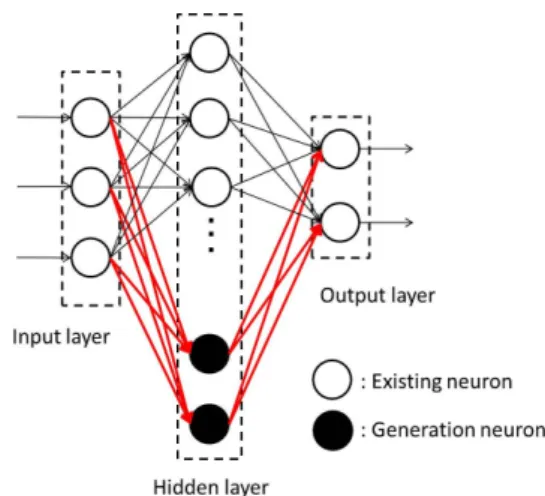
Figure 1 shows a structure of the proposed network.
Fig. 1. MLP with neurogenesis.
In this system, new neurons are generated in the hidden layer during the learning process. At the same time, all the weights connecting to the generated neurons are newly set.
We explain two kinds of the neurogenesis. One is the periodic neurogenesis. In the case of the periodic neurogenesis, new neurons generated at every 10 iterations during the learning process. The other is the chaotic neurogenesis. In the case of the chaotic neurogenesis, new neurons generated by using the logistic map. Hasegawa et al. investigated solving abilities of the Hop-field NN with various surrogate noise, and they concluded that the effects of the chaotic sequence for solving optimization problems can be replaced by stochastic noise with similar autocorrelation [6]. The updating function of the logistic map is described by Eq. (5).
y(n + 1) = αy(n)(1 − y(n)). (1)
We use that the parameter α =3.82740 and 4.0. The neuroge- nesis is occurred when the value of y takes the range between 0.6 to 0.7.
- 115 -
IEEE Workshop on Nonlinear Circuit Networks December 14-15, 2012
III. S
IMULATIONSWe consider a pattern recognition, where 26 alphabets pat- terns in Fig. 2 are stored in the neural network for recognition.
Fig. 2. Input patterns.
We consider that the propose network is composed of three layers. The number of neurons in the input layer is 35, and the output layer is 26. In the proposed MLPs, we set 10 neurons in the hidden layer at the start of learning. Therefore, we set the maximum number of the neurons in the hidden layer. The MLPs learn 5000 iterations during the one trial. The learning rate is η = 0.005 and initial values of the weights are between
− 0.5 and 0.5 at random. Moreover, we compare the learning performance of the following five kinds of MLPs:
1) The conventional MLP
2) The MLP with random neurogenesis 3) The MLP with periodic neurogenesis
4) The MLP with intermittently chaotic neurogenesis (α=3.82740)
5) The MLP with fully chaotic neurogenesis (α=4.0) We make a comparison between the performance of the con- ventional MLP and the proposed MLPs. Moreover, we carry out 100 trials with different initial weights of connections.
The performance of the proposed network being submitted.
In the results, we were able to obtain the performance of the proposed MLPs with 20 neurons as well or better than the conventional MLP with 30 neurons in the hidden layer. We were able to obtain that the average of the processing time of the proposed MLPs are faster than the conventional MLP because used the small number of neurons.
We research the setting method of the connecting weight of neurogenesis. Therefor, we research the learning performance of the proposed MLPs by setting of the parameter of the connecting weight of neurogenesis. We set 10 neurons in the hidden layer at the start of learning process. During the learning process, the network are set that the number of neurons in the hidden layer increases until 20 neurons. We compare the learning performance of the following five kinds of parameters of the neurogenesis’s connecting weight:
1) Random values
2) Copy of values of the next neuron 3) Division of values of the next neuron 4) Constant value (positive value : 0.25) 5) Constant value (negative value : − 0.25)
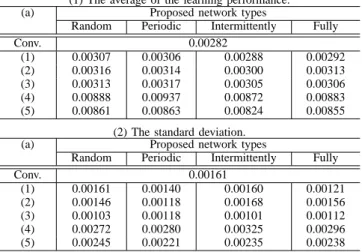
The random value of connecting weights are between − 0.5 and 0.5 at random. We show the average of the learning performance and the standard deviation in Tab. I. Moreover, we show that the conventional has 30 neurons in the hidden layer.
TABLE I
PERFORMANCE AS DIFFERENT CONNECTING WEIGHTS OF THE NEUROGENESIS.
(a) The value of the neurogenesis’s connecting weight. (1) Random values.
(2) Copy of values of the next neuron. (3) Division of values of the next neuron. (4) Constant values (positive value : 0.25). (5) Constant values
(negative value :−0.25).
(1) The average of the learning performance.
(a) Proposed network types
Random Periodic Intermittently Fully
Conv. 0.00282
(1) 0.00307 0.00306 0.00288 0.00292
(2) 0.00316 0.00314 0.00300 0.00313
(3) 0.00313 0.00317 0.00305 0.00306
(4) 0.00888 0.00937 0.00872 0.00883
(5) 0.00861 0.00863 0.00824 0.00855
(2) The standard deviation.
(a) Proposed network types
Random Periodic Intermittently Fully
Conv. 0.00161
(1) 0.00161 0.00140 0.00160 0.00121
(2) 0.00146 0.00118 0.00168 0.00156
(3) 0.00103 0.00118 0.00101 0.00112
(4) 0.00272 0.00280 0.00325 0.00296
(5) 0.00245 0.00221 0.00235 0.00238
From Table I (1), we can say that the learning performance of the constance value is the worst in all networks. Namely, we considered that the connecting weights of the neurogenesis are not good the constant values. Moreover, we considered that the other networks are similar to the random values.
From Table I (2), we can see that the copy and division of values of the next neuron are better than the random value of neurogenesis’s connecting weights. Because, we consider that the information of neurons is participated with each other neuron. Namely, we were able to obtain the good performance by the copy and division of values of the next neuron.
IV. C
ONCLUSIONSIn this study, we investigated setting method of the connect- ing weight of neurogenesis.
We researched that connecting weights of the neurogenesis changed the some values. Then, we were able to obtain the good performance of the standard deviation by copy and division of the next neuron.
R
EFERENCES[1] S. Becker, J. M. Wojtowicz, “A Model of Hippocampal Neurogenesis in Memory and Mood Disorders,” Cognitive Sciences, vol. 11, no. 2, pp. 70-76, 2007.
[2] R. A. Chambers, M. N. Potenza, R. E. Hoffman, W. Miranker, “Simulated Apoto- sis/Neurogenesis Regulates Learning and Memory Capabilities of Adaptive Neural Networks,” Neuropsychopharmacology, pp. 747-758, 2004.
[3] H. Satoi, H. Tomimoto, R. Ohtani, T. Kondo, M. Watanabe, N. Oka, I. Akiguchi, S. Furuta, Y. Hirabayashi and T. Okazaki, “Astroglial Expression of Ceramide in Alzheimer’s Disease Brains: A Role During Neuronal Apoptosis,” Neuroscience, vol. 130, pp. 657-666, 2005.
[4] Y. Yokoyama, T. Shima, C. Ikuta, Y. Uwate and Y. Nishio, “Improvement of Learn- ing Performance of Neural Network Using Neurogenesis,” Proceedings of RISP International Workshop on Nonlinear Circuits and Signal Processing (NCSP’12), pp. 365-368, Mar. 2012.
[5] Y. Yokoyama, C. Ikuta, Y. Uwate and Y. Nishio, “Performance of Multi-Layer Per- ceptron with Neurogenesis,” Proceedings of International Symposium on Nonlinear Theory and its Applications (NOLTA’12), pp.715 718, Oct. 2012.
[6] M Hasegawa, T Ikeguchi, T Matozaki and K Aihara, “An analysis on additive effects of nonlinear dynamics for combinatorial optimization,” IEICE Trans. Fundamentals, vol. E80-A, no. 1, pp. 206-213, 1997.