Propagation of Chaotic and Periodic Solutions in Ten Coupled Chaotic Circuits
with Different Parameters
Katsuya Nakabai, Katsuki Nakashima, Yoko Uwate and Yoshifumi Nishio Dept. of Electrical and Electronic Engineering, Tokushima University
2-1 Minami-Josanjima, Tokushima 770–8506, Japan Email:{nakabai,nakashima,uwate,nishio}@ee.tokushima-u.ac.jp
Abstract—In this study, we investigate the state of propagation of chaotic solution and periodic solution. The state of propagation is diversified with the types of topology. We propose the network model that ten chaotic circuits are coupled on the ladder structure. We use chaotic circuits which are coupled by resistors.
I. INTRODUCTION
In reality network, various things are connected such as:
cities, traffic and human beings are connected each other.
These connects are important factor in the modern. Inciden- tally, these things have little different characters in each even if they are the same type. In this situation, such a differentiation of characters are sometimes propagated to other things. There are some cases that this propagation affects a great deal in the network. For example, the traffic jam of the transportation net- work, the pandemic outbreak of viral infection, deterioration of human relations and so on are the bad influences. Therefore, the investigation of the propagation of these characters is important to block the effects. Then, in the circuit network, we investigate the state of similar phenomenon by propagation of chaotic solution and periodic solution. The behavior of the network affects various phenomena under some different situations.
In this study, we investigate the propagation of chaotic and periodic solution in coupled chaotic circuits. We pro- pose the network that we couple ten chaotic circuits on the ladder structure. These chaotic circuits are little difference of each other by the bifurcation parameter. In this model, five circuits generate three periodic solutions and other five circuits generate chaotic solutions. This structure is coupled by resistor, and we change the value of resistors, in other word, changing the coupling strength. We observe how chaotic and periodic solution propagate in this ladder structure by changing coupling strength.
II. SYSTEM MODEL
A. Circuit model
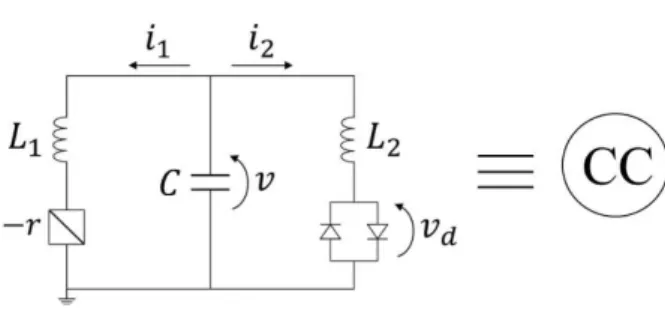
The chaotic circuit is shown in Fig. 1. This circuit consists of a negative resistor, two inductors, a capacitor and dual- directional diodes. This chaotic circuit is called Nishio-Inaba circuit.
Fig. 1. Chaotic circuit.
The circuit equations of this circuit are described as follows:
L1
di
dt =v+ri
L2
di
dt =v−vd
Cdv
dt =−i1−i2.
(1)
The characteristic of nonlinear resistance is described as follows:
vd= rd
2
(i2+ V rd
− i2−V
rd
)
. (2)
By changing the variables and parameters,
i1=
√C L1
V xn, i2=
√L1C L2
V yn, v=V zn
α=r
√C L1
, β=L1
L2
, δ=rd
√L1C L2
,
γ= 1
R, t=√ L1C2τ.
(3)
R is the resistor that couples each chaotic circuit.
The normalized circuit equations are given as follows:
- 108 -
IEEE Workshop on Nonlinear Circuit Networks December 15-16, 2017
dxi
dτ =αxi+zi
dyi
dτ =zi−f(yi) dzi
dτ =−xi−βyi−γ(zi−zi+1) (i= 1,2,· · ·, N-1).
(4)
In Eq. (4),N is the number of coupled chaotic circuits and γ is the coupling strength.f(yi)is described as follows:
f(yi) = 1 2
(yi+1 δ
− yi−1
δ )
. (5)
In Eq. (4),N is the number of coupled chaotic circuits and γ is the coupling strength.
B. System model
In our system, each chaotic circuit is coupled by one resistor R. Figure 2 shows the system model. We couple ten chaotic circuits in ladder structure. In this study, we set the parameters of the system asβ = 3.0 and δ= 470.0. The parameters α are set from 0.411 to 0.420 with step size 0.001 from CC1 to CC10. Figure 3 shows the attractors from CC1 to CC5.
We define these attractors as three periodic solutions. And Fig. 4 shows the attractor from CC6 to CC10. We define these attractors as chaotic solution.
Fig. 2. System model.
x1
z1 z2 z3 z4 z5
x2 x3 x4 x5
Fig. 3. Three periodic attractots.
x6
z6 z7 z8 z9 z10
x7 x8 x9 x10
Fig. 4. Chaotic attractors.
III. SIMULATION RESULTS
We investigate the propagation of chaotic solutions and three periodic solutions in ladder coupled chaotic circuits by changing the coupling strength. All coupling strength is changed evenly. We define that when chaotic attractors change three periodic attractors, three periodic attractors are propagated. When three periodic attractors change chaotic attractors, chaotic attractors are propagated. First, we couple the chaotic circuits from CC1 to CC10. We set the couplling strength as γ= 0.001. In this case, because coupling strength is weak, propagation have not occured.
x1
z1 z2 z3 z4 z5 x2 x3 x4 x5
x6
z6 z7 z8 z9 z10
x7 x8 x9 x10
Fig. 5. Attractors (γ= 0.001).
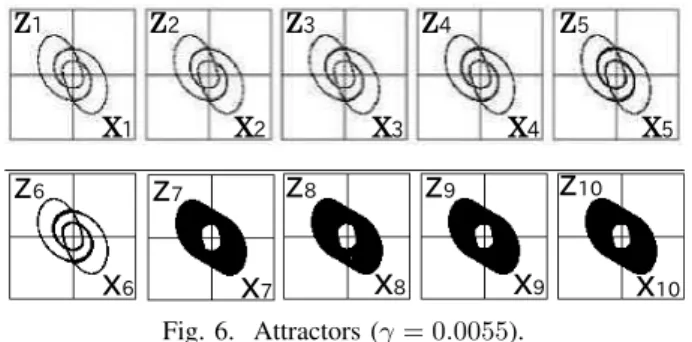
Then, we set the coupling strength asγ= 0.0055, and three periodic attractor is propagated CC6 in Fig. 6 .
x1
z1 z2 z3 z4 z5
x2 x3 x4 x5
z6
x6
z7
x7
z8
x8
z9
x9
z10
x10
Fig. 6. Attractors (γ= 0.0055).
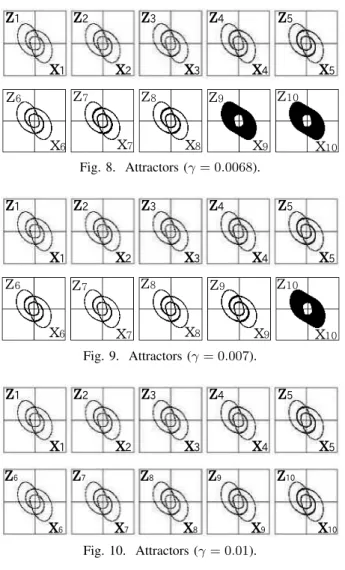
Furthermore, when we increase the coupling strength, three periodic attractors are propagated the chaotic attractors grad- ually one by one. Figure 7 shows that three periodic attracters are propagated to CC7. Figure 8 shows that three periocid attractors are propagated to CC8. Figure 9 shows that three periodic attractors are propagated to CC9. Finally, Fig. 10 shows three periodic attractors are propagated to all coupled chaotic circuits.
x1
z1 z2 z3 z4 z5
x2 x3 x4 x5
z10
x10
z9
x9
z8
x8
z7
x7
z6
x6
Fig. 7. Attractors (γ= 0.0064).
- 109 -
x1
z1 z2 z3 z4 z5
x2 x3 x4 x5
z6
x6
z7
x7
z8
x8
z9
x9
z10
x10
Fig. 8. Attractors (γ= 0.0068).
x1
z1 z2 z3 z4 z5
x2 x3 x4 x5
z6
x6
z7
x7
z10
x10
z9
x9
z8
x8
Fig. 9. Attractors (γ= 0.007).
x1
z1 z2 z3 z4 z5 x2 x3 x4 x5
x6
z6 z7 z8 z9 z10
x7 x8 x9 x10
Fig. 10. Attractors (γ= 0.01).
However, when we set the coupling strength asγ= 0.011, chaotic attractors are propagated all three periodic attractors.
Differently from the propagation of three periodic attractors, chaotic attractors propagate all three periodic attractors at once. Then, even though we increase coupling strength more over, these attractors do not change. Therefore, we obtain the result that when we set the coupling strength as more than γ= 0.011, chaotic attractors are propagated at all times.
x1
z1 z2 z3 z4 z5 x2 x3 x4 x5
x6
z6 z7 z8 z9 z10
x7 x8 x9 x10
Fig. 11. Attractors (γ= 0.011).
We investigate how the relationship between propagation of three periodic attractors and coupling strength. Figure 12 shows the graph of this result. The vertical line shows the number of three periodic attractors. The horizontal line shows the coupling strength.
Fig. 12. Relationship between the number of three periodic attractors and coupling strength .
IV. CONCLUSIONS
In this study, we have proposed the system model that ten chaotic circuits with different parameters are coupled by resisters in ladder structure. The parameters α are set from 0.411 to 0.420 with step size 0.001 from CC1 to CC10. We have investigated the propagation of chaotic solutions and periodic solutions by changing coupling strength γ. By the computer simulations, we confilm that the state of propagation of these attractors is altered when we change the coupling strength. As a result, in ladder ten coupled chaotic circuits, when we increase the coupling strength from γ = 0.0055to 0.01, three periodic attractors are propagated chaotic attractors gradually one by one. Also, when we set the coupling strength as γ = 0.011, chaotic attractors are propagated all three periodic attractors at once.
In the future works, we will develop this model to cou- ple some ladders and investigate the propagation of chaotic attractors and three periodic attractors.
REFERENCES
[1] Y. Nishio, N. Inaba, S. Mori and T. Saito, “Rigorous Analyses of Windows in a Symmetric Circui“ IEEE Transactions on Circuits and Systems, vol. 37, no. 4, pp. 473-487, Apr. 1990.
[2] R. L. V. Taylor,“Attractors: Nonstrange to Chaotic“ Society for Industrial and Applied Mathematics, Undergraduate Research Online, pp. 72-80, 21 6 2011.
[3] Y. Uwate and Y. Nishio,“Chaos Propagation in a Ring of Coupled Cir- cuits Generating Chaotic and Three-Periodic Attractor“ Proceedings of IEEE Asia Pacific Conference on Circuits and Systems (APCCAS’12), pp. 643-646, Dec. 2012.
[4] K. Ago, Y. Uwate and Y. Nishio,“Influence of Local Bridge on a Com- plex Network of Coupled Chaotic Circuit“ Proceedings of International Symposium on Nonlinear Theory and its Applications (NOLTA’14), pp.
731-734, Sep. 2014.
[5] T. Chakazawa, Y. Uwate and Y. Nishio,“Investigation of Spreading Chaotic Behavior in Coupled Chaotic Circuit Networks with Various Feature“ Proceedings of RISP International Workshop on Nonlinear Circuits, Communications and Signal Processing (NCSP’17), pp. 337- 340, Feb. 2017.
- 110 -