Cellular Neural Networks with Changing Templates for Image Processing
Shohei Gotoda, Yoko Uwate and Yoshifumi Nishio Dept. of Electrical and Electronic Engineering, Tokushima University
2-1 Minami-Josanjima, Tokushima 770–8506, Japan Email:{shohei, uwate, nishio}@ee.tokushima-u.ac.jp
Abstract—In 1998, Cellular Neural Networks (CNN) were introduced. The performance of the CNN depends on the pa- rameters called the template. If the template is influenced by the spacially and the temporally variation, CNN can perform complex processing. In this study, we propose a new method of changing templates. We apply the pseudoramdom numbers to template, the pseudoramdom numbers change template. We investigate the performance of the proposed method by some simulations.
I.
INTRODUCTION
Recently, a lot of information have been existed in the word.
In general, digital circuits are used for information processing.
However, digital circuits cannot process many information in real time. Therefore, Neural Networks were proposed. The Neural Networks was based on the human’s nervous system.
This idea has features of nonlinearity and parallel processing.
Cellular Neural Networks (CNN) are a part of ideas which are based on Neural Network. The idea of CNN was inspired from the architecture of the Neural Networks and the Cellular Automata by L.O.Chua in 1998[1]. The structure of CNN resembles the structure of animal retina. Therefore, CNN have been suitable for various image processing. The performance of CNN depends on the parameters called the template. The template has feature that is not influenced by the spatially and temporally variation. This feature causes that CNN cannot complex processing. If the template is influenced by the spacially and the temporally variation, CNN can perform complex processing.
In this study, we propose a new method of changing template of the CNN. We apply the pseudoramdom numbers to tem- plates in our method,. In order to confirm the effectiveness of the proposed method, we perform some simulations in image processing by proposed method.
II.
C
ELLULARN
EURALN
ETWORKSA basic unit circuit of CNN is called cell. The cell contains linear element and nonlinear element. CNN is formed from an array in a reticular pattern of many cells. We show a two dimensional array composed of M×N identical cells arranged in M rows and N columes.
C(1,1) C(1,2) C(1,3)
C(3,1)
C(M,1)
C(2,2) C(2,3) C(2,N)
C(2,1)
C(3,2) C(3,3)
C(1,N)
C(3,N)
C(M,N)
Fig. 1. M×N
A cell couples with only adjacent cells. Adjacent cells interact with one another. Cells which don’t couple with only adjacent cells have an indirect influence. The range which some cells have influence one cell is defined by neighborhood.
We describe state equation of cell and output equation of cell below.
State Equation : dvxij
dt = −vxij+
∑i+r k=i−r
j+r∑
l=j−r
A(i,j;k,l)vykl(t)
+
∑i+r k=i−r
j+r∑
l=j−r
B(i,j;k,l)vukl(t) +T. (1)
Output Equation: vyij(t) = 1
2(|vxij(t) + 1| − |vxij(t)−1|). (2) vx,vy andvu are state value, output value and input value.
In equation (1), A is feedback template, B is feedforward template, T is threshold. These value determine performance of CNN.
III.
PROPODED METHOD
The proposed method changes templates in pseudorandom numbers. We add pseudorandom numbersα to a template A, and add pseudorandom numbers β to a template B. Pseu- dorandom numbers are added every the number of constant processing times Tp. The templates of the proposed method
- 21 -
IEEE Workshop on Nonlinear Circuit Networks December 11-12, 2015
show Eq.(1),
The templates of proposed method :
A =
a11+α a12+α a1n+α a21+α a22+α a2n+α am1+α am2+α amn+α
B =
b11+β b12+β b1n+β b21+β b22+β b2n+β bm1+β bm2+β bmn+β
(3)
In this study, we add pseudorandom numbers to edge detection template. The parameters of pseudorandom numbers are fixed withα = -0.9∼0,β = -0.01∼0.
IV.
SIMULATION RESULTS
In this section, we show simulation results of the edge detection by using our proposed method. Using templates of the edge detection is described as follows.
Edge detection template:
A =
0 0 0 0 1 0 0 0 0
,
B =
−1 −1 −1
−1 8 −1
−1 −1 −1
, T =−1. (4)
Edge detection template of the proposed method:
A =
0 0 0 0 1 +α 0
0 0 0
,
B =
−1 +β −1 +β −1 +β
−1 +β 8 +β −1 +β
−1 +β −1 +β −1 +β
, T =−1.(5)
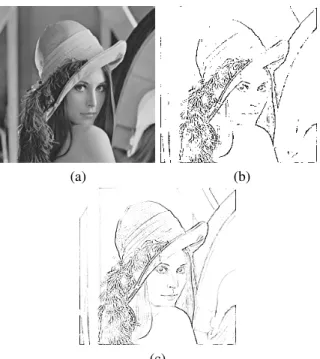
(a) (b)
(c)
Fig. 2. Simulation results. (a) Input image. (b) Simulation result of the conventional CNN. (c)Simulation result of the proposed method (α= -0.9
∼0 ,β= -0.01∼0,Tp= 5 ).
Figure 1(a) is an input image. The input image has indistinct portions. Indistinct portions are the pillar of the left-side and an outline of a woman’s face. Figure 1(b) shows the simulation result of the conventional CNN. The conventional CNN can not detect edge lines of indistinct portions. Figure 1(c) shows the simulation result of the proposed method. In Fig. 1(c), the proposed method can detect edge lines of indistinct portions.
(a) (b)
(c)
Fig. 3. Simulation results. (a) Input image. (b) Simulation result of the conventional CNN. (c)Simulation result of the proposed method (α= -0.9
∼0 ,β= -0.01∼0,Tp= 5 ).
- 22 -
Figure 1(a) is an input image. The input image has indistinct portion. Indistinct portion is the building in the right part of the image. Figure 1(b) shows the simulation result of the conventional CNN. The conventional method of CNN can not detect edge lines of indistinct portion. Figure 1(c) shows the simulation result of the proposed method. In Fig. 1(c), the proposed method can detect edge lines of indistinct portion.
Moreover, our method can detect a hand of a man.
V.
C
ONCLUSIONIn this study, we propose the new method of changing templates. We apply the pseudoramdom numbers to templates in our method. In order to confirm the effectiveness of the proposed method, we investigate the proposed method in image processing. In this case, we perform edge detection.
As a result, proposed method can detect more edge lines of indistinct portions than conventional method. Hence, the proposed method is more effective than the conventional CNN in image processing.
REFERENCES
[1] L. O. Chua and L. Yang, “Cellular Neural Networks: Theory,” IEEE Trans. Circuits Syst., vol. 35, pp. 1257-1272, Oct. 1988.
[2] Martin H 辰 nggi and George S Moschytz, “Cellular Neural Net- works Analysis, Design and Optimization.“ Kluwer Academic Publish- ers.