Synchronization Phenomena in Coupled Nonlinear Oscillators Chains with Hourglass Structure
Takumi Nara, Daiki Nariai, Yoko Uwate and Yoshifumi Nishio Dept. Electrical and Electronic Engineering,
Tokushima University
2-1 Minami-Josanjima, Tokushima 7708506, Japan Email: { nara, nariai, uwate, nishio } @ee.tokushima-u.ac.jp
Abstract—In this study, we investigate synchronization phe-
nomena from circuit network, which is composed of several numbers of van der Pol oscillator chains. We use van der Pol oscillators which are coupled by resistors. We investigate how synchronization phenomena changes by changing the number of van der Pol oscillators. From the computer simulations, we observe relatively interesting synchronization phenomena.
I. I
NTRODUCTIONSynchronization phenomena are the most familiar phenom- ena that exist in nature and it has been studied in various fields, such as in electrical, in mechanics, in biological systems, ba- sically everywhere. Synchronization phenomena are observed everywhere in our life. For example, we can confirm flashing firefly lights, metronome, periodic swinging of candle flames, gate patterns of four-leg animals, beating rhythm of the heart and so on. Among them, van der Pol oscillators can observe phenomena similar to natural phenomena. Therefore we have been interested in coupled oscillators which synchronization phenomena from circuit network.
In this study, we investigate synchronization phenomena from a circuit network, which is composed of several numbers of van der Pol oscillator chains. The circuit model of van der Pol oscillator is shown in Fig. 1. This circuit consists of an inductor, a capacitor and a nonlinear resistance. From the computer simulations, we observe relatively interesting synchronization phenomena. We focus on synchronization phenomena in the coupled nonlinear circuits.
C L
Fig. 1. Circuit of van der Pol.
II. P
REVIOUS STUDYFigure 2 shows the previous study circuit model. Bottom, middle and top are coupled with oscillators by resistors r.
Bottom several numbers of oscillator are coupled by resistors R
i. Further, top several numbers of oscillator are coupled to ground via resistors R
athrough inductors. Middle oscillators
are not coupled with oscillators located in the horizontal di- rection but coupled vertically. In this network, we coupled the oscillators of bottom several numbers of oscillator in the chains to tend to produce in-phase synchronizations. Further, we coupled the oscillators of the top several numbers of oscillator in the chains to tend to produce anti-phase synchronizations.
Middle oscillators are coupled with bottom and top several numbers of oscillator. However, they are not coupled with the other chains.[1]
We define the bottom several numbers of oscillator as Osc
11, Osc
12, and Osc
1mfrom the left. Further the middle several numbers of oscillator as Osc
21, Osc
22, and Osc
2mfrom the left and the top several numbers of oscillator as Osc
31, Osc
32, and Osc
3mfrom the left.
C L
ig12
vC12
iL12
C L
ig11
vC11
iL11
C L
ig13
vC13
iL13
C L C L C L
ig22
vC22
iL22
ig31
vC31 C
ig32
vC32 C
ig33
vC33 C
Ra Ra
Ri Ri
i31b i31a i32b i32a i33b i33a r r
2L 2L 2L 2L 2L 2L
ig21
vC21
iL21 ig23
vC23
iL23
r r r
r
Fig. 2. Previous study system model.
First, we assume that the v − i characteristics of the non- linear resistor in each oscillator are given by the follows:
i
gn= − g
1v
n+ g
3v
n3(1) where g
1, g
3> 0.
- 83 -
IEEE Workshop on Nonlinear Circuit Networks December 7-8, 2018
III. S
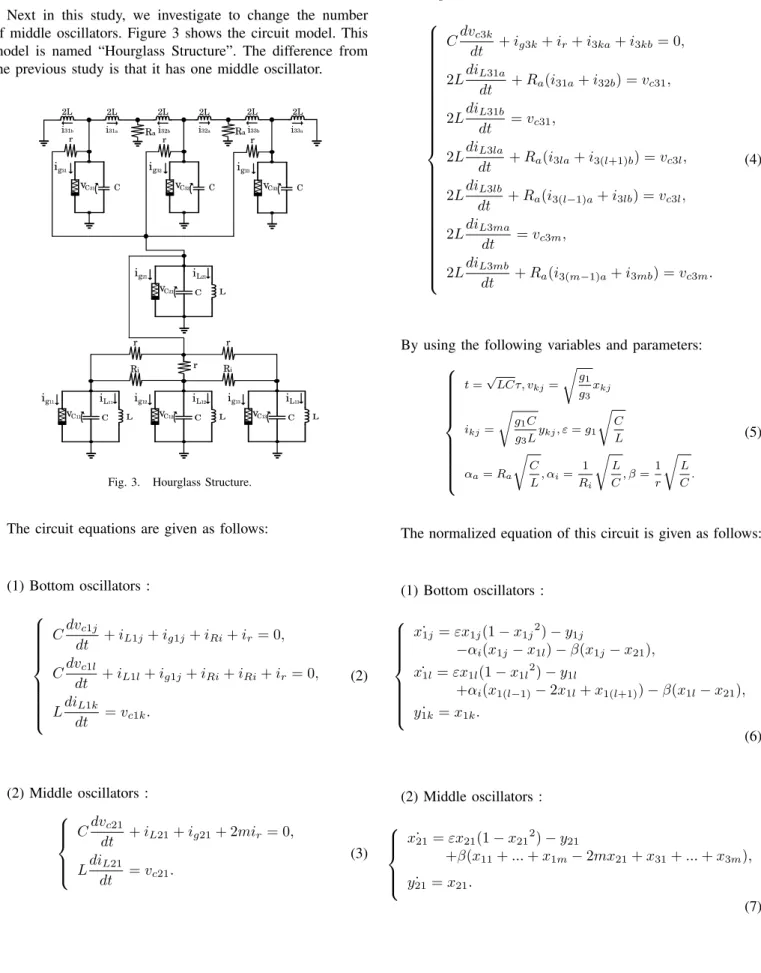
YSTEM MODELNext in this study, we investigate to change the number of middle oscillators. Figure 3 shows the circuit model. This model is named “Hourglass Structure”. The difference from the previous study is that it has one middle oscillator.
C L
ig12
vC12
iL12
C L
ig11
vC11
iL11
C L
ig13
vC13
iL13
C L
ig21
vC21
iL21
ig31
vC31 C
ig32
vC32 C
ig33
vC33 C
Ra Ra
Ri Ri
i31b i31a i32b i32a i33b i33a r
r
2L 2L 2L 2L 2L 2L
r r
r r
Fig. 3. Hourglass Structure.
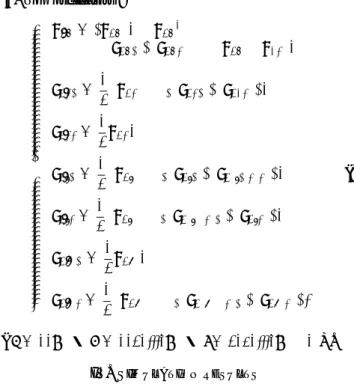
The circuit equations are given as follows:
(1) Bottom oscillators :
C dv
c1jdt + i
L1j+ i
g1j+ i
Ri+ i
r= 0, C dv
c1ldt + i
L1l+ i
g1j+ i
Ri+ i
Ri+ i
r= 0, L di
L1kdt = v
c1k.
(2)
(2) Middle oscillators :
C dv
c21dt + i
L21+ i
g21+ 2mi
r= 0, L di
L21dt = v
c21.
(3)
(3) Top oscillators :
C dv
c3kdt + i
g3k+ i
r+ i
3ka+ i
3kb= 0, 2L di
L31adt + R
a(i
31a+ i
32b) = v
c31, 2L di
L31bdt = v
c31, 2L di
L3ladt + R
a(i
3la+ i
3(l+1)b) = v
c3l, 2L di
L3lbdt + R
a(i
3(l−1)a+ i
3lb) = v
c3l, 2L di
L3madt = v
c3m, 2L di
L3mbdt + R
a(i
3(m−1)a+ i
3mb) = v
c3m. (4)
By using the following variables and parameters:
t=√
LCτ, vkj=
√
g1g3
xkj
ikj=
√
g1C
g3Lykj, ε=g1
√
C L αa=Ra
√
C L, αi= 1
Ri
√
L C, β= 1
r
√
L C.
(5)
The normalized equation of this circuit is given as follows:
(1) Bottom oscillators :
˙
x
1j= εx
1j(1 − x
1j2) − y
1j− α
i(x
1j− x
1l) − β(x
1j− x
21),
˙
x
1l= εx
1l(1 − x
1l2) − y
1l+α
i(x
1(l−1)− 2x
1l+ x
1(l+1)) − β(x
1l− x
21),
˙
y
1k= x
1k.
(6)
(2) Middle oscillators :
˙
x
21= εx
21(1 − x
212) − y
21+β(x
11+ ... + x
1m− 2mx
21+ x
31+ ... + x
3m),
˙
y
21= x
21.
(7)
- 84 -
(3) Top oscillators :
˙
x
3k= εx
3k(1 − x
3k2)
− (y
3ka+ y
3kb) − β(x
3k− x
21),
˙ y
31a= 1
2 { x
31− α
a(y
31a+ y
32b) } ,
˙ y
31b= 1
2 x
31,
˙ y
3la= 1
2 { x
3l− α
a(y
3la+ y
3(l+1)b) } ,
˙ y
3lb= 1
2 { x
3l− α
a(y
3(l−1)a+ y
3lb) } ,
˙ y
3ma= 1
2 x
3m,
˙ y
3mb= 1
2 { x
3m− α
a(y
3(m−1)a+ y
3mb) } .
(8)
( j = 1, m ・ k = 1, 2, ..., m ・ l = 2, 3, ..., m − 1 ) . IV. S
IMULATION RESULTS(A) Case of previous study
Figures 4 and 5 show the computer simulation results for the case of the previous study model. The circuit parameters are chosen as ε = 0.10, α
a= α
i= 0.50 and β = 0.02.
The bottom three oscillators are become in-phase synchro- nization and the top three oscillators are become anti-phase synchronization.
x11 x11 x11 x11
x11 x11
x11 x11 x11
x11 x21
x31
x12 x13 x23 x33
x22 x32
Fig. 4. Computer simulation results (phase shift) for previous study.
x11 x12
x33 x13 x21 x22 x23
x31 x32
→τ
Fig. 5. Computer simulation results (time waveforms) for previous study.
(B) Case of hourglass structure (m = 3)
Figures 6 and 7 show the computer simulation results for the case of hourglass structure. The circuit parameters are chosen at the same.
In comparison with (A), the phase shift with Osc
11is approaching in-phase synchronization or anti-phase synchro- nization.
x
11x
11x
11x
11x
11x
11x
11x
11x
12x
13x
21x
33x
32x
31Fig. 6. Computer simulation results (phase shift) for hourglass structure (m= 3).
x11
x12
x31 x21 x13
x32
x33
→τ
Fig. 7. Computer simulation results (time waveforms) for hourglass structure (m= 3).
(C) Case of hourglass structure (m = 4)
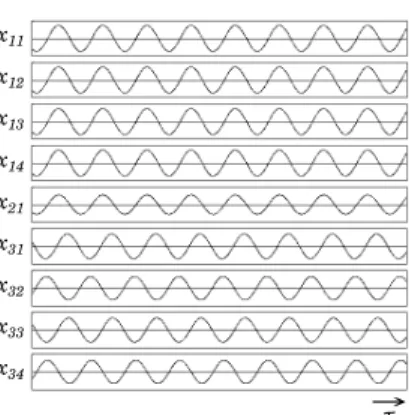
Figures 8 and 9 show the computer simulation results for the case of hourglass structure. The circuit parameters are chosen at the same.
In comparison with (B), we increase one oscillator to the top and bottom. As (A) and (B), the bottom oscillators are in-phase synchronization and the top oscillators are anti-phase synchronization. However, in comparison with (B), the top oscillators are not in-phase synchronization and anti-phase synchronization with Osc
11.
x11 x11 x11 x11 x11
x11 x11 x11 x11
x11 x12 x13 x14 x21
x31 x32 x33 x34
Fig. 8. Computer simulation results (phase shift) for hourglass structure (m= 4).
- 85 -
x11
x12
x13
x14
x21
x31
x32
x33
x34
→τ
Fig. 9. Computer simulation results (time waveforms) for hourglass structure (m= 4).
From Figs. 6 and 8 there is the difference in the synchroniza- tion phenomena of the top oscillators. The top oscillators of all results are anti-phase synchronization. However, looking at the result of phase shift with Osc
11, when the value of m is an odd number, the phase shift with Osc
11is approaching the in-phase synchronization or anti-phase synchronization, and when the value of m is an even number, the different synchronization was observed in Osc
11and top oscillators.
V. C
ONCLUSIONSIn this study, we have investigated synchronization phe- nomena observed by circuit networks, which are composed of several numbers of van der Pol oscillator chains. By the computer simulations, we could obtain of results that the bottom oscillators observe in-phase synchronization and the top oscillators observe anti-phase synchronization. Further, we could observe synchronization phenomena by changing with the value of m .
In the future works, we will investigate synchronization phenomena using other parameters. Further, when the value of m is an odd number or an even number, the synchronization phenomena occur in the Osc
21of the middle oscillator and guess some cause. Therefore, we investigate this case in detail. Further, in this study, we have investigated oscillators connected symmetrically to left and right, but we would like to investigate circuit models that are connected asymmetrically to left and right by increasing the number of oscillators in the middle.
R
EFERENCES[1] K. Matsumura, T. Nagai, Y. wate and Y. Nishio, “Analysis of Synchro- nization Phenomenon in Coupled Oscillator Chains,” Proceedings of IEEE International Symposium on Circuits and Systems (ISCAS’12), pp.620- 623, May 2012.
[2] D. Nariai,M. Tran, Y. Uwate and Y. Nishio, “Synchronization in Two Rings of Coupled Three van der Pol Oscillators,” Proceedings of RISP International Workshop on Nonlinear Circuits, Communications and Signal Processing (NCSP’17), pp.289-292, FEb.2017.
[3] V. Hien,M. Tran, Y. Uwate, Y. Nishio, “Effect of Changing Coupling Strength to Synchronization Phenomena in Coupled van der Pol Oscilla- tors,” Proceedings of RISP International Workshop on Nonlinear Circuits, Communications and Signal Processing (NCSP’18), pp. 148-151, Mar.
2018.
[4] T. Matsunashi, D. Nariai, Y. Uwate and Y. Nishio, “Synchronization Phenomena in a Ring of van der Pol Oscillators Coupled by Time-Varying Resistor,” Proceedings of RISP International Workshop on Nonlinear Circuits, Communications and Signal Processing (NCSP’18), pp. 168- 171, Mar. 2018.