Spectrophotometric Determination of Cobalt (II) after Separation by Coprecipitation of its APDC Complex with Microcrystalline
Naphthalene
journal or
publication title
福井大学工学部研究報告
volume 27
number 2
page range 261‑269
year 1979‑09
URL http://hdl.handle.net/10098/4426
MEMOIRS OF THE FACULTY OF ENGINEERING FUKUI UNIVERSITY
VOL.27 No. 2' 1979
Spectrophotometric Determination of Cobalt(II) after Separation by Coprecipitation of its APDC Complex with Microcrystalline Naphthalene
*
Masatada SATAKE and Nobusute YOSHIDA (Received Jul. 31, 1979)
A new reliable method for the spectrophotometric determination of cobalt after coprecipitation of its complex with microcrystalline naphthalene is described. It is based on the formation of the cobalt complex, the coprecipitation of the complex with micro- crystalline naphthalene, drying of the naphthalene mixture in a dryer, dissolution of the naphthalene mixture in dimethylformamide and the determination of cobalt by absorbance measurement at 390 nm. The complex is relativey stable. Its absorption obeys Beer's law over the range 4-68 pg cobalt in 10 ml of dimethyl- formamide. The molar absorptivity is estimated to be 8.69 x 10³ l'mol-l'cm-l , the sensitivity being 0.00678
~g
of cobalt for the absorbance of 0.001. The other factors such as pH, amounts of reagent and naphthalene, digestion time,standing time and diverse ions are studied. The present procedure has been successfully applied to the analysis of cobalt with APDC.1 Introduction
261
Recently Ammonium Pyrrolidinedithiocarbarnate(APDC) has been widely used for the atomic absorption spectrophotometric determi- nation of various metals by using liquid-liquid extraction method.
We have developed a new method for the spectrophotometric determi- nation of trace amounts of metals using microcrystalline naphtha- lene as an organic coprecipitant, as well as chloroform or methyl isobutyl ketone extraction method. In the present study, a APDC was chosen as a complexing reagent for the determination of cobalt.
*
Division of Applied ScienceThis new spectrophotometric method for the determination of trace amounts of cobalt is reported.
2 Experimental method 2.1 Reagents
Standard cobalt solution, 5 ppm. Prepared by diluting 5 ml of standard cobalt solution(lOOO ppm, Wako Pure Chemicals, Osaka, Japan) to 1000 ml with water.
APDC solution, 0.2%.
100 ml of water.
Prepared by dissolving 0.2 g of APDC in Buffer solutions were prepared by mixing 1M acetic acid and 1M ammonium acetate solution for pH 3-6, or 1M aqueous ammonia and 1M ammonium acetate solution for pH 8-11.
All other chemicals used were of analytical-reagent grade.
2.2 Apparatus
A Hitachi double beam spectrophotometer, Model 200-20, with 10 rom glass cells, was used for the absorbance measurements.
A Toa-Dempa, pH meter, Model HM-5A, equipped with glass and calomel electrodes was used for the pH measurements.
A Tabai, Model K-2 dryer(Tabai Mfg. Co. Ltd. Japan) was used for drying of the microcrystalline naphthalene.
2.3 General procedure
To about 45 ml of a series of sample solution containing 1-7 ml of 10 ppm standard cobalt solution, in a tightly stoppered Erlenmeyer flask, add 1.5 ml of 0.2% APDC solution and 2.0 ml of the acetate buffer solution(pH 4.5). Mix the solution well, and let stand i t to digest for 15 min. Add 2.5 ml of 20% naphthalene solution and shake it vigorously for 1 min. Collect the naphthalene mixture on a filter paper(e.g., No 5c, Toyo Roshi Co.) placed flat on a filte plate in a funnel or glass filter (No 2 or 3) . Wash with water and dry in a dryer when necessary. Then dissolve i t in dimethylformamide and dilute to 10 mI. Measure the absorbance of the solution in a 10 rom glass cell against the reagent blank prepared similarly.
the amount of cobalt from a calibration curve.
3 Results and discussion 3.1 Absorption spectra
Calculate
Sample solution containing 40 pg of cobalt, 1.5 ml of 0.2% APDC solution and 2.0 ml of the acetate buffer solution(pH 4.5) was pre-
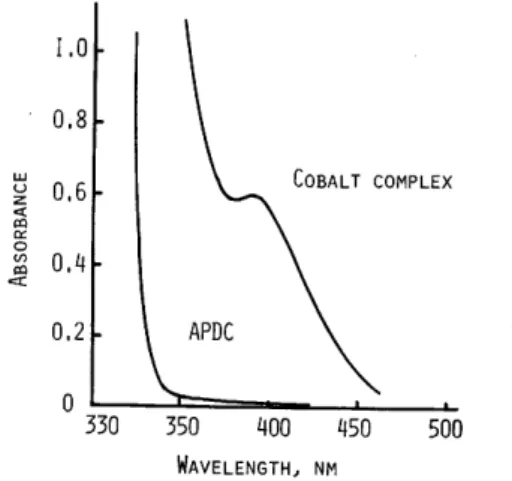
pared according to the general procedure, and the complex formed was coprecipitated with microcrystalJ.ine naphthalene by vigorous shaking for 1 min. The mixture of the complex and naphthalene was dissolved in dimethylformamide, and the absorbance of the solution was measured at the wavelengths between 320 and 450 nm against water. Figure 1 shows the absorption spectra of the reagent blank and the cobalt complex in naphthalene-dimethyl- formamide solution. The curve of the complex has one peak at 390 nm. At this wavelength, the absorption due to the reagent blank was negligible in the comparison with that of the complex.
Therefore, 390 nm was chosen as the most suitable wavelength.
3.2 Effect of pH
~3
The relationship between the absorbance and the pH of the so- lution after coprecipitation was investigated in the pH range up to 10.0 and l-2N hydrochloric acid solution. The result is shown in Fig.2. From the experimental data, the absorbance of the complex increased sharply with increasing pH , reached the maxi- mum and constant over the range 1.5-6.5, and decreased sharply above this pH. Therefore, the pH of the solution was adjusted to 4.5 for the absorbance measurements.
u w COBALT COMPLEX
z ~
~
~
0 ~
0.4
~
~
0.2
0 330 350 400 450 500
WAVELENGTH, NM
FIG. I ABSORPTION SPECTRA OF REAGENT AND COBALT COMPLEX IN NAPHTHALENE-DMF SOLUTION
COBALT: 40 PG ; pH : 4.5 ; 0.2% APDC : 1.5 ML ;
20% NAPHTHALENE: 2.5 ML ; SHAKING TIME: I MIN;
REFERENCE : WATER
w u z
~ ~
~ 0
~
~
~
0.6 0.4 0.2
o
2 2 I HCL, NFIG. 2 EFFECT OF pH 4 6
pH
8 10
COBALT : 40 ~G ; WAVELENGTH : 379 NM ;
0.2% APDC : 1.0 ML ; 20% NAPHTHALENE
2.5 ML ; SHAKING TIME : I MIN REFERENCE : REAGENT BLANK
3.3 Effect of APDC concentration
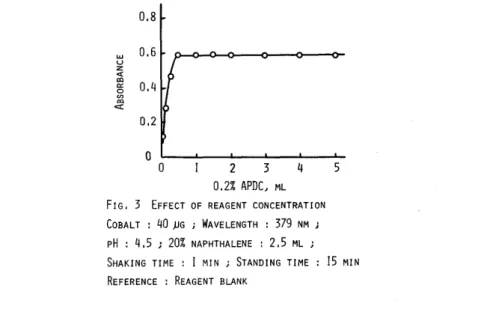
Various amounts of APDC were added to the solution containing 40 ~g of cobalt and 2.0 ml of the buffer solution(pH 4.5), and the effect of variation in the APDC concentration on the absorbance of the complex has been studied. The result is shown in Fig.3. It indicates that 0.5-5.0 ml of 0.2% APDC solution are quite appropri- ate for the quantitative collection of the complex.
0.8
LLI 0.6
u z oct
I:Q 0.4
e:::
~ <Q
cc 0.2
0 0 2 3 4
0.2% APDC ML FIG. 3 EFFECT OF REAGENT CONCENTRATION COBALT : 40 ~G ; WAVELENGTH : 379 NM J
pH : 4.S ; 20% NAPHTHALENE : 2.S ML ; S
SHAKING TIME : I MIN; STANDING TIME IS MIN REFERENCE : REAGENT BLANK
3.4 Effect of buffer solution and digestion time
Varying volume of the buffer solution(pH 4.5) were added to the solution containing 40 pg of cobalt and 1.5 ml of 0.2% APDC solution, and the collection of the complex was carried out according to the general procedure. The addition of 0.5-5.0 ml of the buffer so- lution gave essentially the same absorbance.
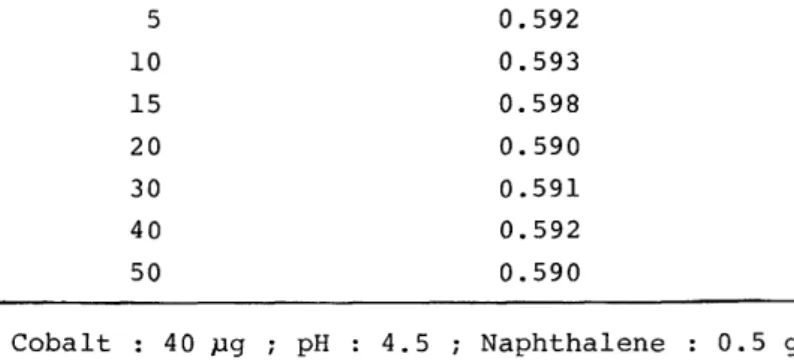
The cobalt complex in the solution containing 40 pg of cobalt was digested at room temperature, and the effect of digestion time on the absorbance was studied. From the experimental result, the digestion for about 5 -50 min had no effect on the absorbance of the complex. Thr result is shown in Table 1.
Table 1 Effect of digestion time Digestion time
min 1 2
Absorbance 390 nm 0.500 0.550
265
5 0.592
10 0.593
15 0.598
20 0.590
30 0.591
40 0.592
50 0.590
Cobalt : 40 pg ; pH : 4.5 Naphthalene 0.5 g 3.5 Effect of naphthalene concentration
The cobalt complex was coprecipitated from the solution with 0-5.0 ml of 20% naphthalene solution under optimum conditions and the effect of the addition of naphthalene on the absorbance was tested. The result is shown in Table 2. The absorbance of the complex increased with increasing amount of naphthalene up to 0.5 ml of 20% solution and became constant over the region of 0.5-5.0 mI. Therefore, 2.5 ml of 20% naphthalene solution were taken as most suitable amount.
Table 2 Effect of naphthalene concentration 20% naphthalene
ml o 0.2 0.5 1.0 1.5 2.0 3.0 4.0 5.0
Cobalt : 40 pg ; pH 3.6 Effect of shaking time
4.5
Absorbance 390 nm 0.530 0.565 0.590 0.598 0.605 0.585 0.586 0.592 0.591
2.5 ml of 20% naphthalene solution were added to the solution containing the cobalt complex , and the coprecipitation of the complex with microcrystalline naphthalene was performed according to the general procedure. Table 3 shows the effect of shaking time on the absorbance. No change was seen in the degree of co-
precipitation of the complex when shaking time was varied from 30 -150 seconds. Therefore, 60 seconds were selected as shaking time for the absorbance measurements.
Table 3 Effect of shaking time Shaking time Absorbance
seconds 390 nm
0 0.530
15 0.562
30 0.592
45 0.590
60 0.589
90 0.592
120 0.597
150 0.595
Cobalt: 40 pg i pH : 4.5 i Naphthalene 0.5 9 3.7 Effect of volume of aqueous phase
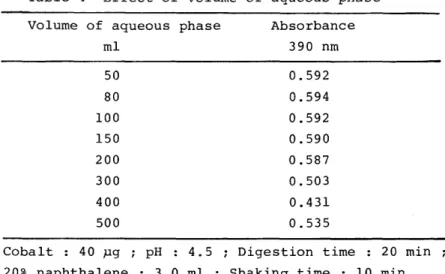
The volume of aqueous phase containing 40 pg of cobalt, 2.0 ml of the buffer solution(pH 4.5) and 3.0 ml of 0.2% APDC solution was varied from 50 to 500 ml, and the coprecipitation of the complex was carried out according to the general procedure. Table 4 shows the effect of volume of aqueous phase on the absorbance. The ab- sorbance was almost constant in the range 50-200 ml, but decreased gradually with increasing volume of aqueous phase.
Table 4 Effect of volume of aqueous phase Volume of aqueous phase Absorbance
ml 390 nm
50 0.592
80 0.594
100 0.592
150 0.590
200 0.587
300 0.503
400 0.431
500 0.535
Cobalt: 40 pg i pH : 4.5 ; Digestion time 20 min 20% naphthalene: 3.0 ml i Shaking time: 10 min
267 3.8 Effect of standing time
The mixture of the complex and naphthalene was dissolved in dimethylformamide, and the effect of standing time on the absorbance was investigated between 5 and 180 min. The result is shown in Table 5. The color of the complex in dimethylformamide solution was very stable
Table 5 Effect of standing time Standing time Absorbance
-min 390 nm
5 0.592
10 0.591
20 0.588
30 0.587
40 0.582
60 0.578
90 0.576
120 0.574
150 0.572
180 0.570
Cobalt : 40 )..1g ; pH : 4.5 Naphthalene 2.5 9 3.9 Calibration curve
The cobalt complex in naphthalene-dimethylformamide solution obeyed Beer's law over the range 4-68 pg cobalt. The molar ab- sorptivity was 8.69 x 10³ l.mol-l.cm-l~ the sensitivity being 0.00678 pg of cobalt for the absorbance of 0.001. Ten sample so- lutions containing 40 pg of cobalt, prepared by the general pro- cedure, gave a mean absorbance of 0.592 with a standard deviation of 6.9 x 10⁻³
or a relative standard deviation of 1.17%.
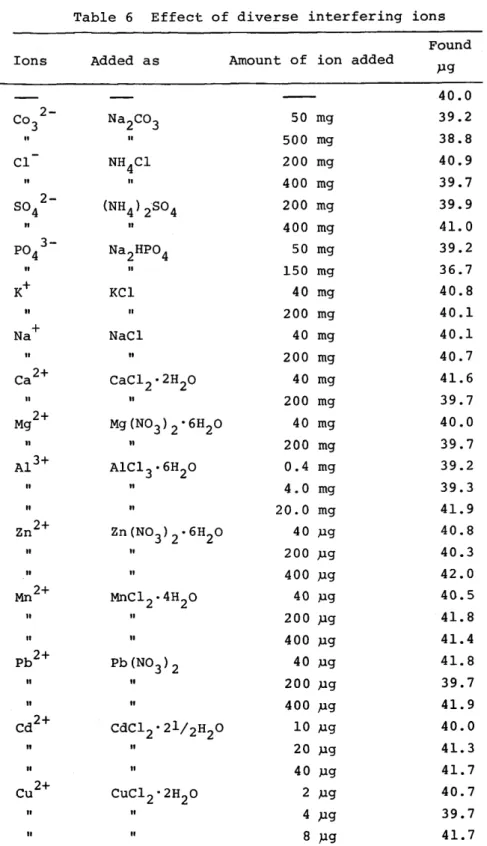
3.10 Effect of diverse ions
Possible interferences were looked for by taking 40 )..1g of cobalt through the general procedure in the presence of various amounts of alkali metal salts and metal ions. Some of the results are given in Table 6. The following species interfered: Al3+(20 mg), Zn2+(400 ).1g), Pb2
+ (400 )..1g), Fe3+ (4 ).1g), Ni 2+ (4 )1g), P0
4 3- (150 mg).
Ions
"
C1
"
SO 2- 4
"
PO 3- 4
"
"
"
"
11
"
"
"
"
Mn2+
"
"
"
"
"
"
"
"
Table 6 Effect of diverse interfering ions Added as
"
"
"
"
KC1
"
NaC1
"
"
"
"
"
"
"
"
"
"
"
"
"
"
Amount of ion added
50 rng 500 rng 200 rng 400 rng 200 rng 400 rng 50 rng 150 rng 40 rng 200 rng 40 rng 200 rng 40 rng 200 rng 40 rng 200 rng 0.4 rng 4.0 rng 20.0 rng 40 p.g 200 ).1g 400 ).1g 40 }J.g 200 ).1g 400 }J.g 40 }J.g 200 ).1g 400 ).1g 10 ,ug 20 }J.g 40 pg
2 ).1g 4 ).1g 8 }lg
Found
].1g
40.0 39.2 38.8 40.9 39.7 39.9 41.0 39.2 36.7 40.8 40.1 40.1 40.7 41.6 39.7 40.0 39.7 39.2 39.3 41.9 40.8 40.3 42.0 40.5 41.8 41.4 41.8 39.7 41.9 40.0 41.3 41.7 40.7 39.7 41.7
269
Fe 3+ FeC1
3·6H2O 0.5 pg 41.1
" "
2.0 ].lg 39.5" "
4.0 ].lg 44.2Ni 2+ NiC1 2·6H
2O 0.5 pg 39.7
" "
2.0 }lg 41.3" "
4.0 pg 45.0Co 40 ,ug pH 4.5 Naphthalene : 2.5 9