Spectrophotometric Determination of Magnesium after Separation by Adsorption of its Oxinate on Microcrystalline Naphthalene
journal or
publication title
福井大学工学部研究報告
volume 27
number 2
page range 279‑286
year 1979‑09
URL http://hdl.handle.net/10098/4428
FUKUI UNIVERSITY
VO L. 27 No. 2 1979
Spectrophotometric Determination of Magnesium after Separation by Adsorption of its Oxinate on
Microcrystalline Naphthalene
Masatada SATAKE, Tsutomu SUZUKI and Nobusute YOSHIDA
*
(Received Jul. 31, 1979)
A procedure is presented for the spectrophotometric determination of magnesium af,ter separation by adsorption of magnesium oxinate on microcrystalline naphthalene. A water-insoluble oxine chelate pro- duced with magnesium is quantitatively adsorbed from aqueous solution with microcrystalline naphthalene. This chelate has an absorption maximum at 382 nm. The optimum pH range for the adsorption is 8.6- 10.8. The molar absorptivity is 4.1 x 10³
l.mol-l·cm-l
. the sensiti- vity being 5.9 K 10-3
pg per cm2
for the absorbance of 0.001. Ten determinations of the sample solution containing 30 pg of magnesium, prepared by the general procedure, gave a mean absorbance of 0.506 with a relative standard deviation of 2.5%.
200 min.
1 Introduction
This chelate is very stable for
Since 1930, oxine(8-hydroxyquinoline, 8-quinolinol) has received a great deal of attention as a precipitation and colorimetric reagent for various metal ions. Recently this reagent has been used for the spec- trophotometric determination of aluminium, iron(III) , copper(II) , lead, nickel, etc. by extracting their oxinates from aqueous solution into organic solvents such as benzene or chloroform. Among these metal oxinates formed with various meta ions, the oxinate of zinc, magnesium and cadmium can not be extracted into organic solvents described above, because of low solubility of the oxinate in organic solvents.
We have already developed a new method involving the adsorption of the chelates on microcrystalline naphthalene. By this method, the oxinates of zinc, magnesium and cadmium were easily adsorbed from aqueous solution, and the trace amounts of these metals were determined spectro- photometrically. In the present paper, magnesium was chosen as a metal
*
Division of Applied Science280
to be determined.
2 Experimental method 2.1 Apparatus
A Hitachi Model 200-20 double beam spectrophotometer was used for the absorbance measurements with 10 mm glass cells.
The pH measurements were made with Toa-Dempa pH meter, Model HM-5A, equipped with combined calomel and glass electrodes.
The naphthalene was dried with a Tabai Model K-2 dryer (Tabai Mfg.
Co. Ltd., Japan).
2.2 Reagents
Standard magnesium solution(5 ppm) was prepared by diluting 5 ml of standard magnesium solution(lOOO ppm, Wako Pure Chemical Industries, Ltd.
Osaka, Japan) to 1000 ml with water.
Oxine solution(l% w/v) was prepared by dissolving 1.0 g of oxine in 2 ml of glacial acetic acid on a water bath and diluting to 100 ml with hot water ..
The water used was deionized water.
Buffer solutions were by mixing 1M acetic acid and 1M ammonium acetate solution for pH 3-6, or 1M aqueous ammonia and 1M ammonium acetaet solution for pH 8-11.
All reagents were of analytical-reagent grade.
2.3 General procedure
To about 45 ml of sample solution containing 1-7 mo of 10 ppm standard magnesium solution in a 100-~1 tightly stoppered Erlenmeyer flask, add 2.0 ml of 1% oxine solution and 2.0 ml of the buffer solution, and then adjust the pH of the solution to 10.0. Mix the solution well and digest for 10 min 40-50 °C. Add 2.0 ml of 20% naphthalene so- lution and shake it vigorously for 1 min. Filter off on a filter paper
( e.g., Toyo Roshi Co., No 5C) placed flat on a disc-shaped filter plate in a funnel by aspiration. After washing i t on a filter paper with water, dry in a dryer at 50-60°C when necessary. Then dissolve in dimethylformamide and dilute to 10 mI. Measure the absorbance of the solution in a glass cell at 382 nm against the reagent blank prepared similarly.
3 Results and discussion 3.1 Absorption spectra
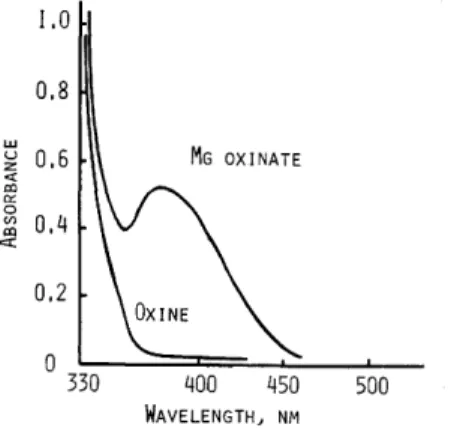
The absorption spectra of oxine and magnesium oxinate in naphtha- lene-dimethylformamide solution, measured against water, are shown in
Fig. 1. The absorbance curve of the oxinate shows a peak at 382 nm.
The reagent blank shows strong absorption below 370 nm. Beyond this wavelength, there is practically a negligible absorption due to the re- agent blank. Therefore, All the absorbance measurements were performed at 382 nm .
3.2 Effect of pH
The relationship of the absorbance and the pH of aqueous solution containing 30 pg of magnesium was investigated in the pH range 7.8-11.8, and the result is shown in Fig. 2. The absorbance curve shows that the adsorption starts from pH 7.8, increases sharply, gives a definite and maximum value over the pH region of 8.6-10.8, and again decreases rapidly beyond pH 10.8. Therefore, the pH region of 8.6-10.8 is suitable for quantitative adsorption of the zinc oxinate. In this experiments, the absorbance was measured at pH 10.0.
1.0
0.8
w
MG OXINATE
u 0.6 z <t co oc 0 (I)
co 0.4 c:c
0.2
400 450 500 WAVELENGTH} NM
FIG. I ABSORPTION SPECTRA OF OXINE AND MAGNESIUM COMPLEX IN NAPHTHALENE-DMF SOLUTION MG: 30).JG; pH: 10.0 i 1% OXINE: 2.0 ML i 20% NAPHTHALENE: 2.0 ML
REFERENCE: WATER; (I) OXINE } (2) CHELATE
0.8
w 0.6 u z
<t aJ
0:: 0.4
g
<C Cil
Q.2
0 7 8 9 IO II 12
pH
FIG. 2 EFFECT OF pH
MG : 30 ~G i WAVELENGTH : 382 NM ; 1% OXINE : 2.0 ML i DIGESTION TIME(40-50 'C) : 10 MIN i SHAKING TIME : I MIN i STANDING TIME : 15 MIN REFERENCE : REAGENT BLANK
3.3 Effect of oxine concentration
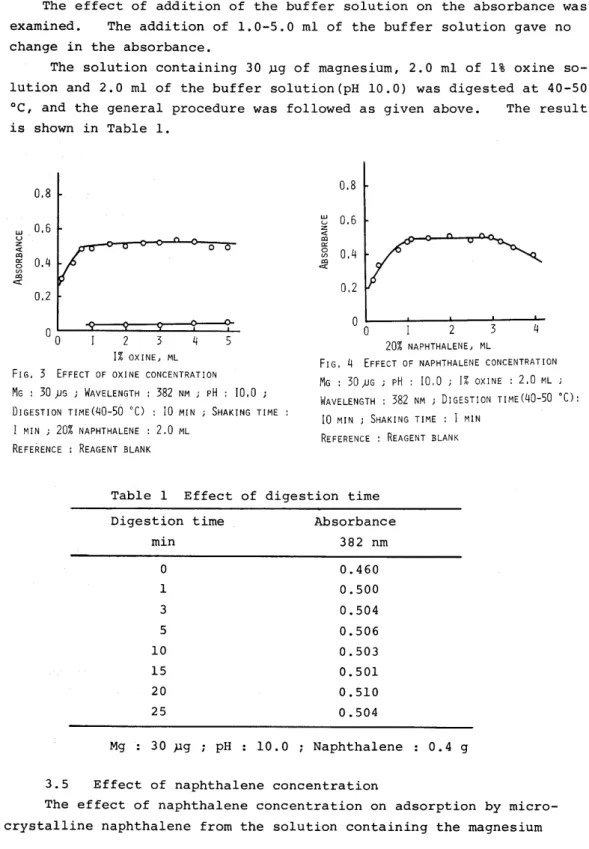
To the solution containing 30 pg of magnesium, different volumes of 1% oxine soluiton were added, the pH of the solution was adjusted to 10.0 and the general procedure was followed, the absorbance being measured at 382 nm. In this experiment, 0.6 ml of 1% oxine solution was at least necessary for maximum and constant absorbance. Any further addition of the reagent solution had no effect on the absorbance. The result is shown in Fig. 3.
3.4 Effect of buffer solution and digestion time
282
The effect of addition of the buffer solution on the absorbance was examined. The addition of 1.0-5.0 ml of the buffer solution gave no change in the absorbance.
The solution containing 30 ).1g of magnesium, 2.0 ml of 1% oxine so- lution and 2.0 ml of the buffer solution(pH 10.0} was digested at 40-50
°C, and the general procedure was followed as given above.
is shown in Table 1.
The result
0.8
w 0.6
u z
<t o
rll c:: 0.4
~ rll
c::c 0.2
00 2 3 4 5
1% OXINE, ML FIG. 3 EFFECT OF OXINE CONCENTRATION MG : 30 ~G j WAVELENGTH : 382 NM j pH : 10.0 j
DIGESTION TlME(40-50 cO : IO MIN j SHAKING TIME I MIN j 20% NAPHTHALENE : 2.0 ML
REFERENCE : REAGENT BLANK
0.8
w 0.6
u z
<t rll c::
0 0.4
CJJ
c::r: rll
0.2
0 0 2 4
20% NAPHTHALENE, ML
FIG. 4 EFFECT OF NAPHTHALENE CONCENTRATION MG : 30)JG ; pH : 10.0 ; 1% OXINE : 2.0 ML WAVELENGTH: 382 NM j DIGESTION TIME(40-50 °C):
10 MIN j SHAKING TIME : I MIN REFERENCE : REAGENT BLANK
Table 1 Effect of digestion time Digestion time Absorbance
min 382 nm
0 0.460
1 0.500
3 0.504
5 0.506
10 0.503
15 0.501
20 0.510
25 0.504
Mg : 30 ).1g ; pH : 10.0 ; Naphthalene 0.4 g 3.5 Effect of naphthalene concentration
The effect of naphthalene concentration on adsorption by micro- crystalline naphthalene from the solution containing the magnesium
oxinate was investigated. The result is shown in Fig. 4, which indicates that the absorbance increases with increasing volume up to 1.1 ml of 20%
solution, becomes almost constant by the addition of 1.1-3.0 ml and decreases slowly. Accordingly, 2.0 ml of 20% naphthalene solution were used for further study.
3.6 Effect of shaking time
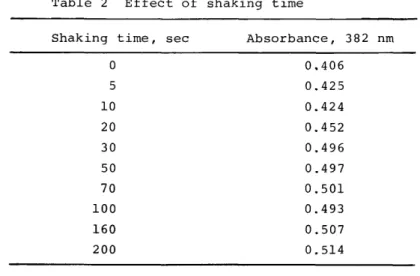
The effect of shaking time on the absorbance was investigated.
The result is shown in Table 2. It was found that shaking of 40 sec sufficed to adsorption of the chelate. Therefore, shaking of 60 sec was selected for the absorbance measurements.
Table 2 Effect of shaking time
Shaking time, sec Absorbance, 382 nm
0 0.406
5 0.425
10 0.424
20 0.452
30 0.496
50 0.497
70 0.501
100 0.493
160 0.507
200 0.514
Mg 30 )1g i pH 10.0 Naphthalene : 0.4 g
3.7 Effect of volume of aqueous phase
The volume of aqueous phase was varied between 50 and 200 ml while other factors were kept constant, and the general procedure was followed.
The result is shown in Fig. 5. The adsorption of the complex decreased slowly with the volume of aqueous phase.
3.8 Effect of standing time
The adsorbed mixture of the magnesium oxinate and naphthalene was dissolved in dimethylformamide, and the effect of standing time on the absorbance was examined. Table 2 showed that the absorbance did not change with increasing standing time up to 200 mI.
3.9 Calibration curve
Based on the optimum conditions described above, the absorbance
284
to the various concentration of magnesium were measured at 382 nm against the reagent blank. The calibration curve proved to be linear over the range 3-63 ~g of magnesium I 10 ml of dimethylformamide. The molar ab- sorptivity for the magnesium oxinate was 4.1 x 10³ l.mol-l'cm-i at 382 nm.
The sensitivity calculated from Beer's law was 5.9 x 10⁻³~g Mg/cm2 at 382 nm for log
lolr
= 0.001. Ten determinations of the sample solution con- taining 30 pg of magnesium gave a mean absorbance of 0.506 with a rela- tive standard deviation of 2.5%.0.8
LJJ 0.6
~
~
« I'Q
a::: 0.4
~
<t: I'Q
0.2
o 0 50
roo
150 200VOLUME OF 'AQUEOUS PHASE, ML FIG. 5 EFFECT OF VOLUME OF AQUEOUS PHASE MG : 30 ~G ; WAVELENGTH : 382 NM ; pH : 10.0 1% OXINE : 2.0 ML ; DIGESTION TIME(40-50 °C) 20 MIN; SHAKING TIME: 15 MIN
REFERENCE : REAGENT BLANK
3.10 Choice of solvent
1.0
0.8
LJJ u z 0.6
« III
a:::
~
I'Q 0.4
<t:
0.2
10 20 30 40 50 60 MAGNESIUM, ~G/IO ML DMF FIG. 6 CALIBRATION CURVE FOR MAGNESIUM WAVELENGTH: 382 NM ; pH : 10.0 ; 1% OXINE 2.0 ML ; DIGESTION TIME(40-50 °C) : 10 MIN 20% NAPHTHALENE: 2.0 ML
REFERENCE : REAGENT BLANK
The tests were made with various organic solvents to dissolve the mixture of the magnesium oxinate and naphthalene. The magnesium oxinate is soluble in dimethylformamide, but insoluble in propylene carbonate, dioxane, acetonitrile, benzene, toluene, xylene, chloro- benzene, o-dichlorobenzene, ethylene dichloride, chloroform, MIBK, acetone and nitrobenzene.
3.11 Effect of diverse ions
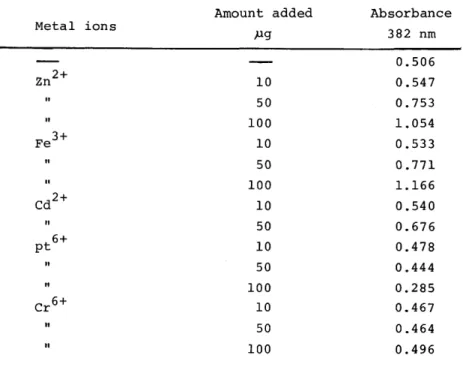
The effect of the diverse ions was examined with the solution con- taining 30 pg of magnesium and various amounts of diverse ions ( alkali metal salts or metal ions). The pH of the solution was adjusted to 10.0. The result is shown in Table 3 and 4. The following alkali metal salts and metal ions did not interfere: Na 2S04 , NaCl, NH 4Cl, Na2HP0 4 ·12H20, NaH2Po4 ·2H20, NaN03 , CH3COONa, sodium tartrate, sodium citrate, Ca2
+. Na2C0
3, EDTA and all metal ions interfere seriously.
Table 3 Effect of diverse alkali metal salts Amount added Absorbance Alkali metal salts
382 nm mg
().506 Na2S0
4 500 0.512
NaCl 300 0.494
NaH2P04·2H20 50 0.501
Na2HPo 4 ·12H2O 500 0.504
NH4Cl 300 0.527
Na 2Co3 300 0.550
NaNo3 300 0.513
CH3COONa 50 0.504
Sodium tartrate 500 0.502
Sodium citrate 100 0.493
KCN 100 0.525
EDTA 1 0.024
Magnesium 30 )lg ; pH : 10.0 ; Naphthalene 0.4 g Table 4 Effect of diverse metal ions
Amount added Absorbance Metal ions
382 nm )lg
0.506
zn 2+ 10 0.547
50 0.753
" 100 1.054
Fe 3+ 10 0.533
50 0.771
100 1.166
Cd2+ 10 0.540
" 50 0.676
pt 6+ 10 0.478
II 50 0.444
" 100 0.285
Cr 6+ 10 0.467
" 50 0.464
II 100 0.496
286
Ni 2+ 10 0.505
" 50 0.513
"
100 0.534Bi 3+ 10 0.417
" 50 0.585
" 100 0.689
Cu 2+ 10 0.530
" 50 0.750
" 100 1.081
Hg2+ 10 0.516
" 50 0.560
" 100 0.620
Ca 2+ 10 0.514
50 0.529
100 0.485
Pb 2+ 10 0.501
"
50 0.512" 100 0.504
Magnesium 30 pg pH 10.0 ; Naphthalene 0.4 9