Spectrophotometric Determination of Zinc after Separation by Adsorption of its Oxinate on
Microcrystalline Naphthalene
journal or
publication title
福井大学工学部研究報告
volume 27
number 2
page range 287‑295
year 1979‑09
URL http://hdl.handle.net/10098/4429
MEMOIRS OF THE FACULTY OF ENGINEERING FUKUI UNIVERSITY
VOL.27 No. 2 1979
Spectrophotometric Determination of Zinc after Separation by Adsorption of its Oxinate on Microcrystalline Naphthalene
Masatada SATAKE, Tsutomu SUZUKI and Nobusute YOSHIDA
*
(Received Jul. 31, 1979)
287
The method of adsorption of zinc oxinate on microcrystalline naphthalene followed by solid-liquid separation is reported for the trace analysis of zinc. The optimum conditions on the determination of zinc were established as described below. Zinc oxinate cannot be directly extracted into benzene or chloroform, but can be easily ad- sorbed on microcrystalline naphthalene, temperature being at room temperature. This complex is very stable in naphthalene-dimethyl- formamide solution. The absorbance of the solution was measured at 400 nm against the reagent blank. The proposed procedure could also be applied to the trace analysis of zinc in the presence of interfering major components. The absorbances showed a linear relationship to the concentration of zinc in the range 8-148 pg per 10 rnl of dimethylform- amide. The molar absorptivity was 4.36 x 10³ l·mol-l·cm-l
, the sensi- tivity being 1.49 x 10⁻²
pg of zinc for the absorbance of 0.001. Ten samples containing 80 pg of zinc gave a mean absorbance of 0.534 with a relative standard deviation of 2.20%.
1 Introduction
Oxine{8-hydroxyquinoline) reacts with various metal ions to form very stable water-insoluble chelates{Oxinates) which are easily extracted into ordinary organic solvents such as chloroform or benzene, and the trace amounts of metals are determined spectrophotometrically. However the method cannot be applied for zinc, magnesium, cadmium, beryllium, etc., because their oxinates are mostly insoluble in organic solvents mentioned above, owing to their structure of strongly hydrated form.
We have already reported on the determination of metals, using a new
"
method called analysis of metals by solid-liquid separation after liquid-liquid extarction".
*
Division of Applied ScienceA few years ago, we developed a new method involving solid-liquid separation after adsorption of metal chelates on microcrystalline naphthalene, and the trace amounts of metals are determined spectropho- tometrically. In the present study, zinc was chosen as a metal to be examined, and its oxinate is adsorbed on microcrystalline naphthalene from aqueous solution by vigorous shaking. The mixture of the oxinate and naphthalene is separated from aqueous solution by aspiration, dried in a dryer at 50-60°C and dissolved in dimethylformamide. The ab- sorbance of the solution is measuerd at 400 nm and the trace amounts of zinc in samples are determined spectrophotometrically. This adsorption method is simple, convenient and very excellent for the spectrophoto- metric determination of trace zinc.
2 Experimental method 2.1 Reagents
Standard zinc solution(20 ppm) was prepared by diluting 20 ml of standard zinc solution(lOOO ppm, Wako Pure Chemical Industries, Ltd., Osaka, Japan) to 1000 ml with water.
Oxine solution (1%) was prepared by dissolving 1.0 g of oxine in 2 ml of glacial acetic acid on a water bath and diluting to 100 ml with hot water.
The water used was ion-exchange water
All reagents were of analytical reagent grade.
Buffer solutions were prepared by mixing 1M acetic acid and 1M ammonium acetate solution, or 1M aqueous ammonia and 1M ammonium acetate solution.
2.2 Apparatus
The apparatus used in this experiment were a Hitachi Model 200-20 spectrophotometer, in matched 10 mm glass cells. The pH measurements were made a Toa Dempa HM-5A pH meter, equipped with glass and colomel electrodes.
Drying of the naphthalene mixture were made with a Tabai K-2 dryer (Tabai Mfg. Co. Ltd., Japan).
2.3 General procedure
To about 45 ml of sample solution containing 1-8 ml of 20 ppm zinc solution in a 100-ml tightly stoppered Erlenmeyer flask, add 2.0 ml of 1% oxine solution and 2.0 ml of the buffer solution to adjust the pH of the solution to 8.5. Mix the solution well and stand i t for above 20 min to digest the chelate at about 40°C. After digestion, add 2.0 ml of 20% naphthalene solution and shake i t vigorously for 1 min. Then
the chelate is adsorbed on microcrystalline naphthalene. Filter them through a filter paper(Toyo Roshi Co., No 5C) placed flat on a filter
289
plate in a funnel, or a glass filter(No 2 or 3) when necessary. Wash with water and dry in a dryer at 50-60°C. Then dissolve them in di- methylformamide and make up to 10 mI. Measure the solution of the so-
lution in 10 mm glass cell against the reagent blank similar ly prepared.
3 Results and discussion 3.1 Absorption spectra
The absorption spectra of oxine and zinc oxinate in naphthalene- dimethylformamide solution, measured against water, are shown in Fig.l.
The absorbance curve of zinc oxinate shows one peak at 400 nm. The reagent blank shows strong absorption below 360 nm. Beyond this wave- length, there is practically a negligible absorption due to the reagent blank. Therefore, all the absorbance measurements were performed at 400 nm.
3.2 Effect of pH
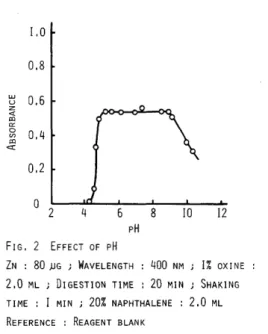
The relationship of the absorbance and the pH of aqueous solution containing zinc oxinate after adsorption was investigated over the pH range 4-10.5. The result is shown in Fig. 2. The absorbance curve shows that the adsorption starts virtually from pH 4.0, increases sharply up to pH 5.2, gives a definite and maximum value in the pH range 5.2-8.9 and then decreases rapidly beyond pH 8.9. Therefore, a pH region of 5.2 -8.9 is suitable for the quantitative adsorption.
absorbance was measured at pH 8.0.
In this study, the
1.0
0,8 ZN COMPLEX
UJ u
z 0,6
« DOl a::
0 (.f)
DOl 0,4
c:::c:
0,2
WAVELENGTH, NM
FIG, I ABSORPTION SPECTRA OF OXINE AND ZINC COMPLEX IN NAPHTHALENE-DMF SOLUTION
ZN : 80 ~G ; pH : 8,0 ; 1% OXINE : 2,0 ML ;
20% NAPHTHALENE: 2,0 ML ; SHAKING TIME : I MIN REFERENCE : WATER; ([) OXINE, (2) COMPLEX
1.0 0,8
UJ 0,6
u z
« ~
~ 0,4
c:::c: DOl
0,2
0 2 4 6 8 10 12 pH
FIG, 2 EFFECT OF pH
ZN : 80 ~G ; WAVELENGTH : 400 NM ; 1% OXINE
2,0 ML i DIGESTION TIME: 20 MIN; SHAKING TIME: I MIN; 20% NAPHTHALENE : 2,0 ML REFERENCE : REAGENT BLANK
290
3.3 Effect of oxine concentration
The effect of oxine concentration on the absorbance was investigated with the solution containing 80 pg of zinc at pH 8.0. It indicates that
0.3-5.0 ml of 1% oxine solution are quite appropriate for the quanti- tative adsorption of zinc. Therefore, 2.0 ml of 1% oxine solution were.
added throughout this experiments. The result is shown in Fig. 3.
3.4 Effect of buffer solution and digestion time
The effect of the amount of the buffer solution on the adsorption was investigated. It was found that the adsorption was almost constant by the addition of 1.0 to 5.0 ml of the buffer solution.
The solution containing the zinc oxinate was warmed at about 40
oc,
and the adsorption was performed according to the general procedure.
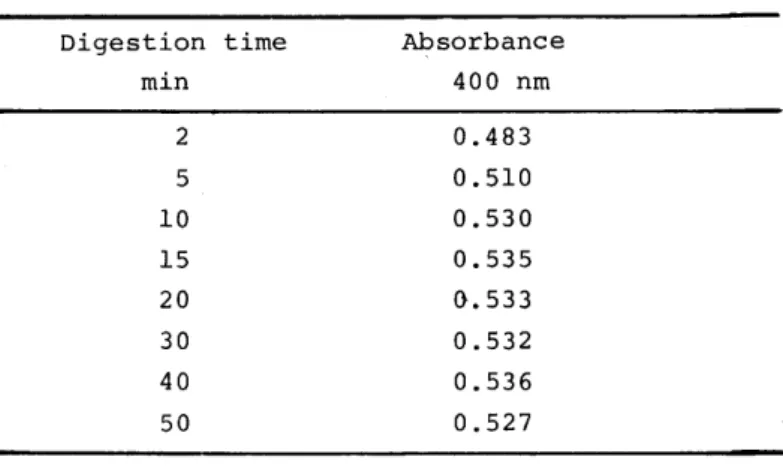
Table 1 shows the effect of digestion time on the adsorption. The digestion of the zinc oxinate for up to 50 min gave no changes in the adsorption. Therefore, the digestion for about 20 min were selected for the further study.
Table 1 Effect of digestion time Digestion time Absorbance
min 400 nm
2 0.483
5 0.510
10 0.530
15 0.535
20 0.533
30 0.532
40 0.536
50 0.527
Zinc 80 pg i pH : 8.0 i Naphthalene 0.4 g 3.5 Effect of naphthalene concentration
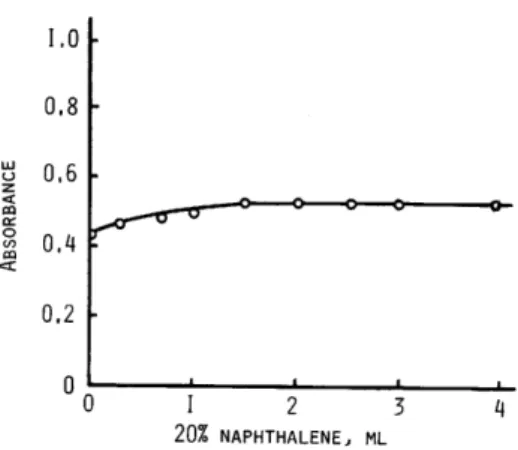
The effect of addition of naphthalene on the adsorption was studied and the result is shown in Fig. 4. The adsorption of the zinc oxinate increased with increasing amount of naphthalene up to 1.5 ml of 20% naph- thalene solution, and became almost constant in the region of 1.5 to 4.0 mI. Therefore, 2.0 ml of 20% naphthalene solution were added for the further study.
3.6 Effect of shaking time
The effect of shaking time on the adsorption of the zinc oxinate was
1.0 0.8
w u
0.6
z «
t:Q cr 0
U) 0.4
.@
0.2
0 0 2 3 4 5
I% OXINE, ML
FIG. 3 EFFECT OF OXINE CONCENTRATION ZN : 80 ~G ; WAVELENGTH : 400 NM ; pH : 8.0 20% NAPHTHALENE: 2.0 ML ; DIGESTION TIME
20 MIN; SHAKING TIME: I MIN REFERENCE : REAGENT BLANK
1.0 0.8
w 0.6
u z
« t:Q
cr ~ 0.4
cr: t:Q
0.2
00 2 3 4
20% NAPHTHALENE, ML FIG. 4 EFFECT OF NAPHTHALENE CONCENTRATION ZN : 80 ~G ; WAVELENGTH: 400 NM ; pH : 8.0 ; 1% OXINE : 2.0 ML ; DIGESTION TIME : 20 MIN;
SHAKING TIME : I MIN; STANDING TIME : IS MIN REFERENCE : REAGENT BLANK
291
examined. The result is shown in Table 2. The adsorption increased with increasing shaking time up to 30 seconds, and became almost constant in the region of 30-300 seconds.
1 min was used for the further study.
Table 2 Effect of shaking time Shaking time Absorbance
sec 400 nm
0 0.452
10 0.503
30 0.530
60 0.535
120 0.545
180 0.528
240 0.537
300 0.532
Therefore, shaking time for
Zinc 80 ).lg pH 8.0 Naphthalene 0.4 g
3.7 Effect of standing time
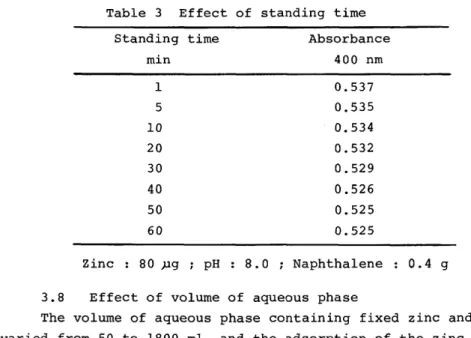
The mixture of the zinc oxinate and naphthalene was dissolved in dimethylformamide and the effect of standing time on the adsorption was examined. The result is shown in Table 3. The color of the zinc
292
oxinate was stable for 60 min.
Table 3 Effect of standing time Standing time Absorbance
min 400 nm
1 0.537
5 0.535
10 0.534
20 0.532
30 0.529
40 0.526
50 0.525
60 0.525
Zinc : 80 )1g ; pH : 8.0 ; Naphthalene 0.4 g 3.8 Effect of volume of aqueous phase
The volume of aqueous phase containing fixed zinc and oxine was varied from 50 to 1800 ml, and the adsorption of the zinc oxinate was carried out by the general procedure. The result is shown in Fig.5.
The adsorption was almost constant over the range 50-1400 ml and then decreased rapidly with the volume in aqueous phase.
0.8
LU 0.6
u 0 0
z 0
"\
« III
a:: 0.4
a (j)
c::t: III
0.2
0 0 500 1000 1500 2000
VOLUME OF AQUEOUS PHASE, ML FIG. 5 EFFECT OF VOLUME OF AQUEOUS PHASE ZN : 80 ~G ; WAVELENGTH : 400 NM pH: 8.0 ;
1% OXINE : 2.0 ML ; SHAKING TIME: I MIN j DIGESTION TIME : 20 MIN
REFERENCE : REAGENT BLANK
3.9 Calibration curve
1.0 0.8
LU u
0.6
« z
III a::
a
(j)
III 0.4
c::t:
0.2
ZINC, pG/IO ML DMF FIG. 6 CALIBRATION CURVE FOR ZINC WAVELENGTH : 400 NM j pH : 8.0 i 1% OXINE
2.0 ML i 20% NAPHTHALENE : 2.0 ML i
DIGESTION TIME : 20 MIN i SHAKING TIME I MIN REFERENCE : REAGENT BLANK
Based on the optimum conditions obtained from the experiment
293 described above, the absorbance was measured at 400 nm against the re- agent blank. Beer's law was obeyed over the range of the concentration, i.e. 8-148 pg of zinc in 10 ml of dimethylformamide. The molar absorp-
3 -1
tivity was 4.36 x 10 l·mol·cm at 400 nm, and the sensitivity 1.49 x 10⁻²
pg of zinc /cm2
for the absorbance of 0.001. Ten replicate deter- minations of the sample solution containing 80 pg of zinc, prepared by the general procedure, gave a mean absorbance of 0.534 with a relative standard deviation of 2.20%.
3.10 Choice of solvent
Various solvents were tested to dissolve the zinc oxinate and naph- thalene. This chelate is soluble in dimethylformamide, methanol and ethanol, but insoluble in ordinary organic solvents such as propylene carbonate, dioxane, acetonitrile, benzene, toluene, xylene, chloro- benzene, o-dichlorobenzene, dichloroethane, chloroform, MIBK, acetone, and DMSO at high temperature.
3.11 Effect of diverse ions
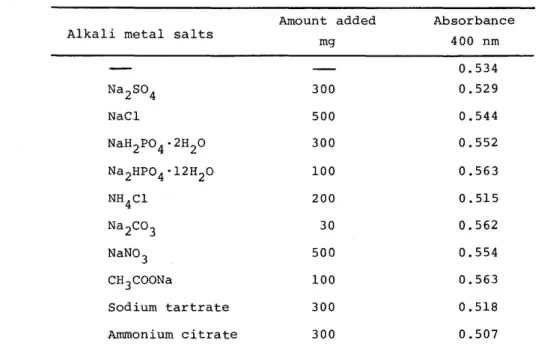
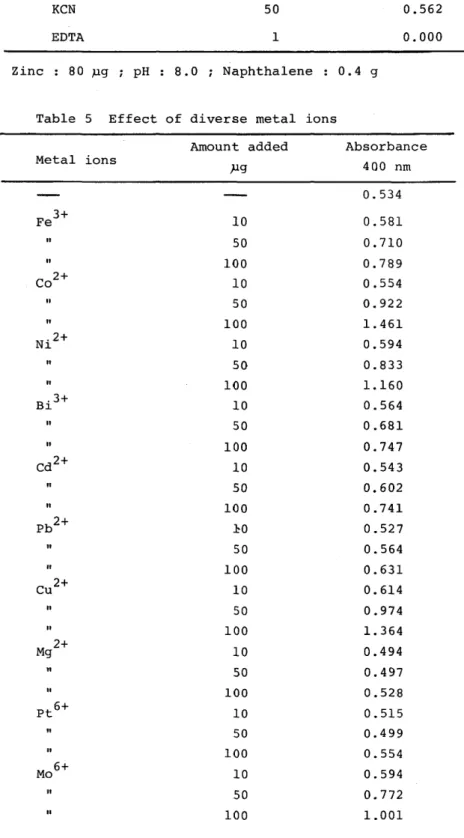
various ions (alkali metal salts or metal ions) were added individu- ally to the solution containing 80 pg of zinc, and their effects on the adsorption examined. The result is shown in Tables 4 and 5.
Table 4 Effect of diverse alkali metal salts Amount added Absorbance Alkali metal salts
400 nm mg
0.534 Na2S0
4 300 0.529
NaCl 500 0.544
NaH2po4·2H20 300 0.552
Na 2HP04 ·12H2O 100 0.563
NH4Cl 200 0.515
Na2C0
3 30 0.562
NaN03 500 0.554
CH 3COONa 100 0.563
Sodium tartrate 300 0.518
Ammonium citrate 300 0.507
294
KCN 50 0.562
EDTA 1 0.000
Zinc : BO ).lg pH B.O Naphthalene 0.4 g
Table 5 Effect of diverse metal ions
Amount added Absorbance Metal ions
)lg 400 nm
0.534
Fe 3+ 10 0.5Bl
..
50 0.710..
100 0.789co2+ 10 0.554
..
50 0.922..
100 1.461Ni 2+ 10 0.594
" 50 0.B33
" 100 1.160
Bi 3+ 10 0.564
..
50 0.681..
100 0.747Cd 2+ 10 0.543
..
50 0.602..
100 0.741Pb2+ }O 0.527
..
50 0.564" 100 0.631
cu 2+ 10 0.614
" 50 0.974
" 100 1.364
Mg 2+ 10 0.494
"
50 0.497" 100 0.528
pt 6+ 10 0.515
" 50 0.499
100 0.554
Mo 6+ 10 0.594
" 50 0.772
..
100 1.001295
Cr 6+ 10 0.531
" 50 0.532
" 100 0.525
Pb 2+ 10 0.552
" 50 0.547
" 100 0.552
Hg2+ 10 0.547
" 50 0.582
\I 100 0.666
Ca 2+ 10 0.529
50 0.527
100 0.532
Zinc 80 pg ; pH : 8.0 Naphthalene 0.4 g The following species did not inter fer : Na
2so
4, NaCl, NaH2Po~.2H2o,
NH4Cl, NaN0
3, sodium tartrate, sodium citrate, Mg2+, pt 6+, Cr +, Pb2 +, ca2
+. Especially small amounts of EDTA gave serious interference.
296