after Separation by Adsorption of its DDTC
Chelate on Microcrystalline Naphthalene
journal or
publication title
福井大学工学部研究報告
volume
28
number
2
page range
187-195
year
1980-09
URL
http://hdl.handle.net/10098/4392
MEMOIRS OF THE FACULTY OF ENGINEERING FUKUI UNIVERSITY VOL.28 No.2 1980
Spectrophotometric Determination of Nickel after Separation by Adsorption of its DDTC Chelate on Microcrystalline Naphthalene
*
Masatada SATAKE
(Received Jul. 31, 1980)
A method is presented for the determination of trace amounts of nickel after separation by adsorption of nickel DDTC chelate on microcrystalline naphthalene. Nickel reacts with DDTC to form a stable chelate, which is quantitatively adsorbed on microcrystalline naphthalene at room temperature. The mixture of the chelate and naphthalene is separated from aqueous solution and dissolved in dimethylformamide. The absorbance of the solution is measured at
382
nm against the reagent blank. Other factors such as pH~ amounts of DDTC and naphthalene, digestion, shaking time, standing time and diverse ions are studied. The Beer's was obeyed over the range of 5-100 Mg nickel in 10 ml of dimethylformamide solution. The molar absorptivity was5.9
x 103
l.mol-l.cm-l at382
nm, the sensitivity being 0.010 Mg nickel per cm2 for an absorbance of 0.001 . . The precision of this method was estimated with ten sample solutiomcontaining 60 pg of nickel. A mean absorbance at382
nm was 0.600 with a relative standard deviation of 0.64%.1 Introduction
Sodium diethyldithiocarbamate(abbreviated as DDTC) forms water-insoluble metal chelates with various metall such as copper, iron(II) , iron(III), cobalt, bismuth, nickel, uranium(IV), chromium(IV), zinc, lead, cadmium. These chelates are easily extracted into chloroform or methl isobutyl ketone and trace amounts of metals are determined by spectrophotometry or atomic absorption spectrophotometry.
187
We have found that metal chelates are quantitatively extracted into molten naphthalene at the elevated temperature. However, the method is more complicate in the experimental operation than a simple
chloroform extraction method.
We have developed a new method of analysis involving adsorption
*
Division of Applied Scienceadsorption of metal chelates on microcrystalline naphthalene and their subsequent spectrophotometric determinations, and demonstrated for palladium 1) and nickel 2) with a-furildioxime and copper
3)
with Ammonium Pyrnolidine dithiocarbamate. The present communication describes the optimum conditions for an improved procedure for the adsorption of nickel-DDTC chelate on micrcrystalline naphthalene at room temperature(-25°) and subsequent determination of this metal spectrophotometrically after dissolution of the naphthalene mixture in dimethylformamide.2 Experimental method
2.1 Reagents
Standard nickel solution, 10 ppm. Prepared by diluting 10 ml of standard nickel solution(lOOO ppm, Wako Pure Chemical Industries,Osaka, Japan) to 1000 ml with deionized water.
DDTC solution, 0.2%. 100 ml of deionized water.
Prepared by dissolving 0.2 g of DDTC in
Naphthalene solution, 20%. Prepared by dissolving 20 g of naphthalene in acetone and diluting to 100 mI.
Buffer solutions. Prepared by mixing 1M acetic acid and 1M ammomium acetate solution for pH
3-6;
1M aqueous ammonia and 1M ammonium acetate solution for pH 8-11.Naphthalene, acetone and all other reagents were of analytical reagent grade, and were used without fUrther purification.
2.2 Apparatus
A Hitachi Model 200-20 double beam spectrophotometer was used for the absorbance measurements.
All pH measurements were done with a Toa-Dempa, HM-5A, pH meter, equipped with a combination calomel and glass electrode assembly.
Naphthalene was dried with a Tabai Model K-2 dryer(Tabai Mfg.Ltd., Japan).
2.3 Procedure
Transfer about 40 ml of sample solution containing 60 pg of nickel to a tightly stoppered Erlenmeyer flask, adjust to about pH 5.5 with the acetate buffer solution and add 2.0 ml of 0.2% DDTC solution. Mix the solution well and stand for 10 min. Transfer into this so-lution as fast as possible 2.0 ml of 20% naphthalene soso-lution using a small nozzled pipet attached to a rubber bulb, and shake vigorously for 1 min. Separate the solid by filtration using a filter paper (e.g., No5C, Toyo Roshi Co. Japan) placed flat on a filter plate in a funnel, or through a sintered glass filter(N02). Wash with water and dry at 50-60°C in a dryer. Then dissolve the product in
dimethyl-formamide and make up to 10 ml. Measure the absorbance of the so-lution in a 10-mm glass cell at 382 nm against a reagent blank prepared similarly.
3 Results and discussion
3.1 Absorption spectra
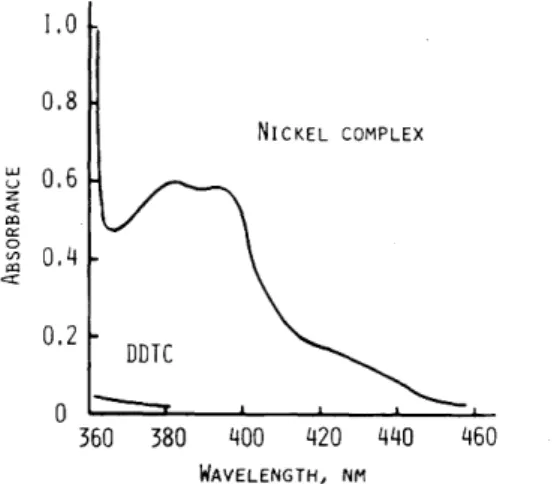
Sample solution containing 60 pg of nickel., 2.0 ml of the buffer solution and 2.0 ml of 0.2% DDTC solution was prepared according to the procedure and the adsorption of the chelate was carried out. Figure I shows the absorption spectra of reagent blank and nickel chelate in naphthalene-dimethylformamide solution, measured against water in 360 to 460 nm range. The absorption curve of the chelate has two peaks at 382 and 392 nm, whereas the absorption of the reagent blank is almost negligible above 380 nm. Therefore, 382 nm was adopted as the optimum wavelength throughout this work.
3.2 Effect of pH
189
The effect of pH on the absorbance of the chelate was investigated with the sample containing 60 Pg of nickel, 2.0 ml of 0.2% DDTC so-lution and 2.0 ml of the buffer soso-lution. The pH measurements was made after adsorption of the chelate. The absorbance variation against pH, is shown in Fig.2. The absorbance of the chelate depend on pH, and maximum absorbance is obtained between 3.0 and
8.5.
It decreases slightly above pH8.5.
Consequently, a pH of5.5
was chosen as the. optimum condition for this work.1.0 0.8 ~
0.6
z <I: ~ a:: o ~ 0.4 c::t: 0.2o
NICKEL COMPLEX 360 380 400 420 440 460 WAVELENGTH , NMFIG. I ABSORPTION SPECTRA OF DDTC AND NICKEL
COMPLEX IN NAPHTHALENE-DMF SOLUTION
NI :
60
»G ;pH : 5.5 ; 0.2%DDTC : 2.0
MLDIGESTION TIME : 5 MIN; 20% NAPHTHALENE : 2 ML
REFERENCE : WATER; (I) DDTC (2) NICKEL COMPLEX
1.0 ~ Z N 0.8 co r<'I .... <: L.U
0.6
u z <I: ~ a:: 0 0.4 <Il <Xl c::t: 0.2 0 0 2 4 6 8 10 pH FIG. 2 EFFECT OF pH NI : 60 j.JG ; 0.2% DDTC : 2.0 f"L ; UIGESTIONTIME : 5 MIN; 20% NAPHTHALENE : 2 ML :
SHAKING TIME :
2
MIN; STANDING TIME :[5
MIN3.3 Effect of reagent concentration
Varying amounts of DDTC reagent were added to the samples containing 60 pg of nickel and 2.0 ml of the buffer solution, and variations in the absorbance of the chelate were studied at 382 nm. The results are shown in Fig.3. It can be seen that the adsorption of the chelate increased with increasing amounts of added DDTC so-lution up to 0.4 ml of 0.2% DDTC soso-lution and then remained almost constant between 0.4 and 5.0 mI. Consequently, 2.0 ml of 0.2% DDTC solution were found sufficient for the absorbance measurements.
3.4 Effect of addition of buffer solution
The various amounts of the acetate buffer solution(pH 5.5) were added to the sample solutions containing 60 pg of nickel and 2.0 ml of 0.2% DDTC solution~ and the adsorption was performed according to the procedure. Figure 4 shows the effect of the buffer solution on the absorbance. It was found from the Figure that the adsorption of the chelate did not given the effect on the absorbance over the range of 0.5-5.0 ml of the buffer solution. Therefore, 2.0 ml of the buffer solution were used for the absorbance measurements.
L Z 1.0 ~ 0,8 /'i"\ LU U Z <l: 0,6 ~ 0,4 VI I:Q <C 0,2
o
°
2 3 4 5 0,2% DDTC. MLFIG. 3 EFFECT OF REAGENT CONCENTRATION
NI:
60
pG jpH : 5.5
j DIGESTION TIME5
MIN20% NAPHTHALENE : 2 ML j SHAKING TIME 2 MIN
REFERENCE : REAGENT BLANK
3.5 Effect of digestion time
LU U Z <l: I:Q a:: o V! a:l < 1.0 0,8 0,6 ~ 0 0,4 0,2
o
o
J o 2 3 4 1M BUFFER SOLUTION, MLFIG. 4 EFFECT OF BUFFER SOLUTION
5
NI :
60
PG ipH : 5.5
i0.2% DDTC : 2,0
~LDIGESTION TIME : 5 MIN j 20% NAPHTHALENE
2.0 ML j SHAKING TIME: 2 MIN
REFERENCE : REAGENT BLANK
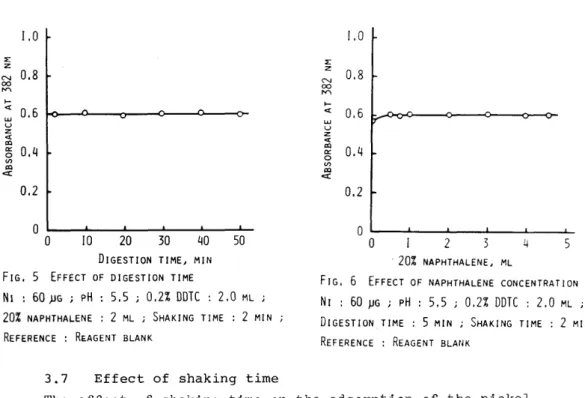
The nickel chelate in the solution containing 60 Mg of nickel and 2.0 ml of 0.2% DDTC solution at pH 5.5 was digested at room tem-perature, and the effect of digestion time on the absorbance was investigated between 5 and 50 min. The results are shown in Fig.5.
lYl
The absorbance is constant independently of digestion time. There-fore, a
5
min of digestion time was selected foe the fUrther work.3.6 Effect of naphthalene concentration
The various amounts of naphthalene were added to the sample so-lution containing the nickel chelate, and the adsorption of the chelate was performed according to the procedure. Figure
6
shows the effect of addition of naphthalene on the absorbance. From the experimental data, the addition of 0.2 - 4.0 ml of 20% naphthalene solution did not cause the effect on the absorbance. Therefore, 2.0 ml of 20% naph-thalene solution were used for the further work.1.0 ~ Z N 0.8 00 ~ ~ < 0.6 w u z < ~ ~ 0.4 0 ~ ~ ~ 0.2 0 0 IO 20 30 40
DIGESTION TIME, MIN
FIG. 5 EFFECT OF DIGESTION TIME
50
NI : 60 PG i pH : 5.5 ; 0.2% DOTe: 2.0 ML
20% NAPHTHALENE : 2 ML ; SHAKING TIME : 2 MIN
REFERENCE : REAGENT BLANK
3.7 Effect of shaking time
I.O ~ z 0.8 N 00 ~ ~ < 0.6 w u z < ~ 0.4 ~ 0 ~ ~ ~ 0.2 0 0 2 4 5 . 20% NAPHTHALENE, ML
FIG. 6 EFFECT OF NAPHTHALENE CONCENTRATION
NI : 60 ~G i pH : 5.5 i 0.2% DOTe: 2.0 ML ;
DIGESTION TIME :
5
MIN; SHAKING TIME :2
MINREFERENCE : REAGENT BLANK
The effect of shaking time on the adsorption of the nickel chelate was examined. The results are shown in Fig.7. The
adsorption of the nickel chelate was completed after several seconds. Therefore, 1 min of shaking time was selected for the further work.
3.8 Effect of aqueous volume
The volume of aqueous phase containing fixed nickel and DDTC reagent was varied from 50 to 300 ml, and the adsorptive operation were carried out by the procedure. The results are shown in Fig.B.
The adsorption was almost constant over the range 50-120 ml, and then decreased gradually with the volume in aqueous phase.
1.0 L Z C'J 0,8 00 rrI .... <t 0,6 UJ u Z <t OJ 0,4 a:: 0 (/) OJ c::t: 0,2 0 0 2 3
SHAKING TIME, MIN
FIG. 7 EFFECT OF SHAKING TIME
NI :
60
~G ;pH : 5,5
j0,2%
DDTC :2,0
ML j20%
NAPHTHALENE :2
ML ; STANDING TIME :15
MINREFERENCE : REAGENT BLANK
1.0 L Z C'J 0,8 00 rrI .... <:: UJ 0,6
~
u Z <t ro a:: 0,4 0 (/) OJ c::t: 0.2o
o
100 200 AQUEOUS VOLUME, MLFIG, 8 EFFECT OF AQUEOUS VOLUME
300
NI :
60
~G ;pH : 5.5
j0,2%
DDTC :2,0
ML ;DIGESTION TIME: 5 MI~ j 20% NAPHTHALENE: 2 ML
SHAKING TIME:
5
MIN; STANDING TIME:15
MINREFEREiKE : REAGENT BLANK
The mixture of the nickel chelate and naphthalene was dissolved in ,~
dimethylformamide, and the effect of standing time on the absorbance was examined. From the experimental result, the color of the nickel chelate was stable for a long time. Therefore, 15 min of standing time were selected for the fUrther work.
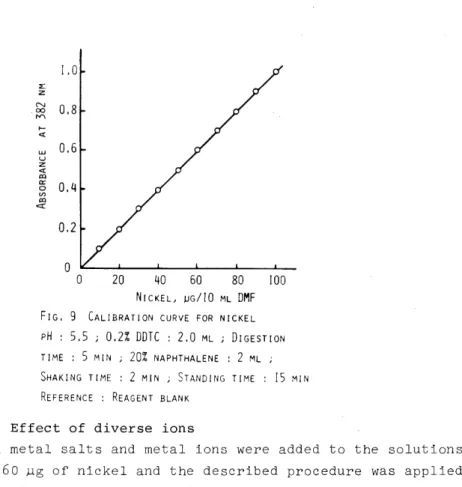
3.10 Calibration curve
Under the optimum conditions described above, a calibration curve for nickel chelate in dimethylformamide was constructed at
382
nm. It was found to be linear over the concentration range of 5-100 pg nickel in 10 ml of dimethylformamide. The results are shown in Fig.9. The molar absorptivity of the chelate was found to be5.9
x 103
-1 -1 -2 f
l'mol 'cm ,while the sensitivity was 0.010 pg·cm for nickel or 0.001 absorbance. Ten replicate analysis of samples containing 60 ~g of nickel gave a mean absorbance of 0.600 with relative standard
deviation of 0.64%.
3.11 Choice of solvent
Various solvents were tested to dissolve the adsorbed nickel-DDTC chelate along with microcrystalline naphthalene. The chelate mixture is soluble in acetonitrile, benzene, toluene, xylene, chlorobenzene, o-dichlorobenzene, dicploroethane, chloroform, acetone, MIBK, isoamyl-acetate and propylene carbonate. It is decolorized in dioxane after several min.
1.0 L Z N 0.8 00 trI t-ex: w 0.6 u z ex: III a: 0.4 0
'"
III c::x::0.2
NICKEL, ~G/IO ML DMF FIG. 9 CALIBRATION CURVE FOR NICKELpH : 5.5 ; 0.2% DDTC : 2.0 ML ; DIGESTION
TIME: 5 MIN; 20% NAPHTHALENE: 2 ML ; SHAKING TIME: 2 MIN; STANDING TIME: 15 MIN REFERENCE : REAGENT BLANK
3.12 Effect of diverse ions
Alkali metal salts and metal ions were added to the solutions containing 60 ~g of nickel and the described procedure was applied. The analytical data are shown in Table I and II. The following species did not interfered: Na 2S04' NaCl, NH 4Cl,NaH2Po
4,
Na 2HP0 4 , Na 2Co 3 , KBr, Na2S04' CH3COONa, Ca(II), Zn(II), Mn(II), Pt(II), Pb(II), Mg;(II),
Al(III). Na
2S04' Cr(IV), Fe(III), Hg(II), Co(II), Bi(III) and Cu(II) gave positive interference,and KCN and Cd(II) did negative one.
Especially EDTA, KCN, Fe(III), Co(II), Bi(III) and CuCII) interfered seriously.
Table I Effect of diverse alkali salts
Diverse alkali salts Amount addedCmg) Absorbance(382 nm) 600 Na 2S04 700 606 NaCl 700 601 NH 4Cl 700 601 NaH 2P0 4 ·2H2O 700 610 Na2HP04,12H20 700 610 Na 2C0
3
700 600 Na 2S03
300 610"
500 630"
700 0.658 Na 2S04 700 0.599 CH 3COONa 700 0.608 KBr 1000 0.607 KCN 0.01 0.603"
0.05 0.606"
0.10 0.608 11 1. 00 0.000 EDTA 0.01 0.600 II 0.05 0.559 II 0.10 0.469"
1. 00 0.000 Sodium tartrate 300 0.610 II 500 0.630 Sodium citrate 700 0.602 Ni : 60 pg ; pH : 5.5 ; 0.2% DDTC : 2.0 mlTable II Effect of diverse metal ions
Diverse metal ions Amount added ().lg) Absorbance(382 nm) 0.600 Ca(II) 1000 0.610 Zn(II) 500 0.603 Cr(VI) 10 0.613
"
100 0.678"
500 0.732 Mn(II) 1000 0.600 Cd(II) 500 0.618 11 1000 0.393 Fe(III) 1 0.611 II 5 0.650 II 50 1.421 Hg(II) 50 0.611 II 100 0.627 Pt(IV) 500 0.610"
1000 0.624 Pb(II) 100 0.618 Mg(II) 100 0.605195 Ca(II)