Clustering Phenomena of Complex Chaotic Circuit Networks
Yuji Takamaru, Hiroshige Kataoka, Yoko Uwate and Yoshifumi Nishio Dept. of Electrical and Electronic Engineering, Tokushima University,
2-1 Minami-Josanjima, Tokushima, 770-8506, Japan Email: { takamaru, hiroshige, uwate, nishio } @ee.tokushima-u.ac.jp
Abstract— This paper presents synchronization phenomena of coupled chaotic circuits when chaotic circuits are connected glob- ally with distance information. By using computer simulations and circuit experiments, clustering phenomena of coupled chaotic circuits is observed on two-dimensional place.
I. I ntroduction
Synchronization phenomena are very typical phenomena in the field of natural science. Recently, many studies have been investigated synchronization of chaotic circuits. It is applied in the field of engineering, physics, biology and so on. Also one of the characteristic of the brain is synchronization of neuronal activity. In addition, this phenomenon is considered to play an important role in brain information processing.
Then, we consider that it is very important to investigate the synchronization phenomena of coupled chaotic circuits for the future engineering applications such as analysis of the brain activity and the realization of a brain computer.
In recent years we often deal with huge amounts of data. By dividing the such data into similar groups for clustering, the information processing can be treated in high speed. Moreover, clustering is one of the most interesting nonlinear phenomena.
The phenomena are also applied to many application, such as data mining, image processing and biological field. Many kinds of models and algorithms by using Coupled Map Lattice (CML) are proposed for clustering [1]-[3]. The systems carried out for discrete-time mathematical models. However, there are not many discussions for clustering of continuous-time electrical circuits such as coupled chaotic circuits.
In this study, we consider the coupled chaotic circuits networks. In order to investigate basic clustering phenomena, seven chaotic circuits are globally coupled with the distance information. The clustering phenomena are observed when the chaotic circuits are placed on 2-dimensional. We make clear the relationship between clustering phenomena and synchro- nization phenomena. We observed that the synchronization of circuit networks depends on the distance information.
Furthermore, we also carry out the circuit experiments and compare with computer simulation results.
II. C ircuit model
Figure 1 shows the circuit model, which is called Nishio- Inaba circuit investigated in [4]-[6].
Fig. 1.
Chaotic circuit.
The circuit consists of a negative resistance, a nonlinear resistance consisting of two diodes, capacitor and two induc- tors. The approximate the I − V characteristic of the nonlinear resistance shows the following equation and the parameter r
dis the slope of the nonlinear resistance.
v
d(i
2) = r
d2
( i
2+ V r
d− i
2− V r
d)
. (1)
Then the circuit dynamics is described by the following piecewise-linear third-order ordinary di ff erential equation:
L
1di
1dt = v + ri
1L
2di
2dt = v − v
d(i
2) (2) C dv
dt = − i
1− i
2. By changing the variables such that
i
1=
√ C L
1V x , i
2=
√ L
1C L
2Vy , v = Vz;
r
√ C L
1= α, L
1L
2= β, r
d√ L
1C L
2= δ, t = √
L
1C
τ, ” · ” = d d τ That the equation (2) is normalized as
˙x = α x + z
˙y = z − f (y) (3)
˙z = − x − β y
- 81 -
IEEE Workshop on Nonlinear Circuit Networks December 9-10, 2011
where f (y) is described as follows;
f (y) = δ 2
( y + 1
δ − y − 1 δ
)
. (4)
Figure 2 shows the chaotic attractor generated from the circuit by using computer simulation (Fig. 2 (a)) and circuit experiment (Fig. 2 (b)). For the computer simulation, we set the parameters as α = 0 . 460, β = 3 . 0 and δ = 470.
For the circuit experiment, the parameters are fixed with L
1= 500[mH], L
2= 200[mH], C = 0 . 0153[ µ F], and r
d= 1 . 46[M Ω ].
(a) Computer simulation. (b) Circuit experiment.
Fig. 2.
Chaotic attractor.
III. S ynchronization phenomena
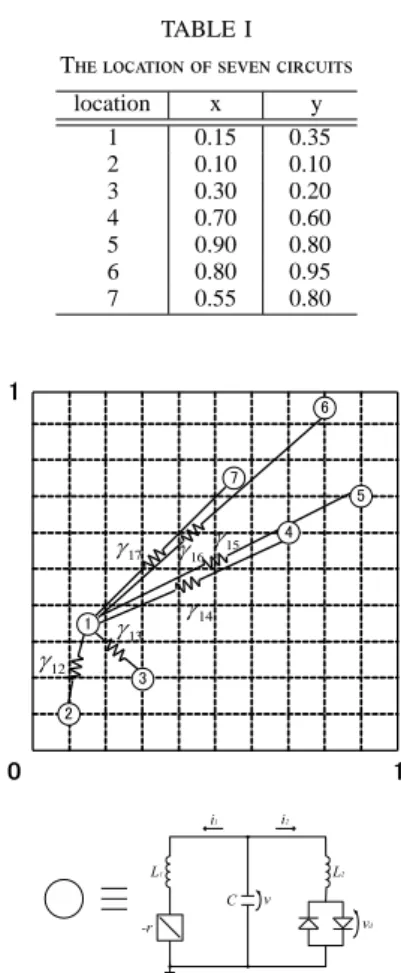
We investigate the clustering phenomena when seven chaotic circuits are coupled globally. The arrangement of seven chaotic circuits is shown in Fig. 3. Table I shows the locations of the chaotic circuits. All the circuits are connected globally each other by resistors. Figure 4 shows the coupling method of the first chaotic circuit as an example.
Fig. 3.
Arrangement of seven chaotic circuits.
We consider the globally coupled chaotic circuits:
dx
id τ = α x
i+ z
idy
id τ = z
i+ f (y) (5)
dz
id τ = − x
i− β y
i−
∑
N i,j=1γ
i j(z
i− z
j) (i , j = 1 , 2 , · · ·, N)
TABLE I The location of seven circuits
location x y
1 0.15 0.35
2 0.10 0.10
3 0.30 0.20
4 0.70 0.60
5 0.90 0.80
6 0.80 0.95
7 0.55 0.80
Fig. 4.
Coupling between the first chaotic circuit and the others.
where, i in the equation represents the circuit itself, and j is the coupling number with other circuits. The parameter γ represents the coupling strength between the circuits. In this simulation, we set the coupling parameter value γ
i,jto correspond the distance between the circuits by the following equation:
γ
i,j= g
(length
i,j)
3. (6) The parameter of g is a variable parameter that determining the each coupling weight. In this case, we set the parameter g = 0 . 00002. And length
i,jdenotes the Euclidean distance between the i − th and the j − th circuits.
Figure 5 shows the computer simulated results obtained from the seven chaotic circuits arranged as shown in Fig. 3.
We also confirm the same synchronization and clustering phenomena by the circuit experiments as shown in Fig. 6.
From these results, we confirm that the first, the second and the third chaotic circuits are synchronized with in-phase state, and also the other chaotic circuits synchronize with in-phase state. However, between the first and the fourth chaotic circuits are not synchronized. Namely, the networks of chaotic circuits can divide two groups from synchronization. Figure 7 shows the clustering results of seven chaotic circuits.
- 82 -
(a) 1-2 (b) 1-3 (c) 1-4
(d) 4-5 (e) 4-6 (f) 4-7
Fig. 5.
Phase di ff erence between two circuits (Computer simulations).
(a) 1-2 (b) 1-3 (c) 1-4
(d) 4-5 (e) 4-6 (f) 4-7
Fig. 6.
Phase difference between two circuits (Circuit experiments).
IV. C onclusion
In this study, we have investigated the coupled chaotic circuits networks. The seven chaotic circuits are globally coupled with the distance information. We have observed the basic clustering phenomena resulting from the synchronization phenomena. From the computer simulations and the circuits experiments, we have made clear that the chaotic circuits arranged in a close distance are synchronized at in-phase state, and when the coupled circuits with the far distance could not be synchronized. The coupled chaotic circuits networks could cluster into two groups. We observed the networks depend on the distance information.
A cknowledgment
This work was partly supported by The Nakajima Founda- tion.
Fig. 7.
Clustering result for seven chaotic circuits.
R eferences
[1] K. Kaneko, “Clustering, Coding, Switching, Hierarchical Ordering, and Control in a Network of Chaotic Elements,” Physical D, vol. 41, pp.
137-172, 1990.
[2] T. Ott, M. Christen and R. Stoop, “An Unbiased Clustering Algorithm Based on Self-organization Processes in Spiking Neural Networks”, Proc.
of NDES’06, p. 143-146, 2006.
[3] L. Angelini, F. D. Carlo, C. Marangi, M. Pellicoro and S. Stramaglia,
“Clustering Data by Inhomogeneous Chaotic Map Lattice”, Phys. Rev.
Lett., 85, pp. 554-557, 2000.
[4] Y. Nishio, N. Inaba, S. Mori and T. Saito, “Rigorous Analyses of Windows in a Symmetric Circuit,” IEEE Transactions on Circuits and Systems, vol.
37, no. 4, pp. 473-487, Apr. 1990.
[5] C. Bonatto and J. A. C. Gallas, “Periodicity Hub and Nested Spirals in the Phase Diagram of a Simple Resistive Circuit,” Phys. Rev. Lett., 101, 054101, Aug. 2008.
[6] Ruedi Stoop, Philipp Benner and Yoko Uwate, “Real-World Existence and Origins of Global Shrimp Organization on Spirals,” Physical Review Letters, vol. 105, no. 7, 074102, 13 Aug. 2010.
![Figure 1 shows the circuit model, which is called Nishio- Nishio-Inaba circuit investigated in [4]-[6].](https://thumb-ap.123doks.com/thumbv2/123deta/7314929.2423240/1.892.545.768.366.539/figure-circuit-called-nishio-nishio-inaba-circuit-investigated.webp)