• 検索結果がありません。

- 24 - IEEE Workshop on Nonlinear Circuit NetworksDecember 13-14, 2013

N/A
N/A
Protected

Academic year: 2021

シェア "- 24 - IEEE Workshop on Nonlinear Circuit NetworksDecember 13-14, 2013"

Copied!
3
0
0

読み込み中.... (全文を見る)

全文

(1)

Synchronizations Phenomena in Two Coupled Chaotic Circuits Containing Time Delay Coupling

Naoto Kageyama

Dept. of Electrical and Electronic Eng., Tokushima University,

2-1 Minami-Josanjima, Tokushima, 770-8506 JAPAN Email: [email protected]

Yoko Uwate

Dept. of Electrical and Electronic Eng., Tokushima University,

2-1 Minami-Josanjima, Tokushima, 770-8506 JAPAN Email: [email protected]

Yoshifumi Nishio

Dept. of Electrical and Electronic Eng., Tokushima University,

2-1 Minami-Josanjima, Tokushima, 770-8506 JAPAN Email: [email protected]

Abstract— Studies on chaos synchronization in coupled chaotic circuits are extensively carried out in various fields. Moreover, interesting phenomena were confirmed in a system including a time delay. In this study, we investigate two Nishio-Inaba chaotic circuits coupled via resistor containing time delay coupling.

Interesting synchronization phenomena can be confirmed by circuit experiments and computer simulations.

I. I NTRODUCTION

Synchronization phenomena in complex systems are very good models to describe various higher-dimensional nonlinear phenomena in the field of natural science. Recently, many studies have been investigated synchronization of chaotic circuits. It is applied in the field of engineering, physics and biology and so on [1]-[4]. Moreover,, interesting phenomena were confirmed in a system including a time delay [5]. We consider that it is very important to investigate the phenomena related with chaos synchronization to realize future engineer- ing application utilizing chaos.

In this study, we consider two Nishio-Inaba chaotic circuits [6]-[8] coupled via resistor containing time delay coupling.

Coupling this system is controlled by the switch. In addi- tional, the switches connection is controlled by the amplitude.

Additionally, this switching operation is included delay, and various phenomena were occurred by varying connection time.

Therefore, we investigate the synchronization phenomena by using the computer calculated and circuit experiments.

II. C IRCUIT M ODEL

Figure 1 shows the circuit model. In the circuit, two Nishio- Inaba circuits are coupled via resistor R and switch SW . The circuit consists of a negative resistance, a nonlinear resis- tance consisting of two diodes, capacitor and two inductors.

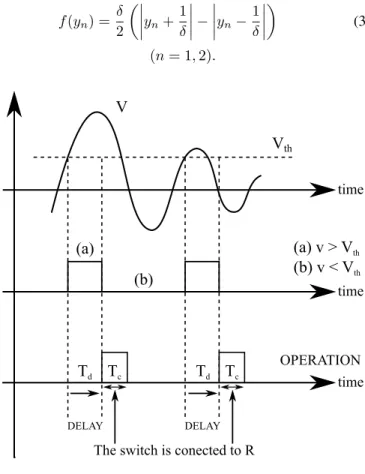
Furthermore, SW is the switch controlled by the amplitude, switch is connected to the resistor R in the case of amplitude is larger than the threshold, and connect time is represented by T

c

. Also, this switching operation is included delay, and delay time is represented by T

d

. Figure 2 shows the switching operation. Voltage reaches the threshold at a certain time, the

switch is not connected to the resistor immediately, which is connected for T

c

seconds after T

d

seconds. Namely, v

1n

reaches V

th

, two chaotic circuits coupled via resistor R is connected for T

c

seconds after T

d

seconds. Figure 3 shows the circuit realization. This circuit is consisted two Monostable Multivibrators. Monostable Multivibrator 1 outputs a pulse at regular intervals in reaction to the rising edge of the input pulse, and Monostable Multivibrator 2 outputs a pulse at reg- ular intervals in reaction to the falling edge of the input pulse.

Pulse width of Monostable Multivibrator 1 is corresponding to the delay time, and pulse width of Monostable Multivibrator 2 is corresponding to the connection time.

L

1

L

2

C -r

v

11

i

11

i

12

v

d

L

1

L

2

C -r

v

11

i

11

i

12

v

d

L

1

L

2

C -r

v

21

i

21

i

22

v

d

L

1

L

2

C -r

v

21

i

21

i

22

v

d

R DELAY(T

d

)

SW

Fig. 1. Circuit model.

By using the variables such that

- 24 -

IEEE Workshop on Nonlinear Circuit Networks

December 13-14, 2013

(2)

 

 

 

 

 

 

 

 

 

i

n1

=

C L

1

V x

n

, i

n2

=

L

1

C L

2

V y

n

, v

n1

= V z

n

α = r

C L

1

, β = L

1

L

2

, δ = r

d

L

1

C L

2

,

γ = 1 R

L

1

C , t = √

L

1

C

2

τ,· ” = d .

(1) That the equation (1) is normalized as

 

 

 

 

 

 

 

 

˙

x

n

= αx

n

+ z

n

˙

y

n

= z

n

f (y

n

)

˙

z

1

= x

1

βy

n

γ(z

1

z

2

)

˙

z

2

= x

2

βy

n

+ γ(z

1

z

2

)

(2)

(n = 1, 2),

The nonlinear function f (y

n

) corresponds to the I V characteristics of the nonlinear resistors consisting of the diodes and are assumed to be described as follows;

f (y

n

) = δ 2

( y

n

+ 1 δ

y

n

1

δ )

(3) (n = 1, 2).

V

th

time

time

time V

DELAY DELAY

The switch is conected to R (b)

(a) (a) v > V

th

(b) v < V

th

T

d

T

d

OPERATION

T

c

T

c

Fig. 2. Switching operation.

III. S YNCHRONIZATION P HENOMENA

We investigate the phenomenon for the case of varying T

c

in the circuit of Fig. 1.

L

1

L

2

C -r

v

11

i

11

i

12

v

d

L

1

L

2

C -r

v

11

i

11

i

12

v

d

L

1

L

2

C -r

v

21

i

21

i

22

v

d

L

1

L

2

C -r

v

21

i

21

i

22

v

d

R

V

th MonostableMultivibrator 1

Monostable Multivibrator 2

Fig. 3. Circuit realization.

A. Circuit Experiments Results

Figure 4 is obtained by cutting out a part of the state to varies continuously.

Figure 4 shows circuit experiments results for the case of varying the T

c

and the parameters are fixed with L

1

= 500[mH], L

2

= 200[mH], C = 0.0153[µF], r

d

= 1.46[M Ω], R = 43.2[kΩ] and V

th

= 5.50[V ]. In Fig. 4(a), two circuits are asynchronous including the in-phase synchronization and anti-phase synchronization. However, in Figs. 4(b) and 4(c), two circuits are synchronized in in-phase. As a result, we confirmed two circuits are synchronized with the increase of T

c

.

B. Computer Calculated Results

Figure 5 shows computer calculated results for the case of varying the T

c

, and the parameters are fixed with α = 0.460, β = 3.0, δ = 470, γ = 0.132 and V

th

= 0.6. In Figs. 5(d), 5(e) and 5(f), we confirmed the phase difference between two circuits decrease with the increase of T

c

. We can say that this interesting phenomenon can be observed from both computer calculations and circuit experiments.

IV. C ONCLUSIONS

In this study, we have investigated the synchronization phenomena observed from coupled chaotic circuits containing time delay coupling. We confirmed the phase difference be- tween two circuits decrease with the increase of connection time and phase difference between two circuits switch in asynchronous and in-phase synchronization with the increase of time delay

Investigating the detail of the states and statistical analysis of the observed phenomena are our important future work as well as more detailed explanation of the mechanism of the generations.

R EFERENCES

[1] Y. Nishio and A. Ushida, “Chaotic Wandering and its Analysis in Simple Coupled Chaotic Circuits,” IEICE Trans. Fundamentals, vol. E85-A, no.

1, pp. 248-255, 2002.

- 25 -

(3)

(a)

Td=100µs,Tc=100µs.

(b)

Td=100µs,Tc=330µs.

(c)

Td=100µs,Tc=560µs.

Fig. 4. Phase difference between two circuits for the case of varying the T

c

(circuit experiments).

[2] G. Abramson,V. M. Kenkre and A. R. Bishop, “Analytic Solutions for Nonlinear Waves in Coupled Reacting Systems,” Physica A: Statistical Mecanics and its Applications, vol. 305, no. 3-4, pp. 427-436, 2002.

[3] I. Belykh, M. Hasler, M. Lauret and H. Nijmeijer, “Synchronization and Graph Topology,” Int. J. Bifurcation and Chaos, vol. 15, no. 11, pp.

3423-3433, 2005.

[4] M. Wada, Y. Nishio and A. Ushida, “Analysis of Bifurcation Phenom- ena in Two Chaotic Circuits Coupled by an Inductor,” IEICE Trans.

Fundamentals, vol. E80-A, no. 5, pp. 869-875, 1997.

[5] T. Maruyama, Y. Nishio, N. Inaba, S. Mori and S. Mori, ”Chaos in an Auto Gain Controlled Oscillator Containing Time Delay” Transactions of IEICE (in Japanese), vol. J72-A, no. 11, pp. 1814-1820, Nov. 1989.

[6] Y. Nishio, N. Inaba, S. Mori and T. Saito, “Rigorous Analyses of Windows in a Symmetric Circuit,” IEEE Transactions on Circuits and Systems, vol. 37, no. 4, pp. 473-487, Apr. 1990.

[7] C. Bonatto and J. A. C. Gallas, “Periodicity Hub and Nested Spirals in the Phase Diagram of a Simple Resistive Circuit,” Phys. Rev. Lett., 101, 054101, Aug. 2008.

[8] R. Stoop, P. Benner and Y. Uwate, “Real-World Existence and Origins of the Spiral Organization of Shrimp-Shaped Domains,” Phys. Rev. Lett., 105, 074102, Aug. 2010.

x 1

x

2

(a)

Td= 50,Tc= 100.

x 1

x

2

(b)

Td= 50,Tc= 200.

x 1

x

2

(c)

Td= 50,Tc= 300.

x

1

-x

2

τ

(d)

Td= 50,Tc= 100.

x

1

-x

2

τ

(e)

Td= 50,Tc= 200.

x

1

-x

2

τ

(f)

Td= 50,Tc= 300.

Fig. 5. State variation for the case of varying the T

c

. (a), (b) and (c) phase difference between two circuits (computer simulations). (d), (e) and (f) the value of x

1

x

2

with varying time.

- 26 -

Figure 1 shows the circuit model. In the circuit, two Nishio- Nishio-Inaba circuits are coupled via resistor R and switch SW
Figure 4 is obtained by cutting out a part of the state to varies continuously.
Fig. 4. Phase difference between two circuits for the case of varying the T c (circuit experiments).

参照

関連したドキュメント

In order to investigate basic clustering phenomena, seven chaotic circuits are globally coupled with the distance information.. The clustering phenomena are observed when the

In this study, we have investigated synchronization state observed some pattern of ring coupled by time delayed chaotic circuits. In case of ring coupled by resistors, we

Abstract—In this study, we investigate chaos propagation and synchronization phenomena in coupled chaotic circuits with star- and-ring combination when one circuit is set to

In this study, we have investigated the synchronization phenomena in coupled oscillators containing star structure connected to another oscillator.. By computer simulation, we

As a result, in ladder ten coupled chaotic circuits, when we increase the coupling strength from γ = 0.0055 to 0.01, three periodic attractors are propagated chaotic

In this study, we investigate the synchronization phenomena of coupled two symmetrical structures and the influence of the network topology when we use chaotic circuits.. One

Nishio, “Effect of Changing Coupling Strength to Synchronization Phenomena in Coupled van der Pol Oscilla- tors,” Proceedings of RISP International Workshop on Nonlinear

Abstract—In this study, we investigate synchronization phe- nomena in coupled chaotic network including one ladder and five ring structuresI. We set the bifurcation parameter of