Chaos Propagation of Scale-Free
Coupled Chaotic Circuits with Different Topology
Takahiro Chikazawa, Yoko Uwate and Yoshifumi Nishio Dept. of Electrical and Electronic Engineering, Tokushima University
2-1 Minami-Josanjima, Tokushima 770–8506, Japan Email: { chikazawa,uwate,nishio } @ee.tokushima-u.ac.jp
Abstract—In this study, we investigate chaos propagation in scale-free coupled chaotic circuits. When one circuit is set to generate chaotic attractor and the other circuits are set to generate three-periodic attractors. We observe how to propagate chaos in each proposed network. Moreover, we confirm that chaos propagation of the compact network with high degree node is more difficult.
I. I
NTRODUCTIONIn the complex network, various type of propagation have attracted a great deal of attention from various fields. The pandemic outbreak of viral infection and the traffic jam of the transportation network are mentioned as an example of propagation in the real network. It is important to investigate chaos propagation under some difficult situations for the circuits. Additionally, it is important to investigate propaga- tion phenomena observed from coupled chaotic circuits for future engineering applications. However, there are not many studies of large-scale network of continuous-time real physical systems such as electrical circuits. [1]-[3]
In our research group, chaos propagation have been investi- gated only in simple networks such as ladder and ring topology [4],[5]. In this study, we investigate chaos propagation in coupled chaotic circuits with scale free network.
1We propose scale free networks using of chaotic circuits coupled by the resistors. In this model, one circuit is set to generate chaotic attractor and the other circuits are set to generate three-periodic attractors. First, we observe how to chaos propagation by increasing the coupling strength. Moreover, we investigate chaos propagation in the entire system when we changed the positions of chaotic attractor and three-periodic attractors according to degree distribution.
II. P
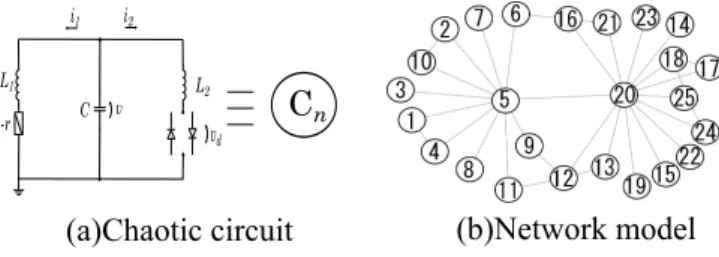
ROPOSED MODELThe chaotic circuit and network model are shown in Fig. 1.
This circuit consists of a negative resistor, two inductors, a capacitor and dual-directional diodes. This chaotic circuit is called Nishio-Inaba circuit (see Fig. 1(a)). The normalized
1The extended version of this study is being reviewed for ISCAS’17[6].
i1 i2
L1
-r C v
vd L2
C
n(a)Chaotic circuit (b)Network model
Fig. 1.
Proposed model.
circuit equations are given as follows:
dx
idτ = αx
i+ z
idy
idτ = z
i− f (y
i) dz
idτ = − x
i− βy
i− ∑
j∈Sn
γ(z
i− z
j) (i, j = 1, 2, · · · , N ).
(1)
f (y
i) is described as follows:
f(y
i) = 1 2
( y
i+ 1 δ
− y
i− 1
δ )
. (2)
In Eq. (1), N is the number of coupled chaotic circuits and γ is the coupling strength. We define α
cto generate the chaotic attractor and α
pis defined to generate the three- periodic attractors. For the computer simulations, we calculate Eq. (1) using the fourth-order Runge-Kutta method with the step size h = 0.01. In this study, we set the parameters of the system as α
c= 0.460, α
p= 0.412, β = 3.0 and δ = 470.0.
In our system, each chaotic circuit is coupled by one resistor R. Our proposed network model is shown in Fig. 1(b). In this network, the number of nodes which use chaotic circuit are 25 nodes and the number of edges which connect one resister are 34 edges. Other feature quantities of proposed each network is expressed in Table 1. In this model, there are high degree nodes such as hub. For example, 5th node and 20th node.
III. S
IMULATION RESULTSA. Chaos propagation
We investigate the chaos propagation by increasing the coupling strength in each model. In initial state, 6th node is
- 73 -
IEEE Workshop on Nonlinear Circuit Networks December 9-10, 2016
25 23
22 20 21
18
11
17
19 24 16
12 10
6
5
9 13
14
8 15 7
4 3
1 2
25 23
22 20 21
18
11
17
19 24 16
12 10
6
5
9 13
14
8 15 7
4 3
1 2
25 23
22 20 21
18
11
17
19 24 16
12 10
6
5 9
13 14
8 15 7
4 3
1 2
(i) γ=0.000 (ii) γ=0.001 (iii) γ=0.008 (iv) γ=0.013
:Chaotic attractor :Three-periodic attractor 25
23
22 20 21
18
11
17
19 24 16
12 10
6
5
9 13
14
8 15 7
4 3
1 2
Fig. 2.
The appearances from three-periodic attractor to chaotic attractor.
TABLE I
FEATURE QUANTITIES OF PROPOSED NETWORK.
Feature Network model
Avg. degree 2.72
Avg. path length 2.3
Avg. clustering coefficient 0.397
set to generate chaotic attractor and the other 24 nodes are set to generate three-periodic attractors. Moreover, the bond number of 6th node is 2.
Figure 2 shows the appearances how to spread from three- periodic attractor to chaotic attractor. When we increased the coupling strength in γ = 0.013, all three-periodic attractors change to chaos attractors. From the result, all three-periodic attractors are propagated the chaotic attractor by increasing the coupling strength and chaos behavior shifts to the neighbor circuits.
B. Ratio of propagation
In this section, we investigate ratio of propagation by changing the value of degree in the initial chaos position.
First, we define initial number of chaotic attractor and three- periodic attractor. we set the parameter so that one node is set to generate chaotic attractor and other 24 nodes are set to generate three-periodic attractors. Moreover, when we fix coupling strength as γ = 0.000, we change the initial position of chaotic attractor according to degree distribution in each model. For example, when the value of degree in the initial chaos position is 11, we set the chaotic attractor in 5th node. Finally, we investigate ratio of propagation when we fix coupling strength as γ = 0.001, 0.005. Ratio of propagation according to degree distribution in each model are shown in Fig. 3.
When we fix coupling strength as γ = 0.005. The highest ratio of propagation is 80% when the value of degree in the initial chaos position is 1. Therefore, 20 three-periodic attractors are changed to chaotic attractor by chaotic node.
From the result, in each coupling strength, when we in- creasing the value of degree in the initial chaos position, chaos propagation is more difficult.
IV. C
ONCLUSIONSIn this study, we have investigated chaos propagation in cou- pled chaotic circuits as our proposed model. By the computer simulations, we confirmed that the three-periodic attractors are
Fig. 3.
Ratio of propagation according to degree distribution.
affected from the chaotic attractors when the coupling strength increase. Moreover, we investigate the ratio of propagation by changing the initial chaos position. From the result, we consider that high degree node such as hub weakens weight of chaos.
For the future works, we develop the network model into large scale complex networks. Considering the other network of chaotic circuits is important subjects for us.
A
CKNOWLEDGMENTThis work was partly supported by JSPS Grant-in-Aid for Scientific Research 16K06357.
R
EFERENCES[1] Y. Nishio and A. Ushida, “Chaotic Wandering and its Analysis in Simple Coupled Chaotic Circuits,” IEICE Trans. Fundamentals, vol. E85-A, no.
1, pp. 248-255, 2002.
[2] G. Abramson, V.M. Kenkre and A.R. Bishop, “Analytic Solutions for Nonlinear Waves in Coupled Reacting Systems,” Physica A: vol. 305, no. 3-4, pp. 427-436, 2002.
[3] L. Jinhu, Y. Xinghuo and C. Guanrong, ”Chaos synchronization of general complex dynamical networks” Physica A: Statistical Mechanics and its Applications, vol. 334, pp.281-302, 2004
[4] Y. Uwate and Y. Nishio, “Chaos Propagation in a Ring of Coupled Cir- cuits Generating Chaotic and Three-Periodic Attractors” Proceedings of IEEE Asia Pacific Conference on Circuits and Systems (APCCAS’12), pp. 643-646, Dec. 2012.
[5] Y. Uwate, T. Ott and Y. Nishio,“Clustering Phenomena in Coupled Chaotic Circuits with Different Coupling Strength” Proceedings of European Conference on Circuit Theory and Design (ECCTD’13), DOI:10.1109/ECCTD.2013.6662220 (4 pages), Sep. 2013.
[6] T. Chikazawa, Y. Uwate and Y. Nishio,“Spread of Chaotic Behavior in Complex Network with Coupled Chaotic Circuits”, IEEE International Symposium on Circuits and Systems(ISCAS), 2017. (being submitted)