Synchronization Phenomena of Coupled Chaotic Circuit Network with Bridge
Kenta Ago, Yoko Uwate and Yoshifumi Nishio Dept. of Electrical and Electronic Eng.,
Tokushima University, 2-1 Minami–Josanjima, Tokushima,
770-8506 JAPAN
Email:{kentago, uwate, nishio}@ee.tokushima-u.ac.jp
Abstract— In this study, we investigate synchronization phe- nomena of coupled chaotic circuit network with the bridge. By computer simulations, synchronization of the bridge on the network is easy to break down and clustering of circuits is occurred from the bridge. Moreover, we statistically investigate synchronous rate.
I. INTRODUCTION
Recently, engineering applications of chaos have received a lot of attention by many researchers. For example, commu- nication systems of chaos, control of chaos, synchronization of chaos and so on. Especially, synchronization of chaos is very interesting phenomena that chaotic elements synchronize in spite of different initial values[1]. Additionally, coupled systems of chaotic elements generate many kinds of com- plexity phenomena such as spatiotemporal intermittency[2], clustering[3], and so on. Coupled Map Lattice (CML) and Globally Coupled Map (GCM) proposed by Kaneko are very simple and carried out for discrete–time mathematical model. However, many of nonlinear phenomena generated in nature would be not so simple. Therefore, it is important to investigate the complex phenomena observed in continuous–
time real physical system such as electrical circuits[4]–[6].
In this study, we investigate synchronization phenomena in coupled chaotic circuit network with the bridge. The Bridge is the edge which provide the only route between two nodes. In order to analyze complex phenomena of the bridge on the network, each node is applied chaotic circuits and connected via registers. By computer simulations, we observe synchronization phenomena between circuits. Moreover, we statistically investigate synchronous rate.
II. NETWORK MODEL
Figure 1 shows chaotic circuit which is three-dimensional autonomous circuit proposed by Mori et al.[7][8]. A Proposed network model is shown in Fig. 2. In this study, chaotic circuits are applied to nodes of the network and are used resistors as coupling elements. In this model, the bridge is the resistor between CC3 and CC4.
-g
c
2v
2nCCn c
1 Lv
1nidn in
Fig. 1. Chaotic circuit.
R
CC1
CC2 CC3
CC3 CC4
CC6
CC5 CC7
R
R R R R
R
R R
↑ bridge
Fig. 2. Model of coupled chaotic circuits network with bridge.
First, the circuit equations are given as follows:
Ldin dt =v2n C1dv1n
dt =gv1n−idn− 1 R
∑
k∈Cn
(v1n−v1k)
C2
dv2n
dt =−in+idn,
(1)
(n= 1,2,3, ...,7),
where Cn is set of nodes which are connected to CCn. We approximate thei−vcharacteristics of the nonlinear resistors consisting of the diodes by the following 3-segment piecewise- linear function,
idn=
Gd(v1n−v2n−a) (v1n−v2n > a) 0 (|v1n−v2n| ≤a) Gd(v1n−v2n+a) (v1n−v2n <−a).
(2)
- 27 -
IEEE Workshop on Nonlinear Circuit Networks December 13-14, 2013
By using the parameters and variables as follows:
in =
√C2
Laxn, v1n=ayn, v2n=azn t=√
LC2τ, “·” = d
dτ, α= C2
C1
β =
√ L C2
Gd, γ=
√ L C2
g, δ= 1 R
√L C2
,
(3)
the normalized circuit equations are given as follows:
˙ xn=zn
˙
yn =αγyn−αβf(yn−zn)−αδ ∑
k∈Cn
(yn−yk)
˙
zn=βf(yn−zn)−xn,
(4)
where the nonlinear function corresponding to the character- istics of the nonlinear resistor of the diodes and are described as follows:
f(yn−zn) =
yn−zn−1 (yn−zn >1) 0 (|yn−zn| ≤1) yn−zn+ 1 (yn−zn <−1).
(5)
This circuit generates chaotic attractor as shown in Fig. 3.
y
1Z
1Fig. 3. Example of chaotic attractor.α= 0.4,β= 0.5andγ= 20.
III. SIMULATIONRESULT
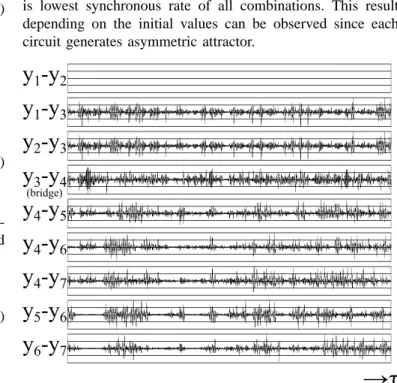
In this study, we fix the parameters as α= 0.4, β = 0.5, γ = 20 and δ on all circuits. We focus on the coupling strength δ. Each circuit is given different initial values each other. Figure 4 shows the computer simulation result in the case of δ = 0.25. Also, the vertical axes are the differences between the voltage of the two chaotic circuits. Namely, if the two chaotic circuits synchronize, the value of the graph should be almost zero likey1−y2. In Fig. 4, synchronization of the bridge (y3−y4) is easy to break down compared with other circuit combinations and clustering of circuits is occurred from the bridge.
Moreover, in order to analyze synchronization, we define the synchronization as following equation,
|yn−yk|<0.01, (6) wherenis the number of circuits andkis circuits which con- nected circuitn. Figure 5 shows statistically investigated result
of synchronous rate. Synchronous rate of Fig. 5 corresponds to Fig. 4. Also, iteration time is fixed with 10,000,000. In Fig. 5, we confirmed that CC1 and CC2 synchronized almost completely. On the other hands, the other combinations show low synchronous rate. In addition, the bridge (CC3 and CC4) is lowest synchronous rate of all combinations. This result depending on the initial values can be observed since each circuit generates asymmetric attractor.
y
1-y
2y
1-y
3y
2-y
3y
3-y
4y
4-y
5y
4-y
6y
4-y
7y
5-y
6y
6-y
7(bridge)
→τ
Fig. 4. Computer simulation result.δ= 0.25.
Fig. 5. Synchronous rate.δ= 0.25.
IV. CONCLUSION
In this study, we have investigated influence of the bridge on the network via synchronization phenomena of coupled chaotic circuits. By computer simulations, synchronization of the bridge is easy to break down and clustering of circuits is occurred from the bridge. In our future works, we investigate the other networks with the bridge and carry out circuit experiment.
- 28 -
REFERENCES
[1] L. M. Pecora and T.L. Carrol, “Synchronization in Chaotic Systems,”
Physical Review Letters, vol. 64, pp. 821-824, 1990.
[2] K. Kaneko, “Spatiotemporal Intermittency in Coupled Map Lattices,”
Progress of Theoretical Physics, vol. 74, No. 5, pp. 1033-1044, 1985.
[3] K. Kaneko, “Clustering, Coding, Switching, Hierarchical Ordering, and Control in a Network of Chaotic Elements,” Physica D, vol. 41, pp. 137- 172, 1990.
[4] T. Endo, and S. Mori, “Mode Analysis of a Ring of a Large Number of Mutually Coupled van der Pol Oscillators,” IEEE Trans. Circuit and Systems, vol. CAS-25, no. 5, pp. 7-18, 1978.
[5] D. A. Likens, “Analytical solution of large numbers of mutually- coupled nearly-sinusoidal oscillators,” IEEE Trans. Circuit and Systems, col. CAS-21, pp. 294-300, 1974.
[6] H. Sekiya, S.Moro, S.Mori, and I.Sasase, “ Synchronization Phenomena on Four Simple Chaotic Oscillators Full-Coupled by Capasitors,” IEICE Trans., vol. J82-A, No.3, pp. 375-385, 1999.
[7] M. Shinriki, M. Yamamoto and S. Mori, “ Multimode Oscillations in a Modified van der Pol Oscillator Containing a Positive Nonlinear Conductance,” Proc. IEEE, vol. 69, pp. 394-395, 1981.
[8] N. Inaba, T. Saito and S. Mori, “ Chaotic Phenomena in a Circuit with a Negative Resistance and an Ideal Switch of Diodes,” IEICE Trans., vol. E-70, pp. 744-754, 1987.
[9] S. Mark, “ The Strength of Weak Ties,” American Journal of Sociology, vol. 78, pp. 1360-1380, 1973.
[10] M. Miyamura, Y. Nishio and A.Ushida, “ Clutering in Globally Coupled System of Chaotic Circuits,” IEEE Proc. ISCAS’02, vol. 3, pp. 57-60, 2002.
- 29 -
![Figure 1 shows chaotic circuit which is three-dimensional autonomous circuit proposed by Mori et al.[7][8]](https://thumb-ap.123doks.com/thumbv2/123deta/7315200.2423323/1.892.486.784.325.690/figure-shows-chaotic-circuit-dimensional-autonomous-circuit-proposed.webp)