Extraction. Spectrophotometric Determination
of Copper after Extraction of Its Oxine
(8-hydroxyquinoline) Chelate with Melted
Naphthalene
journal or
publication title
福井大学工学部研究報告
volume
18
number
2
page range
215-219
year
1970-09
URL
http://hdl.handle.net/10098/4794
Solid-liquid Separation after Liquid-liquid
~xtraction.Spectrophotometric Determination of Copper
a~ter
I:xtraction of Its Oxine (8-hydroxyquinoline) Chelate
with Melted Naphthalene
Masatada SATAKE*
(Received Apr. 9, 1970)
A new method of liquid-liquid extraction of copper oxinate with melted naphthalene followed by solid-liquid separation has been proposed by Fujinaga et al.ll ,2) for the trace analysis of copper. In this experiment, the pH of sample
solution was adjusted to 3.5-12 after oxine solution was added. The solution was then heated on a water bath at about 90°C, shaken vigorously after the addition of naphthalene as the solvent to extract copper oxinate, and stood still at room temperature. The solidified naphthalene phase was washed with distilled water by decantation, dissolved and diluted to a definite volume with benzene. The optical absorbancy at 420 nm was measured to determine the amount of copper. Beer's law was obeyed with the amount of copper up to 100 f1.g in 10ml of benzene.
1 Introduction
Oxine reacts with various metal ions to form very stable chelates (oxinates), and these oxinates have been widely used for the spectrophotometric determination of metals using organic solvent such as chloroform or benzene as extractant. A new method "analysis by solid-liquid separation after liquid-liquid extraction" has been suc-cessfully applied using melted organic compound with appropriate degree of melting point (namely, solidified at room temperature and liquefied on a water bath) as extra-ctant, e. g., naphthalene (mp : 80. 05°C), diphenyl (mp : 70. 5°C), etc. By standing the melted layer at room temperature, it changes to solidified beads. These beads are washed with water by decantation, dissolved and diluted to a definite volume with an appropriate solvent. Then the optical absorbancy of the solution is measured at definite wavelength to determine the amount of metal. Fujinaga et al. have already reported on the determination of copper using melted diphenyl as extractant. 1> In the
present work, the melted naphthalene is chosen as extractant of copper oxinate from its aqueous solution. The distribution equilibrium is attained very rapidly under the condition. The melted naphthalene layer changes to solidified deposit by standing it at
room temperature. The naphthalene deposit is soluble in benzene, methyl alcohol, ethyl alcohol, etc. forming transparent yellow solution. Spectrophotometric determination of copper using the extraction method has been discussed here in details.
2 Experimental method 2 • 1 Reagents
All reagents were of analytical reagent grade. The water used was redistilled water after deionization. Standard copper solution (1 x
la-
2M) was prepared by dissolving1.2485 g of copper sulfate in water containing a few drops of concentrated sulfuric acid and diluting to 1 litre. This solution was standardized against EDT A solution. More dilute copper solutions were prepared as required by diluting the standard solution. Oxine solution (1%) was prepared by dissolving 1 g of oxine in 2 ml·of glacial acetic acid on a water bath and diluting to 100 ml with water. Buffer solution was prepared by mixing adequate volume of 1 M ammonium chloride and 1 M ammonia water. Alkali salts solutions were prepared by dissolving 1.000 g of each salt in water and diluting to 100 ml. Metal salts solutions were made to contain 0.250 g of each salt per 250 ml of the solution. All other reagents of analytical grade were used without further purifi-cation.
2 • 2 Apparatus
Spectrophotometer: Shimadzu Spectrophotometer, Model AQ-50, with matched 10mm glass cell.
pH meter: Toa-Dempa, Model HM-5A, with general-purpose glass electrode.
2 • 3 Procedure
To 0.5-4 ml of sample solution of copper sulfate (5 x 10⁻⁴ M) in a 50-ml Erlenmeyer
flask furnished with a tight stopper, add 1 ml of 1 % oxine solution, 2 ml of the buffer solution and a few drops of concentrated ammonia water, adjusting the pH of the solution to 4.5. Shake the solution sufficiently, heat it on a steam bath at 90°C, add 2.5 g of naphthalene and keep it on the bath until naphthalene melts completely. Shake the mixture vigorously, stand it at room temperature till the naphthalene layer solidifies to many fine crystals. Filter the mixture with a filter paper. After washing the deposit on the filter paper with water, spread them on a dry filter paper for air-drying. Dissolve the naphthalene crystals with benzene after addition of 2 g of an-hydrous sodium sulfate and dilute the solution to 10 m!. Transfer a portion of this solution into a cell and measure the absorbance at 420 nm against the reagent blank to determine the amount of copper.
3 Results and Discussion 3 • 1 Absorption spectra
absorption maximum at 420 nm as shown in Fig. 1. At wavelengths greater than 370 nm, there were small absorbances due to the reagent blank (curve 1). Therefore, 420 nm was taken as the optimum wavelength throughout this experiment.
(J) v s:: C1j 0.8 0.6 ~0.4 r:Jl ,....D
-<
0.2 0.0 350 _370 390 410 430 450 Wavelength, nmFig. 1 Absorption spectra Cu : (<1) 64.ug, ® 159.ug) ; pH : 4.5 Naphthalene: 2.5g ; Buffer solution: 2ml ; Reference: Water; CD Reagent blank in 10ml benzene ; ® Cu-oxinate in 10ml benzene ; ® Cu-oxinate in 25ml ethyl alcohol 3 • 2 Effect of pH 0.8 0.6 2 4 6 8 10 12
pH
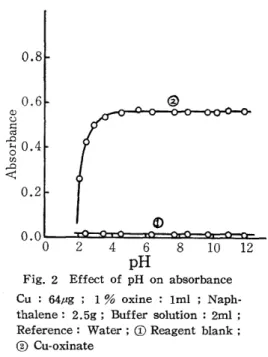
Fig. 2 Effect of pH on absorbance Cu : 64.ug ; 1 % oxine : 1ml ; Naph-thalene: 2. 5g; Buffer solution : 2ml ; Reference: Water; CD Reagent blank;
® Cu-oxinate
The relation between the absorbance and the pH of the aqueous solution containing copper oxinate was investigated in the pH range of 2 - 12, and the results obtained is shown in Fig. 2. A definite and maximum absorbance was obtained in the pH range of 3.5-12. The pH value of the solution was adjusted to 4.5 throughout this experiment considering the effect of the diverse ions.
3 • 3 Effect of oxine concentration
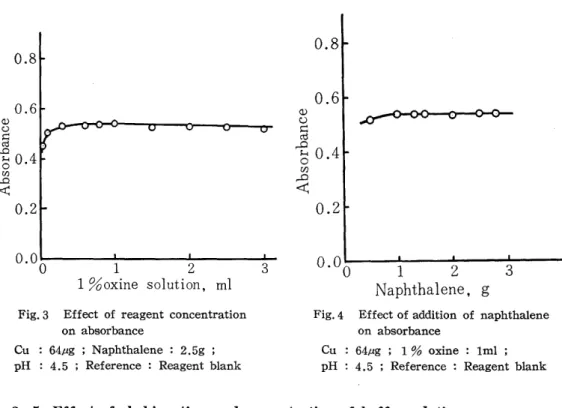
The effect of the oxine concentration in the solution containing 64 p.g of copper at pH 4.5 on extraction was investigated, and the result is shown in Fig. 3. It indicates that when more than 1.5 ml of 1 % oxine solution was added, the absorbances became almost constant. Therefore, 2 ml of the oxine solution were taken throughout this experiment.
3 • 4 Effect of amount of naphthalene
The effect of the amount of naphthalene on extraction was investigated, and the result is shown in Fig. 4. It indicates that the absorbance increases with the increase of the amount of naphthalene and became almost constant by addition of 1 - 2.8 g of naphthalene. The volume of benzene required to dissolve 1 g of naphthalene was 3.5 ml
a.l C,) ~
0.8
0.6 cd . ..0. ~0.4 (J) ..0.<r:
0.2
1 2 1 %oxine solution, mlFig. 3 Effect of reagent concentration on absorbance
Cu : 64.ug ; Naphthalene: 2.5g ; pH : 4.5 ; Reference : Reagent blank
3 1 2 3
Naphthalene, g
Fig. 4 Effect of addition of naphthalene on absorbance
Cu 64.ug; 1 % oxine : 1ml ; pH : 4.5 ; Reference : Reagent blank
3 • £) Effect of shaking time and concentration of buffer solution
The effect of the shaking time and the concentration of 1 M ammonium chloride-ammonia buffer solution on extraction of copper oxinate was investigated. The speed of extraction by shaking was very fast owing to high temperature, namely, only several seconds' shaking was sufficient to extract copper oxinate completely. The absorbance became almost constant by the addition of 0.5-5 ml of the buffer solution. Two ml of the buffer solution were used throughout this experiment.
3 • 6 Calibration curve
Based on the optimum conditions obtained from the experiments described above, the absorbances of the standard copper solutions of various concentrations were mea-sured. The absorbance of the extract shows a linear relationship to the concentrations of copper in the range of 10-100 pg per 10 ml of benzene. The calculated molar absorp-tivity under these conditions was 5.4 x 10³
•
3 • 7 Effect of diverse ions
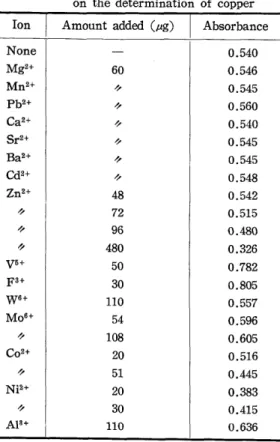
The effects of diverse ions on copper determination were investigated, and the result is shown in Table I. The absorbance measurements were carried out with the naphthalene-benzene solutions of copper oxinate extracted from the aqueous solutions containing various amount of diverse ions. The following ions gave considerable interferences: Fe3+, AP+, V5+, C02+, NP+, MoH, oxalate. Especially even small amount
of EDTA gave serious interferene. Amoung these metal ions, AJ3+ can be masked with the addition of 0.5 ml of 10 % ammonium fluoride, NiH and V5
Table I Ion None Mg2+ Mn2+ Pb2+ Ca2+ Sr2+ Ba2+ Cd2+ Zn2+ Ni~+
The effect of diverse metal ions on the determination of copper Amount added (pg) 60 48 72 96 480 50 30 110 54 108 20 51 20 30 110 Absorbance 0.540 0.546 0.545 0.560 0.540 0.545 0.545 0.548 0.542 0.515 0.480 0.326 0.782 0.805 0.557 0.596 0.605 0.516 0.445 0.383 0.415 0.636
ammonium citrate, Fe3+ and Co2+ with
2 ml of 20 % ammonium citrate. Chloride, nitrate, sulfate, carbonate, thiocyanate, fluoride, tartrate and citrate did not interfer.
Acknowledgement The auther wishes to thank Professor Taitiro Fujinaga, University of Kyoto, and Professor Tatsuo Yonekubo, University of Fukui for their kind comments.
References
1) T. Fujinaga, T. Kuwamoto and E. Nakayama: Talanta, 1969, 16, 1225. 2) T. Fujinaga, T. Kuwamoto, T.
Yoneku-bo and M. Satake: Bunseki Kagaku, 1969, 18, 1113.