Solid-liquid Separation after Liquid-liquid
Extraction. Sped:rophotometric Determination
of Magnesium after Extraction of Its Oxinate
with Melted Naphthalene
journal or
publication title
福井大学工学部研究報告
volume
18
number
2
page range
225-228
year
1970-09
URL
http://hdl.handle.net/10098/4796
Solid-liquid Separation after Liquid-liquid
~xtraction.Sped:rophotometric Determination of Magnesium after
~xtraction
of Its Oxinate with Melted Naphthalene
Masatada SATAK.E*
(Received Apr. 9, 1970)
A new method by "solid-liquid separation after liquid-liquid extraction" was proposed for the spectrophotometric determination of trace amount of magne-sium. This method is based on the formation of a yellow chelate (oxinate) which is quantitatively extractable by melted naphthalene in the pH range of 10-12. The extract of oxinate in naphthalene is not soluble in ethyl alcohol, benzene or chloroform, but is soluble in methyl alcohol. The optical absorbancy at 375 nm was measured against the reagent blank and the Beer's law was obeyed with 5-120 p.g of magnesium in 25 m1 of methyl alcohol. The chelate in methyl alcohol solution is very stable for a long time.
1 Introduction
Oxine has been used for the spectrophotometric determination of aluminum, iron, copper and various other metals by extracting their oxinates from the aqueous solution into organic solvents such as chloroform or benzene.
The auther has already mentioned in the previous paper!) that the method cannot be applied for the determination of some metals such as zinc, magnesium, cadmium or beryllium. On the contrary, a new method called "solid-liquid separation after liquid-liquid extraction" can be applied for these cases. The characteristic of the method is to extract metal oxinate into melted organic compound with appropriate degree of melting point such as naphthalene, diphenyl, paraffins, etc .. In the present study, mag-nesium was chosen as a metal to be determined and its oxinate was extracted into melted naphthalene. After cooling the mixture of oxinate and naphthalene, the solidified crystals were dissolved in methyl alcohol (transparent yellow solution). Spectrophotome-tric determination of magnesium by this method has been discussed in details.
2 Experiemntal method 2 • 1 Reagents
Standard magnesium solution (l0-2M) was prepared by dissolving 2.0333 g of magne-sium chloride in water and diluting to 1 liter. This solution was standardized against EDT A solution. More dilute magnesium solutions were prepared as required by diluting the standard solution. The other reagents and apparatus are the same as that reported in the previous paper.2)
2 • 2 Procedure
In a 5O-ml tightly glass-stoppered Erlenmeyer flask was added 0.5-4 ml of 10-3 M standard magnesium solution, approximately 20 ml of distilled water, 2 ml of 1% oxine solution, 2 ml of 1 M ammonium chloride-ammonia buffer solution and several drops of concentrated ammonia water to give a solution (pH about 10) and the total volume of approximately 30 ml. The solution was mixed thoroughly, allowed to stand for 30 minutes, and warmed 15 minutes on a water bath at 60°C. Add 1.6 g of naphth-alene and warm the mixture at 90° C resulting the naphthnaphth-alene layer to melt completely. Shake it vigorously till naphthalene layer solidifies forming many fine crystals, and stand to cool them to room temperature. Again heat and melt slowly the suspended naphthalene in a water bath,and the fine crystals grow up to larger crystalline deposit. After cooling at room temperature, the solidified deposit was washed with distilled water by decantation, spread them on a dry filter paper for air-drying. Dissolve the naphth-alene crystals with methyl alcohol, and dilute the solution to 25 ml. Transfer a portion of this solution into a cell and measure the absorbance at 375 nm against the reagent blank to determine the amount of magnesium.
3 Results and discussion 3· 1 Absorption spectra
The absorption spectra of magnesium oxinate in naphthalene-methyl alcohol solution,
1.0
0.8
0.2
0.0 340 360 380 400 420
Wavelength, nm
Fig. 1 Absorption spectra of oxine and mag-nesium oxinate in naphthalene-methyl alcohol
Mg : 49,ug ; 1% oxine : 2ml; Naphth-alene: 1.6 g ;
pH : 10 ; Buffer solution : 2ml ;
CD Reagent blank against water
® Mg+reagent blank against water
® Mg+reagent blank against rea-gent blank
which contains 49 p.g of magnesium, had an absorption maximum at 375 run as is seen in Fig. 1. Beyond this wavelength, there
0.5 0.4 (J)
g
0.3 cd ...a...
o ~ 0.2 0.1 Fig. 2 8 9 10 11pH
Effect of pH on absorbance Mg: 49 ,ug ; 1% oxine: 2m1 ; Naphthalene: 1.6g ; pH : 10 ; Buffer solution : 2ml ; Reference : Water;CD Reagent blank ® Mg-oxinate
was a slight absorption due to the reagent blank (curve 1). Therefore, 375 nm was chosen as the optimum wavelength throughout this experiment.
3 • 2 Effect of pH
The relation between the absorbance of the extract and the pH of the aqueous solution was investigated in the pH range of 8-12, and the result obtained is shown in Fig. 2. A curve at 375 nm shows that magnesium oxinate begins to be extracted from pH 8 and increases with the increase of pH, finally reaching to almost constant beyond pH 9.5. The pH of the solution was adjusted to 10 throughout the experiment; 2 ml of the buffer solution were added.
3 • 3 Effect of oxine concentration
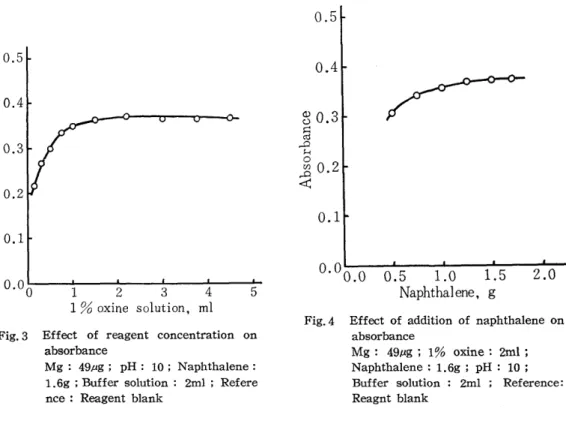
The effect of the oxine concentration on extraction was investigated, and the result obtained is shown in Fig. 3, which indicates that 2 ml of 1% oxine solution are enough for the quantitative work.
3 • 4 Effect of amount of naphthalene
The effect of the amount of naphthalene on extraction was investigated. The result obtained is shown in Fig. 4. It indicates that the absorbance increases with the increase of the amount of added naphthalene, and becomes almost constant by the addition of more than 1.5 g of naphthalene.
The volume of methyl alcohol required to dissolve 1 g of naphthalene was 13 ml.
1
%
oxine solution, mlFig. 3 Effect of reagent concentration on absorbance
Mg : 49.ug; pH: 10; Naphthalene: 1.6g ; Buffer solution: 2ml; Refere nce : Reagent blank
0.5 0.4 ~
0.3
~ ...D. H o ~ 0.2 ~ 0.1 0·°0.0 0.5 1.0 1.52.0
Naphthalene, gFig. 4 Effect of addition of naphthalene on absorbance
Mg: 49J.lg; 1% oxine: 2ml; Naphthalene: 1.6g j pH : 10 j
Buffer solution: 2ml ; Reference: Reagnt blank
3 • 5 Effect of shaking time
The effect of the shaking time on extraction of magnesium oxinate by melted naph-thalene was investigated. It shows that the absorbance reaches to a constant value by shaking of more than 1 minute.
3 • 6 Calibration curve
Based on the optimum conditions obtained from the experiments described above, the absorbances of the standard magnesium solutions of various concentrations were mea-sured against the reagent blank. The absorbance of the extracts shows a linear rela-tionship to the concentrations of magnesium over the range of 5-120 fJ.g in 25 m1 of methyl alcohol. The calculated molar absorbancy under these conditions is 4.5 X 10³ at the wavelength of 375 nm.
3 • 7 Effect of diverse ions
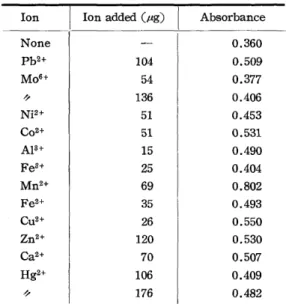
The effect of diverse ions on magnesium determination was investigated, and the result is shown in Table 1. The absorbance measurements were made with magnesium
1) 2)
Table I Effect of diverse metal ions on the determination of magnesium Ion Ion added (Jlg) Absorbance
None 0.360 Pb2+ 104 0.509 MoG+ 54 0.377 ~ 136 0.406 Ni2+ 51 0.453 C02+ 51 0.531 Al3+ 15 0.490 Fe8+ 25 0.404 Mn2+ 69 0.802 Fe2+ 35 0.493 Cu2+ 26 0.550 Zn2+ 120 0.530 Ca2+ 70 0.507 Hg2+ 106 0.409 ~ 176 0.482 References
M. Satake : This memoirs, to be submitted. M. Satake : This memoirs, to be submitted.
in the presence of various amount of div-erse ions. The following ions gave con-siderable interferences: F-, C032-, H2P04 -,
tartrate, MoG+, NF+, C02+, AP+, Fe2+, Fe3+, Mn2+, Cu2+, Zn2+, Ca2+, Hg2+, etc .. Especi-ally large amount of citrate and even small amount of EDT A gave serious interfere-nce. The interference of C02+, Ni2+, Cu2+ and Hg2 + could be masked with the addition of 2 ml of 5% potassium cyanide.
Acknowledgement - - The auther wishes to express his deep gratitude to Professor Taitiro Fujinaga, Facwty of Science, Uni-versity of Kyoto, and Professor Tatsuo Yonekubo, Faculty of Engineering, Univer-sity of Fukui, for their kind advices.