Determination of Nickel with
1‑(2‑thiazolylazo)‑2‑naphthol bySolid‑liquid Separation after Liquid‑liquid Extraction and Spectrophotometry
journal or
publication title
福井大学工学部研究報告
volume 26
number 2
page range 259‑264
year 1978‑09
URL http://hdl.handle.net/10098/4458
FUKUI UNIVERSITY VOL.26 No.2 1978
Determination of Nickel with 1-(2-thiazolylazo)-2-naphthol by Solid-liquid Separation after Liquid-liquid Extraction and Spectrophotometry
Jun'ichiro Miura* and Masatada Satake*
Summary
(Received June 30, 1978)A spectrophotometric method for the determination of nickel based upon the extraction with TAN into a molten naphthalene is described. The nickel-TAN chelate is extracted quantitatively in the pH range 5.0 - B.O.
Zinc, iron(II) and iron(III) are masked with pyrophos- phate. Copper and cobalt are masked
w~thDTCS.
Beer's law is obeyed over the nickel concentration range 2.0 - lB.O
~gper 20 ml of dioxane. The molar absorptivity at 595 nm is 4.1 x 10⁴ 1.mo1e-1.cm-l . Sandell sensitivity is 0.0014 ~g of nickel per cm2.
INTRODUCTION
The separation of metal ions from aqueous solution has been exten- sively investigated. In various methods studied, a solvent extraction is useful as a practical method for the selective separation of specif- ic metal ions. Besides a conventional method such as an extraction with benzene, chloroform and other solvents, several methods have been reported by Fujinagal
), Ikeda 2 ) and Watanabe 3 ) .
The solvent extraction of a colored metal chelate can be applied to a spectrophotometric determination of the metal ion. In this work, the extraction of metal chelate with molten naphthalene was investigated.
This method is called as solid-liquid separation after liquid-liquid extractionl
) . After a chelate is extracted into molten naphthalene, the naphthalene is crystallized by cool. The naphthalene crystal which contains the chelate is separated from aqueous phase.
Satake and co-workers have extensively studied this method by use of 8-hydroxyquinoline(oxine) and its derivatives4
) ,5) .
The purpose of the present work is to establish the practical method by use of this technique.
* Division of Applied Science.
260
Application to the extraction of nickel with 1-(2-thiazolylazo)-2-naph- thol(TAN) is suitable for this purpose. TAN and nickel-TAN chelate are stable at high temperature. It is well known that extraction rate of nickel with TAN is slow at room temperature6
) •
In the proposed method, the extraction is accomplished at elevated temperature. Nickel is rapidly extracted. The time required for filtration is shortened by use of sintered glass ball filter joined to an aspirator. The method established is successful for the spectro- photometric determination of nickel.
EXPERIMENTAL Apparatus and reagents
Apparatus: A Hitachi Model 200-20 Spectrophotometer was used with 10 rom quartz cell. Measurements of pH were made with a Toa Dempa Model HM-6A pH meter and calomel-glass electrode system.
Reagents : Standard metal solutions were prepared from their 1000 ppm standard solutions(Wako Pure Chemical Industries Ltd.).
The 1000 ppm standard solutions were diluted to the desired concentra- tion with 0.1 N hydrochloric acid or 0.1 N nitric acid solution, res- pectively. A 10-3M 1-(2-thiazolylazo)-2-naphthol,TAN, solution was prepared by dissolving 0.0638 g of powder of TAN(Dojindo Labo.) into ethyl alcohol and diluting with ethyl alcohol up to 250 mI.
A pH 6.9 buffer solution was prepared from ammonia water and ammonium phosphate. Other reagents used were of analytical grade.
Recommended procedure
An aliquot of nickel solution was placed in a 50-ml stoppered
Erlenmeyer flask. Masking agents were added as required. Two ml of 10-3
M TAN solution and 5 ml of buffer solution(pH 6.9) were added,and then the mixture was diluted to about 30 ml with distilled water.
A 1.50 g of naphthalene was added to the solution. The mixture was warmed on a water-bath. After the naphthalene melted completely, the solution was tightly stoppered and shaken vigorously while being allowed to cool t i l l the naphthalene crystallized to form a granule.
The granular crystal was filtered off with sintered glass ball filter joined to an aspirator. The naphthalene crystal was washed with distilled water and dissolved in dioxane in the flask. The solution was transferred to a 20-ml volumetric flask and diluted up to mark.
A portion of the solution was transferred into a 10 rom cell and its
absorbance was measured at 595 nm against dioxane as reference.
RESULTS AND DISCUSSION Choice of solvent
TAN, metal-TAN chelates and naphthalene are soluble in various organic solvents. A water-miscible solvent is prefered for the pro- posed method because water, which cannot be eliminated by aspirating, slightly remains in the flask. Attempts were made to dissolve the solid mixture into the water-miscible solvents such as alcohol, dioxane and dimethylformamd..de(DMF).
Naphthalene was slightly soluble in alcohol but was successfully soluble in dioxane or DMF. The absorption maximum of nickel-TAN chelate was at 595 nm in both dioxane
(Figure 2) and DMF. On the other hand, the spec- trum of TAN obtained in dioxane was shifted to shorter wavelength range as shown Figure 1.
The absorption of TAN at 595 nm (peak of nickel chelate) was negligible small in dioxane.
In this work, dioxane
3.0
2.0
Q)
u ~ ..0 ro
10-1 1.0
0 !I)
..0 tct
0
450 550
Wavelength, nm Figure 1. Absorption spectra of TAN
1: TAN in DMF (Ref.: DMF) 650
2: TAN in dioxane (Ref.: dioxane)
was chosen as the mst sui table solvent to dissolve the mixture of nickel chelate and naphthalene.
Absorption spectra of TAN and nickel-TAN chelate
Absorbance was measured against dioxane as reference solution.
In Figure 2, The curves land 2 show the spectra of TAN and nickel-TAN chelate in dioxane, respectively.
Nickel-TAN chelate had an absorption maximum at 595 nm.
Effect of amount of naphthalene
The nickel chelate was extracted int6 naphthalene at pH 6.9.
Amount of naphthalene was varied from 0.50 to 3.00 g. Over the range
262
examined, the, nickel was extracted quantitatively as ShO\V11 inFigure. 3.
In this work, 1.50 9 of naphthalene was used.
0.5
E s::
,
0.4 Ln 0.5 f-
-
0)
Ln 0.4 f-
4J ~
m f0-
G) 0.3
() G)
()
0.3 s:: m
...Q l-!
0.2 f- -
m s::
...Q
0.1 fo-
~
0.2
l-! 0 (/l...Q A!
0.1
o ~1
---
550 600
Wavelength, nm
650
...Q 0
A!
,
0 Figure 3.
-
1.0 2.0 3.0 Naphthalene, g Effect of amount of naphthalene
Nickel: 10.0 pg;
pH:6.9: Ref.:dioxane
Figure 2. Absorption spectra of TAN and its nickel chelate
1: Reagent blank (Ref.: dioxane) 2: Nickel chelate, Nickel: 10.0
pg(Ref.: dioxane)
Influence of pH on the extraction of nickel-TAN chelate
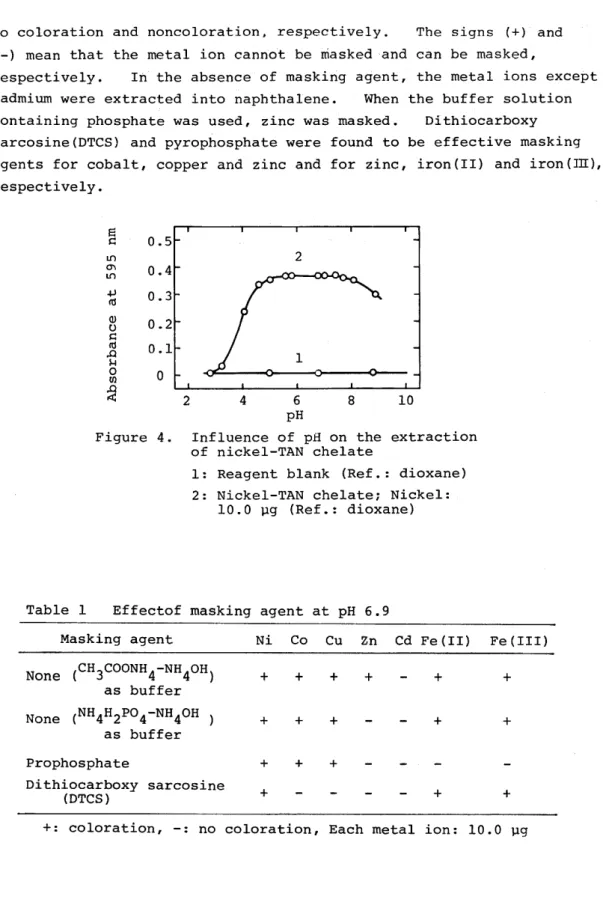
Absorbance of reagent blank was constant independent of pH and the value was 0.01.
A series of solution containing 10.0 pg of nickel was prepared by the recommended procedure, except for variation in the buffer added.
The absorbance of nickel-TAN chelate at 595 nm was constant and maxi- mum over the pH range 5.0 - 8.0 as shown in Figure 4.
extracted at pH 6.9 through all experiments.
Nickel was
Selection of masking agents for selective extraction of nickel
Various metal ions react with TAN to form water-insoluble Chelates.
These chelates are extracted into molten naphthalene. These metal ions must be eliminated for the selective extraction of nickel.
Effect of masking agents was investigated on the extraction of these metal ions. The absorbance measured of a metal-TAN Chelate is shown in Table 1 by the following manner: the signs (+) and (-) corespond
to coloration and noncoloration, respectively. The signs (+) and (-) mean that the metal ion cannot be masked and can be masked,
respectively. In the absence of masking agent, the metal ions except cadmium were extracted into naphthalene. When the buffer solution containing phosphate was used, zinc was masked. Dithiocarboxy sarcosine (DTCS) and pyrophosphate were found to be effective masking agents for cobalt, copper and zinc and for zinc, iron(II) and iron(IIT), respectively.
E ~ 0.5
~ 2
0"1
~
o
2 4 6
pH
8 10
Figure 4. Influence of pH on the extraction of nickel-TAN chelate
1: Reagent blank (Ref.: dioxane) 2: Nickel-TAN chelate; Nickel:
10.0 pg (Ref.: dioxane)
Table 1 Effectof masking agent at pH 6.9
Masking agent Ni Co Cu Zn Cd Fe (II) None (CH3COONH4-NH4OH)
+ + + + +
as buffer None (NH 4H2P0 4-NH4OH
+ + + +
as buffer
Prophosphate + + +
Dithiocarboxy sarcosine
(DTCS) + +
Fe(III) + +
+ +: coloration,
.
no coloration, Each metal ion: 10.0 pg264
Calibration curve
Beer's law was obeyed over the concentration range 2.0 - 18.0 pg of nickel in 20 ml of dioxane. Precision of the method was evaluated 5 identical samples containing 10.0 pg of nickel.
The mean absorbance was 0.366 with a coefficient of variation of 4.8 %.
4 - 1 - 1 The molar absorptivity was found to be 4.1 x 10 l·mole ·cm • The Sandell sensitivity was 0.0014 pg of nickel per cm2
. AKNOvlLEDGMENT
The authors wish to thank Professor Taitiro Fujinaga of Kyoto University for useful suggestions and valuable discussions.
REFERENCE
I} T.Fujinaga, T.Kuwamoto and E.Nakayama, Ta1anta 12, 1225(1969) 2) K.Murata, Y.Yokoyama and S.Ikeda, Anal. Chern.,
ii,
805(1972) 3) J .Mi ura, H. Ishi and H. \vatanabe, Bunseki Kagaku, 2..2, 808 (1976) 4) T.Fujinaga, T.Kuwamoto, E.Nakayama and M.Satake, ibid.,l[, 398(1969): T.Fujinaga, M.Satake and M.Shimizu, ibid.,~, 313(1976) 5) M.Satake et al., Memoirs of the Faculty of Engineering Fukui
University,
M,
31(1976); ibid.,~, 349(1976) 6) A.Kawase, Bunseki Kagaku,..!l,
801(1963)(Presented in part at the 25th Annual Meeting of the Japan Society for Analytical Chemistry, Niigata, Japan, October 1976.)