Cellular Neural Networks with Delay Output for Half-Toning
Taro Nakano, Yoko Uwate and Yoshifumi Nishio Dept. of Electrical and Electronic Engineering, Tokushima University
2-1 Minami-Josanjima, Tokushima 770–8506, Japan Email:{taro, uwate, nishio}@ee.tokushima-u.ac.jp
Abstract—Cellular Neural Network (CNN) is constructed the grating coupling of analog circuits. The performance of the CNN depends on the parameters called the template. Template can use for various image processing applications. In this study, we apply the CNN with delay output (D-CNN) to image processing. In a general way, the D-CNN is used by motion picture processing.
However, we apply the D-CNN to image processing and obtain effective results. From simulation results, we confirm that the proposed model is effective for half-toning processing.
I.
I
NTRODUCTIONIn recent years, our life teems with information by growth of high information society. Generally, digital circuit is used for many information processing. However digital circuit can- not perform real time processing. In 1988, Cellular Neural Networks (CNN) were introduced by L. O. Chua and L. Yang [1]. The idea of the CNN was inspired from the architecture of the cellular automata and the neural networks. The CNN has features of time continuity, spatial discreteness, nonlinearity and parallel processing capability. Furthermore, the structure of the CNN resembles that of the human’s nervous system [2]- [6]. Therefore, the CNN has been successfully used for various high-speed parallel signals processing applications such as image processing, pattern recognition and so on [7]. The performance of the CNN depends on the parameters called the template. The template of the CNN consists three elements as the feedback template A, the control template B, and the constant biasT. Generally, the conventional CNN depends on an input image because of space invariant template. In general images, the complex portions of input image are not processed well.
In this study, we apply the CNN with delay output (D-CNN) to image processing. The D-CNN depend on the past informa- tion as well as the current information in the processing. In a general way, the D-CNN is applied motion picture processing.
On the other hand, we applied it to image processing of half-toning processing. Additionally, we investigate how the D-CNN influenced image processing. From some simulation results, we obtain good results in the image processing by using the D-CNN.
II.
C
ELLULARN
EURALN
ETWORKSIn this section, we explain the structure of the CNN. The CNN has M by N processing unit circuits called cells.
These circuit elements are constructed linear capacitors, linear resistors, linear and nonlinear controlled sources. The CNN is
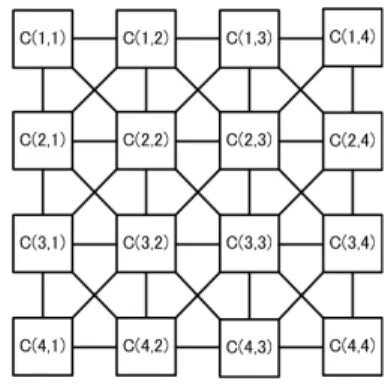
an array of cells. Cells are arranged in a reticular pattern toM line andN row. Each cell is coupled only to its neighboring cells according to a template. Usually, the template is the same for all cells except for boundary cells. The array of the CNN is shown in Fig.1. Also, Fig.2shows a block diagram of the conventional CNN.
Fig. 1. The structure of the conventional CNN.
Fig. 2. The block diagram of the CNN.
State Equation :
dvxij
dt = −vxij+
∑i+r k=i−r
j+r∑
l=j−r
A(i,j;k,l)vykl(t)
+
∑i+r k=i−r
j+r∑
l=j−r
B(i,j;k,l)vukl(t) +T. (1)
Output Equation : vyij(t) = 1
2(|vxij(t) + 1| − |vxij(t)−1|). (2) Where vx, vy and vu represent a state, an output and an input values of cell. In the state equation,A is the feedback
- 67 -
IEEE Workshop on Nonlinear Circuit Networks December 12-13, 2014
template, B is the control template and T is the constant bias. State and output equation of the conventional CNN can be shown as Eqs. (1) and(2). The r-neighborhood of a cell C(i, j)in the CNN defined by
Nr(i, j) ={C(i, j)|(max|k−i|, |l−j|)≤r,
1≤k≤M; 1≤l≤N}. (3)
Where r is the positive integer number, and called as the neighborhood radius. The output equation can be shown by piecewise linear function. The piecewise linear function is shown in Fig. 3.
Fig. 3. The piecewise linear function of the CNN.
III.
C
ELLULARN
EURALN
ETWORKS WITHD
ELAYO
UTPUTIn this section, we explain the structure of the D-CNN.
Figure4shows the block diagram of the D-CNN. In the block diagram,Ais the feedback template,Bis the control template, T is the bias andD is the delay type feedback template. The state and output equation of the D-CNN are shown as follows.
State Equation :
dvxij
dt = −vxij+
∑i+r k=i−r
j+r∑
l=j−r
A(i,j;k,l)vykl(t)
+
∑i+r k=i−r
j+r∑
l=j−r
B(i,j;k,l)vukl(t)
+
∑i+r k=i−r
j+r∑
l=j−r
D(i,j;k,l)vykl(t−τ) +T. (4)
Output Equation : vyij(t) = 1
2(|vxij(t) + 1| − |vxij(t)−1|). (5)
Fig. 4. The block diagram of the D-CNN.
In Fig.4, the D-CNN contains the output with time delay. In the conventional CNN, it can perform image processing only depending on current information. On the other hand, the D- CNN depends on the past information as well as the current information in the processing. In a general way, the D-CNN is useful of motion picture processing. However, in this study, we use the D-CNN in the image processing of half-toning processing .Dtemplate can substitute the value with various characteristics in the D-CNN.
IV.
S
IMULATIONR
ESULTIn this section, we show some simulation results for half- toning by using the D-CNN. Moreover, from simulation re- sults, we compare the difference of result in the conventional CNN and the D-CNN. In the conventional CNN, it is more difficult to detect indistinct parts in the input image well.
Templates of the half-toning are shown as follows.
Half-toning template :
A =
−0.07 −0.1 −0.07
−0.1 2 −0.1
−0.07 −0.1 −0.07
,
B =
0.07 0.1 0.07 0.1 0.32 0.1 0.07 0.1 0.07
, T = 0. (6) Half-toning of the D-CNN :
A =
−0.07 −0.1 −0.07
−0.1 2 −0.1
−0.07 −0.1 −0.07
,
B =
0.07 0.1 0.07 0.1 0.32 0.1 0.07 0.1 0.07
,
D =
0 −1 0
−1 3.25 −1
−0 −1 0
, T = 0. (7)
- 68 -
(a) (b)
(c) (d)
(e) (f)
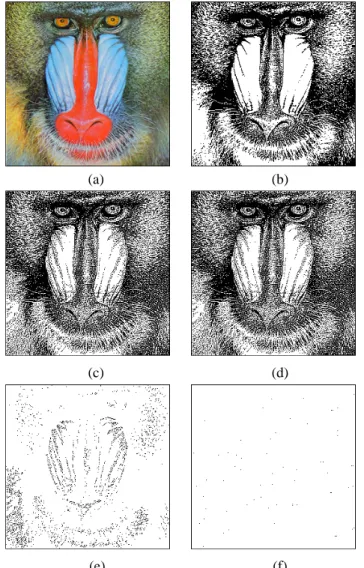
Fig. 5. Simulation results. (a) Input image. (b) Simulation result of the conventional CNN. (c) Simulation result of the D-CNN(τ= 5).
(d) Simulation result of the D-CNN(τ= 10). (e) Simulation result of the logical difference from the D-CNN to the conventional CNN.
(f) Simulation result of the logical difference fromτ = 10to5in the D-CNN.
Figure 5 shows simulation results of the half-toning. Fig- ure5(a) shows an input image. Figure5(b) shows the result of the conventional CNN. In Fig.5(b), the conventional CNN can not process half-toning well. It is expressed only with black or white when it exceed a certain constant pixel level in the half-toning. Because of this, the parts of lips and the moat of eyes express almost all with white or black. Figures 5(c) and (d) show simulation results of the D-CNN (τ = 5 and 10). In Fig. 5(c) and (d), the D-CNN can process the half- toning well. In the D-CNN, the parts of lips and the moat of eyes express color strength by using white and black.
Figure 5(e) is the simulation result of the logical difference from the D-CNN to the conventional CNN. In Fig.5(e), the D- CNN can process half-toning well comparing the conventional CNN. Moreover, we investigate how processing change in the different delay time. Figure5(f) is the simulation result of the
logical difference from τ = 10 to 5 in the D-CNN. From Fig.5(f), even if delay time is changed, simulation results are similar visually.
V.
C
ONCLUSIONIn this study, we investigate the D-CNN to image process- ing. In the half-toning processing, we compare the results of the conventional CNN and the D-CNN. The D-CNN adds a past output value by theD template. The D-CNN depend on the past information as well as current information in the processing. From some simulation results, the D-CNN can detect indistinct parts of the input image. In the future works, we would like to research other templates in the D-CNN.
REFERENCES
[1] L. O. Chua and L. Yang, “Cellular Neural Networks: Theory,” IEEE Trans. Circuits Syst., vol. 35, pp. 1257-1272, Oct. 1988.
[2] F. Dirk and T. Ronald, “Coding of Binary Image Data using Cellu- lar Neural Networks and Iterative Annealing,” Proc. of ECCTD’03, vol. 1, pp. 229-232, Sep. 2003.
[3] M. Namba and Z. Zhang, “Cellular Neural Network for Associative Mem- ory and its Application to Braille Image Recognition,” Proc. of IJCNN’06, pp. 4716-4721, Jul. 2006.
[4] H. Koeppl and L. O. Chua, “An Adaptive Cellular Nonlinear Net- work and its Application,” Proc. of NOLTA’07, pp. 15-18, Sep. 2007.
[5] T. Kozek, K. R. Crounse, T. Roska and L. O. Chua, “Smart Image Scan- ning Algorithms for the CNN Universal Machine,” Proc. of NOLTA’95, vol. 2, pp. 707-712, 1995.
[6] K. R. Crounse and L. O. Chua, “Methods for Image Processing and Pat- tern Formation in Cellular Neural Networks: A Tutorial,” IEEE Trans.
Circuits Syst., vol. 42, no. 10, pp. 583-601, Oct. 1995.
[7] Z. H. Yang, Y. Nishio and A. Ushida, “Image processing of two- layer CNNs applications and stability,” IEICE,Trans. Fundamentals, vol. E85-A, no. 9, pp. 2052-2060, Sept. 2002.