Investigation of Image Denoising by Cellular Neural Networks
with Effect from Friend of a Friend
Yoshihiro Kato, Yoko Uwate and Yoshifumi Nishio
Department of Electrical and Electronic Engineering, Tokushima University, 2-1 Minami Josanjima, Tokushima 770-8506, Japan
Email: { kkato, uwate, nishio } @ee.tokushima-u.ac.jp Abstract—In previous study, we have proposed “cellular neural
networks with effect from friend of a friend” (FF-CNN). The FF- CNN is the method of constituting a new connection of among cells in CNN. Then, we confirmed that the FF-CNN could perform image denoising, edge-preserving smoothing and divide domains.
In this study, we investigate about image denoising by using the FF-CNN.
I. I
NTRODUCTIONIn recent years, our life teems with information by growth of high information society. Generally, sequential digital circuit is used for many information processing. However, the digital circuit cannot perform real time processing. Then, Cellular Neural Networks (CNN) [1] were introduced. The idea of the CNN was inspired from the architecture of the cellular automata and the neural networks. A different point from the conventional neural networks is that CNN has local con- nectivity property. It makes the CNN tailor made for VLSI implementation. Furthermore, the structure of CNN resembles that of animals’ retina. Therefore, CNN can be used for various image processing applications [2]-[6].
Generally in the conventional CNN, template of 3 × 3 matrix is used. In this case, the information that a cell can obtain from its neighboring cells is limited. Then, as approach to increase the information, there is also an approach of extending size of template. However, this approach has the potential to collapse the local connectivity property of CNN. In previous times, method of changing connection of among cells without extending size of template has been proposed. Especially, a method of inspired from the network theory is interesting for us like a “Small-world cellular neural networks” [7].
In previous time, we have proposed “cellular neural net- works with effect from friend of a friend” (FF-CNN) [8]. The FF-CNN is the method of constituting a new connection of among cells in CNN. Then, we confirmed that the FF-CNN could perform image denoising, edge-preserving smoothing and divide domains. In this study, we investigate about image denoising by using the FF-CNN from two way. At first, we compare processing flow of the conventional CNN and the FF-CNN. In the second way, we discuss about why an object remains.
The list of this paper is structured as follows. In Sec. 2, we review the conventional of the conventional CNN. In Sec. 3,
we review the FF-CNN. In Sec. 4, some simulation results of image denoising by using the proposed method are shown.
In Sec. 5, we investigate about image denoising by using the FF-CNN The section 6 concludes the article.
II. C
ELLULARN
EURALN
ETWORKSIn this section, we explain the conventional structure of the CNN. The CNN has M by N processing unit circuits called cells. The cell contains linear and nonlinear circuit elements which are typically linear capacitors, linear resistors, linear and nonlinear controlled sources. Cells are arranged in a reticular pattern to M line N row. We represent a cell C(i, j) using a variable i which denotes vertical position and a variable j which denotes horizontal position. The CNN is an array of cells. Each cell is connected to its neighboring cells according to a template. Usually, the template is the same for all cells except for boundary cells. The CNN has the features of time continuity, spatial discreteness, nonlinearity and parallel processing capability. The state equation and the output equation of the CNN are shown as follows.
State equation :
dv
xijdt = − v
xij+
∑
i+rk=i−r
∑
j+rl=j−r
A
(i,j;k,l)v
ykl(t)
+
∑
i+rk=i−r j+r
∑
l=j−r
B
(i,j;k,l)v
ukl(t) + I, (1)
Output equation :
v
yij(t) = 1
2 ( | v
xij(t) + 1 | − | v
xij(t) − 1 | ), (2) where v
x, v
yand v
urepresent a state, an output and an input of cell, respectively. In the Eq. (1), A is the feedback template and B is the control template. These and the constant bias I are collectively called general template. The output equation is a piece-wise linear function. In fact, the output value of CNN is within of − 1 to 1. When the CNN is used for image processing, values of black and white are treated as 1 and − 1, respectively.
- 105 -
IEEE Workshop on Nonlinear Circuit Networks December 14-15, 2012
III. C
ELLULARN
EURALN
ETWORKS WITHE
FFECT FROMF
RIEND OF AF
RIENDIn this section, we explain about the algorithm of the cellular neural networks with effect from friend of a friend (FF-CNN).
It is new approach in consideration of the actual society which is concept of effect from best friend and its friends. Then, The FF-CNN is the method of constituting new connections of among cells. In this paper, we consider the local connection of CNN as friendship. Then in each cell, the neighboring cells are defined as friend cells. Based on this, the algorithm of FF- CNN is described as follows.
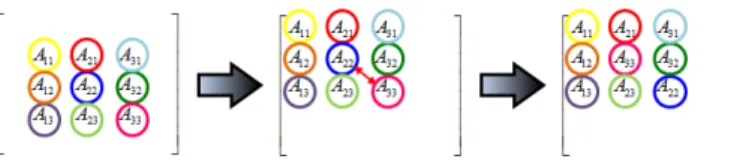
Fig. 1. Definition the best friend cell in input.
Fig. 2. The combination on centering on the best friend cell in input.
Fig. 3. Elements of new template.
Step 1: In each cell of input image, a cell with the most nearest value of center cell C(i, j) is defined as “Best friend cell” in eight neighboring cells like Figs. 1 and 2.
Step 2: The combination centering on a cell C(i, j) is changed into a combination centering on the best friend cell.
Moreover, the element of template of the best friend and the center cell C(i, j) are replaced. With this, a new combination is constituted like Fig. 3.
Step 3: The value of each cell is updated according to the Eqs. (1) and (2) using the new combination.
Step 4: In each cell of output image, a cell with the most nearest value of center cell C(i, j) in input image is defined as
“Best friend cell” in eight neighboring cells like Figs. 4 and 5.
Step 5: Steps 2 to 4 are repeated every 0.005 [τ].
In every case when cell with the most nearest value are two or more, the best friend cell is chose at random out of their
Fig. 4. Definition the best friend cell in output.
Fig. 5. The combination on centering on the best friend cell in output.
cells. In the proposed method, each cell in input image is used for basis of definition the best friend. Therefore, the state value of each cell is updated by receiving influences from the best friend cell and its neighboring cells.
IV. S
IMULATIONR
ESULTSIn this section, we show some simulation results of image denoising by using the FF-CNN. Generally, in the conventional CNN, “Small object remover” template [8] is used for image denoising. However, output values are converged on black or white by using this template. In fact, the conventional CNN can not perform with maintained gray scale. As the other way for image denoising, noisy image is defused. In the FF-CNN, we use “Heat dif f usion” template [8] for image denoising. Boundary condition is fixed to +1. Size of using image is 128 × 128 [pixels].
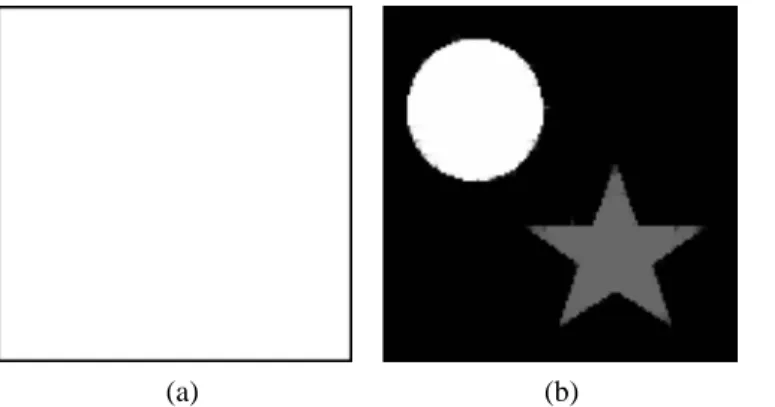
Figure 6(b) shows the image denoising result by the conven- tional CNN using “Small object remover” template to gray scale image like Fig. 6(a). Noises are not removed completely.
Moreover, values of cells are converged on black or white when the “Small object remover” template is used. Then, the right side object with gray scale has disappeared.
On the other hand, Fig. 7 shows the image denoising result by the FF-CNN using “Heat dif f usion” template.
Figure 7(b) shows the output image by using the FF-CNN to gray scale input image and the initial state image like Figs. 6(c) and Fig. 7(a). All noise in the input image are removed regardless of gray scale. Moreover, there is remained with keep the value of gray scale which is the object of the right side disappeared by the conventional CNN. Furthermore, the angle of the right side object is sharp.
- 106 -
(a) (b)
Fig. 6. Image denoising by the conventional CNN using
“Small object remover” template. (a) Gray scale input and initial state images. (b) Image denoising result for gray scale image.
(a) (b)
Fig. 7. Image denoising by the FF-CNN. (a) Initial state image. (b) Image denoising result for gray scale.
V. D
ISCUSSION OFI
MAGED
ENOISING BY THEFF-CNN In this section, we investigate about image denoising by using the FF-CNN from two way.
At first, we compare the processing flow of image denois- ing by the conventional CNN and the FF-CNN. Figure 8 show the processing flow of image denoising by the conven- tional CNN. Some noises are removed by behavior of the
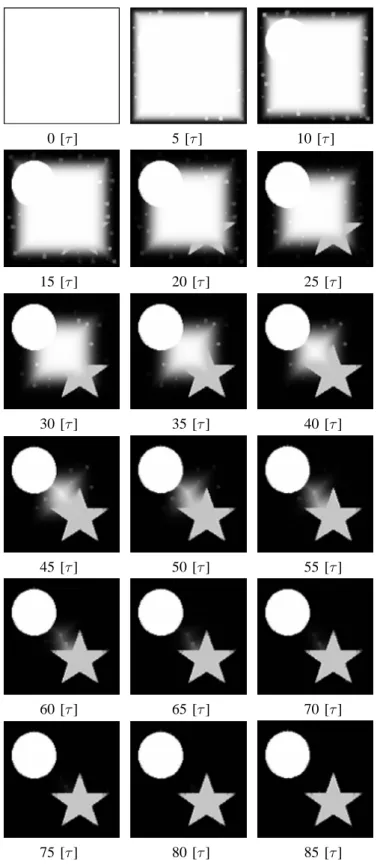
“Small object remover” template. However, other noises with certain size are remained. Furthermore, output values are converged to black or white. Then, the right side object with gray scale has disappeared. Figure 9 show the processing flow of image denoising by the FF-CNN. The initial state image is set white image. And, the boundary values are set as black.
Therefor, the initial state image is processed from the outside under the influence of boundary cells. By behavior of the FF- CNN, all noise in the input image are removed and the object of the right side is remained with keep the value of gray scale.
In the second way, we discuss about why an object remains.
We consider that cells in the object choose the “Best friend cell” from the inside of object Fig. 10(a). On the other hand, cells in the background choose the “Best friend cell” from the back ground like Fig. 10(b). Then, in boundary between the object and background, connections split up into the object side and the background side Fig. 10(c). In the case of
0 [τ] 0.05 [τ] 0.1 [τ]
0.15 [τ] 0.2 [τ] 0.25 [τ]
0.3 [τ] 0.35 [τ] 0.4 [τ]
0.45 [τ] 0.5 [τ] 1 [τ]
1.5 [τ ] 2 [τ] 2.5 [τ]
Fig. 8. Processing flow of the conventional CNN using the
“Small object remover”template.
large size object, connections in the object are strong because connections are lot. Then, the large size object was remained.
On the other hand, in the case of small object, connections in the object are not strong because connections are low.
This phenomena like an actual phenomena which is large companies have strength compared with small and medium- sized enterprises.
VI. C
ONCLUSIONIn this study, we investigated about image denoising by using the FF-CNN from two way. At first, we compared processing flow of the conventional CNN and the FF-CNN. In
- 107 -
0 [τ] 5 [τ] 10 [τ ]
15 [τ] 20 [τ ] 25 [τ]
30 [τ] 35 [τ ] 40 [τ]
45 [τ] 50 [τ ] 55 [τ]
60 [τ] 65 [τ ] 70 [τ]
75 [τ] 80 [τ ] 85 [τ]
Fig. 9. Processing flow of the FF-CNN using the “Heat dif f usion”
template.
(a) (b)
(c)
Fig. 10. Image denoising by the FF-CNN. (a) In the case of cell in the background. (b) In the case of cell in object. (c) Connections split up into the object side and the background side.
the second way, we discussed about why an object remains.
From speculations, we considered that connections among cells split up into the object side and the background side is boundary between object and background. Then, the large size object was remained by connections in the object are strong because connections are lot.
In the future works, we would like to try another determin- ing condition of the “Best friend cell”.
R
EFERENCES[1] L. O. Chua and L. Yang, “Cellular Neural Networks: Theory,” IEEE Trans. Circuits Syst., vol. 32, pp. 1257-1272, Oct. 1988.
[2] F. Dirk and T. Ronald, “Coding of Binary Image Data using Cellu- lar Neural Networks and Iterative Annealing,” Proc. of ECCTD’03, vol. 1, pp. 229-232, Sep. 2003.
[3] M. Namba and Z. Zhang, “Cellular Neural Network for Associative Mem- ory and Its Application to Braille Image Recognition,” Proc. of IJCNN’06, pp. 4716-4721, Jul. 2006.
[4] H. Koeppl and L. O. Chua, “An Adaptive Cellular Nonlinear Net- work and its Application,” Proc. of NOLTA’07, pp. 15-18, Sep. 2007.
[5] T. Kozek, K. R. Crounse, T. Roska and L. O. Chua, “Smart Image Scan- ning Algorithms for the CNN Universal Machine,” Proc. of NOLTA’95, vol. 2, pp. 707-712, 1995.
[6] K. R. Crounse and L. O. Chua, “Methods for Image Processing and Pat- tern Formation in Cellular Neural Networks: A Tutorial,” IEEE Trans.
Circuits Syst., vol. 42, no. 10, pp. 583-601, Oct. 1995.
[7] Y. Kato, Y. Uwate and Y. Nishio, “Cellular Neural Networks with Ef- fect from Friend of a Friend,” Proc. of NOLTA’12, pp. 711-714, Oct.
2012.
[8] Cellular Sensory Wave Computers Laboratory Computer and Au- tomation Research Institute Hungarian Academy of Sciences, “Cellu- lar wave Computing Library (Template, Algorithms, and Programs) Version 2.1”