Chaotic Phenomena in Cellular Neural Networks Using Three Kinds of Cloning Templates
Mana Tanaka
Dept. Media and Information Syst., Shikoku University
Email:[email protected]
Yasuteru Hosokawa Dept. Media and Information Syst.,
Shikoku University
Email:[email protected]
Yoshifumi Nishio
Dept. Electrical and Electronic Eng., Tokushima University
Email:[email protected]
Abstract—In this study, chaotic phenomena in cellular neural networks using three kinds of cloning templates are shown. Cases of number of cells is six, twelve and twenty-four are investigated.
Some interesting phenomena are observed.
I. INTRODUCTION
There are many studies of coupled oscillatory systems. In these systems, observed phenomena are influenced by the network structures which are ladder, ring, full-coupled and so on. Additionally, characteristics of the oscillator affect the phe- nomena. Especially, chaotic systems can be generated many kinds of phenomena. These two factors are very important to study coupled oscillatory systems.
On the other hand, some interesting phenomena can be observed in Cellular Neural Networks (CNN) [1][2] using two kinds of cloning templates in [4]. The study showed that the system is one of novel coupled oscillatory system.
In this study, cellular neural networks using three kinds of cloning templates are proposed. This system consists of three kinds of cells which have different values of cloning templates.
In [3], CNN using three cells which have different cloning templates generates chaos is reported. Therefore, the proposed system is one of chaotic coupled oscillatory system.
The element of the system is coupled as triangle lattice.
By applying symmetric cloning template, the system becomes homogeneous coupled system. By some computer simulations, relationships between phenomena and the number of cells or parameters are investigated.
II. CELLULAR NEURAL NETWORKS USING THREE KINDS OF CLONING TEMPLATES
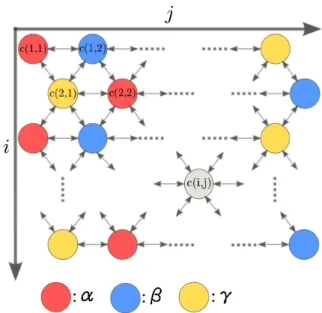
Figure1shows a structure of cellular neural networks using three kinds of cloning templates. Cells are coupled as triangle lattice. The system consists of three kinds of cells which name is Cell α, Cell β or Cell γ. The difference of three kinds of cells is only values of cloning templates. The boundary condition is set as a periodic condition. Namely, this system has a torus structure. The state equations are shown as follows.
Fig. 1. Structure of cellular neural networks using three kind of cloning templates.
Cell α:
dxij
dt =−xij+Iα
+ ∑
c(k,l)
Aα(i, j;k, l)ykl
+ ∑
c(k,l)
Bα(i, j;k, l)ukl
(1)
Cell β:
dxij
dt =−xij+Iβ
+ ∑
c(k,l)
Aβ(i, j;k, l)ykl
+ ∑
c(k,l)
Bβ(i, j;k, l)ukl
(2)
- 30 -
IEEE Workshop on Nonlinear Circuit Networks December 13-14, 2013
Fig. 2. Chaotic phenomena in the case of three cells.
Cellγ:
dxij
dt =−xij+Iγ
+ ∑
c(k,l)
Aγ(i, j;k, l)ykl
+ ∑
c(k,l)
Bγ(i, j;k, l)ukl
(3)
where, A{αβγ}(i, j;k, l)ykl, B{αβγ}(i, j;k, l)ukl, I{αβγ} show feedback value, input value, bias value, respectively. The output function is shown as follows.
yij=f(xij). (4)
where
f(x) = 0.5(|x+ 1| − |x−1|). (5) In order to keep a symmetric property, symmetric cloning template is defined as follows.
Aα=
k l
l 1.24 k
k l
,
Aβ=
−m k
k 1.1 −m
−m k
,
Aγ =
l m
m 1.0 l
l m
,
Bα=Bβ=Bγ = 0and Iα=Iβ=Iγ = 0.
(6)
III. COMPUTER SIMULATIONS
A. Three cells
In this section, some computer simulations are shown. In the case of three cells, chaotic phenomena were confirmed by [3]. Figure 2 shows a simulation result in the case of three cells. A double-scroll type attractor is observed. By changing parameterk, some periodic orbits, bifurcation phenomena and chaos are observed.
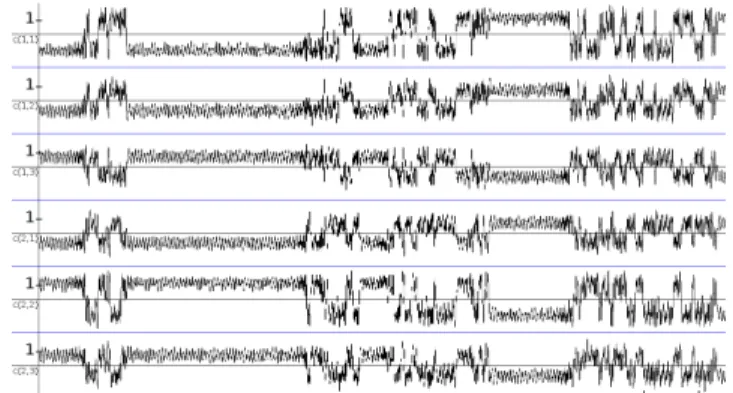
Fig. 3. Waveforms in the case of six cells.k=−1.06,l=−1.07and m=−1.47.
Fig. 4. Waveforms in the case of six cells.k=−1.05,l=−1.07and m=−1.47.
B. Six cells
In the case of six cells ( i = 2, j = 3 ), clustering phe- nomena depend on initial values are observed. Additionally, cells divided into two groups as shown in Fig. 3 as are observed. In this case, c(1,1) and c(1,2) have very similar waveforms and inverse waveform of c(1,3) is also similar to c(1,1). Similarly,c(2,1),c(2,2)andc(2,3)have also similar waveforms. Namely, each group consists of same row cells in Fig. 1. Note that these are not synchronized. By changing a parameter k or l, sojourn time of high or low waveforms is changed. Figure 4 shows a case of increasing a parameterk.
Sojourn time of high or low waveforms is increased. On the other hand, decreasing a parameterkdecreases sojurn time as shown in Fig. 5.
C. Twelve cells
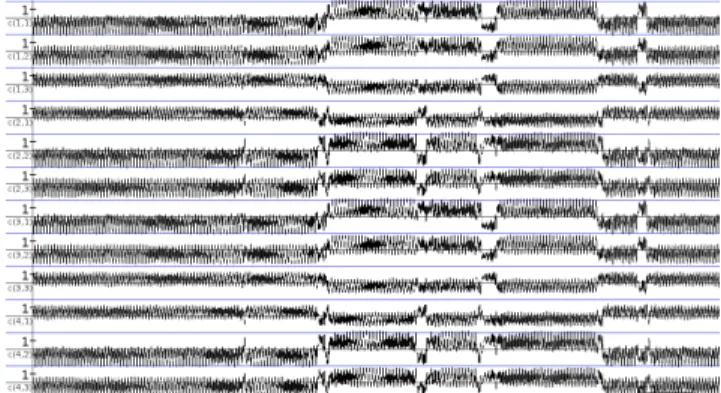
Figure 6 shows a simulation result in the case of twelve cells ( i= 4, j= 3). In this case, four groups which consists of same row cells are observed. Each group does not concern each other. By changing a parameter k or l, sojourn time of high or low waveforms is changed as shown in Fig. 7.
D. twenty four cells
Figure8shows a simulation result in the case of twenty four cells (i= 4, j= 6). In this case, there are no groups which are observed in cases of six and twelve cells. Two kinds of
- 31 -
Fig. 5. Waveforms in the case of six cells.k=−1.095,l=−1.07and m=−1.47.
Fig. 6. Waveforms in the case of twelve cells.k=−1.06,l=−1.07and m=−1.47.
oscillatory phenomena ( left side and right side of Fig.8) are observed alternately. These switching is almost same timing.
However, these waveforms are not synchronized. By changing a parameterk orl, sojourn time of high or low waveforms is changed as shown in Fig.9 and10.
E. Consideration
Each group which observed in six and twelve cases consists of a Cellα, Cellβand Cellγ. These two cases show that each group consists of cells which is same number ofi. Namely, three cells of a group are coupled as a loop. Coupling strength between cells of one group becomes higher than other cells.
We consider that loops is the reason groups exist.
In the case of twenty four cells, a loop which consist of three cell can not exist. Therefore, groups which observed in six and twelve cases are disappeared.
IV. CONCLUSIONS
In this study, cellular neural networks using three kinds of cloning templates have been proposed. Some computer simulations were carried out. In cases of six cells and twelve cells, cells can be some groups which have a Cell α, Cell β and Cellγ. However, these groups are disappeared in case of twenty-four cells.
Fig. 7. Waveforms in the case of twelve cells.k=−0.95,l=−1.07and m=−1.47.
In the future work, a relationship between phenomena and the number of cell, the reason of group exist and so on will be investigated.
REFERENCES
[1] L. O. Chua and L. Yang, “Cellular Neural Networks: Theory,” IEEE Trans. Circuits Syst., vol. 35, no. 10, pp. 1257–1272, 1988.
[2] L. O. Chua and L. Yang, “Cellular Neural Networks: Applications,”IEEE Trans. Circuits Syst., vol. 35, no. 10, pp. 1273–1290, 1988.
[3] F. Zou, and J. A. Nossek, “Bifurcation and chaos in cellular neural networks,” IEEE Trans. Circuits Syst. I, vol. 40, no. 3, pp. 166–173, 1993.
[4] J. Fujii, Y. Hosokawa and Y. Nishio, “Wave Phenomena in Cellular Neural Networks Using Two Kinds of Template Sets,” Proc. of NOLTA’07, pp. 23–26, 2007.
- 32 -
Fig. 8. Waveforms in the case of twenty four cells.k=−1.26,l=−1.20andm=−2.50.
Fig. 9. Waveforms in the case of twenty four cells.k=−1.10,l=−1.20andm=−2.50.
Fig. 10. Waveforms in the case of twenty four cells.k=−1.25,l=−1.20andm=−2.50.