Synchronization of Oscillatory Ring Topology Coupled by Two Types of Resistors
Takahiro Nagai, Yoko Uwate and Yoshifumi Nishio Dept. of Electrical and Electronic Engineering, Tokushima University,
2-1 Minamijosanjima, Tokushima, 770-8506 Japan Email:{nagataka, uwate, nishio}@ee.tokushima-u.ac.jp
Abstract— In this study, we investigate synchronization phe- nomena observed in coupled oscillatory networks by using two types of resistors. Negative and normal resistors are used as coupling resistors in our circuit model. By giving particular parameters, we can observe the oscillation death and amplifi- cation of the amplitude. Finally we extend coupled oscillators to polygonal oscillatory networks.
I. INTRODUCTION
There are a lot of synchronization phenomena in this world.
This is one of the nonlinear phenomena that we can often observe by natural beings which does collective actions. For example, firefly luminescence, cry of birds and frogs, applause of many people and so on. Synchronization phenomena have a feature that the set of small power can produce very big power by synchronizing at a time. Therefore studies of synchronization phenomena have been widely reported not only engineering but also the physical and biological fields [1]- [6]. Investigation of coupled oscillators attracts attention from many researchers because coupled oscillatory network produce interesting phase synchronization such as the phase propaga- tion wave, clustering and complex patterns.
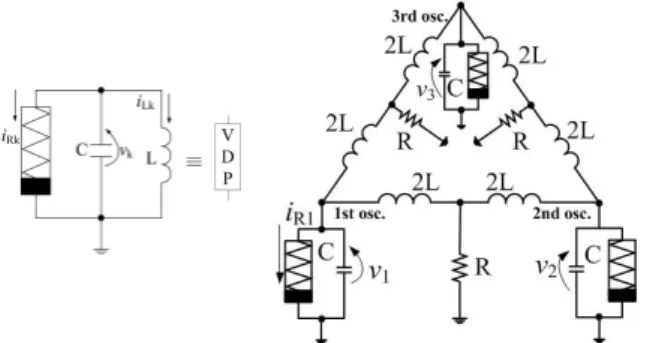
In our investigations, we use several van der Pol oscillators (see Fig. 1(a)). Van der Pol oscillators have been coupled in various form and investigated about their synchronization phenomena [7], [8]. We have observed three-phase synchro- nization in the circuit model which are shown in Fig. 1(b) since the discrepancy occurs in synchronization phenomena between adjacent oscillators [9]. This three-phase synchronization is always observed stability.
On the other hand, we can observe generically in-phase synchronization in two coupled oscillators for Fig. 2(a) and
Fig. 1. (a) Van der Pol oscillator. (b) Three coupled oscillators.
(a)
(b)
Fig. 2. Synchronization phenomena between first and second oscillators.
(a) In-phase synchronization. (b) Anti-phase synchronization.
anti-phase synchronization in the case of Fig. 2(b). Namely what kind of synchronization phenomena will be observed in coupled oscillators which are included these two types of synchronization states? First, we consider coupled oscillators including two types of coupling resistor which is shown in Fig. 3. Seeing partly, anti-phase synchronization is observed between first and second oscillators and in-phase synchro- nizations are observed between first and third or second and third oscillators. However because frustration occurs in whole system, we guess unexpected synchronization phenomena are found out.
II. SYNCHRONIZATIONPHENOMENA
In this study, we investigate synchronization phenomena of coupled oscillatory networks using different types of resistors
Fig. 3. Conceptual circuit model for three coupled oscillators.
- 74 -
IEEE Workshop on Nonlinear Circuit Networks December 14-15, 2012
(a)
(b) (c) (d)
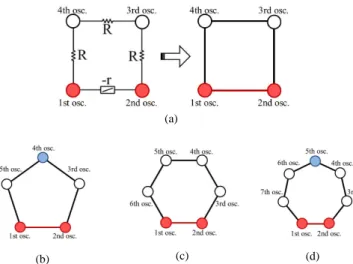
Fig. 4. Several types of coupled polygonal oscillatory networks. (a) tetragon network. (b) pentagon network. (c) hexagon network. (d) heptagon network.
partially. We focus on the amplitude of each oscillator and phase differences between adjacent oscillators by changing coupling strength. Also, we increase number of oscillators in the ring topology and we consider differences of synchroniza- tion phenomena by changing number of oscillators.
III. SYNCHRONIZATIONPHENOMENA
In this section, we show the simulation result for several types of oscillatory networks as shown Fig. 4. We calculate circuit equations using the fourth-order Runge-Kutta method with the step sizeh= 0.001. We fix the parameterε= 0.020 in these simulations. First, we explain the synchronization phe- nomena in the case of triangle networks for coupling strength γ1 = γ2 = 0.050. We show the simulation result of each oscillator in Fig. 5(a). Obvious difference of the amplitude of each oscillator appears in this parameters. Namely, oscillation death is observed in third oscillator. Phase differences between first and second oscillators shows anti-phase synchronization, because third oscillator stops oscillating in order to match consistency.
In the case of polygonal oscillatory networks, different synchronization phenomena for odd and even number are produced even if same parameter are given. For example, giving same values for coupling strength, odd polygonal oscillatory networks cause oscillation death. The oscillator which oscillation stops is the farthest oscillator from first and second oscillators. We show the farthest oscillator as blue oscillator in Fig. 4(b) and (d). Also, getting away first and second oscillators, oscillators attenuate. Figure 5(b) and (c) show simulation results for odd polygonal networks and we set coupling strength γ1 =γ2= 0.050 for pentagon network and γ1 = γ2 = 0.075 for heptagon network. In the case of heptagon network, fifth oscillator attenuates but does not occur the oscillation death forγ1=γ2= 0.050.
On the other hand, even polygonal oscillator networks can not produce oscillation death but we can observe small and large of amplitudes. Regardless of the number of oscillators,
(a)
(b)
(c)
Fig. 5. Simulation results for polygonal oscillatory networks. (a) triangle network forγ1=γ2= 0.050. (b) pentagon network forγ1=γ2= 0.050.
(c) heptagon network forγ1=γ2= 0.075.
synchronization state between first and second oscillators is observed anti-phase synchronization and case of between other oscillators are observed in-phase synchronization except the farthest oscillator.
IV. CONCLUSION
In this study, we have been able to observe several patterns of synchronization phenomena. For three coupled oscillators, we have observe the oscillation death in third oscillator. In addition, we have investigated differences of synchronization phenomena in the ring topology by increasing number of oscillators. We could confirm that odd polygonal networks produced oscillation death but even one do not produce oscillation death.
In our future works, we will derive each amplitude for polygonal networks by using averaging method.
REFERENCES
[1] L.L. Bonilla, C.J. Perez Vicente and R. Spigler, “Time-periodic phases in pop- ulations of nonlinearly coupled oscillators with bimodal frequency distributions,”
Physica D: Nonlinear Phenomena, vol.113, no.1, pp.79-97, Feb. 1998.
[2] J.A. Sherratt, “Invading wave fronts and their oscillatory wakes are linked by a modulated traveling phase resetting wave,” Physica D: Nonlinear Phenomena, vol.117, no.1-4, pp.145-166, June 1998.
[3] G. Abramson, V.M. Kenkre and A.R. Bishop, “Analytic solutions for nonlinear waves in coupled reacting systems,” Physica A: Statistical Mechanics and its Applications, vol.305, no.3-4, pp.427-436, Mar. 2002.
[4] 4. Belykh, M. Hasler, M. Lauret and H. Nijmeijer, “Synchronization and graph topology,” International Journal of Bifurcation and Chaos, vol.15, no.11, pp.3423- 3433, Nov. 2005.
[5] J. Cosp, J. Madrenas, E. Alarcon, E. Vidal and G. Villar, “Synchronization of nonlinear electronic oscillators for neural computation,” IEEE Trans. Neural Networks, vol.15, no.5, pp.1315-1327, Sep. 2004.
[6] R. Stoop and C. Wagner, “Neocortex’s architecture optimizes computation, informa- tion transfer and synchronizability, at given total connection length,” International Journal of Bifurcation and Chaos, vol.17, no.7, pp.2257-2279, 2007.
[7] T. Suezaki and S. Mori, “Mutual synchronization of two oscillators,” Trans. IECE, vol.48, no.9, pp.1551-1557, Sep. 1965.
[8] T. Endo and S. Mori, “Mode analysis of a multimode ladder oscillator,” IEEE trans.
Circuit Syst., vol23, pp.100-113, Feb. 1976.
[9] Y. Uwate, Y. Nishio and R Stoop, “Synchronization in three coupled van der Pol oscillators with different coupling strength,” Proc. of NCSP’10, pp.109-112, Mar.
2010.