• 検索結果がありません。

- 111 - IEEE Workshop on Nonlinear Circuit NetworksDecember 14-15, 2012

N/A
N/A
Protected

Academic year: 2021

シェア "- 111 - IEEE Workshop on Nonlinear Circuit NetworksDecember 14-15, 2012"

Copied!
4
0
0

読み込み中.... (全文を見る)

全文

(1)

Investigation of Two-Layer Cellular Neural

Networks with Switching Only Coupling Templates for Motion Picture Processing

Kazushige Natsuno, Yoshihiro Kato, Yoko Uwate and Yoshifumi Nishio Dept. of Electrical and Electronic Eng.,

Tokushima University, 2-1 Minami-Josanjima,Tokushima,

770-8506 JAPAN

Email: { natsushige, kkato, uwate, nishio } @ee.tokushima-u.ac.jp

Abstract— In this paper, we propose the new system of two- layer CNN and investigate the output characteristics. The pro- posed two-layer CNN has different structure of conventional two-layer CNN. In particular, the proposed system is connected to first-layer and second-layer with one coupling template. Also coupling template is switched by each layer of input and output values. In this study, we investigate the output characteristics for changing input images.

I. I NTRODUCTION

Our society is called advanced information society. Because of this, the large size of data cause trouble over process- ing speed. Conventional digital computation methods have problem of processing speed. However analog computation methods are high speed processing. We focus on new com- putation model of neural networks. The concept of neural networks is neurobiology and adapted to integrated circuits.

The key features of neural networks are asynchronous parallel processing, continuous-time dynamics and global interaction of network elements. Cellular Neural Networks (CNN) were introduced by Chua and Yang [1]. CNN is a type of mutual coupling neural network. CNN is used the concept of cellular automata [2]. The structure of CNN is grating coupling of circuit. The circuit is called a cell that has an effect on each other. The structure of cell circuit is simple analog circuit.

The cell circuit is constructed from linear capacitor, linear resistors, independent voltage source, linear and nonlinear controlled sources. Two-layer CNN is constructed two con- ventional single-layer CNNs. The two-layer CNN has two coupling template. In some two single-layer CNN, both layers are effected on each other by two coupling templates. In some image processing, the two-layer CNN is better than the single- layer CNN [3]. Also, CNN with switching template is better than the single-layer CNN [4].

In the moving image processing, a lot of images were continuously processed with time. We consider a new system which new system be processed moving image by using the input image and previous output image of other layer. In this study, we propose the two-layer CNN with switching only coupling template. The proposed system has only effect

from the second-layer to the first-layer. The first-layer and the second-layer are connected by switching templates.

From simulation results, we confirm the effective moving image processing of the proposed system.

II. CELLULAR NEURAL NETWORK

In this section, we explain about the single-layer CNN and the two-layer CNN.

A. Single-layer CNN

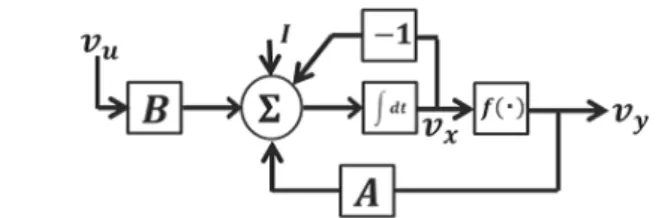
Fig. 1. Block diagram of the conventional single-layer CNN.

In this subsection, we explain the basic structure of the CNN. A block diagram of the conventional single-layer CNN shown Fig. 1. The conventional single-layer CNN use two templates B and A in processing. Template B is used in processing of input image. Template of A is used in processing of feedback of output image.

The state equation and output equation are described as follows.

State equation of the conventional single-layer CNN : dv xij

dt = v xij +

i+r k=i r

j+r l=j r

A (i,j;k,l) v xkl (t)

+

i+r k=i r

j+r l=j r

B (i,j;k,l) v ukl (t) + I ( | i k | ≤ 1 , | j l | ≤ 1). (1) Output equation of the conventional single-layer CNN :

v yij (t) = 1

2 ( | v xij (t) + 1 | − | v xij (t) 1 | ). (2)

- 111 -

IEEE Workshop on Nonlinear Circuit Networks

December 14-15, 2012

(2)

B. Two-layer CNN

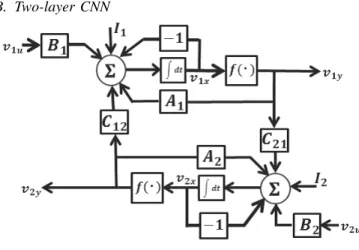
Fig. 2. Block diagram of the two-layer CNN.

Figure 2 shows the block diagram of the conventional two- layer CNN. The conventional two-layer CNN is constructed two conventional single-layers CNN by coupling two tem- plates C 1 and C 2 . The coupling templates are used to trans- ferred data between both layers. In addition, the conventional two-layer CNN has been confirmed to have more efficient structure for high performance image processing.

The state equations and output equations are described as follows.

State equation of second-layer CNN : dv 1 xij

dt = v 1xij +

i+r k=i r

j+r

l=j r

A 1(i,j;k,l) v 1xkl (t)

+

i+r k=i r

j+r

l=j r

B 1(i,j;k,l) v 1ukl (t)

+

i+r k=i r

j+r

l=j r

C 12(i,j;k,l) v 2ykl (t) + I 1

( | i k | ≤ 1 , | j l | ≤ 1). (3) Output equation of first-layer CNN :

v 1 yij(t) = 1

2 ( | v 1 xij(t) + 1 | − | v 1 xij(t) 1 | ). (4) State equation of second-layer CNN :

dv 2 xij

dt = v 2xij +

i+r k=i r

j+r

l=j r

A 2(i,j;k,l) v 2xkl (t)

+

i+r k=i r

j+r

l=j r

B 2(i,j;k,l) v 2ukl (t)

+

i+r k=i r

j+r

l=j r

C 21(i,j;k,l) v 1ykl (t) + I 2

( | i k | ≤ 1 , | j l | ≤ 1). (5) Output equation of second-layer CNN :

v 2 yij(t) = 1

2 ( | v 2 xij(t) + 1 | − | v 2 xij(t) 1 | ). (6)

III. P ROPOSED T WO - LAYER CNN

Fig. 3. Block diagram of the proposed two-layer CNN.

In this section, we explain the system of the proposed two- layer CNN. Figure 3 shows the block diagram of the proposed system. The structure of the proposed system is based on conventional two-layer CNN. The feature of proposed system is the switching only coupling template. In the only coupling template, the coupling template is switched two types. The only coupling template is decided by the input values of the first-layer and the output values of the second-layer. The input value of each layer are two type. Input values switched at 10 [τ ]. In after 10 [τ], second-layer CNN are inputed previous output value of first-layer CNN.

The algorithm of the proposed system is shown as follows.

Step 1 : We determine the difference value D ij by the output value of second-layer and the input value of first-layer. The difference value is calculated by

D ij = v 2yij v 1uij . (7) Step 2 : The boundary value and the difference value are compared. If D ij is not 0, the template of C 1 is used. On the other hand, if D ij is 0, the template of C 2 is used. The switching rule of coupling template is shown as follows.

Switching rule of coupling template : D ij ̸ = 0 : C 1 template,

D ij = 0 : C 2 template. (8) Step 3 : The value of each cell is updated. The state equation and the output equation of each layer are described as follows.

State equation of first-layer CNN : dv 1

a

xij

dt = v 1

a

xij +

i+r k=i r

j+r l=j r

A 1(i,j;k,l) v 1

a

ykl (t)

+

i+r k=i r

j+r

l=j r

B 1(i,j;k,l) v 1

a

ukl (t)

+

i+r k=i r

j+r

l=j r

C S (i, j; k, l)v 2

a

ykl (t) + I 1

( | i k | ≤ 1 , | j l | ≤ 1), (a = 1, 2). (9)

- 112 -

(3)

Output equation of first-layer CNN : v 1

a

yij(t) = 1

2 ( | v 1

a

xij(t) + 1 | − | v 1

a

xij (t) 1 | ).

(a = 1, 2). (10)

State equation of second-layer CNN : dv 2

1

xij

dt = v 2

1

xij +

i+r k=i r

j+r

l=j r

A 2(i,j;k,l) v 2

1

ykl (t)

+

i+r k=i r

j+r l=j r

B 2(i,j;k,l) v 2

1

ukl (t) + I 2 ( | i k | ≤ 1 , | j l | ≤ 1). (11) Output equation of second-layer CNN :

v 2

1

yij(t) = 1

2 ( | v 2

1

xij(t) + 1 | − | v 2

1

xij(t) 1 | ). (12) In after 10 [τ], state equation of second-layer CNN are updated as follows.

State equation of second-layer CNN : dv 2 xij

dt = v 2

2

xij +

i+r k=i r

j+r

l=j r

A 2(i,j;k,l) v 2ykl (t)

+

i+r k=i r

j+r l=j r

B 2(i,j;k,l) v 1ykl (t) + I 2 ( | i k | ≤ 1 , | j l | ≤ 1). (13) Output equation of second-layer CNN :

v 2

2

yij(t) = 1

2 ( | v 2

2

xij(t) + 1 | − | v 2

2

xij(t) 1 | ). (14) By repeating step1, template is changed.

Step 4 : Step 1 to Step 3 are repented every 0.005 [τ].

IV. S IMULATION R ESULTS

In this section, we show simulation results of moving image processing by using the proposed system. In this simulation, we use the 3 × 3 inverse halftoning template. Used templates are found in [5]. Templates A, B, threshold I 1 and I 2 of each layer are assigned as follows.

The template of proposed system :

A 1 = A 2 = 0, B 1 = B 2 =

 0.07 0.1 0.07 0.1 0.32 0.1 0.07 0.1 0.07

,

I 1 = I 2 = 0. (15)

Using two type of coupling templates are described as follows.

Coupling templates:

C 1 =

 0.1 0.1 0.1 0.1 1.5 0.1 0.1 0.1 0.1

,

C 2 =

 0.07 0.1 0.07 0.1 0.32 0.1 0.07 0.1 0.07

. (16)

(a) (b)

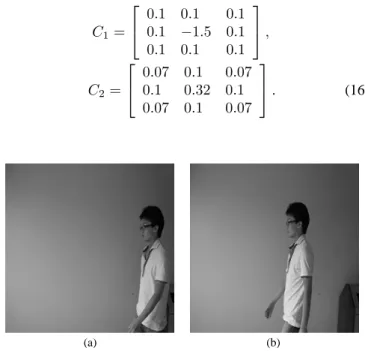
Fig. 4. Input images of first-layer. (a) Input image 1. (b) Input image 2.

Fig. 5. First input image of first-layer and initial state image.

(a) (b)

Fig. 6. Output images of first-layer CNN. (a) output image 1 (10 [τ]). (b) output image 2 (20 [τ]).

- 113 -

(4)

(a) (b)

Fig. 7. Output images of second-layer CNN. (a) output image 1 (10 [τ]). (b) output image 2 (20 [τ]).

Figure 5 is background of input images in Figs. 4(a) and (b). In Fig. 4(a), a parson of right side is moving object. In Figs. 4(a) to (b), a parson is moving on to right side from left side. The results of the proposed system are shown in Figs, 6 and 7. Figure 6 shows the output images of the first-layer CNN. Figure 7 shows the output images of the second-layer CNN. In Fig. 6(b), the image is appeared moving object of previous output. In addition, the moving object of previous output has the characteristic of changing gray-scale values.

We compare Fig. 6(a) with Fig. 6(b). The moving object of Fig. 6(a) is changed gray-scale value for Fig. 6(b). From results, we can say that the proposed system is effective of moving image processing.

V. C ONCLUSION

In this study, we have proposed two-layer CNN with switch- ing only coupling template. The feature of proposed system is the switching of coupling template. Outputs of second-layer CNN has an effect on processing of first-layer CNN. The first- layer and the second-layer are connected switching templates.

From simulation results, the proposed system could verify the effect of moving image processing.

In the future works, we would like to process the proposed CNN for a lot of image processing.

R EFERENCES

[1] L. O. Chua and L. Yang, “Cellular Neural Networks:Theory,” IEEE Trans.

Circuits Syst., vol. 32, pp. 1257-1272, Oct. 1988.

[2] S.Wolfram, ”Computation theory of cellular automata,” Communications in Mathematical Physics, vol. 96, pp.15-57, 1984.

[3] Z. H. Yang, Y. Nishio and A. Ushida, “Image processing of two- layer CNNs -applications and stability-,” IEICE,Trans. Fundamentals, vol. E85-A, no. 9, pp. 2052-2060, Sept. 2002.

[4] Y. KATO, Y. UEDA, Y. UWATE and Y. NISHIO, “Cellular Neural Net- works with Switching Two Types of Templates,” Proc. of IJCNN’ 11, pp. 1423-1428, Jun. 2011.

[5] L. Kek, K.Karacs and T .Roska, “Cellular Wave Computing Li- brary(Templates, Algorithms, and Programs), Version 2.1, ” Cellular Sensory Wave Computers laboratory, Hungarian Academy of Sciencesk, Budapest, Hungary, 2007.

- 114 -

Fig. 1. Block diagram of the conventional single-layer CNN.
Fig. 2. Block diagram of the two-layer CNN.
Fig. 5. First input image of first-layer and initial state image.
Fig. 7. Output images of second-layer CNN. (a) output image 1 (10 [τ]). (b) output image 2 (20 [τ]).

参照

関連したドキュメント

position by processing the image of preceding the cost function is concerned with the errors control.. of

To solve this drawback, we developed a new system capable of detecting the accident in the washing place together with the pulse and respiration rate using a bath mat type

In this paper, we study the solvability and nonsolvability of a singular nonlinear system of partial differential equations which appear in the normal form theory of vector fields. It

q-series, which are also called basic hypergeometric series, plays a very important role in many fields, such as affine root systems, Lie algebras and groups, number theory,

By con- structing a single cone P in the product space C[0, 1] × C[0, 1] and applying fixed point theorem in cones, we establish the existence of positive solutions for a system

S.; On the Solvability of Boundary Value Problems with a Nonlocal Boundary Condition of Integral Form for Multidimentional Hyperbolic Equations, Differential Equations, 2006, vol..

A monotone iteration scheme for traveling waves based on ordered upper and lower solutions is derived for a class of nonlocal dispersal system with delay.. Such system can be used

In this paper, based on a new general ans¨atz and B¨acklund transformation of the fractional Riccati equation with known solutions, we propose a new method called extended