Clustering Patterns Generated in Coupled Chaotic Circuits Networks
Yuji Takamaru
†, Yoko Uwate
†, Thomas Ott
‡and Yoshifumi Nishio
††
Dept. of Electrical and Electronic Engineering, Tokushima University, 2-1 Minami-Josanjima, Tokushima, 770-8506, Japan
phone: + 81-88-656-7470, fax: + 81-88-656-7471 Email: { takamaru, uwate, nishio } @ee.tokushima-u.ac.jp
‡
Institute of Applied Simulation, Zurich University of Applied Sciences, Einsiedlerstrasse 31a, 8820 Waedenswil, Switzerland
phone: + 41-058-934-56-84 Email:[email protected]
Abstract— This paper presents clustering patterns generated in coupled chaotic circuits networks. In these networks, the coupling strength is reflected the distance information. Also, each chaotic circuit is connected globally. We investigate the relationship between coupling strength and phase difference.
I. Introduction
Synchronization phenomena is one of typical phenomena when we analyze coupled chaotic circuits. This phenomenon widely can observe and studying in the field of natural and technical sciences. In order to understand synchronization phenomena in detail, we analyze electronic circuits. Many researches studied on synchronization phenomena using cou- pled chaotic circuits. However, there are not many studies on clustering phenomena in coupled chaotic circuits. We can see many phenomena when we connect chaos circuits each other, whereas all phenomena are not clear. We consider that we can approach the new method by applying to chaos synchronization for clustering.
In a previous study, we investigated the relationship be- tween clustering and density of coupled chaotic circuits in 2- dimensional place. For this investigation, the coupling strength reflected the distance information [4]-[6] and we changed the number of circuits in cluster. We showed that clustering phenomena affected other cluster when density in the chaotic circuits was high. We also observed that networks of coupled chaotic circuits could split into different synchronized groups.
In this study, we consider clustering patterns generated in coupled chaotic circuits networks. In these networks, chaotic circuits are connected globally. The variable parameter of coupling strength and density of chaotic circuits are changed.
By using computer simulation, the network can observe 3 clustering patterns.
II. Circuit model
Figure 1 shows the model of the chaotic circuit, investigated in [7]-[8].
Fig. 1. Chaotic circuit.
The circuit consists of a negative resistance, a nonlinear resistance consisting of two diodes, a capacitor and two inductors.
The normalized equations of this circuit are described as follows:
˙x=αx+z
˙y=z−f (y) (1)
˙z=−x−βy where f (y) is described as follows:
f (y)=δ 2
(y+1
δ−y−1 δ
)
. (2)
For the computer simulation, we set the parameters asα= 0.460, β=3.0 and δ=470.
We can consider the following equations when each chaotic circuit is coupled globally with each other.
dxi
dτ =αxi+zi dyi
dτ =zi+f (y) (3)
dzi
dτ =−xi−βyi−
∑N j=1
γi j(zi−zj) (i,j=1,2,· · ·,N)
- 138 -
IEEE Workshop on Nonlinear Circuit Networks December 14-15, 2012
where i in the equation represents the circuit itself, and j indicates the coupling with other circuits. The parameter γi j
represents the coupling strength between the circuits. The value of γi j reflects the distance between the circuits in an inverse way, described by the following equation:
γi j= g
(lengthi j)2. (4)
lengthi j denotes the Euclidean distance between the i−th circuit and the j −th circuit. The parameter g is a scaling parameter that determines the coupling strengths.
III. Clustering phenomena A. Clustering phenomena
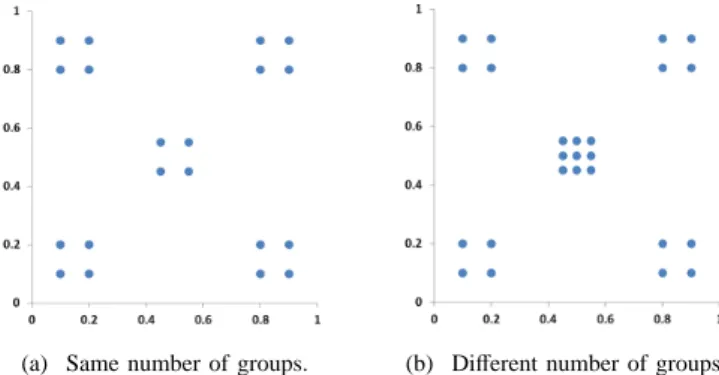
In this section, we investigate clustering phenomena when we configure network of coupled chaotic circuits in 2- dimensional. In our previous study [6], we researched the relationship between clustering and density of coupled chaotic circuits when we changed density of chaotic circuits. Arrange- ment of chaotic circuits are shown in Fig. 2. Figure 2 (a) is composed same number of chaotic circuits, however Fig. 2 (b) is composed high density of chaotic circuits in inside and some low density chaotic circuits groups. In these figures, we denote chaotic circuits with a simple model like small circle.
(a) Same number of groups. (b) Different number of groups.
Fig. 2. Arrangement of chaotic circuits.
Simulation results of these networks are shown in Fig. 3.
From simulation results, all chaotic circuits are synchronized in one cluster from the result of Fig. 3 (a), however we can see 2 clusters from chaos synchronization between high density group and same low density groups from the result of Fig. 3 (b).
From these results, clustering phenomena are related density of coupled chaotic circuits.
B. Investigation of clustering phenomena
Next, we investigate the clustering result corresponding to Fig. 3 (b) in detail. This network can be divided 2 clusters between high density and low density from chaos synchroniza- tion. We consider the state of this network when we change the parameter g determined by Eq. (4). Furthermore, we calculate
(a) One cluster. (b) Two clusters.
Fig. 3. The clustering results.
the phase difference between chaotic circuits using computer simulation.
For this simulation, the iteration is set toτp =10,000 for calculating the result more precisely. Figure 4 shows the phase difference between two chaotic circuits when we change the value of parameter g.
We define state of synchronization patterns from the average of phase difference when we calculate τp = 10,000. The state of synchronization can be defined if the average of phase difference below 40◦. Similarly, we define the state of asynchronous that the average of phase difference is between 70◦ and 110◦. In the region between g = 2.0 ×10⁻⁶ and g = 3.0×10⁻⁵ inside chaotic circuits group is synchronized one cluster, however other chaotic circuits that composed outside groups are not synchronized. In the region between g=4.0×10⁻⁵and g=2.0×10⁻⁴inside chaotic circuits group is synchronized one cluster, also outside chaotic circuits groups are synchronized one cluster. Therefore, clustering phenomena can observe in this region. Finally, all chaotic circuits are synchronized in one cluster if the region between g=3.0×10⁻⁴ and g=4.0×10⁻⁴. Thus, this network can observe 3 clustering patterns from the average of phase difference.
Fig. 4. The relationship between g and phase difference.
IV. Conclusions
In this study, we have considered clustering patterns gener- ated in coupled chaotic circuits networks. In these networks,
- 139 -
TABLE I State of networks
The value of g In - In In - Out Out - Out 2.0×10⁻⁶≤g≤3.0×10⁻⁵ Syn. Not-syn. Not-syn.
4.0×10⁻⁵≤g≤2.0×10⁻⁴ Syn. Not-syn. Syn.
3.0×10⁻⁴≤g≤4.0×10⁻⁴ Syn. Syn. Syn.
the coupling strength reflected the distance information and each chaotic circuit is connected globally. For this investi- gation, we have changed the scaling parameter of coupling strength. From computer simulation results, we have confirmed that the state of clustering patterns depend on the scaling parameter g and density of chaotic circuits networks.
In our future work, we would like develop relationship be- tween clustering and density of chaotic circuits. Additionally, we hope to apply this clustering method for data mining, image processing and something application in our lives.
References
[1] K. Kaneko, “Clustering, Coding, Switching, Hierarchical Ordering, and Control in a Network of Chaotic Elements,” Physical D, vol. 41, pp.
137-172, 1990.
[2] T. Ott, M. Christen and R. Stoop, “An Unbiased Clustering Algorithm Based on Self-organization Processes in Spiking Neural Networks”, Proc.
of NDES’06, pp. 143-146, 2006.
[3] L. Angelini, F. D. Carlo, C. Marangi, M. Pellicoro and S. Stramaglia,
“Clustering Data by Inhomogeneous Chaotic Map Lattice”, Phys. Rev.
Lett., 85, pp. 554-557, 2000.
[4] Y. Takamaru, H. Kataoka, Y. Uwate and Y. Nishio, “Clustering Phenom- ena in Complex Networks of Chaotic Circuits”, Proc. of ISCAS’12, pp.
914-917, Mar. 2012.
[5] Y. Takamaru, Y. Uwate, T. Ott and Y. Nishio, “Clustering Phenomena of Coupled Chaotic Circuits for Large Scale Networks”, Proc. of NDES’12, pp. 70-73, Jul. 2012.
[6] Y. Takamaru, Y. Uwate, T. Ott and Y. Nishio, “Clustering Phenomena Considering the Density of Coupled Chaotic Circuits Networks”, Proc.
of APCCAS’12, Dec. 2012. (to appear)
[7] Y. Nishio, N. Inaba, S. Mori and T. Saito, “Rigorous Analyses of Windows in a Symmetric Circuit,” IEEE Transactions on Circuits and Systems, vol.
37, no. 4, pp. 473-487, Apr. 1990.
[8] C. Bonatto and J. A. C. Gallas, “Periodicity Hub and Nested Spirals in the Phase Diagram of a Simple Resistive Circuit,” Phys. Rev. Lett., 101, 054101, Aug. 2008.
[9] R. Stoop, P. Benner and Y Uwate, “Real-World Existence and Origins of the Spiral Organization of Shrimp-Shaped Domains,” Phys. Rev. Lett., 105, 074102, Aug. 2010.
![Figure 1 shows the model of the chaotic circuit, investigated in [7]-[8].](https://thumb-ap.123doks.com/thumbv2/123deta/7315075.2423283/1.892.560.755.400.546/figure-shows-model-chaotic-circuit-investigated.webp)