Research on Improvement
of Two-Layer Cellular Neural Networks
Nurul Amirah binti Ramlan, Yoshihiro Kato, Yasuhiro Ueda, Yoko Uwate and Yoshifumi Nishio
Dept. Electrical and Electronic Eng., Tokushima University
2-1 Minami-Josanjima, Tokushima, Japan
Email: { mira88, kkato, yasuhiro, uwate, nishio } @ee.tokushima-u.ac.jp
Abstract—In this paper, we research the combination of two
neurons in the Cellular Neural Networks (CNN). Our proposed method is inspired from the two-layer CNN. Compare to two- layer CNN the data from each neurons are send using templates
A1and
B2. We apply this method to image processing of gray scale image and binary image. From two examples in simulation, we confirm proposed method have great potential in image processing.
I. I
NTRODUCTIONCellular Neural networks (CNN) were introduced by Chua and Yang in 1988 [1][2]. The idea of the CNN was inspired from the architecture of cellular automata [3][4] and neural networks [5][6]. Unlike the conventional neural networks, the CNN has local connectivity property and since the structure of CNN resembles the structure of animals’ retina, they have been successfully developed in various image processing applications [7]. Wiring weights of the cells are established by parameters called a template. The template is used to decide the performance of CNN.
In previous study of CNN, single-layer and two-layer CNNs have been introduced with many kinds of templates. For high performance processing, two-layer CNN have been proposed [8]. In this study we are not using parameter “template C” to carry the data between both layers. As a new approach, we propose a combination of two neurons for one cell in CNN. In the propose method, two templates are used simultaneously. In order to investigate the process, we apply the method to binary image. Frankly speaking, we also consider that the propose method is the new characteristic to investigate the behavior of CNN and the image feature when value is directly transferred into the next neuron using templates A, B and I.
The list of this paper is structured as follows. In Sec.II, we describe about two-layer CNN. In Sec.III, we explain the propose method. In Sec.IV, we show example of simulation result from the combination of two kinds of templates. Finally in section V, we conclude the article.
II. T
WO-L
AYERC
ELLULARN
EURALN
ETWORKSIn this section, we explain about the structure of two-layer CNN. The basic circuit unit in the CNN is called a cell. Each cell in the CNN only take interaction communication with the cell in neighborhood. The values of each cell change according
to the neighbor cells. In the CNN, output value also depends on parameters called a template. The CNN is contain with feedback template A, control template B and constant bias I.
In previous paper, the two-layer CNN has been introduced.
The two-layer CNN have been confirmed to have more effi- cient structure for image processing. The two-layer CNN is a combination of two set of the single-layer CNN. The different point from the single-layer CNN is that the two-layer CNN has coupling templates C
12and C
21. The templates are used to connect and transferred the data between first and second layers.
The state equations and the output equations for the two- layer CNN are given as follows.
State equation :
dv
x1ijdt = − v
x1ij+
∑
i+1 k=i−1∑
j+1 l=j−1A
1(i, j; k, l)v
y1kl(t)
+
∑
i+1 k=i−1j+1
∑
l=j−1
B
1(i, j; k, l)v
u1kl(t)
+
∑
i+1 k=i−1j+1
∑
l=j−1
C
12(i, j; k, l)v
y2kl(t) + I
1, ( | i − k | ≤ 1, | j − l | ≤ 1). (1)
dv
x2ijdt = − v
x2ij+
∑
i+1 k=i−1∑
j+1 l=j−1A
2(i, j; k, l)v
y2kl(t)
+
∑
i+1 k=i−1j+1
∑
l=j−1
B
2(i, j; k, l)v
u2kl(t)
+
∑
i+1 k=i−1j+1
∑
l=j−1
C
21(i, j; k, l)v
y1kl(t) + I
2,
( | i − k | ≤ 1, | j − l | ≤ 1). (2) Output equation :
v
y1ij(t) = 1
2 ( | v
x1ij(t) + 1 | − | v
x1ij(t) − 1 | ). (3)
- 137 -
IEEE Workshop on Nonlinear Circuit Networks December 9-10, 2011
v
y2ij(t) = 1
2 ( | v
x2ij(t) + 1 | − | v
x2ij(t) − 1 | ). (4) III. P
ROPOSEDM
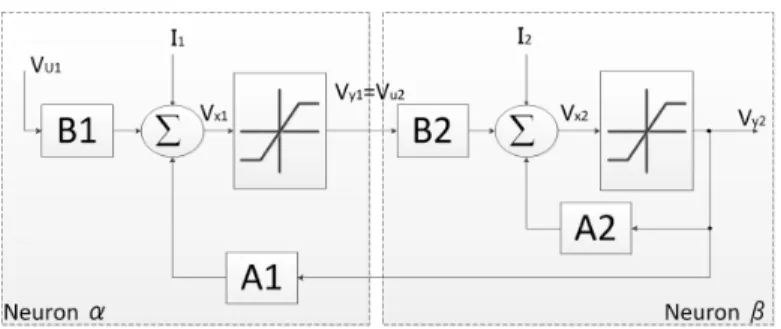
ETHODIn this section, we explain the algorithm of the proposed method. The proposed method is inspired from the two-layer CNN. In the proposed method, coupling templates are dismiss and the connection between two layers are accomplished by A
1and B
2. It is the different point between the proposed method and the two-layer CNN. By not using coupling tem- plates, the structure becomes simple compare to the two-layer CNN.
Fig. 1. Block diagram of the proposed method.
Figure 1 shows the block diagram for the proposed method.
In Fig. 1, we can see how the connection is taken between neuron α and neuron β. We define the input and the output values as v
u1, v
u2, v
y1and v
y2. At first the initial state for the neuron α and the neuron β are same. The input value v
u1is carried out with template B
1in the neuron α. The output from the neuron α is directly transfer into the neuron β as the input value v
u2. In the neuron α, v
y2is carried out with template A
1, and in parallel v
y2is also carried out with template A
2in the neuron β. These processes continue until the output converges. The state equations and the output equations are given as follows.
State equation in the neuron α :
dv
x1ijdt = − v
x1ij+
∑
i+1 k=i−1j+1
∑
l=j−1
A
1(i, j; k, l)v
y2kl(t)
+
∑
i+1 k=i−1∑
j+1 l=j−1B
1(i, j; k, l)v
u1kl(t) + I
1,
( | i − k | ≤ 1, | j − l | ≤ 1). (5) State equation in the neuron β :
dv
x2ijdt = − v
x2ij+
∑
i+1 k=i−1j+1
∑
l=j−1
A
2(i, j; k, l)v
y2kl(t)
+
∑
i+1 k=i−1∑
j+1 l=j−1B
2(i, j; k, l)v
y1kl(t) + I
2, ( | i − k | ≤ 1, | j − l | ≤ 1). (6)
Output equation :
v
u2ij(t) = v
y1ij(t) = 1
2 ( | v
x1ij(t) + 1 | − | v
x1ij(t) − 1 | ). (7)
v
y2ij(t) = 1
2 ( | v
x2ij(t) + 1 | − | v
x2ij(t) − 1 | ). (8) IV. S
IMULATIONR
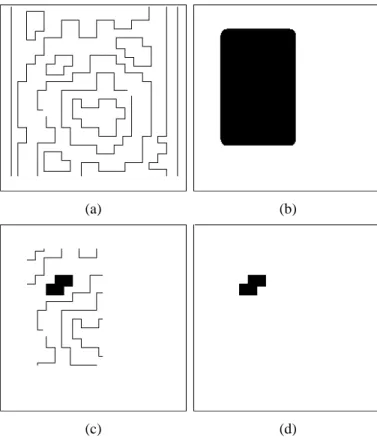
ESULTSIn this section, we show the simulation result using our proposed method. Figure 2(a)(b) are set as the input images in both neurons α and β . The “Hole filling” template [9] is used in the neuron α, and a new “White propagation” template is used in the neuron β .
“Hole filling” template :
A
1=
0 1 0 1 3 1 0 1 0
,
B
1=
0 0 0 0 4 0 0 0 0
, I
1= − 1. (9)
New “White propagation” template :
A
2=
0 0.5 0 0.5 3 0.5
0 0.5 0
,
B
2=
0 0 0 0 1 0 0 0 0
, I
2= − 2.75. (10)
The simulation results are shown as Fig. 2. The output of the neuron α is obtained as Fig. 2(c). It is the same as the case of the single layer CNN with“Hole filling” template.
The connection between v
y1and v
u2let the value from the neuron α directly process to the neuron β in the same loop.
Figure 2(d) is the output of the neuron β when the input value v
u2is processed with the initial state in Fig. 2(b). Only enclosed shape that exists in a black area of the initial state in Fig. 2(b) is detected as the output of neuron β. From these results, we can say that both templates can be used simultaneously.
V. C
ONCLUSIONSIn this study, we have proposed combination of two neurons for a cell in CNN. In our proposed method, two types of templates can be confirmed to effect in one output value. We can say that the data from each neurons still can be send to each other by only using template A
1and template B
2. From these simulation results, we could be said our proposed method have potential in image processing.
In the future works, we like to change the size of template and circuit to investigate the effects for output feature. Besides binary images, we also would like to try to use the proposed method for gray scale image and motion picture.
- 138 -
(a) (b)
(c) (d)
Fig. 2. Simulation results. (a) Input image (256×256). (b) Initial state.
(c) Output image of neuronα. (d) Output of neuronβ.
R
EFERENCES[1] L.O. Chua and L. Yang, “Cellular Neural Networks: Theory,” IEEE Trans.
Circuits Syst., vol. 32, pp. 1257-1272, Oct. 1988.
[2] L.O.Chua and L.Yang, “Cellular Neural Networks:applications,” IEEE Trans.Circuits Syst., vol. 35, no. 10, pp.1273-1290, Oct. 1988.
[3] S. Wolfram, “Computation theory of cellular automata,” Communication in Mathematical Physics, vol. 35, no. 96, pp.15-57, 1984.
[4] T.Toffoli and N. Margolus, Cellular Automata Machines: A New Envi- ronment for modeling, MIT Press, Cambridge, MA, 1987.
[5] J. J. Hopfield, “Neural networks and physical systems with emergent collective computational abilities,” Proc. Natl. Acad. Sci., vol. 79, pp.
2254-2258, 1982.
[6] J. J. Hopfield, “Neurons with graded response have collective computa- tional properties like those of two state neurons,” Proc. Natl. Acad. Sci., vol. 81, pp. 3088-3092, 1984.
[7] H. Koeppl and L. O. Chua, “An Adaptive Cellular Nonlinear Net- work and its Application,” Proc. of NOLTA’07, pp. 15-18, Sep. 2007.
[8] Zonghuang Yang, Yoshifumi Nishio and Akio Ushida, “Templates and Algorithms for Two-Layer Cellular Neural Networks,” Proceesings of IEEE International Joint Conference on Neural Networks(IJCNN’02), vol.
3pp. 1946-1951, May. 2002
[9] L.Kek, K.Karacs, and T.Roska, “Cellular Wave Computing Library (Templates, Algorithms, and Programs), Version 2.1,” Cellular Sensory Wave Computers laboratory, Hungarian Academy of Sciences, Budapest, Hungary, 2007.