Effects of Higher Dimensions on Chaos in Four Dimensional Hyperchaotic Systems
Tsuyoshi Isozaki, Takumi Nara, Yoko Uwate and Yoshifumi Nishio Dept. of Electrical and Electronic Engineering, Tokushima University
2-1 Minami-Josanjima, Tokushima 770–8506, Japan Email: { isozaki, nara, uwate, nishio } @ee.tokushima-u.ac.jp
Abstract—This paper considers the change of behavior with higher dimensions in four dimensional hyperchaotic systems. In particular, we focus on the shape and the complexity of chaotic attractors by changing the number of elements in the circuit.
By means of the computer simulation and circuit experiment, the changes in the shape of chaotic attractors are investigated.
Further, by means of simple poincaremap, the changes in the complexity of chaotic attractors are investigated. From the these results, it is shown that the system becomes more complex as the system becomes higher dimensions.
I.
INTRODUCTIONChaos is familiar phenomena in our daily lives. For exmaple, natural phenomena and neurons which build the brain and so on. From these viewpoints, the study of chaos has attracted a great interest from various fields such as natural sci- ence, biology and engineering. Particularly in the engineering field, confidential communications [1] are expected due to the randomness of chaos. In addition, chaos has attracted attention and research as a complex behavior which obtained from a simple low dimensional system. As the study progresses, it has been shown that higher dimensions result in more complex behaviors. In recent years, the studies on the behavior in high dimensional systems and analysis of complex networks [2]-[3]
that interconnect systems are conducted.
We focus on the systems that generate hyperchaos. Hy- perchaos is generated from high dimensional systems with a minimum dimension of four. Further, the behavior of hyper- chaos is harder to predict more than general chaos because it has at least two positive Lyapunov exponents. Therefore hyperchaotic systems are expected to be more secure com- munications [4]. In this study, we use the four dimensional hyperchaotic system proposed by Nishio et al. [5]. In this system, the results show that the inductor and capacitor values affect the generated attractor. Therefore, we change dimen- sions by increasing the number of inductors and capacitors and investigate the changes of dynamics.
II.
EXTREAMELY SIMPLE HYPERCHAOS GENERATORSFigure 1 shows the chaotic circuit which generates hyper- chaos [5]. This circuit consists of a negative resistor, two inductors, two capacitors and one diode.
Fig. 1. Chaotic circuit.
The circuit equations are given as follows:
C
1dv
1dt = i
1− i
dC
2dv
2dt = i
2− i
1L
1di
1dt = v
2− v
1L
2di
2dt = − v
2+ ri
2.
(1)
By using the parameters and the variables:
v
1= Ex
1, v
2= Ex
2, t = √ L
1C
1τ
i
1=
√ L
1C
1Ex
3, i
2=
√ L
1C
1Ex
4, ε = 1 G
√ C
1L
1γ
C= C
1C
2, γ
L= L
1L
2, α = R
√ L
1C
1L
2.
The normalized circuit equations are given as follows:
˙
x
1= x
3− f (x
1)
˙
x
2= γ
C(x
4− x
3)
˙
x
3= x
2− x
1˙
x
4= − γ
Lx
2+ αx
4.
(2)
where the parameter f (x) is the equation for the diode and described as follows:
f(x) = 1
2 ε
−1( | x − 1 | + x − 1) . (3)
- 29 -
IEEE Workshop on Nonlinear Circuit Networks December 13-14, 2019
We set the values of parameters. Computer simulation for γ
C= 0.47, γ
L= 0.4, α = 0.16, ε = 0.01. Circuit exper- iment for L
1= 20mH, L
2= 50mH, C
1= 0.022µF, C
2= 0.047µF .
III.
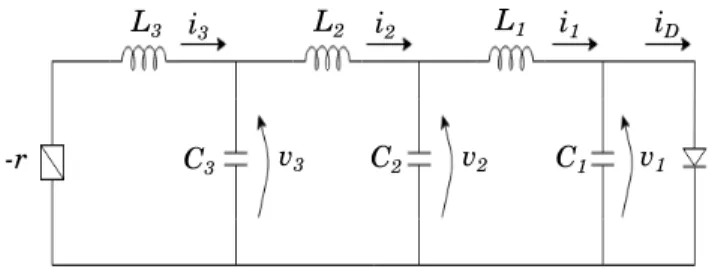
SYSTEM MODELFigure 2 shows the chaotic circuit which one inductor and one capacitor are added to Fig. 1.
-r
L
3i
3L
2i
2L
1i
1i
Dv
3v
2v
1C
3C
2C
1Fig. 2. Proposed model.
By using the parameters and the variables:
v
1= Ex
1, v
2= Ex
2, v
3= Ex
3, t = √ L
1C
1τ
i
1=
√ L
1C
1Ex
4, i
2=
√ L
1C
1Ex
5, i
3=
√ L
1C
1Ex
6γ
C1= C
1C
2, γ
C2= C
1C
3, γ
L1= L
1L
2, γ
L2= L
1L
3α = R
√ L
1C
1L
2, ε = 1 G
√ C
1L
1.
The normalized circuit equations are given as follows:
˙
x
1= x
4− f(x
1)
˙
x
2= γ
C1(x
5− x
4)
˙
x
3= γ
C2(x
6− x
5)
˙
x
4= x
2− x
1˙
x
5= γ
L1(x
3− x
2)
˙
x
6= − γ
L2x
3+ αx
6.
(4)
We set the values of parameters. Computer simulation for γ
C1= 0.45, γ
C2= 0.21, γ
L1= 0.5, γ
L2= 0.4, α = 0.06, ε = 0.01. Circuit experiment for L
1= 10mH, L
2= 20mH, L
3= 50mH, C
1= 0.010µF, C
2= 0.022µF, C
3= 0.047µF .
IV.
COMPUTER SIMULATION AND CIRCUIT EXPERIMENTFirstly, we compare the shape of attractors from the results obtained from computer simulations and circuit experiments.
In this study, we measure the values of two capacitors close to negative resistor and diode in the circuit. Figure 3(a) shows the attractors which obtained from the circuit of Fig. 1. Figure 3(b) shows the attractors which obtained from the circuit of Fig. 2.
Further the figures of left side show the results of circuit experiment and the figures of right side show the results of computer simulation in Fig. 3. In this results, we confirmed that the shape of attractors did not change so much.
x
2x
1v
2v
1(a) Attractors obtained from the circuit of Fig. 1.
x 3
x 1 v 3
v 1
(b) Attractors obtained from the circuit of Fig. 2.
Fig. 3.
Attractors by the computer simulation and circuit experiment.
V.
SIMPLE POINCAREMAPSecondly, we compare the complexity of attractors by using simple poincaremap. The poincaremap is obtained by setting a plane that crosses the trajectory of the attractor. Further it is used to analyze the local properties of attractors by plotting points when the trajectory intersects the plane. For example, when the attractor has one periodic trajectory, it is expected that the trajectory always intersects the plane at the same position. On the other hand, when the attractor has multiple trajectories, it is expected that the trajectories intersect the plane at various positions. That is, the attractor has a complex trajectory and many points are plotted on the plane.
In this study, we evaluate the complexity of attractors from two viewpoints using simple poincaremap. First, many points are plotted extensively. Second, losing the structural order of the shape. In other words, the outline of the shape is not clear.
Figure 4(a) shows the attractors obtained from the circuit of Fig. 1. Figure 4(b) shows the attractors obtained from the circuit of Fig. 2. Further the figures of left side show the attractors and the figure of right side show the attractors of simple poicaremaps in Fig. 4. In this results, we confirmed
- 30 -
that many points are plotted extensively in Fig. 4(b) and the outline of the shape is clear in Fig. 4(a) but the outline of the shape is not clear in Fig. 4(b). Therefore, it is confirmed that the attractors which obtained from the circuits with increased dimensions become complex.
x 2
x 4 x 4
x 2
(a) Attractors obtained from the circuit of Fig. 1.
x 6 x 6
x 3 x 3
(b) Attractors obtained from the circuit of Fig. 2.
Fig. 4.
Attractors by the computer simulation.
VI.
CONCLUSIONThis study considers the change of behavior with higher dimensions in four dimensional hyperchaotic systems. In par- ticular, we focus on the shape and the complexity of chaotic attractors by changing the number of elements. By means of the computer simulation and circuit experiment, the change in the shape of chaotic attractors are investigated. Further, by means of simple poincaremap, the change in the complexity of chaotic attractors are investigated. Firstly, from the results of the computer simulation and circuit experiment, we confirmed that the shape of attractors did not change so much. Secondly, from the results of simple poincaremap, we confirmed that the complexity of attractors changed with increased dimensions.
R
EFERENCES[1] Takami Matsuo, Member, Haruto Suemitsu, Non-member, Kazushi Nakano, Member “A Design of a Nonlinear Decrypter for Chaotic Secure Communications”,IEEJ Trans. EIS, vol. 123, No. 9, 2003
[2] Shuhei Hashimoto, Takahiro Chikazawa, Yoko Uwate and Yoshifumi Nishio “Synchronization Phenomena due to Changes in Network Struc- ture of Coupled Chaotic Circuit in Complex Networks”, Proceedings of international Symposium on Nonlinear Theory and its Applications (NOLTA’ 17), pp. 522-525, Dec. 2017.
[3] Kenta Ago, Yoko Uwate and Yoshifumi Nishio, “Influence of Local Bridge on a Complex Network of Coupled Chaotic Circuits”,Proceedings of international Symposium on Nonlinear Theory and its Applications (NOLTA’ 14), pp. 731-734, Sep.2014.
[4] Xingyuan Wang, Mingjun Wang“A hyperchaos generated from Lorenz system”,Physica A: Statistical Mechanics and its Applications, vol. 387, issue. 14, pp. 3751-3758, 1 June 2008.
[5] Y. Nishio, S. Mori and T. Saito “Extremely simple hyperchaos generators including one diode”,Proc. IEEE international Symposium on Circuits and Systems, vol. 6, pp. 2797-2800, May 1992.
![Figure 1 shows the chaotic circuit which generates hyper- hyper-chaos [5]. This circuit consists of a negative resistor, two inductors, two capacitors and one diode.](https://thumb-ap.123doks.com/thumbv2/123deta/7315970.2423555/1.892.483.802.319.437/figure-chaotic-generates-consists-negative-resistor-inductors-capacitors.webp)