著者
加藤 智洋
学位授与機関
Tohoku University
修士論文
基本対称性の破れの探索に向けた
測定系の開発
東北大学大学院理学研究科
物理学専攻
加藤智洋
平成24年
3
修士論文概要
基本対称性の破れの探索に向けた測定系の開発
東北大学大学院 理学研究科 物理学専攻
加藤智洋
平成24年 電子の永久電気双極子の能率の精密探索 我 々 は 時 間 反 転 (T ) 対 称 性 を 破 る 観 測 量 で あ る 電 子 の 永 久 電 気 双 極 子 能 率de(Electric Dipole Moment, EDM)をアルカリ原子・最大の電子EDM増幅度を持
つフランシウム(Fr)を用いて測定感度|de| <∼ 10−28 e cmでの精密探索を目指してい る.場の理論で一般的に成り立つCPT定理*1によれば,T対称性の破れは,荷電共役 変換(C)と空間反転変換(P )を組み合わせたCP対称性の破れを意味する.標準理論 におけるCP対称性の破れは,3世代6種類のクォーク間の混合行列であるCKM行 列の対角成分において複素位相が現れることにより説明される.K中間子やB中間子 の崩壊におけるCP非保存現象の理解は深まっているが,それでもなお反物質消失の 機構を完全に説明することは現在の標準理論では困難である.標準理論を超える様々 な理論模型による電子EDMの予測値は,既に現在の実験技術で探索可能な領域にさ しかかっており,EDM探索は新物理の検証を意味する. 我々は東北大学サイクロトロン・ラジオアイソトープセンター(CYRIC)にレーザー 冷却不安定原子生成工場を建設している.930AVFサイクロトロンで100 MeVに加 速された18O5+を液体の金ターゲットに入射した際に起こる核融合反応(18O +197 Au→ 210Fr + 5n)を用いて寿命が約3分の放射性元素,210Frを生成し,ターゲット 直下で∼ 106 ppsの収量を確認している.しかしながら,ターゲット付近は18O5+や 金蒸気,熱中性子等が存在するため,精密測定には適さない.そこで,Frを一度イオ ン化させて低バックグラウンド環境へと輸送し中性化する.中性化器から熱原子ビー ムとして射出されたFrを中性原子線横方向速度減速器によりコリメートし,Zeeman 減速器により冷却した後に磁気光学トラップ(MOT)で捕獲·冷却し,その後光双極子 トラップにより測定領域へと移送されEDM測定が行われる.EDMは静磁場と平行 及び反平行に静電場を印加した際のスピン歳差周波数の極微な変化として検出される. したがって,EDM探索実験では一様な高電場印加及び時間的・空間的に安定な磁場環 境,原子集団の局在化が重要な要素となる.原子が印加静磁場に対して速度を持つ場合 は電磁場の非一様性や原子の速度により誘起される磁場の影響,原子同士の衝突による 状態の変化が系統誤差となるが,原子が十分に冷却されていれば,これらの系統誤差を 抑えた上で電磁場と長時間相互作用させることが可能である.故に原子の冷却·局在化 も本測定の鍵となる.本研究ではEDM測定装置の重要な構成要素:電場印加システ ム,原子トラップ装置,磁気シールドに関して開発を行い,それら性能評価を進めた. EDM測定系 我々は,電子EDMの高精度探索を実現するために,冷却原子を用いたEDM測定 装置の開発を行った.この手法には系統誤差を抑える長所が多くあるものの,これまで 冷却原子を用いたEDM測定は行われていない.今回,EDM測定系を構成する要素を 個々に開発し,その性能評価を行い,目標精度を実現するための課題を明らかにした. *1 Lorentz不変な系はC, P, T の3つの変換を組み合わせた操作に関して不変であるという定理
EDM探索で重要となるのは,原子のスピン歳差運動の周期を高精度に測定する事であ る.測定装置は,(1)原子を予備冷却・トラップするためのMOT装置,(2)予備冷却 された原子を光でトラップする光双極子トラップ装置,(3)原子に高電場を印加するシ ステム,そして(4)外部磁場の変動による偽EDM信号を抑制するための高遮蔽率磁 気シールドで構成する.核融合反応で生成・輸送・中性化されたFrは(1)のMOTに 導入され,磁場を切って光トラップで捕捉し,高電場中の歳差周期を測定する. 電場印加システム 電子EDMの測定精度は, δde= ¯ h 2R F E 1 τ 1 √ mN *2 と表され電場強度に依存するため,原子集団に対して高電場を印加する必要がある. 電子EDM増幅度: 895,トラップ原子数106 個,スピン偏極保持時間1秒ととい う条件において電場強度を100 kV/cmとすると,1日間の測定で目標の測定感度 ∼ 10−28 e cmを得る事が可能になる. そこで,我々は目標とする統計精度を達成する ため,100 kV/cmの電場強度を目指し電場印加試験チェンバーを作成し,高真空中で の電場印加試験を行った.電場印加試験チェンバーは真空槽内に設置した間隙1 cm, 直径2 cmの対の無酸素銅製円筒型電極,高圧電源(出力電圧0∼100 kV)より構成さ れる.電極間隔が狭い方が高電場を達成しやすいが,我々の実験手法においては電極間 に原子をトラップする必要がある.この電極の形状は原子集団の分布,トラップレー ザーの入射角度および直径により最適化される.アノード電圧100 kV,カソード電圧 を0 kVとして行ったシミュレーションの結果,電極中心電場勾配はそれぞれ,r方向 で∼ 2 kV/cm2,z方向で ∼ 10 kV/cm2となった.今回行った実験では,印加電圧 が40 kV/cmの際の電極間の漏れ電流が20 pA以下であった.また,漏れ電流の測定 を行わずに本装置の安全運用上で達成可能な最大印加電圧50 kVまで到達した. Trapped atoms Laser Field plate Static field; E0, B0 z r 図1 光トラップ中でのEDM測定の概念図 *2de=|de|, ¯h: 換算Planck定数, R: EDM増幅度, F : 全角運動量, E: 電場強度, τ : 相互作用時間, m: 測定回数, N : 原子の個数
5 原子の局在化 EDMの測定感度は電場と原子の相互作用時間が長いほど向上する.原子を冷却・捕 捉した状態は高速で運動する原子ビームの場合とは異なり,長い相互作用時間を達成 することが可能である.さらに,原子を局在化させた場合,電場や磁場の空間的非一様 性,静電場中の原子の運動により誘起される磁場の影響による系統誤差を抑えることが 可能である.これらの利点から,我々は原子を長時間ある領域に閉じ込めることが可能 なEDM測定装置を設計した.MOTを用いて原子を捕捉した場合,原子集団の局在 化は可能であるが,四重極磁場の影響により,我々が測定対象とする一様静磁場中での 原子の歳差運動を観測することが困難である.そこでMOTで捕獲·冷却された原子 を光双極子トラップへ移行して原子集団を測定領域に移送することにより,一様静電 磁場中でのEDM測定が可能になる.今回,Frと同じアルカリ原子であるルビジウム (Rb)原子集団をMOT中に捕獲することを確認し,そのトラップ原子集団のサイズ, 原子数を蛍光強度から評価した.さらに,MOTで捕獲された原子集団に対して,光双 極子トラップに移行する装置を開発し,トラップ実験を行う.これらの結果から,光双 極子トラップに捕捉される原子数を評価し,現状のシステムでの測定感度と系統誤差を 議論する. 磁場安定化 EDM測定の際に測定領域で起こる磁場変動は系統誤差の大きな要因となる.そのた め,測定領域を磁気シールドで蔽い,地磁気等の直流成分を限りなくゼロに近づける必 要がある.我々が目標とするEDM測定精度では測定時間である約10秒間の磁場変動 を0.3 pT以下に抑えることが要請される.磁場安定化のためにEDM測定領域付近 の環境磁場をFluxgate磁力計を用いて測定し,環境磁場変動要因の調査を行った.ま た,EDM測定領域付近に静的磁気シールドを導入し,磁気シールド内部及び外部の磁 場を測定することで,Fr生成・輸送実験時におけるEDM測定領域の環境磁場変動を 見積もり,目標とする磁場安定精度の達成に向けた対策として,磁気シールド室の設計 を行った. まとめ 本研究ではEDM測定の際の重要な要素となる,電場印加システムの開発,測定領域 の磁場変動の計測を行った.本論文では原子集団に電場を印加するための電極の開発 状況,原子集団を局在化させるための光双極子トラップ,測定領域の環境磁場の現状お よび安定性の向上について論ずる.
i
目次
論文概要 2 第1章 物理的背景 1 1.1 基本対称性とCPT定理 . . . 1 1.2 CP対称性の破れ . . . 2 1.3 CP対称性の破れとEDM . . . 2 1.4 標準理論によるEDMの評価 . . . 4 1.5 標準理論を超える模型によるEDM . . . 6 1.6 電子EDMの増幅 . . . 9 1.7 電子EDMの探索 . . . 10 1.8 レーザー冷却Frを用いたEDM測定 . . . 17 第2章 EDM測定原理 19 2.1 電磁場との相互作用 . . . 19 2.2 Ramsey共鳴によるEDM測定 . . . 22 2.3 レーザー冷却不安定原子生成工場 . . . 25 第3章 EDM測定系の開発と性能評価 27 3.1 電場印加システム . . . 27 3.2 原子の局在化 . . . 32 第4章 磁場安定化 49 4.1 磁場安定精度 . . . 49 4.2 電磁場変動要因 . . . 49 4.3 環境電磁場変動の抑制 . . . 50 4.4 環境磁場計測 . . . 54 第5章 EDM測定系の探索感度の評価と議論 59 5.1 統計精度 . . . 59 5.2 系統誤差 . . . 60 5.3 EDM探索感度 . . . 64第6章 まとめ 65
付録A 幾何学的位相効果 67
参考文献 73
iii
図目次
1 光トラップ中でのEDM測定の概念図 . . . 4 1.1 時間反転・空間反転対称性とEDM . . . 3 1.2 基本的なCP-odd起源に対する3種類のEDMの寄与 . . . 3 1.3 標準理論でのdクォークのEDMに寄与するダイアグラム . . . 4 1.4 標準理論での中性子のEDMに寄与するダイアグラム . . . 5 1.5 標準理論での電子のEDMに寄与するダイアグラム . . . 5 1.6 SUSYによる電子EDMの生成 . . . 6 1.7 SUSY CP問題 . . . 8 1.8 LFVに対する電子EDMの寄与 . . . 9 1.9 電子EDM探索実験の歴史. . . 10 1.10 Csセルを用いたEDM探索実験. . . 11 1.11 Tl原子ビームを使った電子EDM探索実験 . . . 12 1.12 YbF分子ビームを使った電子EDM探索実験. . . 13 1.13 Cs原子泉法を用いたEDM探索実験 . . . 15 1.14 Cs光格子を用いたEDM探索実験 . . . 16 2.1 Ramsey共鳴の概念図 . . . 19 2.2 EDMが存在する場合のスピン1/2系のエネルギー準位図 . . . 20 2.3 Ramsey共鳴のEDMの効果による位相変化 . . . 24 2.4 Fr-EDM実験用ビームライン . . . 26 2.5 Fr由来ののα線スペクトラム . . . 26 3.1 磁気光学トラップからEDM測定系への輸送方法 . . . 28 3.2 電極の電場計算結果 . . . 29 3.3 電極中心での電場勾配のシミュレーション計算結果 . . . 30 3.4 電場印加システムの概略図 . . . 30 3.5 電場印加システムの写真 . . . 31 3.6 電極の写真 . . . 31 3.7 コンディショニングによるリーク電流の電圧依存性の変化 . . . 32 3.8 2準位原子系 . . . 333.9 MOTの原理 . . . 35 3.10 吸収イメージング . . . 38 3.11 トラッピング光光学系 . . . 41 3.12 リポンピング光光学系 . . . 42 3.13 MOT光学系 . . . 43 3.14 ODT光学系 . . . 45 3.15 Double MOTシステム . . . 46 3.16 MOT-1、MOT-2中のRbの蛍光 . . . 47 3.17 MOT-2の寿命測定 . . . 47 4.1 補償コイルを用いた磁場安定化 . . . 51 4.2 磁場安定化システム立面図 . . . 53 4.3 EDM測定領域周辺にある電磁場ノイズ源. . . 54 4.4 環境磁場測定装置の概略図 . . . 55 4.5 プロトタイプ磁気シールド . . . 56 4.6 Fr生成・輸送実験中のY方向環境磁場・温度の計測結果 . . . 58 5.1 磁気シールド内部軸方向残留磁場のAllan分散 . . . 61 5.2 電極間のリーク電流がつくる磁場 . . . 62 A.1 Ramsey-Bloch-Seigertシフト . . . 68 A.2 容器のxy平面図 . . . 69
v
表目次
1.1 超対称性 . . . 6 1.2 常磁性原子の電子EDM増幅度 . . . 10 4.1 主な磁場変動要因 . . . 52 4.2 磁気シールドの寸法 . . . 56 4.3 磁気シールドの性能 . . . 571
第
1
章
物理的背景
素粒子の基礎法則を記述する場の量子論には、一般的に成り立つCPT定理が存在す る。ここで、C、P、Tはそれぞれ荷電変換、空間反転、時間反転を示し、連続変換とは異 なり、離散的な変換である。CPT定理とは、素粒子の反応において、これらの変換を反 応の前後に同時に施すと、この反応と変換後の反応が同じ遷移確率でおこる事を示してい る。しかしながら、C、P、Tの各々の変換による不変性(対称性)は、4つの基本相互作 用のうち、弱い相互作用において破れている事が知られている。さらに、CとPの同時 変換CPによる対称性に関しても、中性K中間子やB中間子の崩壊現象によって破れて いることが詳細に調べられてきている。CPが破れていることは、CPT定理をふまえる と、T変換(時間反転対称性)も破れていることが示唆され、これまで、様々な現象にお いて、時間反転対称性の破れに関して、調べられてきた。本研究の対象である素粒子の電 気双極子能率(EDM)とは、後述するように、時間反転対称性を破る観測量であり、有 限のEDMの存在が確かめられれば、それは時間反転対称性、ならびにCP対称性の破れ を示す新たな物理量となり、基本対称性の破れの機構解明に向けて、新たな知見が加わる 事となる。以下で、基本対称性について、本研究に必要な事項を述べる。1.1
基本対称性と
CPT
定理
自然界に存在する4つの基本相互作用に対して空間反転(P )、荷電共役(C)、時間反転 (T )の変換がある。空間反転P は位置座標を反転させる変換であり、空間座標をx、時間 座標をtとした場合、P 変換は、 (t, x) P←→ (t, −x) のように空間座標を反転させる。 次にC変換は、 (t, x) C←→ (t, x) のように時空間の座標は変化せず、電荷が反転する。次にT 変換は、 (t, x) T←→ (−t, x) と時間を反転させる変換である。それにともない、運動量及びスピンも反転する。 CPT定理とはLorentz不変な系は上述の3つの変換を組み合わせた操作に関して不変 であるというもので、1955年にPauliによって発見された。CPT定理が成り立つとすれ ば、物質とその反物質は完全に同じ質量を持たなければならない。反陽子の質量の高精度 測定が行われているが、現在CPT定理の破れは発見されていない[1]。
1.2
CP
対称性の破れ
かつて物理法則はこれらの変換に対して不変であると考えられていた。しかし、1956 年、LeeとYangは弱い相互作用で空間反転対称性が破れていることを主張した [2]。後 にWuらが偏極させた60Co原子核のβ崩壊において、60Co原子核のスピンの向きに対 して反対方向に電子が放出されやすいことを発見し、これが弱い相互作用で空間反転対 称性が破れていることの実験的証拠となった[3]。さらに、ニュートリノのヘリシティが ニュートリノは常に右巻きであり、反ニュートリノは常に左巻きであるという実験結果 はC 対称性を破るものである。C、P 変換単独では対称性を破っていることが示された が、P 変換とC変換との積であるCP 変換は対称性を保つ変換であると考えられた。し かし、1964年にCroninとFitchがK中間子の崩壊現象がCP も破っていることを実験 的に示した[4]。このCP 対称性の破れは小林・益川理論において、3世代 6 種のクオー クの間の混合行列(CKM行列)要素に複素位相が現れることにより説明された [5]。1.3
CP
対称性の破れと
EDM
電気双極子能率dは二つの点電荷+q と−q が距離 r離れて存在している場合、d = qr(ベクトルの方向は−qから+q)のように表すことができる。もし基本粒子がスピンに並行もしくは反平行な永久電気双極子能率(permanent Electiric Dipole Moment, EDM)
を持つ場合、図1.1で示すようにP 変換を施した場合、電荷分布が反転するため空間反転 対称性が破れる。また、T 変換を施すと、位置座標は符号を変えず、スピンが反転するた め、時間反転対称性を破ることになる。さらに、CPT定理を仮定すれば、CP対称性の破 れを意味する。EDMはCP非保存の起源の解明にとって重要な物理量であり、様々な素 粒子や量子多体系を対象に、最先端の実験技術を駆使してEDM探索が行われている。 CP対称性を破る起源は、素粒子の種類により、様々な機構によってEDMという形に なって生じてくる。素粒子であるレプトンとクォークのEDMを直接測定できれば、CP 非保存の機構解明直接的に行う事ができる。しかし、クォークは単体では存在せず、電
1.3 CP対称性の破れとEDM 3
T
P
EDM
Spin
EDM
Spin
EDM
Spin
+
-
+
-
+
-図1.1 EDMは空間反転対称性、時間反転対称性の両方を破る。 子は電荷を持っている故にEDMを直接測定することは困難*1である。そこでEDMの 測定は中性子や反磁性原子、常磁性原子、極性分子といった電気的に中性な系を対象に 探索が進められている。図1.2に示されるように、中性子は主にQCDに置けるCP対 称性のやぶれを通じたクォークのEDM(dq)、電子の閉殻構造を持つ反磁性原子は核子間 のPT-oddな相互作用を通じてクォークの色電荷によるEDM ( ˜dq)に、不対電子を持つ 常磁性原子は主に電子のEDM(de)およびクォーク·電子間相互作用(Cqe)、クォーク· クォーク間相互作用(Cqq)を通じたP, T-pddな相互作用(CS,P ,T)にそれらの大きな源 泉があり、さらに全ての原子系は電子-核子間のPT-oddな相互作用CS,P,T に感度があ る。大半の複合系はクォークと電子から構成されているため、各々のEDMの寄与は正確 に評価する必要がある。クォークのEDMを引き出すためには、中性子の場合、核子の クォーク構造やQCDの情報が必要となり、原子核の場合はさらに核構造の情報が必要に なる。一方、電子EDMの場合は、QCDや核構造の理論が介在しない分、解釈がシンプ ルになるが、クォークとレプトンのEDMを精密に調べるためには、クォークの様々な量 子多体系のEDMを測定し、総合的な理解をすることが重要である。tion relies on the validity of the CPT theorem. The interaction dE Æ S for a spin 1/2 particle then has the following relativistic generalization:
HT ;P-odd¼ "dE # S S ! L¼ "d i 2wr lmc 5wFlm: ð2:2Þ
Parenthetically, it is worth remarking that the precision of EDM experiments has now reached a level sufficient to provide competitive tests of CPT invariance, since one can also consider a CP-even, but CPT-odd, relativistic form of dE Æ S, namely L¼ dwclc
5wFlmnm, with a preferred frame nm= (1, 0, 0, 0), which spontaneously
breaks Lorentz invariance and CPT.
The problem of calculating an observable EDM from the underlying CP-violation in a given particle physics model can be conveniently separated into different stages, depending on the characteristic energy/momentum scales. At each step the result can be expressed as an effective Lagrangian in terms of the light degrees of freedom with Wilson coefficients that encode information about CP-violation at higher-energy scales. As usual in effective field theory, it is convenient to classify all possible effec-tive CP-violating operators in terms of their dimension, with the operators of lowest dimension usually leading to the largest contributions. This logic may need to be re-fined if symmetry requirements imply that certain operators are effectively of higher dimension than naive counting would suggest. This is actually the case for certain EDM operators due to gauge invariance, as discussed in more detail below.
We will present this analysis systematically in order of increasing energy scale, working our way upwards in the dependency tree outlined inFig. 1, which allows us to remain entirely model-independent until the final step where some high-scale model of CP-violation can be imposed and then subjected to EDM constraints.
Fig. 1. A schematic plot of the hierarchy of scales between the CP-odd sources and three generic classes of observable EDMs. The dashed lines indicate generically weaker dependencies.
124 M. Pospelov, A. Ritz / Annals of Physics 318 (2005) 119–169
EDMs of diamagnetic atoms (Hg, Xe, Ra, Rn) EDMs of paramagnetic molecules (YbF, PbO, HfF+) atoms(Tl, Rb, Cs, Fr)
図1.2 基本的なCP-odd起源に対する3種類のEDMの寄与。異なる粒子のEDM
測定は、基本粒子のEDMを通してCP対称性の破れおよび基本相互作用の解明に相 補的な役割を担う。点線は一般的に寄与が小さいことを示す[6]。
1.4
標準理論による
EDM
の評価
クォークの3世代間の混合を表すCabibbo-Kobayashi-Maskawa行列(CKM行列)は 次のように表され、各行列要素の絶対値は(式1.2)で表される。[7]。 VCKM = VVudcd VVuscs VVubcb Vtd Vts Vtb (1.1) = 0.97427± 0.00015 0.22534 ± 0.00065 0.00351 +0.00015 −0.00014 0.22520± 0.00065 0.97344 ± 0.00016 0.0412+0.0011−0.0005 0.00867+0.00029−0.00031 0.0404+0.0011−0.0005 0.999146+0.000021−0.000046 (1.2) 式(1.1)のVub とVtd が虚数部分を持つことによりCP対称性を破ることが知られてい る。また、(1.2)より、CP対称性を破りうる世代間の混合が小さいこともわかる。 EDMはCP対称性を破る高次の項で発現するため、非常に小さい値が予想されている。 まず、ハドロンセクターのEDMとしてdクォークのEDM(dCKMd )を例にとると、図1.3 で示すように3ループで初めて発現し、dCKMd ' 10−34 e cmと計算されている[8]。さら に、クォークの多体系である中性子のEDM(dCKMn )は図1.4で示すように2ループダイ アグラムで記述され、dCKM n ' 10−32 e cmと見積もられる[9] [10]。V
OLUME
78, N
UMBER
23
P H Y S I C A L R E V I E W L E T T E R S
9 J
UNE
1997
FIG. 3.
Heavy top quark contributions to d
d.
with those of the mass of the second heaviest quark, m
b
.
In this way we arrive at our final formulas for the down
quark,
d
d
e
≠
m
d
m
c
2
a
s
G
F
2
˜d
108p
5
∑µ
L
2
bc
2
2L
bc
1
p
2
3
∂
L
Wb
1
5
8
L
2
bc
2
µ
335
36
1
2
3
p
2
∂
L
bc
(5)
2
1231
108
1
7
8
p
2
1
8z
3
∏
1
O sm
2
yM
2
d ,
and for the up quark,
d
u
e
≠
m
u
m
2
s
a
s
G
F
2
˜d
216p
5
∑µ
2
L
2
bs
1
2L
bs
1
2 2
2p
2
3
∂
L
Wb
2
L
bc
L
2
cs
1
2L
bc
L
cs
2
5
8
L
2
bs
(6)
2
µ
259
36
1
p
2
3
∂
L
bs
1
µ
140
9
1 p
2
∂
L
cs
2
121
108
1
41
36
p
2
2
4z
3
∏
1
O sm
2
yM
2
d ,
where
O sm
2
yM
2
d denotes terms with an additional
sup-pression by quark or W boson masses; L
ab
; lnsm
2
a
ym
b
2
d,
z
3
is the Riemann zeta function
sz
3
≠ 1.202 . . .d, and ˜d
denotes the CP violating invariant
˜d ≠ s
2
1
s
2
s
3
c
1
c
2
c
3
d
,
(7)
where, for the CKM matrix, we use the convention of
[22,27]. From our expressions it is not obvious that
the quark EDM vanishes if any two up- or
down-FIG. 4.
Heavy top quark contributions to d
u.
type quarks have degenerate masses. This is because
we have assumed a hierarchy of masses, and retained
only the leading terms in the expansions in mass ratios.
Such expansion, while delivering a simple and compact
formula, obscures the symmetry of the full result.
It is instructive to compare our findings with the results
obtained in the Fermi theory [22]. In that reference the
terms with three powers of logarithms were calculated
and if the top quark mass is replaced by the mass of
the W boson they coincide with our L
2
bc
L
Wb
(for d
d
) and
2
L
2
bs
L
Wb
2
L
bc
L
2
cs
(for d
u
). However, it turns out that
the terms with the highest power of logarithms are not
the dominant components of the complete result. In fact,
the large negative coefficient of the single logarithms L
bc
leads to more than a complete cancellation of the triple log
contribution to d
d
. Partial cancellation is also found in d
u
.
For the numerical estimates we use the following values
of parameters: ˜d
≠ 5 3 10
25
, a
s
≠ 0.2, m
s
≠ 0.2 GeV,
m
c
≠ 1.5 GeV, m
b
≠ 4.5 GeV, M
W
≠ 80 GeV. We
find
d
d
≠ 20.7 3 10
232
m
d
GeV
e
cm ,
d
u
≠ 20.3 3 10
232
m
u
GeV
e
cm .
(8)
Previous estimates were based only on the terms with
three powers of logs; from those we find
d
d
striple log approx.d ≠ 15 3 10
232
m
d
GeV
e
cm ,
d
u
striple log approx.d ≠ 20.4 3 10
232
m
u
GeV
e
cm .
(9)
We see that the “non-leading-log” terms suppress the
quark EDM, especially strongly for the d quark, where
they even change the sign of the effect. For the
experi-mentally interesting neutron EDM, the d quark EDM
is the more important quantity. The suppression factor
we found decreases the part of the standard model
contribution generated by the quark EDM and renders it
definitely unobservable for the experiments in the near
future.
Inserting current quark masses for m
u
,d
in Eq. (8), we
obtain the following numerical values:
d
d
≠ 20.7 3 10
234
e
cm for m
d
≠ 10 MeV ,
(10)
d
u
≠ 20.15 3 10
234
e
cm for m
u
≠ 5 MeV .
We should stress here that we have neglected terms with
more than one power of light quark masses m
u
,d
. They
tend to result in an additional suppression, especially for
d
u
, where m
2
s
should be replaced by m
2
s
2
m
2
d
in most
terms.
Regarding the accuracy of our result, it is clear that
the issue of what light quark masses should be used
4341
図1.3 標準理論でのdクォークのEDMに寄与する3ループダイアグラム[8]。
一方、レプトンである電子のEDMはWボソンのEDMに由来する。電子EDMは4
ループのダイアグラムで表され、図1.5で示されるようにグルーオンによる効果によりゼ
ロでない値を持ちうる[11]。WボソンのEDMの値はdCKMW ' 10−30 e cmと計算されて
いる[10]。電子EDMの値はWボソンのEDMの値から計算され、dCKM
1.4 標準理論によるEDMの評価 5
1.2: d
EDM
㫅
㰿
㪄㱜
䋫㫌㪃㪻
㱏
䌗
㫊
㪻
㫅
g㪺㪃㫋
㫌㪃㪻
㪺㪃㫋
1.3:
EDM
11
図1.4 標準理論での中性子のEDMに寄与するダイアグラム[9] [10]。 cmとなる[10] [12]。これは、現在の電子EDM世界最高精度|de| ≤ 10.5×10⁻²⁸e cm [13] に比べて10桁以上も小さい値であり、現在の世界最高精度付近でEDMが発見された場 合、CKM行列要素の複素位相以外のCP対称性を破る源泉があることが示唆される。g
図1.5 標準理論での電子EDMがグルーオンの効果によりゼロでない値を持つダイア グラム[11]。6 第1章 物理的背景
1.5
標準理論を超える模型による
EDM
標準理論を超える模型として、超対称性標準模型(Super symmetry model, SUSY)が
有力な候補に挙げられる。超対称性とはフェルミ粒子(フェルミオン)とボース粒子(ボソ ン)の対称性であり、標準理論を超対称化することにより、表1.1のように超対称性粒子 が導入される。超対称性粒子は超対称性の自発的破れによりその質量を獲得する。ゲー 表1.1 超対称性 標準粒子 超対称性粒子 Quarks (s = 1/2) ↔ Squarks (s = 0) Leptons (s = 1/2) ↔ Sleptons (s = 0)
Gauge bosons (s = 0) ↔ Gauginos (s = 1/2)
Higgs bosons (s = 0) ↔ Higgsinos (s = 1/2)
ジーノ、ヒグシーノの質量項及び、ヒッグスボソン、スクォーク、スレプトンの混合質量
項は一般に複素数でその位相はCP対称性の破れの起源となる。また、スクォーク、スレ
プトン、ヒッグスボソンの質量項はエルミート行列なので非対各項は一般に複素数であ
り、その位相はCPの破れの起源となる。このように標準模型と比べて、超対称性模型
においては超対称性の破れに付随した多くのCPの破れが存在し得る。MSSM(Minimal
Supersymmetric Standard Model)模型においては、1 ループのダイアグラムで電子
EDMが生成される。また、超対称性を自発的に破るパラメータを全て超対称性粒子の質
Arg ðlM
im
2"
12
Þ; Arg ðA
fM
"iÞ; Arg ðM
iM
"jÞ; Arg ðA
fA
"f0Þ.
ð4:85Þ
Going to an even more restrictive framework, by assuming a common phase for the
gaugino masses and another common phase for A
ireduces the number of
indepen-dent CP-violating parameters to two. Using phase redefinitions, one can choose the
phase of the gaugino mass to be zero, and use
h
A= Arg (A) and
h
l= Arg (l) as the
basis for parametrizing CP-violation.
It has been known for over 20 years that even in the absence of new flavour
phys-ics, large EDMs can be induced at the one-loop level within a single generation
[94,95]
. Indeed, one would anticipate large EDMs as both of the reasons that
ren-dered d
i(d
KM) very small, namely high loop order and also mixing angle/Yukawa
coupling suppression, are not present for EDMs induced by the phases of the
soft-breaking parameters.
Fig. 7
exhibits examples of one-loop diagrams at the supersymmetric threshold
that generate non-zero contributions to the CP-odd Lagrangians
(2.14) and (2.16)
.
If we leave aside the problematic s-quark CEDM, then at one loop we can
concen-trate on diagrams involving just the first generation of quarks and leptons. Within
the parametrization described above, the phases residing in
l and A permeate the
squark, selectron, chargino, and neutralino spectrum, which in the mass eigenstate
basis translates into complex phases in the quark–squark–gluino and
fermion–sferm-ion–chargino(neutralino) vertices. To make this explicit, for a moment let us
trun-cate the flavour space to one generation and write down the expression for the
2
· 2 d-squark mass matrix at the electroweak scale in the basis of ~
d
Land ~
d
RM
2 ~d
¼
m
2Q
þ Oðv
2Þ
&m
dðl tan b þ A
"dÞ
&m
dðl
"tan
b þ A
dÞ
m
2Dþ Oðv
2Þ
!
;
ð4:86Þ
where we further assume that the soft masses m
2Q
and m
2Dare large relative to the
weak scale, and thus we can ignore subleading O (v
2) corrections to the diagonal
en-tries. Similar expressions can be written for the selectron mass matrix with the
obvi-ous substitutions in
(4.86)
, and for the u squark, where in addition one has to
exchange tan
b by cot b. In the generic case of three generations, M
2becomes a
6
· 6 matrix with 3 · 3 blocks which are traditionally called M
2LL, M
2LR, M
2RL, and
M
2RR
. For our purposes, the crucial terms in
(4.86)
are the off-diagonal components
Fig. 7. One-loop SUSY threshold corrections in the down quark sector induced by a gluino–squark loop.
On the left, a threshold correction generating Im (m
d), while on the right the analogous diagram for the
EDM. The CP-violating source enters via the highlighted vertex, squark-mixing in the present case.
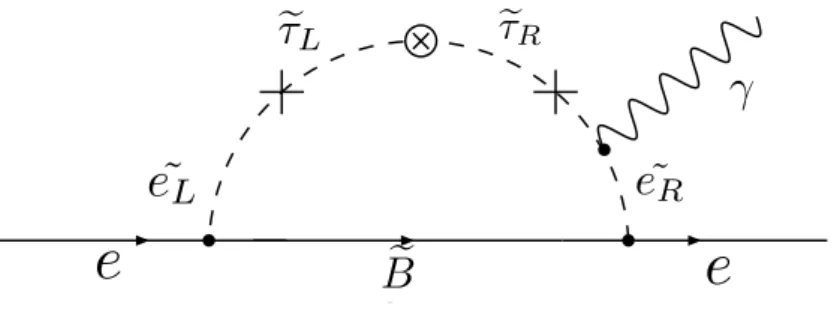
図1.6 スレプトンの混合によりCP対称性が破れ、電子EDMが生成される1ループ ダイアグラム[6]。
量MSUSY で置き換えて単純化した場合、SUSYにより生成される電子EDMの大きさ
dSUSY
e 、クォークのEDMの大きさdSUSYq 、クォークのChromoEDMの大きさd˜q
SUSY
1.5 標準理論を超える模型によるEDM 7 dSUSYe eκe = g1 2 12 sinθA+ ( 5g22 24 + g12 24 ) sinθµtanβ, dSUSYq eqκq = 2g3 2 9 (
sinθµ[tanβ]±1− sinθA ) + O(g12, g22 ) , (1.3) ˜ dSUSY q eqκq = 5g3 2 18 (
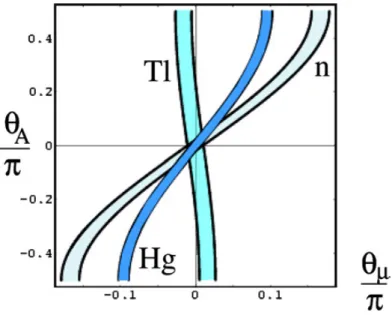
sinθµ[tanβ]±1− sinθA ) + O(g12, g22 ) . ここで、θA、θµはCP対称性を破る位相で、tanβは真空期待値、giはゲージ結合定数で ある。また、κi(i = e, d, u)は式(1.4)のように表される。 κi= me 16π2M SUSY2 = 1.3× 10⁻²⁵ cm× me 1MeV ( 1TeV MSUSY )2 (1.4) 式(1.3), (1.4)より、電子EDMの値deは、超対称性粒子の質量MSUSYの2乗に反比例 する。このことから、超対称性粒子が存在する場合、電子EDMの探索は大規模実験施設 LHCで行われているTeVスケールの現象に、超低エネルギー高精度実験によりアクセス する相補的な方法と考えられる。高エネルギー実験では、直接、超対称性粒子等を生成し て調べるのに対して、EDM探索実験は、図1.6で示すように、不確定性関係の範囲内で 生成・消滅する仮想的な未知粒子の存在を高精度で検出するものである。また、図1.7で 示すように、EDM実験上限値からCP対称性を破る位相であるθA、θµに制限をかける ことができる。 常磁性原子(タリウム(Tl)原子)、反磁性原子(水銀(Hg)原子)、中性子の実験による EDM上限値は、それぞれ |dTl| ≤ 9 ×10⁻²⁵ e cm [14] d199Hg ≤3.1×10⁻²⁹ e cm [15] |dn| ≤ 2.9 ×10⁻²⁶ e cm [16] であり、これらと式(1.3)式(1.4)を用いて、電子EDMからは |sinθµ| < ( MSUSY 6TeV )2( tanβ 10 )−1 ,|sinθA| < ( MSUSY 0.7TeV )2 (1.5) 中性子EDMからは、 |sinθµ| < ( MSUSY 12TeV )2( tanβ 10 )−1 ,|sinθA| < ( MSUSY 4TeV )2 (1.6)
のように制限がかけられる。さらにMSUSY = 500 GeV, tanβ = 3とした場合、CP対称
性を破る位相はそれぞれの重なり部分のθA = θµ = 0付近の領域に制限される。これは
SUSY CP問題と呼ばれる。
8 第1章 物理的背景 超対称性粒子の質量が数 TeVよりも重い CPを破る位相が∼0.1以下 位相角のEDMの寄与がキャンセルしている 電弱相互作用には超対称性がない 等の理由が考えられ、議論されている。このように式(1.3)で示されるように、レプトン、 クォーク、そしてクォークの色電荷によるEDMは、各模型においてそのCPを破る位相 等に対する依存性が異なり、図1.7のように位相パラメータ領域で、異なるパターンを示 す。したがって、様々な粒子に対するEDMの実験結果の統合的解釈が、CPを破る機構 解明には必要不可欠である。
plicit result only for the gluino–squark diagram that dominates in this limit. All these
contributions to d
iare proportional to
j
i, a universal combination corresponding to
the generic dipole size
j
i¼
m
i16
p
2M
2 SUSY¼ 1:3 " 10
#25cm "
m
1
iMeV
1 TeV
M
SUSY!
"
2;
ð4:90Þ
which varies by a factor of a few for i = e, d, u depending on the value of the fermion
mass. The perturbative nature of the MSSM provides a loop suppression factor in
(4.90)
so that
j
iis about two orders of magnitude smaller than the estimate
(4.80)
.
Correspondingly, the reach of the current EDM constraints in SUSY models cannot
exceed the scale of a few TeV.
In
(4.90)
the quark masses should be normalized at the high scale, M
SUSY. To
make the explicit connection with the dipole operators in
(2.16)
, the results of Eq.
(4.89)
should be evolved down to the low-energy normalization point of 1 GeV using
the relevant anomalous dimensions (see e.g.
[81]
). Plugging these results into the
expressions for d
n, d
Tl, and d
Hgand comparing them to the current experimental
bounds, we arrive at a set of constraints on
h
Aand
h
ldepending on M
SUSYand
tan
b. In
Fig. 8
, we plot these constraints in the (h
l,
h
A)-plane for M
SUSY= 500 GeV
and tan
b = 3. The region allowed by the EDM constraints is at the intersection of all
three bands around
h
A=
h
l= 0. One can observe that the combination of all three
constraints strengthens the bounds on the phases, and protects against the accidental
cancellation of large phases that can occur within one particular observable. The
uncertainty in the QCD calculations of !
g
ð1ÞpNNand the nuclear calculation of Sðg
ð1ÞpNNÞ
discussed earlier may affect the width of the d
Hgconstraint band, but do not change
its slope on the (
h
l,
h
A) plane.
Before we review the most common approaches to address the ‘‘overproduction’’
of EDMs in supersymmetric models, for completeness, we will briefly discuss some
of the additional contributions which become important when tan
b is large, a regime
favoured for consistency of the MSSM Higgs sector with the final LEP results
[97]
.
Fig. 8. The combination of the three most sensitive EDM constraints, d
n, d
Tl, and d
Hg, for
M
SUSY= 500 GeV, and tan
b=3. The region allowed by EDM constraints is at the intersection of all
three bands around
h
A=
h
l= 0.
図1.7 dTl, d199 Hg, dnの上限値を用い、MSUSY=500 GeV、tanβ = 3とした場合 に、CP対称性を破る位相はそれぞれの重なり部分のθA = θµ = 0付近の領域に制限 される[6]。 またEDM 自身はフレーバーを保存する観測量あるが、ミューオン崩壊: µ→ eγなど の荷電 レプトンにおけるフレーバー数非保存過程(LFV)とも深く関連している。図1.6 のように、1ループ以上のダイアグラムにより生成されるが、右巻き・左巻き両方のスカ ラーレプトンにおいて世代間混合がある場合、図1.8のようにループの内線において2度 フレー バー変換が起きることで EDMが生成される。スレプトンの線の中央にある右巻 き、左巻き混合部分はタウ粒子の超対称性粒子であるスタウの質量に対応する。EDMは LFVによるCP対称性の破れの位相にも感度がある。
1.6 電子EDMの増幅 9
M
2S¼ diag ðm
2S11; m
S222; m
2S33Þ þ dM
2Sij;
ð4:94Þ
where, as before, S labels the different squarks and sleptons, and i
„ j. Using this
approximation, we can calculate the contributions to the relevant observables using
dM
2Sijas a perturbation via insertions along the squark line, as in
Fig. 10
.
Calculating the gluino one-loop diagram in the approximation of equal SUSY
mass scales, ðM
2SÞ
ii¼ M
2i¼ jlj
2
¼ M
2SUSY, we arrive at the following result for the
d-quark EDM, and the imaginary correction to the d quark mass
Im m
d¼ %d
d131& m
ba
stan
b
18p
;
d
d¼ d
d131& e
dm
ba
stan
b
45
pM
2SUSY;
ð4:95Þ
where
d
d131denotes the following CP-odd dimensionless combination
d
d131¼
Im ðdM
2 Q13e
ihldM
2D31Þ
M
4 SUSY:
ð4:96Þ
In
(4.95)
, for simplicity, we neglected the contributions from the A parameters, and
retained only the mixing coefficients between the first and the third generations.
There are two important points about Eq.
(4.95)
that we should emphasize here:
d
131can be non-zero even if
h
l= 0, and both Im (m
d) and d
dare enhanced relative
to
(4.88) and (4.89)
by the large ratio (m
b/m
d) ' 10
3, which can compensate the
sup-pression associated with flavour violation. In the case of u quark operators, this
enhancement factor is even larger, m
t/m
u' 10
5.
As we have seen in the previous subsection, renormalization of !
h ' Imðm
qÞ=m
qcan be very large, capable of producing bounds on
d
d131and
d
u131at the 10
%9level
or better unless !
h is removed via PQ symmetry. In the latter case, using
(4.95)
and
similar results in the lepton sector, one obtains the following sensitivity of EDMs
to the above combination of flavour-changing transitions on electron, u, and d quark
lines for M
SUSY= 1 TeV
d
e131' 10
%4–10
%3;
d
u131' 10
%6–10
%5;
d
d131' 10
%4–10
%3:
ð4:97Þ
Thus, EDMs independently provide very stringent constraints on the combined
sources of flavour- and CP-violation in the soft-breaking sector. These constraints
Fig. 10. Contribution of flavour-changing processes to the d-quark EDM. The middle insertion on the sfermion line corresponds to LR mixing proportional to mb; the insertions on the left and on the right
correspond to flavour transitions in the LL and RR squark mass sector.
160 M. Pospelov, A. Ritz / Annals of Physics 318 (2005) 119–169
図1.8 フレーバーを変える過程への電子EDMの寄与[6]。
1.6
電子
EDM
の増幅
電子EDMを探索するためには電場中の電子のエネルギーシフトを測定することが必要 であるが、荷電粒子であるため、電場により加速されてしまい測定が困難となる。しかし ながら、相対論的速度までに加速させ、偏極させた電子を偏極方向と同じ方向の磁場中に 入射してEDMを探索する実験が行われている [17]。相対論的速度の荷電粒子はv× B の電場を感じるため、EDMの存在は磁場中の歳差周波数に変化を与える。この実験から 電子EDMの上限値は|de| < 4 × 10⁻¹⁸ e cmと求められている。この実験の精度は電子 の分布に広がりがあるため、軌道により歳差周波数が異なってしまうことからくる系統誤 差により制限されている。さらに高精度なEDM探索方法として、電気的に中性な束縛系 を用いた方法がPurcellとRamseyにより提唱された[25]。ここで問題となるのが、電気 的に中性な束縛系に電場を印加した場合、有限なEDMが存在したとしても非相対論的な 量子力学によるとEDMの効果は現れないことである。これはSchiffの定理*2と呼ばれ る [18]。しかしながら、P. G. H. Sandersによって、原子中の電子*3は相対論的である ため、Schiffの定理は適用されず、さらにアルカリ原子においては原子中で価電子が感じ る有効電場が原子番号と原子の偏極度に依存するために、原子のEDMの大きさは電子 のEDMより数桁大きくなることが示された。[19] [20]。この、電子と原子のEDMの比 をR ≡ datom/de のように定義し、これを増幅度と呼ぶ。アルカリ原子やTlの基底状態 において価電子はs1/2やp1/2軌道に存在し、|R| ∝ Z3であることが知られている。現 在、増幅度に対する高精度の理論計算が様々な手法を用いて行われている。主な原子の電 子EDM増幅度を表1.2にまとめる。 *2中性原子は一様な電場中に存在する場合、加速されない。従って、原子の内部に存在する荷電粒子にかか る力の平均はゼロでなければならない。非相対論的極限をとれば、静電場からの力のみが働くため、それ ぞれの荷電粒子にかかる静電場の平均値もゼロになる。原子に印加された電場は、平均をとれば内部の偏 極によりキャンセルされる。 *3原子核は点粒子ではないため、原子核の変形によりEDMはキャンセルされない。Schiffの定理は常磁 性原子と反磁性原子で破れている。また、中性子は電荷を持たないので、Schiffの定理は適用されない。表1.2 常磁性原子の電子EDM増幅度
Paramagnetic atom Z State R Year Reference
Li 3 22S 1/2 .0043 1966 [20] Na 11 32S1/2 .32 1966 [20] K 19 42S1/2 2.42 1966 [20] Rb 37 52S1/2 25.74 2008 [21] Cs 55 62S1/2 120.53 2008 [21] Fr 87 72S1/2 894.93 2009 [22] Tl 81 62P1/2 -585 1992 [23] 62P 1/2 -466 2011 [24]
1.7
電子
EDM
の探索
これまで、図1.9に示すように、電子EDMの探索は様々な方法を用いて行われてき た。それらは大きく以下のように分類される。それぞれ、系統誤差を減らすために、様々 な実験の工夫が凝らされており、今回のレーザー冷却原子を用いたEDMの測定手法を確 立する上で、重要な実験技術である。以下に、その特徴について、簡潔に述べる。 1. セル(原子を蓄積する容器)を用いる方法 2. 原子・分子ビームを用いる方法 3. 原子泉を用いる方法 4. 冷却原子を用いる方法 2field reversal; and for moving atoms and molecules, the magnetic field from the Lorentz transform of the applied electric field, the so-called motional magnetic field.
1960 1970 1980 1990 2000 2010 10—50 10—48 10—46 10—44 10—42 Year e—EDM limit (C-m) TlF YbF TlF GdFeGar Hg Cs Cs Cs Cs Cs CsTl Xe Tl Tl Tl Tl Cs 10—40 Rb
FIG. 1: Experimental upper limits to the e-EDM 1962 — 2007. Atomic and molecular beam experiments are shown as filled circles, cell experiments as open squares and solid state experiments as filled squares. The atom, molecule, or solid used is indicated.
Since 1964, improvements in the control of systematic effects have allowed the limit on the e-EDM to be lowered by about six orders of magnitude, as shown in Fig. 1. Most experiments used thermal beams of atoms [4, 6, 21, 22, 23, 24, 25, 26, 27, 28, 29, 30, 31], but thermal beams of molecules [5, 32, 33], atoms confined in buffer-gas filled cells [7, 34, 35, 36], and recently solids [37] have also been used. For thermal beams of atoms, the most important systematic effect is caused by the motional magnetic field [21].
The motional magnetic field Bmot, seen by a neutral atom moving with velocity v through an electric field E is (S.I. units)
B
mot= v × E/c2. (1) Here c is the speed of light. When a static magnetic field B0, such as may be used to lift the degeneracy between mF levels, is also present, misalignment between E and B0 causes a component of Bmot to lie along B0. This component is linear in E and hence mimics an EDM.
To suppress the motional magnetic field effect, thermal Cs and Tl atomic beam experiments used velocity can-cellation from colinear beams traveling in opposite direc-tions [4, 6, 22, 31], or alignment of E and B0 with low-enhancement-factor alkali atoms serving as the alignment magnetometer [4, 23, 24, 26, 27, 29], or both [4]. After six orders of magnitude of improvement in suppressing the motional magnetic field effect, these techniques may have reached a practical limit, as is evidenced by a slow-ing in the rate of improvement in the e-EDM limit in Fig. 1.
A fountain e-EDM experiment can use two potent methods, not generally available to thermal atomic beam experiments, to suppress the motional magnetic field ef-fect: atom-by-atom cancellation of the net beam velocity by the rise and fall of the slowly moving atoms under gravity, and electric field quantization. Using electric field quantization, no static magnetic field is needed be-cause the electric field lifts the degeneracy of states of different |mF| (Fig. 2), and energy shifts due to the mo-tional magnetic field are absent to first order [30].
Electric field quantization was first used in an e-EDM experiment by Player and Sandars [30] on the xenon3P
2 metastable state which has a very large quadratic Stark effect. It was not possible to perform such an experiment on an alkali atom ground state because the alkali tensor polarizabilites are too small to lift the mF state degener-acy past the several hundred Hz transit time broadening of a practical thermal atomic beam. But a fountain ex-periment can have a transit time broadening of one Hz, allowing tensor Stark splittings for heavy alkali atoms to be much larger than the transit time broadening. And even a beam of slow Cs atoms can be used.
The incentive for pursuing this approach to improving the e-EDM limit is that it greatly suppresses the motional magnetic field systematic while preserving the desirable features of thermal atomic beams. These features include a simple and well understood system on which to exper-iment; experiments done in free space; the knowledge gained from thermal beam experiments; and the fruits of years of development of Cs fountain atomic clocks.
This paper describes an e-EDM experiment that is a prototype for a Cs fountain experiment intended to reach a sensitivity of 2 × 10−50C-m (1.3 × 10⁻²⁹e-cm), about two orders of magnitude below that of recent experiments [4, 5, 6, 7]. The present experiment demonstrates electric field quantization (with average magnetic fields below 200 pT); state preparation, transport and detection in mag-netic and electric field-free regions; and separated oscil-latory field type resonances between states with energy separations comparable to the transit time broadening.
II. EXPERIMENT
A. Electric Field Quantization
In electric-field quantization, energy shifts due to the motional magnetic field are absent to first order [30]. The energy shift W (mF) of an F = 4, mF "= 1 sublevel in a strong electric field and with weak residual magnetic fields (Fig. 2), and with the quantization axis defined by the electric field direction is given by
W (mF) h = !E 2m2 F+ gµB||mF +K1 (gµ)2B2 ⊥ !E2 − K2 (gµ)3B2 ⊥B|| (!E2)2 (2)
e-ED
M
limi
t (
e
cm)
10-19 10-21 10-23 10-25 10-27 10-29 2field reversal; and for moving atoms and molecules, the magnetic field from the Lorentz transform of the applied electric field, the so-called motional magnetic field.
1960 1970 1980 1990 2000 2010 10—50 10—48 10—46 10—44 10—42 Year e—EDM limit (C-m) TlF YbF TlF GdFeGar Hg Cs Cs Cs Cs Cs CsTl Xe Tl Tl Tl Tl Cs 10—40 Rb
FIG. 1: Experimental upper limits to the e-EDM 1962 — 2007. Atomic and molecular beam experiments are shown as filled circles, cell experiments as open squares and solid state experiments as filled squares. The atom, molecule, or solid used is indicated.
Since 1964, improvements in the control of systematic effects have allowed the limit on the e-EDM to be lowered by about six orders of magnitude, as shown in Fig. 1. Most experiments used thermal beams of atoms [4, 6, 21, 22, 23, 24, 25, 26, 27, 28, 29, 30, 31], but thermal beams of molecules [5, 32, 33], atoms confined in buffer-gas filled cells [7, 34, 35, 36], and recently solids [37] have also been used. For thermal beams of atoms, the most important systematic effect is caused by the motional magnetic field [21].
The motional magnetic field Bmot, seen by a neutral atom moving with velocity v through an electric field E is (S.I. units)
Bmot= v × E/c2. (1) Here c is the speed of light. When a static magnetic field B0, such as may be used to lift the degeneracy between mF levels, is also present, misalignment between E and B0 causes a component of Bmot to lie along B0. This component is linear in E and hence mimics an EDM.
To suppress the motional magnetic field effect, thermal Cs and Tl atomic beam experiments used velocity can-cellation from colinear beams traveling in opposite direc-tions [4, 6, 22, 31], or alignment of E and B0 with low-enhancement-factor alkali atoms serving as the alignment magnetometer [4, 23, 24, 26, 27, 29], or both [4]. After six orders of magnitude of improvement in suppressing the motional magnetic field effect, these techniques may have reached a practical limit, as is evidenced by a slow-ing in the rate of improvement in the e-EDM limit in Fig. 1.
A fountain e-EDM experiment can use two potent methods, not generally available to thermal atomic beam experiments, to suppress the motional magnetic field ef-fect: atom-by-atom cancellation of the net beam velocity by the rise and fall of the slowly moving atoms under gravity, and electric field quantization. Using electric field quantization, no static magnetic field is needed be-cause the electric field lifts the degeneracy of states of different |mF| (Fig. 2), and energy shifts due to the mo-tional magnetic field are absent to first order [30].
Electric field quantization was first used in an e-EDM experiment by Player and Sandars [30] on the xenon3P
2 metastable state which has a very large quadratic Stark effect. It was not possible to perform such an experiment on an alkali atom ground state because the alkali tensor polarizabilites are too small to lift the mF state degener-acy past the several hundred Hz transit time broadening of a practical thermal atomic beam. But a fountain ex-periment can have a transit time broadening of one Hz, allowing tensor Stark splittings for heavy alkali atoms to be much larger than the transit time broadening. And even a beam of slow Cs atoms can be used.
The incentive for pursuing this approach to improving the e-EDM limit is that it greatly suppresses the motional magnetic field systematic while preserving the desirable features of thermal atomic beams. These features include a simple and well understood system on which to exper-iment; experiments done in free space; the knowledge gained from thermal beam experiments; and the fruits of years of development of Cs fountain atomic clocks.
This paper describes an e-EDM experiment that is a prototype for a Cs fountain experiment intended to reach a sensitivity of 2 × 10−50 C-m (1.3 × 10⁻²⁹e-cm), about two orders of magnitude below that of recent experiments [4, 5, 6, 7]. The present experiment demonstrates electric field quantization (with average magnetic fields below 200 pT); state preparation, transport and detection in mag-netic and electric field-free regions; and separated oscil-latory field type resonances between states with energy separations comparable to the transit time broadening.
II. EXPERIMENT
A. Electric Field Quantization
In electric-field quantization, energy shifts due to the motional magnetic field are absent to first order [30]. The energy shift W (mF) of an F = 4, mF "= 1 sublevel in a strong electric field and with weak residual magnetic fields (Fig. 2), and with the quantization axis defined by the electric field direction is given by
W (mF) h = !E 2m2 F+ gµB||mF +K1(gµ) 2B2 ⊥ !E2 − K2 (gµ)3B2 ⊥B|| (!E2)2 (2) 1960 1970 1980 1990 2000 2011 YbF 図1.9 電子EDM探索実験の歴史。1962年から2011年までのに行われたの実験で の上限値が示されており、●が原子・分子ビーム、□がセル、■が固体をそれぞれ用い た実験であることを表している[28]。
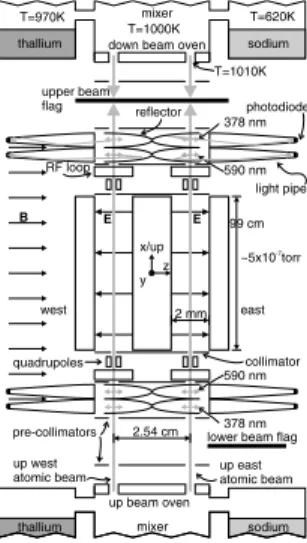
1.7 電子EDMの探索 11 セルを用いた電子EDM測定 セルを用いた電子EDM探索実験としては、電子EDM増幅度が120であるセシウム (Cs)を用いたものがある[29]。この実験は図1.10のように磁気シールドの中心に重ねて 置かれた二つのセルを用いて行われる。セルはガラス製で、それぞれにCsおよびCsの 基底状態でのスピン緩和を抑制するための窒素ガスが封入されている。セルの上下には錫 酸化物をガラスに貼付けた電極がVarian Toor-sealで貼付けられており、それぞれのセ ルに+4 kV/cm、-4 kV/cmの電場を印加して実験が行われる。この実験では、Csの横 緩和時間(∼20 ms)による統計誤差とセルを伝わって電極間に発生するリーク電流による 系統誤差が支配的であり、測定精度は |de| ≤ 1 ×10⁻²⁵ e cm である。
VOLUME63, NUMBER 9 PHYSICAL REVIEW LETTERS 28AUGUST 1989 New Limits on the Electron Electric Dipole Moment from Cesium
S.A.Murthy, D. Krause, Jr.,Z. L.Li,t')and L.R.Hunter Department ofPhysics, Amherst College, Amherst, Massachusetts Ol002
(Received 23January 1989;revised manuscript received 12 June 1989)
The electric dipole moment (EDM)ofthe ground stateofcesium has been measured using a two-laser method that does not require the presence ofan external Bfield. The measured value dc, (—1.8
+6.7+1.8) X10 ecm implies that the electron EDMisd, (—1.5+5.5+1.5)x10 26ecm. This
result represents more than an order-of-magnitude improvement overallprevious limits. PACSnumbers: 35.10.Di,11.30.Er, 32.80.Bx
Despite a search ofmore than twenty years, starting from the discovery of T(time reversal) violation in the
Ep meson system, ' no further examples of Tviolation have been found. Some ofthe most sensitive searches have looked for a permanent electric dipole moment (EDM) ofthe neutron or various atomic and molecular systems. Three independent experiments on different atomic systems have all resulted in limits on the electron
EDM of about 2x10 ecm. Some gauge models predict that the electron EDMmay be as large as 10 to 10 ecm. We report new limits on the electron
EDM based on a measurement ofthe EDM ofcesium (dc,). Indeed, according totheory, a limit on the EDM of the cesium ground state results in a limit on the electron's EDM that is120
~
10times smaller.We have developed a new two-laser scheme for measuring anatomic EDM inacellthat does not require the presence ofany external Bfields (except for calibra-tion). The independence ofthe pump and probe beams permits separate optimizations of their intensities and frequencies, and more importantly, permits independent reversal oftheir helicities, resulting ina clear
characteri-zation ofthe various atomic polarizations.
Optical pumping isused tospin polarize (along x)the
Cs ground state in the presence of an electric field E
(along z). A term —dc, Ein the Hamiltonian would
create a small precession ofthe polarization into the y
direction. When the Efield is reversed, the precession would beinthe opposite sense. Forsmall angles of
rota-tion, the change in the component ofthe polarization along ywhen the applied E6eldisreversed isgiven by
2P„toe z 4P„dc,Ez/(2I+1)h.
Here z isthe characteristic decay time ofthe polariza-tion
(=
15ms), co+ isthe angular precession frequency inE,andI
2 isthe nuclear spin. A measurement ofapolarization along y that reverses with the applied Efield is thus a measurement of dc,.
Aschematic ofthe apparatus isshown in Fig. 1. The
most critical elements in the apparatus are the cells that
contain the Csvapor. Eachcell consists ofa 1-cm-long,
l-in.-square segment ofCorning 7052glass tubing with
tin-oxide-coated glass electrodes sealed onto the top and
PUMP LINEAR POLARIZER I POCKELS CELL(+X/4) g/4 Pxx4 PELLICLE FOR INTENSIT BALANCE DIODE LASERS(894nrn) PROBE MANUALLY ROTATED X/2 T
+LINEAR POLARIZER viii~~w PEM (+ X/4033kHz) EXES '4IV A IIy (2) 4LAYER MAGNETIC SHIELD A X z MIRRO FLUXGATE3-D PICO-AMMETERS(2) M /'~
LOCK—INDETECTORS
(933kHz) 1I &Ilrll TEMPERATURE ~ C0MPUTE R SENSOR PHOTO-DIODES 1I POCKELS CELL lI
B—FIELD COILS (6SETS)
FIG.1. Schematic diagram ofthe experimental apparatus (nottoscale).
bottom using Varian Torr-Seal epoxy. The cells are filled with 250 Torr ofN2 to minimize the Cs
ground-state spin-relaxation rates. Two cells are stacked upon one another and +4or —4kV is applied totheir
com-mon electrode while their outer electrodes are main-tained at ground. The resulting electric fields in the two cells are opposed. Bytaking the difference between the precession signals observed in the two cells, the EDM
signal isdoubled while any precession associated with
re-sidual magnetic fields iscanceled, tothe extent that the residual Bfield isthe same atthe twocells.
The experimental cells are housed atthe center offour large, cylindrical, high-permeability magnetic shields.
1989The American Physical Society 965
図1.10 磁気シールドで囲われた領域の中央に2つのCsがセル重ねられ、それぞれ のセルに+ ˆy、−ˆy方向に電場が印加される。さらに電場と平行に静磁場が2つのセル に対して同じ方向に印加され、xˆ方向にレーザーでポンピングされたCsの歳差周波数 を二つのセルで比較することによりdCsが測定される[29]。 このセルを用いた手法では、原子がこの体積内に分布するため、磁場・電場の非一様性 によりEDM信号に誤差が生じる。この実験の限界を超える一つの方法は、できる限り原 子集団を局所化して真空中に存在させ、限られた空間領域において、極めて高い磁場・電 場の一様性を実現することである。レーザー冷却原子を用いた手法は、その実現案の一つ と考えられる。