全国アンケート調査からみた下部直腸がんに対する括約筋間切除術の 術後排便障害の発生の現状と問題点
船橋 公彦1) 板橋 道朗2) 赤木 由人3) 幸田 圭史4) 前田耕太郎5)
1) 東邦大学医療センター大森病院一般・消化器外科
2) 東京女子医科大学病院消化器・一般外科
3) 久留米大学病院外科
4) 帝京大学ちば総合医療センター外科
5) 藤田保健衛生大学病院国際医療センター
目的:全国アンケート調査から括約筋間切除術(intersphincteric resection;以下,ISRと略記)の術後排 便障害発生の現状と問題点を明らかにする.方法:日本大腸肛門病学会の認定施設441施設を対象に無記 名の郵送法で行った.結果:回答率は,39%(172施設)であった.調査対象の1年間にISRを施行した 施設は88施設(51%)で,施行件数は5件未満に集中し7割を占めた.ISRの術後はほぼ全施設で一時的 ストーマが造設されていた一方で,52%の施設で再発,吻合部の問題,括約筋機能障害の理由から閉鎖で きず,一時的ストーマの永久化を経験していた.また,約9割の施設で一時的ストーマを閉鎖して術後2 年以上経過している患者においても何らかの排便障害が認められ,便失禁は81%の施設で認められた.そ の原因には「括約筋切除量」,「肛門吻合トラブル」,「年齢」,「放射線療法」,「性」があがった.便失禁患 者の頻度は,ISR術後患者の「20~30%」に認めるとした施設が41%と最も多く,「半数」20%,「ほぼ全 員」12%,「70~80%」8%であった.発生した排便障害の各施設の対応は,術者が単独で対応している施設 が最も多く,さまざまな対応法が考えられる中で薬物療法が多くを占めた.結語:ISRの術後には一時的 ストーマの永久化や便失禁の重篤な排便障害が高率に発生している現状が判明した.術式の選択に大きな 影響力をもつ外科医は,術後の排便障害を含めてISRを理解し,十分なインフォームドコンセントと適応 を含めたISRの適正な実施が重要である.
キーワード:直腸がん,括約筋間切除術(ISR),術後排便障害,アンケート調査
はじめに
「究極の肛門温存術」としての括約筋間切除術(intersphincteric resection;以下,ISRと略記)が本邦に導 入され,約17年余りが経過した.これまでがんの根治性から永久のストーマを強いられてきた患者にとっ て,ISRの導入は永久のストーマを回避できる点で大きな福音となったが,その一方で直腸の切除に伴う 便貯留能の低下や直腸周囲の神経損傷,サンプリング機能を有する歯状線近傍での直腸の切離・吻合が術 後urgency,soiling,clustering,frequently bowel movement,incontinenceなどの低位前方切除術症候群(low
anterior resection syndrome;以下,LARSと略記)として術後の排便機能にも大きく影響してくる可能性が
懸念されてきた1)2).本邦でもISRの中長期の機能成績が示されつつある3)~6)なかで,欧米では機能面では
〈2019年5月29日受理〉別刷請求先:船橋 公彦 〒143-8541 大田区大森西6-11-1 東邦大学医療センター大森病院消化器センター 外科
継時的に改善はみられるものの術後長期に亘って便失禁が継続するとの報告7)~9)や,排便がQOLに与える 影響が低位前方切除術に比べて不良10)で,腹会陰式直腸切断術患者と違いはなかったとする報告11)もある.
技術的にも高度のテクニックを要するISRではあるが,各施設でこれまでabdominoperineal resection(以 下,APRと略記)が適応と考えられてきた病変に対し,歯状線近傍から肛門側で切離・吻合しての肛門の 温存が術後の排便にどのような影響を与え,問題が発生しているのか,その実態は明らかになってはいな い.今回,我々はその実態を知る目的で日本ストーマ・排泄リハビリテーション学会のプロジェクト研究 の一環として日本大腸肛門病学会の協力を得て全国にアンケート調査を行った.
目 的
アンケート調査から本邦のISRの術後排便障害発生の現状と問題点を明らかにする.
方 法
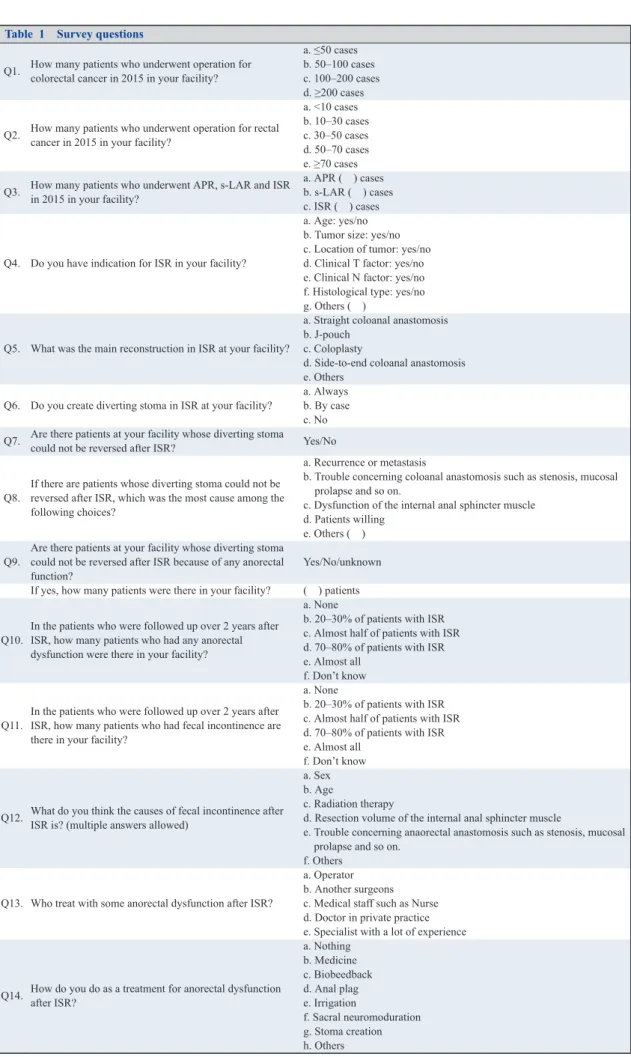
本研究は,日本ストーマ・排泄リハビリテーション学会の倫理委員会の承認(研究番号第3号)をもと に,東邦大学医療センター大森病院倫理委員会(承認番号:27-256)の承認を得て実施した.アンケート 調査は,日本大腸肛門病学会の認定施設441施設に対して2016年4月1日から2016年6月30日の3か月 間の調査期間を設けて,無記名式の郵送法で施行して,無回答は全て除外してアンケートの解析を行った
(Table 1).
結 果
回答数は172施設で,回答率は39%であった.
1.回答施設の属性
回答は,山形県,和歌山県,島根県の3県を除く,1都1道41県のほぼ全国にわたっての施設からの回 答が得られた(Fig. 1).回答施設の98%が日本大腸肛門病学会の専門医を取得した医師が勤務する施設で あった.調査期間(2015年1年間)における回答施設の大腸癌手術件数をFig. 2に示したが,ISRは回答
施設172施設中76施設44%で「0件」との回答があり,施行された88施設のISRの手術件数は,5件未
満に集中し62施設7割を占めた.その一方で10件以上のISRを施行している施設は8施設(9%)に過ぎ なかったが,この中には20件以上施行した施設4施設(5%)が含まれていた(Fig. 2C).
2.ISRの適応
各施設では,どんな項目をもとにISRの適応を判断しているのか?患者因子として「年齢」,腫瘍因子 として「腫瘍の大きさ」,「位置」,「進行度:clinical T因子およびN因子」の項目ごとに二者択一で質問し た.「年齢」は,約2/3の107施設73%が考慮すると回答した.一方,施設として重視している腫瘍因子 は,「腫瘍の大きさ」が88%と一番多く,次いで「N因子」68%,「組織型」48%,「部位」41%,「T因子」
27%の順であった.
3.ISR施行時の一時的ストーマの造設と閉鎖
一時ストーマについては,94%の施設で「必ず造設する」,6%の施設が「症例によって造設する」とし,
ほぼ全施設で併設されていた.しかしながら,一時的としながら「閉鎖に至っていない患者がいる」と回 答した施設が172施設中無回答30施設を除いた142施設中,74施設52%の半数に認められた.閉鎖でき なかった理由には,複数回答で「がんの再発」が最も多く,次いで「肛門吻合部のトラブル」,「術後の括 約筋機能不良」が続いた.また,「機能的問題」を理由に一時的ストーマが閉鎖できなかった患者がいます かの質問に対しては,172施設中無回答の38施設を除いた134施設のうち74施設55%で,「閉鎖ができな かった患者がいる」と回答があり,その患者数は,ほとんどの施設で1~3名に集中した(Fig. 3).
日本消化器外科学会雑誌.2019;52(10):551-563
括約筋間切除術の術後排便障害発生の現状と問題点
Table 1 Survey questions
Q1. How many patients who underwent operation for colorectal cancer in 2015 in your facility?
a. ≤50 cases b. 50–100 cases c. 100–200 cases d. ≥200 cases
Q2. How many patients who underwent operation for rectal cancer in 2015 in your facility?
a. <10 cases b. 10–30 cases c. 30–50 cases d. 50–70 cases e. ≥70 cases Q3. How many patients who underwent APR, s-LAR and ISR
in 2015 in your facility?
a. APR ( ) cases b. s-LAR ( ) cases c. ISR ( ) cases
Q4. Do you have indication for ISR in your facility?
a. Age: yes/no b. Tumor size: yes/no c. Location of tumor: yes/no d. Clinical T factor: yes/no e. Clinical N factor: yes/no f. Histological type: yes/no g. Others ( )
Q5. What was the main reconstruction in ISR at your facility?
a. Straight coloanal anastomosis b. J-pouch
c. Coloplasty
d. Side-to-end coloanal anastomosis e. Others
Q6. Do you create diverting stoma in ISR at your facility?
a. Always b. By case c. No Q7. Are there patients at your facility whose diverting stoma
could not be reversed after ISR? Yes/No
Q8.
If there are patients whose diverting stoma could not be reversed after ISR, which was the most cause among the following choices?
a. Recurrence or metastasis
b. Trouble concerning coloanal anastomosis such as stenosis, mucosal prolapse and so on.
c. Dysfunction of the internal anal sphincter muscle d. Patients willing
e. Others ( ) Q9.
Are there patients at your facility whose diverting stoma could not be reversed after ISR because of any anorectal function?
Yes/No/unknown If yes, how many patients were there in your facility? ( ) patients
Q10.
In the patients who were followed up over 2 years after ISR, how many patients who had any anorectal dysfunction were there in your facility?
a. None
b. 20–30% of patients with ISR c. Almost half of patients with ISR d. 70–80% of patients with ISR e. Almost all
f. Don’t know
Q11.
In the patients who were followed up over 2 years after ISR, how many patients who had fecal incontinence are there in your facility?
a. None
b. 20–30% of patients with ISR c. Almost half of patients with ISR d. 70–80% of patients with ISR e. Almost all
f. Don’t know
Q12. What do you think the causes of fecal incontinence after ISR is? (multiple answers allowed)
a. Sex b. Age
c. Radiation therapy
d. Resection volume of the internal anal sphincter muscle
e. Trouble concerning anaorectal anastomosis such as stenosis, mucosal prolapse and so on.
f. Others
Q13. Who treat with some anorectal dysfunction after ISR?
a. Operator b. Another surgeons c. Medical staff such as Nurse d. Doctor in private practice e. Specialist with a lot of experience
Q14. How do you do as a treatment for anorectal dysfunction after ISR?
a. Nothing b. Medicine c. Biobeedback d. Anal plag e. Irrigation
f. Sacral neuromoduration g. Stoma creation h. Others
Fig. 1 Prefecture distribution of 172 responding approved facilities
Fig. 2 A: The number of operations for colorectal cancer in the responding approved facilities. B: The number of low anterior resections and abdominoperineal resections for low rectal cancer in the responding approved facilities. C: The number distribution of intersphincteric resections and reconstructions in 88 responding facilities.
日本消化器外科学会雑誌.2019;52(10):551-563
括約筋間切除術の術後排便障害発生の現状と問題点
4.ISRの結腸再建
ISRの結腸再建は,術後の排便機能に影響を与える因子の一つと考えられる .今回,ストレート吻合,
J型結腸囊,coloplasty,端側吻合の再建法を選択肢にあげて,各施設での再建法を質問した.その結果,
118/140施設84%のほとんどの施設がストレート吻合を第一選択としており,coloplastyは2/140施設1%で
あった(Fig. 2C).
5.ISR術後長期経過患者の排便障害の実態
直腸がん術後の排便障害は経時的に改善が認められるとされるなかで,一時的ストーマ閉鎖後2年以上 経過した長期観察例に限定して質問した.術後長期経過患者において,排便障害は「認められていない」
と回答した施設は9施設6%に過ぎず,124施設88%の施設がISRの術後に何らかの排便障害が認められる 患者の診療を経験していた.その排便障害が認められた患者の頻度は,ISR術後患者の「半数程度」と回 答した施設が40施設32%と最も多く,「ほぼ全員」31施設25%,「70~80%」が27施設22%,「20~30%」
26施設21%と続いた(Fig. 4).さらに,QOLにも大きく関わる「便失禁」についてみると,172施設中無
回答の40施設を除いた132施設のうち「便失禁患者はいない」と回答したのは17施設14%であり,約8 割の施設で便失禁を認める患者の存在があった.その頻度は,ISR術後患者の「20~30%」と回答施設が
Fig. 3 A: The rate of facilities having patients whose diverting stoma could be reversed after intersphincteric resection (Q7). B: The reason why the diverting stoma could not be reversed (Q8). C: The rate of facilities having patients whose diverting stoma could not be reversed after intersphincteric resection because of functional issues. D: The number of patients whose diverting stoma could not be reversed because of functional issues (Q9).
59施設41%と最も多く,「半数程度」が25施設20%,「ほぼ全員」が15施設12%,「70~80%」が10施設 8%と続いた.外科医(術者)が考える便失禁発生の原因については,多い順に「括約筋の切除量」,「肛門 との吻合のトラブル」,「年齢」,「放射線治療」,「性」であった(Fig. 5).
6.ISRの施行経験がISR術後の排便に与える影響
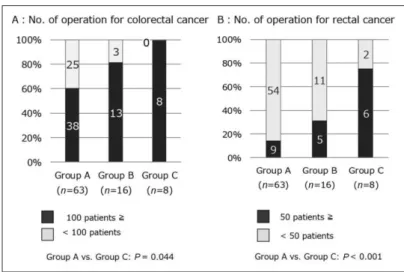
ISRの施行経験がISRの術後の一時的ストーマ閉鎖,長期経過における便失禁を含む排便障害に与える 影響について,対象期間にISRを行ったと回答した88施設のうち有効回答の得られた87例を対象に検討 を行った.87施設をISR施行経験数に準じてA群:1~4件(n=63),B群:5~9件(n=16),C群:10件 以上(n=8)の3群に分類して比較検討を行った.
1)3群の背景
今回,対象となった2015年の1年間に施行された大腸癌および直腸癌の手術件数をみると,大腸癌,直 腸癌ともにISRの施行経験数の多い順に手術件数は多く,A群とC群でそれぞれ有意差(P=0.044,
<0.001)を認めた(Fig. 6).
Fig. 4 The number of patients with some anorectal dysfunction (Q9): In 88%
of responding facilities, some anorectal dysfunction developed in patients who were followed for over 2 years after intersphincteric resection. The occurrence frequency of anorectal dysfunction (% of patients with some anorectal dysfunction by percentage of responding facilities).
Fig. 5 A: The occurrence frequency of fecal incontinence in patients who were followed for over 2 years after intersphincteric resection (Q10). B: The cause of fecal incontinence after intersphincteric resection that could be considered (Q11).
日本消化器外科学会雑誌.2019;52(10):551-563
括約筋間切除術の術後排便障害発生の現状と問題点
2)一時的ストーマ閉鎖
一時的ストーマが「閉鎖に至っていない」と回答した施設の割合は,A群(n=63)35施設(56%),B 群(n=16)13施設(81%),C群(n=8)7施設(88%)であり,ISRの施行経験が多い施設群ほど一時的 ストーマの閉鎖ができていない患者を有する施設の比率が高かったが,統計学的な有意差はなかった.ま た,その理由としては,3群とも共通して複数回答で「がんの再発」が最も多く,次いで「肛門吻合部ト ラブル」,「術後の括約筋機能不良」が続いた.さらに,「機能的問題」を理由に一時的ストーマの閉鎖がで きなかったと回答した施設の比率は,A群(n=63)25施設(40%),B群(n=16)8施設(50%),C群
(n=8)6施設(75%)で,ISRの施行経験が多い施設群ほどその比率は高かったが,統計学的有意差はな かった(Fig. 7).
3)長期観察例における排便障害
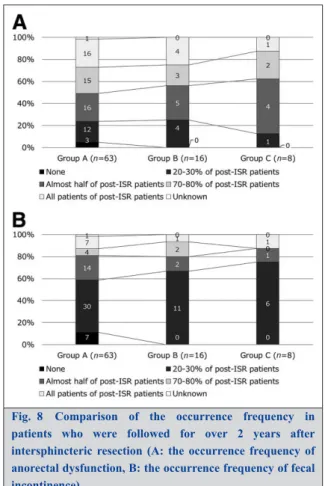
2年以上の長期観察例の中で「何らかの排便障害」を認めている患者の診察経験は,各群とも共通して
「半数程度」と回答した施設が最も多く,次いで「ほぼ全員」が続いた.また,「便失禁」についても同様 で,いずれの群でも「20~30%」と回答した施設の比率が最も多く,次いで「半数程度」が続き,ISRの
Fig. 6 Characteristics of the three groups according to the number of intersphincteric resections.
Fig. 7 Comparison between the three groups according to the number of intersphincteric resection. A: The rate of facilities having patients whose diverting stoma could be reversed after intersphincteric resection. B: The reason why diverting stoma could not be reversed. C: The rate of facilities having patients whose diverting stoma could be reversed after intersphincteric resection because of functional issues.
術後に「何らかの排便障害」,「便失禁」の発生を認めた患者を有する施設の比率は,3群で共通しており,
ISRの施行経験数の多寡で差はなかった(Fig. 8).
7.ISR術後の排便障害に対する対応
ISRの術後に発生した排便障害に対して,各施設の現場ではどのように対処しているのか,その対応方 法についてQ12,13で質問した.回答のあった87施設のほとんどの施設が手術を行った自らの施設で術 者が対応しており,一部の施設では皮膚・排泄認定看護師などの他職種が対応に当たっている施設もあっ た.具体的な対応法として,薬物療法,バイオフィードバック,アナルプラグ,洗腸療法,仙骨神経刺激 法,ストーマ造設を選択肢にあげて質問した.その結果,「特に何も行っていない」と回答したのは87施
設中13施設15%であったが,薬物療法,バイオフィードバック,アナルプラグ,洗腸療法,仙骨神経刺
激法,ストーマ造設のそれぞれの回答率は,82%,28%,14%,14%,15%,37%で,薬物療法を除いて有 効回答率は低いものであった(Fig. 9).
考 察
肛門近傍の悪性腫瘍に対して,自然肛門の温存を目的に内括約筋を一部あるいは全て切除するISRが,
従来のlow anterior resection(以下,LARと略記),super-LARやAPRに比べて腫瘍学的,機能学的にどの ような影響を及ぼすかについては,臨床学的には大きな懸念事項であり,これまでにも多くの学会・研究 会で熱く討論が交わされてきた.ISRが本邦に導入されて約17年余りが経過し,究極の肛門温存術として ISRが全国に徐々に普及しつつある中で,各施設で実施されてきたISRが術後臨床的にどのような問題を 引き起こしているのかについては明らかにはなっていない.本調査の回答率は39%と決して高いものでは なかったが,これはアンケート用紙を郵送で送る方法を採用したこと,対象施設を日本大腸肛門病学会の
Fig. 8 Comparison of the occurrence frequency in patients who were followed for over 2 years after intersphincteric resection (A: the occurrence frequency of anorectal dysfunction, B: the occurrence frequency of fecal incontinence).
日本消化器外科学会雑誌.2019;52(10):551-563
括約筋間切除術の術後排便障害発生の現状と問題点
認定施設としたが,この中に肛門疾患を主に扱っている施設が含まれていた可能性があったこと,対象期 間を1年間に限定したことなどが理由として考えられた.直腸癌に対する肛門温存の機運が益々進む一方 で,本調査では172回答施設の46%でISRの施行はなかった.また,ISRを施行した88施設の中で積極的 にISRに取り組んでいる1割程度の施設を除いては,7割の62施設が年間ISRの手術件数が5件未満であ り,LARやAPRと同様にISRをmajorな術式と位置づけするには難しかった.これには,技術的に高度 な手技を必要とすることをはじめ,日本に導入されてまだ時間が浅く,腫瘍学的や機能面を含めてのエビ デンスも少なく,施設としての適応の問題がその導入に慎重となっていることが主な理由と推察される.
このようにISRにおいては各施設での経験数が決して多いとはいえないなかで,各施設で日々手術に携 わっている外科医がISR術後に発生する排便に関連した諸問題を客観的に捉え,実臨床にフィードバック するのは難しく,今回の調査から得られた知見の共有は重要な意味をもつものと考える.
本調査から得られた知見の一つは,ISRではほとんどの施設で吻合部の安静を目的12)に一時的ストーマ が併設されていた一方で,52%の施設が「再発・転移」,「肛門吻合部トラブル」,「術後括約筋機能不良」
の理由から一時的ストーマを閉鎖できず,一時的ストーマの永久化が発生していたことである.調査対象 期間にISRが施行された88施設を対象にISRの施行件数に従って3群に分類した検討では,統計学的有 意差はなかったが,ISRの施行経験数の多い施設群ほど一時的ストーマの永久化の比率が高く認められて いた.この3群の背景にはISRの施行経験が多い施設群では直腸癌をはじめ大腸癌の手術件数が多かった 背景があった.3群に共通して一時的ストーマが閉鎖できなかった理由として「がんの再発・転移」が最 も多く挙げられていたものの,ISRの施行経験数の多い施設では,進行癌に対しても積極的に肛門の温存 をはかるために,安全なsurgical marginの確保や術後の再発防止の目的から術後の排便機能に大きな影響 を及ぼす術前放射線療法や内括約筋の全切除などが施行されている可能性が推察された.しかしながら,
今回のアンケート調査では,患者の年齢や性の患者背景,ISRを行ううえで施設毎に施行した放射線治療 の有無,手術において最終的に切除した内括約筋切除量などの詳細についてはアンケート項目に入れてい なかったために,この理由についての詳細な検討は困難であった.いずれにしても,一般に,結腸ストー マに比べてストーマ関連合併症の発生頻度も高い13)~16)回腸ストーマが閉鎖されないままに永久化すること は,患者のQOLにも大きな影響を及ぼす可能性17)が考えられ,ISRがもたらした新たな問題として認識す べきものと考えられた.
知見の二つ目として,今回,ISRの長期にわたる排便への影響を知る目的でISR術後2年以上経過した Fig. 9 Treatment for anorectal dysfunction after intersphincteric resection in
responding facilities (Q13).
長期観察例についての調査を行ったが,その結果多くの施設でISRでは術後長期に亘って排便障害が遷延 し,便失禁を伴う重篤な排便障害が発生していた.実際,「排便障害患者はいない」と回答した施設は9施
設6%に過ぎず,排便障害のなかでもQOLの低下につながる可能性の高い「便失禁」は,施設によってそ
の患者数には差があるものの,回答施設全体の約8割にも及ぶ施設で便失禁を経験している現状があった.
外科医が考える原因として多かったものは,「内括約筋の切除量」18),「肛門吻合部のトラブル」19),「年齢」,
「放射線治療」20),「性」と,これまでの報告同様にISRの術式に関係するものであった.ISR術後の排便障 害は,排便回数は2.2~3.7行/日に増加し,便意逼迫,ガス漏れ,soilingの発生はそれぞれ2~31%,9~
29%,11~63%,完全禁制が維持できたのは33~86%であり9)21),本邦のSaitoら6)の報告でも術後5年以上 経過してもこれらの症状の発現頻度に大きな変化はない.また,Bretagnolら22),Konanzら10),Shiokawa ら23)の報告にもあるように,ISRではこれまでのLAR,super-LAR,conventional coloanal anastomosisでの 経験とは異なってISR術後の排便障害の出現頻度は想像以上に高く,便失禁を高頻度に伴う重篤なもので あることが,今回の調査結果からも推察できた.ISRのQOLについてはcontroversialで,Saitoら6)はSF-36
とmFIQL24)によるQOL評価で,術後5年以上で身体的,精神的側面で改善を認めたとしているが,Dumont
ら25)はpenineal pseudocontinent colostomyを造設したAPRに比べて,ISRでは多くの排便障害が認められ,
QOLや禁制はAPRと同等であったとしている.
一般に,排便習慣は加齢や生活環境にも大きく影響を受け,特に術後の排便障害においては評価される 対象者やその背景,評価時期によっても異なるうえに,発生した排便障害に対する患者の受容は個人の価 値観や取り巻く環境の違いにも大きく左右され,その評価は難しい.従来の括約筋温存術では術後の肛門 機能が術後経時的に改善するとの報告26)27)はあるが,内括約筋を一部または全てを切除するISRでは,禁 制において内肛門括約筋が本来担っている役割を考えると機能の経時的改善が期待できる場合は少なく,
社会復帰を進めていくうえでは術後に発生した排便障害に対する積極的な対応が重要であると考える.最 近,本邦でも便失禁ガイドライン28)が刊行され,術後を含めて排便障害に対する対処法が示された.今回 の調査では,各施設が行っているISRの術後排便障害の対応法について,食事療法,薬物療法,バイオ フィードバック,アナルプラグ,洗腸療法,仙骨神経刺激など具体的に質問したが,薬物療法を除いて有 効回答率は低かった.この背景には,外科医の中での排便障害への関心がまだ低いことに起因していると 推察されるが,術後の排便障害にもバイオフィードバックによるanal sphincter trainingや仙骨神経刺激が有 効とする報告も散見29)30)され,今後の成績が期待される.
今回の調査は,医師視点で行ったが,患者視点でアンケートを行った場合にはこれを上回る排便に関連 した問題があるものと推測する31).ISRの術後排便障害に関する本邦のエビデンスがまだまだ不足してい る中で,術式の選択に大きな影響力を持つ外科医の振り返りの声は重要と考えられる.迫る2025年に向け て,益々高齢者を取り巻く問題に直面する機会も増え,がんの根治性に加えて患者の社会環境を考慮して の治療法の選択が重要視される場面がこれまで以上に多くなると考える.老若男女を問わず肛門温存を願っ てやまない患者に対して,術式の選択に大きな影響力をもつ外科医は,術後の排便障害を含めてISRを正 しく理解し,インフォームドコンセントの重要性の再認識と適応を含めたISRの適正な実施が,ISRの利 点を最大限に生かすうえで重要であると考える.
利益相反:なし
文献
1) Koda K, Saito N, Seike K, Shimizu K, Kosugi C, Miyazaki M. Denervation of the neorectum as a potential cause of defecatory disorder following low anterior resection for rectal cancer. Dis Colon Rectum. 2005 Feb;48(2):210–7.
日本消化器外科学会雑誌.2019;52(10):551-563
括約筋間切除術の術後排便障害発生の現状と問題点
2) Kusunoki M, Shoji Y, Yanagi H, Hatada T, Fujita S, Sakanoue Y, et al. Function after anoabdominal rectal resection and colonic J pouch-anal anastomosis. Br J Surg. 1991 Dec;78(12):1434–8.
3) Yamada K, Ogata S, Saiki Y, Fukunaga M, Tsuji Y, Takano M. Long-term results of intersphincteric resection for low rectal cancer. Dis Colon Rectum. 2009 Jun;52(6):1065–71.
4) Koyama M, Murata A, Sakamoto Y, Morohashi H, Takahashi S, Yoshida E, et al. Long-term clinical and functional results of intersphincteric resection for lower rectal cancer. Ann Surg Oncol. 2014 Jun;21 Suppl 3:S422–8.
5) Beppu N, Kimura H, Matsubara N, Tomita N, Yanagi H, Yamanaka N. Long-term functional outcomes of total mesorectal excision following chemoradiotherapy for lower rectal cancer: stapled anastomosis versus intersphincteric resection. Dig Surg.
2016;33(1):33–42.
6) Saito N, Ito M, Kobayashi A, Nishizawa Y, Kojima M, Nishizawa Y, et al. Long-term outcomes after intersphincteric resection for low-lying rectal cancer. Ann Surg Oncol. 2014 Oct;21(11):3608–15.
7) Kienle P, Abend F, Dueck M, Abel U, Treiber M, Riedl S. Influence of intraoperative and postoperative radiotherapy on functional outcome in patients undergoing standard and deep anterior resection for rectal cancer. Dis Colon Rectum. 2006 May;49:557–67.
8) Bruheim K, Guren MG, Skovlund E, Hjermstad MJ, Dahl O, Frykholm G, et al. Late side effects and quality of life after radiotherapy for rectal cancer. Int J Radiat Oncol Biol Phys. 2010 Mar;76(4):1005–11.
9) Martin ST, Heneghan HM, Winter DC. Systematic review of outcomes after intersphincteric resection for low rectal cancer. Br J Surg. 2012 May;99(5):603–12.
10) Konanz J, Herrle F, Weiss C, Post S, Kienle P. Quality of life of patients after low anterior, intersphincteric, and abdominoperineal resection for rectal cancer—a matched-pair analysis. Int J Colorectal Dis. 2013 May;28(5):679–88.
11) Digennaro R, Tondo M, Cuccia F, Giannini I, Pezzolla F, Rinaldi M, et al. Coloanal anastomosis or abdominoperineal resection for very low rectal cancer: what will benefit, the surgeon’s pride or the patient’s quality of life? Int J Colorectal Dis.
2013 Jul;28(7):949–57.
12) Chude GG, Rayate NV, Patris V, Koshariya M, Jagad R, Kawamoto J, et al. Defunctioning loop ileostomy with low anterior resection for distal rectal cancer: should we make an ileostomy as a routine procedure? A prospective randomized study.
Hepatogastroenterology. 2008 Sep–Oct;55(86–87):1562–7.
13) Tilney HS, Sains PS, Lovegrove RE, Reese GE, Heriot AG, Tekkis PP. Comparison of outcomes following ileostomy versus colostomy for defunctioning colorectal anastomoses. World J Surg. 2007 May;31(5):1142–51.
14) Williams NS, Nasmyth DG, Jones D, Smith AH. De-functioning stomas: a prospective controlled trial comparing loop ileostomy with loop transverse colostomy. Br J Surg. 1986 Jul;73(7):566–70.
15) Ihnát P, Guňková P, Peteja M, Vávra P, Pelikán A, Zonča P. Diverting ileostomy in laparoscopic rectal cancer surgery: high price of protection. Surg Endosc. 2016 Nov;30(11):4809–16.
16) Amelung FJ, Van’t Hullenaar CP, Verheijen PM, Consten EC. Ileostomy versus colostomy: which is preferable? Ned Tijdschr Geneeskd. 2017;161:D788. Dutch.
17) Schiergens TS, Hoffmann V, Schobel TN, Englert GH, Kreis ME, Thasler WE, et al. Long-term quality of life of patients with permanent end ileostomy: results of a nationwide cross-sectional survey. Dis Colon Rectum. 2017 Jan;60(1):51–60.
18) Zhang B, Zhao K, Liu Q, Yin S, Zhuo G, Zhao Y, et al. Clinical and functional results of laparoscopic intersphincteric resection for ultralow rectal cancer: is there a distinction between the three types of hand-sewn colo-anal anastomosis? Int J Colorectal Dis. 2017 Apr;32(4):587–90.
19) Tokoro T, Okuno K, Hida J, Ueda K, Yoshifuji T, Daito K, et al. Analysis of the clinical factors associated with anal function after intersphincteric resection for very low rectal cancer. World J Surg Oncol. 2013 Jan;11:24.
20) Chamlou R, Parc Y, Simon T, Bennis M, Dehni N, Parc R, et al. Long-term results of intersphincteric resection for low rectal cancer. Ann Surg. 2007 Dec;246(6):916–21.
21) Kuo LJ, Hung CS, Wu CH, Wang W, Tam KW, Liang HH, et al. Oncological and functional outcomes of intersphincteric resection for low rectal cancer. J Surg Res. 2011 Sep;170(1):e93–8.
22) Bretagnol F, Rullier E, Laurent C, Zerbib F, Gontier R, Saric J. Comparison of functional results and quality of life between intersphincteric resection and conventional coloanal anastomosis for low rectal cancer. Dis Colon Rectum. 2004 Jun;47(6):
832–8.
23) Shiokawa H, Funahashi K, Kaneko H, Teramoto T. Long-term assessment of anorectal function after extensive resection of the internal anal sphincter for treatment of low-lying rectal cancer near the anus. J Anus Rectum Colon. 2017;1(1):29–34.
24) Hashimoto H, Shiokawa H, Funahashi K, Saito N, Sawada T, Shirouzu K, et al. Development and validation of a modified fecal incontinence quality of life scale for Japanese patients after intersphincteric resection for very low rectal cancer. J Gastroenterol. 2010 Sep;45(9):928–35.
25) Dumont F, Ayadi M, Goéré D, Honoré C, Elias D. Comparison of fecal continence and quality of life between intersphincteric resection and abdominoperineal resection plus perineal colostomy for ultra-low rectal cancer. J Surg Oncol. 2013 Sep;108(4):
225–9.
26) Kakodkar R, Gupta S, Nundy S. Low anterior resection with total mesorectal excision for rectal cancer: functional assessment and factors affecting outcome. Colorectal Dis. 2006 Oct;8(8):650–6.
27) Liu LG, Yan XB, Shan ZZ, Yan LL, Jiang CY, Zhou J, et al. Anorectal functional outcome following laparoscopic low anterior resection for rectal cancer. Mol Clin Oncol. 2017 Apr;6(4):613–21.
28) 日本大腸肛門病学会編.便失禁治療ガイドライン2017年版.東京:南江堂;2017.
29) Laforest A, Bretagnol F, Mouazan AS, Maggiori L, Ferron M, Panis Y. Functional disorders after rectal cancer resection: does
a rehabilitation programme improve anal continence and quality of life? Colorectal Dis. 2012 Oct;14(10):1231–7.
30) Mizrahi I, Chadi SA, Haim N, Sands DR, Gurland B, Zutshi M, et al. Sacral neuromodulation for the treatment of faecal incontinence following proctectomy. Colorectal Dis. 2017 May;19(5):O145–52.
31) 大東 誠司,星野 好則,鈴木 研裕,岩渕 敏久,小野寺 久.直腸癌肛門括約筋温存術後における排便機能,QOL,患 者満足度の検討―パウチ手術は本当に有用か?―.日本大腸肛門病学会雑誌.2009;62(1):7–13.
日本消化器外科学会雑誌.2019;52(10):551-563
括約筋間切除術の術後排便障害発生の現状と問題点
Analysis of the Current Status of Intersphincteric Resection for Lower Rectal Cancer and the Issue of Post-Resection Anorectal Dysfunction:
Results of a Questionnaire in Japan
Kimihiko Funahashi
1), Michio Itabashi
2), Yoshito Akagi
3), Keiji Koda
4)and Koutarou Maeda
5)1) Department of General and Gastroenterological Surgery, Toho University Omori Medical Center
2) Department of Surgery, Institute of Gastroenterology, Tokyo Women’s Medical University
3) Department of Surgery, Kurume University School of Medicine
4) Department of Surgery, Teikyo University Chiba Medical Center
5) International Medical Center, Fujita Health University Hospital
Purpose: The aim of this study was to analyze the current status of intersphincteric resection (ISR) for lower rectal cancer and the issue of post-resection anorectal dysfunction in Japan, based on the results of a questionnaire.
Materials and Methods: A questionnaire was distributed to 441 facilities in Japan approved by the Japan Society of Coloproctology. Result: The response rate was 39% (172 facilities). Eighty-eight (51%) facilities performed ISR procedures during the survey period. In 62/88 (70%) facilities, less than 5 patients underwent an ISR procedure. A diverting stoma was created following ISR in almost all of the facilities. In 52% of 142 responding facilities, the diverting stoma could not be reversed because of issues including recurrence, problems associated with anastomosis, and anal sphincter-related dysfunction; thus, a permanent stoma remained. In addition, about 90% of 142 responding facilities reported that patients had anorectal dysfunction, even though they were followed for over 2 years after diverting stoma reversal. In 81% of the facilities, patients had fecal incontinence. Fecal incontinence after ISR was associated with resection volume of the internal anal sphincter muscle, anastomosis-related issues, age, radiation therapy, and gender. Most of the responding facilities reported that 20%–30% of patients who underwent ISR had fecal incontinence, followed by 50%, almost all, and 70%–80%, with frequencies of 41%, 20%, 12%, and 8%, respectively. Regarding treatment of anorectal dysfunction, the surgeon alone provided treatment in almost all facilities. Many patients were treated with medication, although various treatments were used. Conclusion: This survey analysis found that patients in many facilities had a diverting stoma that could not be reversed after ISR, and in some patients, severe anorectal dysfunction occurred after ISR. Surgeons should understand the risks associated with an ISR procedure, including the possibility of anorectal dysfunction following ISR. When choosing an ISR procedure for lower rectal cancer, surgeons must perform the procedure properly, upon obtaining informed consent.
Key Words: rectal cancer, intersphincteric resection, anorectal dysfunction after surgery, questionnaire survey [Jpn J Gastroenterol Surg. 2019;52(10):551-563]
Reprint requests: Kimihiko Funahashi Department of General and Gastroenterological Surgery, Toho University Omori Medical Center
6-11-1 Omorinishi, Ota-ku, 143-8541 JAPAN Accepted: May 29, 2019
© 2019 The Japanese Society of Gastroenterological Surgery