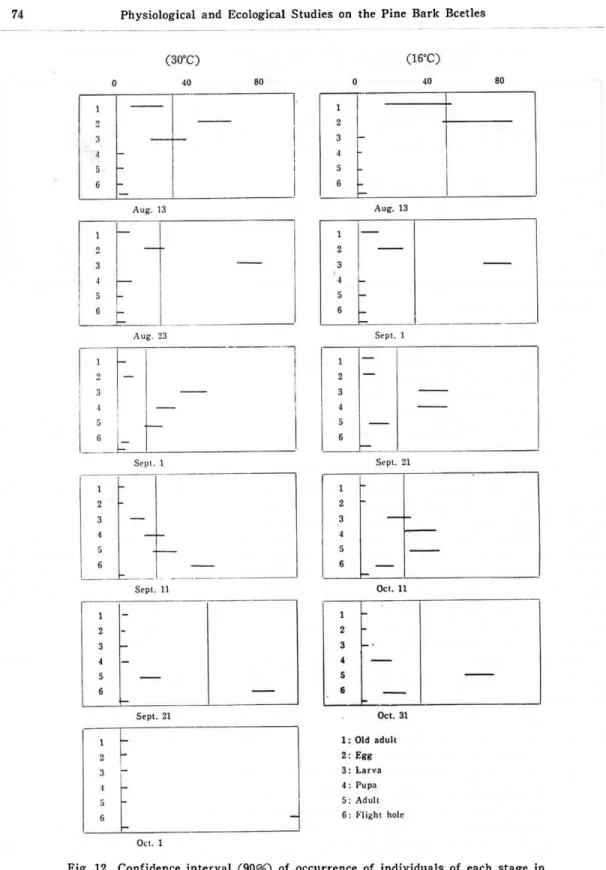
Physiological and Ecological Studies on the
Pine Bark Beetles
著者
ISHIKUBO Shigeru
journal or
publication title
鹿児島大学教育学部研究紀要. 自然科学編
=Bulletin of the Faculty of Education,
Kagoshima University. Natural science
volume
14
page range
26-81
26 Physiological and Ecological Studies on the Pine Bark Beetles
Physiological and Ecological Studies on the
Pine Bark Beetles.
By
Shigeru lsHIKUBO
Biological Institute, Faculty of Education,
Kagoshima University.
(with 39 text・tables and 13 text-6gures.)
Contents.
In troduction
Thermal reactions of adult and larva
The effect of temperature and humidity on the hatching 1) Myelophilus piniperda Linnaeus.
2) Cryphalus fuvus Niijima.
Ⅳ. Problems concerning the growth rate of the larval stage of the Pine Bark Beetle・・・ 51 1) Myelophilus piniperda Linnaeus.
2) Cryptorrhynchus insidiosus Roelofs.
3) Monohamus tesseruia White.
V. The developing process of Ipidae and temperature l) Myelophilus piniperda Linnaeus.
2) Cryphalus fulvus Niijima.
Ⅵ. Summary Ⅶ. References
1. mt富Oduction
From old times Japan has been called a land of pine trees. This is because Pjnus
thumbergii Parュ and Pinus densi脅ora Sieb. and Suc°. are widely distributed throughout
the country from Kyushu to Hokkaido, servlng tO maintain the health of the entire nation and adding greatly to the beauty of the land as scenic forests and landscape gardening trees. They also play an important part in protecting the land from damage
done by the tide, checking 鯖ying sand or feeding headwaters. Needless to say, they provide building timber, pulp wood, mine timber and亀rewood, thereby making a great
contribution to national life.
Owing to the reckless feュlings during and after the war as well as to a number
of typhhons, however, the pine forests of this country have been completely devastated.
Trees cut down or destroyed by the wind or insects lie neg一ected in the forests, and from them pine bark beetles have multiplied rapidly throughout the country. At亀rst
much damage was done chiefly in the Kyushu, Sanyo and Kinki districts, but gradually
the a触cted areas spread up north to Hokkaido, and a vast number of trees are being
destroyed each year. However, no drastic measures have been taken so far, and the mere makeshift now being adopted is by peeling and burning the bark of the infested trees. Incidentally, the pine bark beetle is a general term for those beetles which penetrate the bark and from galleries between the bast and the sap wood. So far 13
genera 38 species of Ipidae, 7 genera 8 species of Curculionidae, 12 genera 15 Ceram・
bycidae and 3 genera 3 species of Buperestidae have been reported. In this study the writer took up prlmary harmful insects and representative species as his subjects. A
l Ⅲ Ⅲ
Shigeru lshikubo 〔研究紀要 第14巻〕 27
new light is being shed from the standpoints of taxology and ecology upon the pine
bark beetles, but a lot of problems in the魚eld of physiological ecology have been left
unsolved, and the number of students specializing in these insects is very small as compared with those engaging in other agricultural insects. The present study was
chieay designed to clear up various fundamental problems such as the e楢ect of
tem-perature upon the adult, hatching, growth rate, development of population・
The writer is deeply indebted to Prof. Tosiziro KAWAMURA and Prof. Hiroshi
NAGAHAMA Of Hiroshima Univ. for their kind guidance in planning and snythesizing
this study. He desires to thank Prof. Chihisa WATANABE Of Hokkaido Univ : Dr.
Motonari INOUE Of Hokkaido Forest Experiment Station, Agriculture and Forestry
Ministry; Prof. Mutsuo KATO Of Tohoku Univ言Dr. Sukehisa AINO and Dr. Akira
NoBUCHI Of the forest experiment station, Agriculture and Forestry Ministry ; Dr. Jyo20
MuRAYAMA of Yamaguchi Univ. : Prof. Kyozo YASUMATSU and Dr. Masaaki MoRISHITA
of Kyushu Univ.: Prof. Masatake SHIBUYA, dean of Agriculture Faculty, Kagoshima
Univ. : and Akira NAGATOMI Of Kagoshima Univ. for helping him identify species and lending him literature as well as giving him invaluable advice. He also wishes to express his feeling of obligation to Prof. Atsuo YoKOYAMA and other faculty members of Kagoshima Univ. for much aid and encouragement received sonstantly from them.Again he owes thanks to Kumamoto Forestry Bereau: Mr. Chikanobu KAWAKAMI,
chief of Kagoshima Forestry Station and other members of the same station: Prof.Masayoshi NISHIDA and Mr. Tadashi SEO Of Kagoshima Univ. This research has
been角nanced by a grant-in-aid for Fundamental Scienti魚c Resarch from the government
in 1952 and 1960.
II. Themal reactions of adult and larva
lt is not too much to say that of all the physical factors that exert in色uence upon
the activities of insects beneath the pine bark, temperature is the most decisive. Ge-nerally speaking, temperature plays an important role in determining the growth and distribution of insects, and it is necessary to study how they react to various degrees of temperature. For this reason investigations have been made abroad for a considerable length of time concernlng the activities of insects in relation to changes in temperature. In this country too, ln Order to determine the limit of fatal high temperature of
ortho-ptera, MoTOMURA (1938) adopted the method of rising temperature 負rst devised by
Chapman and others in 1926. Through ithis method, the objectives in view can be achieved with comparative ease, and so many students have resorted to this method in studying how insects behave in response to temperature. Thus the study of thermal
reactions has recently gone a long way toward making clear the activity 組uctuation
of insects and foreknowlng their development. The species that have so far been studied range from insects harmful to farm products to those harmful to garden
plants, but there is no literature which deals with the pine bark beet一e. The environ一 mental factors beneath the bark require Our SpeC沌c attention, and to study the thermal
reactions of insects living beneath the bark is not only necessary to bring light on their activities in general but also signiRcaht from a practical point of view. The present paper reports the results of experiments carried out from 1954 to 1958 With nine typical species of pine bark beetles.
A. Materials and methods
Materials were collected from beneath or on the bark under natural environmental
conditions a day or two before the beginning of experiments, and preserved at the28 physiological and Ecological Studies on the Pine Bark Beetles
room temperature, The pine bark beetles used for the experiments and the data of experiments are shown in table 1.
Table 1 The kinde of the Experiment Insects
Fa-ilyispecificna-eiJapanesena-eiEXp善nta" ・ic二哩1usfulVusNiiji-a車irokokikui-ushiiApr.,54 ・pidaeⅡiMyel両市市電i二:siMatunokikuimushilMarch.,55
・lHylurgopsglabr(azteu.S..rst.dt)lMatunokabairokikuiiJu,.,58
Ⅳ‖psproXi-usEichhoffIMatunokawakikuiiAug.'55 VipissodesobscurusRoelofs車atunokurokiboshizomushiiAug.,58 curculionidaeⅦ半ryptorrhynchusin謹…iMatunoshirahoshizomushiIJun.,55 _____可pissodesnitTLL.ofslMatunokiboshi20-uShiIJun.,55 ⅧーMonochamustesserula-h串Matunotobiiroka-ikirilJu'.,58 cera-bycidaeⅨiAcantho dli-his一gi-i-a-e-FJaST.-i-.-i二十S言idiraー--0㌔-b-iiElJu,.,58In each case of the nine species mentioned above, six adults (male and female) and six mature larvae were used. The experiments were conducted after OyAMA's method
(1951) which follows MoTOMURA's method (1938). One insect was put in a thin glass
tube (2.2 cm across and 9 cm deep) and a魚ne wire net was inserted into the tube in
such a way that the tube could stand on the protruding end of the net. In the case of Cerambycidae larger tubes (3.5 cm across) were used. Two tubes were placed upside down in a 500 cc beaker full of water, and some pieces Of ice were put in so that the temperature of the tubes was OoC. In this case the water did not come into the tubes because of the air in them. The humidity is supposedly saturate. In this way the insect in the tube could move freely between the top of the tube and the net without touching the water. The movement of the insect was observed through a magnifying glass. Then lukewarm water was poured into the beaker so that the temperature of the water might rise at a rate of loC every 3 or 4 minutes. The water was stirred all the
time so that the temperature of the water was uniform everywhere. The electro-tem・
perature meter was used to take tlle temperature.B. Experimental results
As indices of activity responsive to the rising temperature, seven phases (cold stupor, slight movement, beginning of crawling, normal activity, excitement, heat stupor and death from heat) were chosen for the adult, and six phases (Cold stupor, slight movement, normal activity, excitement, heat stupor and death from heat) for the larva. Since it may well be assumed that the records of temperature thus gained for each
phase of activity form regular curves, the limits were estimated with a con魚dence of 95
% after Masuyama's calculating method (1943). Figure 1 shows the results.
a. Thermal reactions of the adult
l) Cold stupor : Within this thermal range, the adult ceases to move and lies sti一l on its side or back owlng tO the low temperature. The species that are easily a倍ected
by low temperatures are Monochamus tesserulla White and Acanthocinus griseus
Falri-cus of Cerambycidae, and those that are somewhat a∬ected are Crypllalus fulvus Niijima
Shigeru lshikubo 〔研究紀要 第14巻〕 29
Adq't∴L/妨槻hr'鳥偽偽偽〟
////dへへ//////////
40 傚3ケ: 7iz8
ナt牝ツ
30 諦B
「r
、・y7b
、ヲ程・r
20 10 0 唏
エ }
、ヽ
7、
60 120 180 孤0 300 360 420 480 540 600 660 720 780 840 00O Time in MinutesFig I Activity gradients of exposing Insects from the Pine Beetles to a rising temperature. 〔Phase of activity⊃ 1. Cold stupor. 2. Slight movement. 3. Begining of crawling.
4. Normal walking (or flying). 5. Excitement. 6. Heat stupor, 7. Death from heat.
〔Scientific name〕 I. Cryphalus fulvus Niijima. Ⅱ. Myelophilus piniperda Linnaeus. 皿. Hylurgops glabratus Zetterstedt. Ⅳ. lps proximus Eichhoff. Ⅴ. Pissodes obscurus Roelofs. Ⅶ. Cryptorrhyncbus insidiosus Roelofs. Ⅶ. Pissodes nitidus Roelofs. Ⅶ: Monochamus tesserula White. Ⅸ. Acanthocinus griseus Fabricius.
2) Slight movement: The adult which is in a stationary state because of the low temperature begins to move its legs, antennae and proboscis just a bit in response to a
slight rise of temperature. The movement iaspasmodic at亀rst, but gradually becomes
continuous. Ipidae, curculionidae and cerambycidae are sensitive to a rise of temperat-ure within low thermal range in the order mentioned.
3) Beginning of crawling ; The movement of the legs, and antennae becomes active, and the subject begins to crawl about. The insect rights itself from a lying position and begins crawling, but the space of time consumed between the two actions is extre-mely short. In most cases the preceding stage passes into this stage so unperceivably that no dividing line can be drawn between the two. It is usually thought that the meidan of this thermal range is the starting point at which the insect begins its normal
activity. The temperature is 7.2へC with Ips proximus Eichho儲of Ipidae, and 7.8oC with
Cryphalus nuvus Niijima. In the cases of Monochamus tesserulla White of
Ceramby-cidae and Acanthocinus griseus Fabricius, it is 13.5oC and 12.6oC respectively, while Curculionedae ranks between the former two and the latter two.4) Normal activity: The crawling of the adult is slow and spasmodic at魚rst, but
at this temperature, the crawling distance becomes longer and the movement itself
grows active. Sometimes it even純es・ In this stage approximately the same reaction
can be observed as in the preceding stage. 、
5) Excitement : Abnormity begins to appear within this thermal range. The subject
does not show its normal activeness anymore, but亀nds it hard to crawl the wall of
the tube and falls down from the top. It falls into a frenzy and crawls on the net or
凪ies in a魚tful manner. The movement of the whole body gradually passes into the
local movement of bodily parts. The median is usually used as the upper limit of
thermal range for normal activity. The resistible temperature is 40.3℃ with
Monocha-. 0 . . 8 J B e o e J n ︺ t Z J e d u a J .
30 Physiological and Ecological Studies on the Pine Bark Beetles
mus, and lpidae, which is immune from low temperatures, can stand 38.3℃, showing a similar tendency to other Curculionidae. lps has a thermal range of 32.1℃ for its
normal activity, and Cryphalus 30.5oC while 、Monochamus of Cerambycidae and
Acantho-cinus have a narrower range.6) Heat stupor: The local movement of bodily menders gradually ceases, and
危nally the insect comes to a standstill. When placed in the room of ordinary temperature immediately afterward, the insect is restored to normalcy. At this stage, 重ps of lpidae
can stand a high temperature the best, and is followed by Cryptonhynchus and Pissodes
of Curculionidae. Monochamus and Acanthocins do not stand so high a temperature.
7) Death from heat: When exposed to this temperature the insect was not restored
to life even if it was aken out of the tube and placed in the room. In this stage the same tendency can be observed as in the preceding stage.In short, Ipidae can withstand a lnw temperature and the fact that they begin to be
active in the乱eld earlier than any other species early ln Spring can be corroborated in the laboratory, while Cerambycidae, which is a鮪ected by a low temperature and get active in high summer, shows the same tendency in the laboratory as in the丘eld.
When exposed to a high temperature Cerambycidae can stand it a little better than
Ipidae, and Curculionidae falls under the same category. It is interesting to note that
the fact that Curculionidae develops in th e缶eld throughout the year can be corroborated
in the laboratory. Table 2 shows the results stated above.
Table 2 Temperature ranges at which various phases of Adult activity are shown.
(Confidence coefficient : 95%)
PhaseofactVity
Specifcname ニB 7GW " ー2.Slighti3.Begi- mov-iningof ementIcrawling 箔E貿 '豆匁顋 ニ R蹤TVラよ6剃澱 GVR 呈偵r粐罔V FV
_i=NfiTil.vmuasSl..6-4.2-5.3-7.916.0-9.61...9-24.0阜8-42.車.0-45.4144.8-47.2 ICryphalusNfiT.ivmu:♀ig..-4.Sis.7-7.3)5.8-9.6回8-23.4I34.8-4..8車1-44.5145.I-46.9 ⅡMy謹某誌Linnausio.9-5.1中一8.3車5-10.A阜l-25.1 劔l34..-42.314..I-4331'一高二訂 HHylurgop(S2.g,lta.b,rse.I.u..:)).8-6.2 .=8T.-..3 免ツ纈モ#b紮 2絣モC2經 C"絣モCB ケ B モCR Ⅳ[pTTEE.T2T-4.0 .2-6.416.2-7.4 湯 モ#偵iXテふC2纉 CB綯モC偵x bモS"苒
Ⅳ`psproX蕊hoffS中一4.7
.1-7.3i可9.4-28.7(33-0-44.1両
'pissodesobscT嵩ofsi3.2-5.5 .2-8.8I78-10.1 售 ル(f " モC"緤XテふCR繹銈2モS 絣 Ⅵcr轄磐蕊lofs巨.4-5.0中一9.8中一11.4 剿ニツ紕モ#ゅb ,34.0-43.Oi42.2-47.5-47.3-49,5 iⅦPissodesnitiduRS...0,slo.6-5.6 .3-8.8i78-." 篥 モ#r綸 "繧モC2緝ケ "繧モCb蔬鼎R絣モCゅ2 ⅧMo.neos:.A.auTaTwT二高 .2-..TTT8=T2- 售b紕モ3 c 3b苒モC"繪(c2モCb纔銈 モC偵b 高一高窓Pua.TuShit.♀ー12.8-7.I 剋O二10.8巨..7+_5:. 冕Hソ8銈r繧モC)D紕繧モCR繝 Cr絣モC剃 KAcanthocfnaubS,i.g塞:e計4.0-6ー8 0.3-中土Ii-13.1 r繧モ3 銈C 竟C モCR紿+SCb ? ヒ2 「雨読高卒藷i.gut:SeuqSI4.3-6.1-9.8-.0.中.5-13.7i 劒SeDc"モ疋b モモC 貳鼎" モCB 鼎R纈モCrb. Thermal reaction of the larva
l) Cold stupor: Within this thermal range, the subject is in a stationay state, and
assumes an irregular position. Curculionidae is the most immune here. This may haveShigeru lshikubo 〔研究紀要 第14巻〕 31
something to do with the fact that coldness stimulates the insect into activity・ In the
case of Cerambycidae, stupor begins at about 7℃, and lpidae ranks between the two・
2) Slight mcvement: The larva which was in a stationary state starts moving its head and tail very slowly at this temperature. Ipidae, Curculionidae and Ceramby-cidae do not show any peculiar reaction at this stage.
3) Normal activity: Following a slow movement of the head and tail stated above, the belly begins to expand and contract slowly, and with a rise of temperature the looping and straightening of the body becomes active and continuous・ The species that start normal activities at a comparatively low temperature are Curculionidae and lpidae, but Cerambycidae does not need a high temperature to start normal activities・
4) Excitement: Within this thermal range, the above一mentioned movement of the
larva becomes extremely active, and falls into a state of agony, wagglng its tale violently from side to side. This seems to be an abnormal movement caused by the
high temperature・ The d韓erences among the families which were not apparent in the
preceding stages become manifest here bit by bite Curculionidae and Cerambycidae withstand the highest temperature, while Ips of Ipidae alone show a peculiar reaction・
The fact that, unlike Myelophilus which becomes active early in spring, this species is
active in high summer is corroborated in the laboratory・5) Heat stupor : At this stage the movement of the larva grows very inactive and
it falls into a stationary state. When placed in the room of normal temperature, it is
restored to life. Here each species shows approximately the same tendency as in the preceding stage.6) Death from heat: Once exposed to this temperature, the insect was not restored
to life even when it was placed in the room of normal temperature. 嘉ps shows the
highest thermostability, and pissodes and cryptorhynchus of curculionidae also withs・
tan° a high temperature, and are all active at high temperature and high humidity.
The reason why Cryphalus develops throughout the year is because it can withstand both high and low temperatures. It seems that the larva withstand a high temperatnre a little less, and a low temperature more, than the adult because it dwells beneath the bark and is scarcely innuenced by the changes in temperature of the outside world. Table 3 shows the results.
Table 3 Temperature ranges at which various phases of Larvae activity are shown (Confidence coeffcient : 95%)
lphaeofacti,ity
specificname モ、3ヲ FヌVG メ罔テ&辻 fニV没ヨΙF勇C2簫#「ヨ ヤ椿カヨ 繭#Bモ「ヨ椿カ佑ヲV簽エ蔦R艸6R謦ツモ」ゥ< メ脾籔Vヨ I_6V
ICryphalus塞轟smaI..2-5.817.6-10.年0.8-227130.2-37.2巨8.;-i-ii-.車T-i-;.i一一 Ⅲ薯ioep,A.iluiinna.usi..8-5.6日1-.0.1巨..0-23.SIS..I-34.5I38.5-41.5-42.2-44.7 ⅢHylurg(ozp.S"geiasl.reedt.u)Si2.7-61日4-.0.sill/.3-25.2130.0-34.OI39.5-41.2142.3-43.1 ⅣIpsproXimiEuiS.hhof,i2.0-6.617.0-9.9i10.9-25.4!33.2-42.7I43,3-46.9車5-49.3 vpissosd.eps.求-R.。.,sI3.-4.918.7-.0.31,...3-26AI32.9-40.OI42,-45.2145-8.8 咋nyspitdOir.rshuysnSho:.S..sI..5-5.316.8-9.4il0.7-25.1133.1-40.8143.1二元言「1-4T-i-4-8-.2 Ⅶpissodesniti諾ofs巨2-4.4i7.7-10.Silo.8-24.0巨2.7-42.Oi41.7-45.3143.3-46.1 ⅧMon.oecs:ea.muraswhit.i3.5-7.118.3-10.8i1..3-25.4-329-38.9140.9-42.7144.2-45.2 KA窪書誌ri.iusi3.I-6.8)6.9-10.0日2.0-26寸;3.7-319.2-40.I-43.8144.0-45.4
32 Physiological and Ecological Studies on the Pine Bark Beetles
C. Discussion
Figure 2 gives the mean temperature of each month in the southern.part of Kyushu・
We are not in a position to discuss the activity of the insect with relation to changes
in temperature. 35 30 25 20 15 10 5 十 坪耳 ネ耳爾メツ 苓耳耳爾 -●--●一一 ∼ 白 / / /'食. 二::i (6ィ イメ " / r y ラ-SOS一一一 / tノ/ / / 兪ー-一一i一一 凵R i ィ爾 /∴ / ホ粨ャrテ ・ ル 5 ヽ ヽ ヽ ヽ ヽ / / ィ爾 I 隷#イ イ 停苒 " / ヽ ヽ ヽ ヽ" ヽ
o Jan・ Feb・March. Apr・ May・ Jun. Jul. Aug. sept. Oct. Nov・ Dec.
Fig 2 Mean temperature in Kagoshima.
(1) Cryphalus fulvus Niijima: In the case of an adult, the thermal range for
each stage is wide, and there is no d描erence between male and female. In the case of
a larva, approximately the same reaction can be observed, but the thermal range for
normal activity ranging from crawling to excitement is from 4oC to 5℃ narrower than
in the case of an adult. It was probably for this reason that some larvae were
found dead beneath the bark directly exposed to the rays of the sun in summer. With
the exception to Hokkaido, a time lag in the development of a family is large thronghout Japan. In the southern part of Kyushu, the number of developments are three at the
least and缶ve at the outside, and every stage of life, that is, egg, larva, pupa and adult,
can be found throughout the year. In southern Kyushu this species begins its activity
along with Myelophilus piniperda Linnaeus early in spring, and even in January or
February it was found penetrating the food tree when the stmospheric temperature rose more than 15cc. Eggs are laid from the beginnmg Of February to the beginningof November. This species ranks 丘rst on the list of primary harmful insects, One
generation taking three weeks in high summer and six weeks in sprlng and fall・
(2) Myelophilus piniperda Linnaeus : As is the case with the preceding species,
the adult has a wider thermal range for normal activity than the larva. To be speci危C,
in the case of a larva, the high temperature limit is 4.doc lower, and the low tempera-ture limit is 3.C higher, than in the case of an adult. Usually it develops once a year,
and its activity begins in February or March, but in this region it sometimes makes
its appearance in the middle of December, and even in the coldest season,触ght and
egg laying behavior take place in the daytime when the atmospheric temperature rises.
At the beginning of May new adults appear, and then enter upon after-eating. This
species is distributed from Hokkaido to Kyushu, but according to the date obtained in the Kyushu district, damage done directly by this species is slight. The larve seemsto be easily a借ected by meteorological conditions.
(3) Hylurgrops glabretus (zetterstedt) : Both adult and larva show the same ther一
Shigeru lshikubo 〔研究紀要 第14巻〕 33
withstand 負high temperature a little better. This species usually eats into the bark
Pinus densinora, but sometimes Injures the bark of Pious thumbergii. It begins its
activity a little later than Myelophilus piniperda Linnaeus in early spring, and can be
found especially in humid woods in high summer. This species is distributed all over the country, but being a secondary harmful insect, it seldom injures live trees.(4) lps proximus Eichho卸of all the species of lpidae, this species has the widest
thermal range for normal activity. As in the case of Cryphalus fulvus Niijima, no
marked d班erence can be seen between male and female adults; only a male seems to
be able to withstand a high temperature a little better than a female. Then begin to
appear about April, and lay eggs from May through September, during which period
two or three generations altemate. Especially in midsummer (August) they grow very rapidly, and eat into live trees along with Cryphalus, and blight them. Experiments and ecological observations agree that this species can withstand a high temperature.(5) Pisdodes obscurus Roelofs: This species resembles Pissodes nitidus Roelofs
morphologically and ecologically. No d描erences in thermal reaction among the three
species of Curculionidae can be seen. This family has a wider thermal range for normal activity than lpidae and Cerambycidae, and is active throughout the year, and injures the shallow part of the bark. It has been looked upon as a secondary harmful insect, but it deserves our attention that some cases of primary Injury have been conhrmed in the Kyushu District.
(6) Pissodes nitidus Roelofs: The adult enters on the stage of sight movement at a higher temperature than Ipidae, and its thermostability is about the same as the
former two with the exception of Ips proximus Eichho描. Like the above mentioned
three, the lower limit is a little higher, and the upper limit is lower in the case of a larva, than that of an adult. This species is a secondary harmful insect that eatsinto the deep part of bark of debilitated trees and windfalls. The adult which has survived
the winter season begins its activity early in March, and the larva which has survived
the winter season grows into an adult in the middle of May. The egg-laying season of this species is so long that every stage of life can be seen beneath the same barkthroughout the lrear. It is easily a∬ected by dryness, but proves to be immune against
moisture. This corroborates the fact that this species is very active during the moist and hot rainy season of July and August.
(7) Cryptorrhynchus insidiosus Roelofs : The adult can withstand a high tempe-rature than Pissodes nitidus Roelofs by two or three degree C, and the larva also withstand a high temperature. Like the former four species, the adult has a wider thermal range for normal activity. This species has been looked upon as a secondary harmful insect, but when the insects develop in great numbers, they Injure live trees
as primary harmful insects together with Monochamus tesserula White. The larva
which has passed winter beneath the bark grows into an adult at the beginning Of
May and starts its activity. The egg-laying Season is comparatively long, extending
from May to October, but the activity reaches its peak from June to August. Like the
species mentioned above, this species is also considerably immune against humidity, and damage done by this species is large in a.year when much rain Falls or in a damp place. The fact that this species multitudes rapidly in midsummer and withstand acomparatively high temperature was con丘rmed by the experiments, showing that it is
gifted with a high degree of adaptability.
(8) Monochamus tesserula White : Both adult and larva are not sensitive to low
temperature, but they withstand a considerably high temperature, which con負rms the fact that this species are active in the允eld in midsummer. This species does not live34 Physiological and Ecological Studies on the Pine Bark Beetles
in Hokkaido. In the Kanto and Chubu districts言t is looked upon as a secondary harmful
insect, but since it is native to southern regions, it is a primary harmful insect in the Kyushu district. Cryphalus fulvus Niijima injures old trees and debilitated trees, while this species damages young plants as well as sound trees. The egg-laying season is from the beginning of June to the end of September, The growth during the hot months of July and August is great, and the larva goes through the period of growth in about two months, and begins to gnaw into the xylem, and so it comes to be highly resistant to high te mperature, dryness and low temperature. This species can be said to char・ acterize pine bark beetles in general in the Kyushu district.
(9) Acanthocinus griseus Fabricus: Both adult and lal・Va are not SO resistant to high and low temperature as the preceding species of Cerambycidae, but this species
shows the same tendency as the latter on the whole. It can not be con丘rmed that it does a prlmary harm in its缶eld ecology as the preceding species, but in many cases it
gnaws at about the same time as the preceding species, and lives mixed with the preceding species. The egg-laying Season Of this species lasting till the middle of October, is longer than that of the preceding species. The characteristic of this species is that it forms an oval cavity beneath the bark without gnawing into the xylem, and
makes a pupal chamber which is surrounded with負brous stu楢and scobs.
Figure 3 gives the嵐uctuation of
temperature beneath the bark during the daytime in the Kagoshima district・ August 8 th represents high tempera・
tur° days in the summer season and
January 15th represents low tempera-ture days in the winter season. The median of the higher critical tempera・
tur° is 38.9℃ for the adult of Ips
proximus EichhoE, and 38.5℃ for the
larva, and the mdeian of the lower
critical temperature is 6.8℃ for the
adult of Ips proximus Eichho的 and
10.8℃ for the larva of Pissodes nitidus
Roelofs. Even when it is hot in su-mmer, the temperature beneath the bark varies with the region, and so it is necessary to take this into consid・ eration in utilizing the heat of the sun for killing insects. According to observations conducted in concreate wood store, a considerable number of deaths could be found out among those which had been exposed to the rays of the sun for long time. Incid-entally in Kagoshima the mean tem・
perature of February is 6.3℃, and that of January is 6.9℃, but since
the temperature beneath the bark is
2.3℃ higher than that of the
atmos-phere, the temperature beneath the
45 40 E2 Max.TA 35 30 25 20 15 Ma二t.TA A富S ATW 10 磐問薀ツ
/隷yTL
5 0 田sン # 3 C S c s TIMEFig 3 Hourly fluctuation of temperature beneath the bark during the daytime in Kagoshima. ATs : BTS : ATW : BTW : Max. TA: Max. TL: Mュn. TA: Min. TL :
Air temperature in summer.
Temperature beneath the Bark in summer. Air temperature in winter.
Temperature beneath the Bark in winter. Maximum temperature for normal activity of Adult.
Maximum temperarure for normal actvity
of Larva.
Minimum tempsrature for normal activity of Adult.
Minimum temperature for normal activity
of -Larva.
Shigeru lshikubo 〔研究紀要 第14巻〕 35
bark often rises more than loo° in the daytime. As a result, the effect of low
tempe-rature on the insect's activity is presumably not so large as that of high tempetempe-rature. Taple 4 shows the median of the thermal range for normal activity of Coleoptera. Generally speaking it is resistant to high and low temperature, and shows considerable adaptability to changes in temperature, which is also the case with the pine bark beetle. The geographical distribution of coleoptera ranges from the Hokkaido and Tohoku districts to south Kyushu・ This substantiates the fact that this species has great adaptability to temperature.
Table 4 Temperature ranges of the normal activity of the plne bark beetles as compared with several other insects
specificna-e__士uthors甫 剽4ニ 'f R
UFVトァ
RヌBラW&V
2趙ニvR
Anthono三一tTs-ig-A-i-E言;-che'Irk.i_雪中竺_____(:4_C)I___9.7-42.9 剴32 椿辻 Aula.opho.afemo.alisMots.hulskyIMid-rieー1- - .hikaki(,52)∃I仕.8-37.9 剴#2 - 辻 EpllachaVigintioctomaculata Moschulsky 噺 ヨ テS ?」r纈モ3偵Vツ 綯 絣モ3r b繧 EugnathusdistinctusRoelofsLYa-ashita(,52) 7.2-40.0(22.8 凵 ツ 器ar.aol競oedatess_sXt.u.rsa.lhi:.sky__i_Ya「ashit:__(′52_) .3-34.4 宝#U 貳滅 辻
phaedonbrassicaeBalyiYamshita(,52) .6-35.5
纐稗 辻
LemaoryzaeKu-ayamaiMiu.rhaik&aki(,53)15.8-32.0127○2 劔6.1-31当25.5 Rna-phuspulicariusHerbstishiP:tuTj___(′54)_l18.2-41.2日3.0 劔)popil.iaJapOnicaNeman巨幸三幸子「2-.74-L3;ニ6- 剴
?「
i Cryphalusful、iuSNiijimaSiWaku(′56)i .8-38.130.3 剴 .8-33.7122.9 i CryphalusfulVusNiijima♀iIshikubo(′56) i .7-38.3,30.6-I MyelophiluspiniperdaLinnaeusilshikubo(′56) .5-38.2 偵r i ll.0-35.3 B 'psproXi-usEichho'f6日shikubo('56))'6.8-28.9 剪モモ2ヨ停闔ィ自?」 メ謦モ32綮"ヨ途綯 IpsproXimusEichhoff♀ilshikubo(′56) .5-38.6 " メヤ pissodesnitidusRoelelofs‖shikubo(,56))9.0-38.2 剴#偵)?」 繧モ3r紊「 r cryptorrhynchusinsidiosusRoelofsIIshikubo(,56)lュo.9-38.5 剴#r綯 ー10.7-37.0 b Hylurgopsglabretus(Zettel.Stedt)IIshikubo(,59) 0.2-38.5 ゅ8銈2モ3"蔬 縒 MonochamustesserulaWhite6-Ishikubo('59) 3.5-39.5 b蔕ニニツ モ3Y?「 B綯 MonochamustesserulaWhite♀llsnikubo(′59) 3.4-40.3 b纉 辻 AcanthocinusgriseusFabricius8 迫6 鵡V&ⅲTS鋳 12.6-38.3 b 言2.も-3-6.5日:.-5-- AcanthocinusriseusFabricius♀車hikubo(′59) 2.6-38.7 b pissodesobscurusRoelofsllshikubo('59)i9.0-37.5 剴#b絣 ll.3-36.5i i R D. Results36 Physiological and Ecological Studies on the Pine Bark Beetles
beetles after Motomura's method in which the temperature was raised at a rate of loC
every three minutes.
( 2) In the case of adults, seven grades (cold stupor, slight movement, beginning of crawling, normal activity, excitement, heat stupor and death from heat) Were chosen as indices of activities. In the case of larvae, six grades (Cold stupor, slight movement, normal activity, excitement, heat stupor, and death from heat) were established chosen・
(3) Both adult and larva of lpidae withstand high and low temperature, and show
great adaptability. Especially lps proximus Eichho仔has the widest range・ Ceramby
cidae can with stand low temperature the least of all the species of pine bark beetles,
but can withstand high temperature. Acanthocinus grlSeuS Fabricius and Monochamus
tesserulla White show a similar reaction on the whole, Only the former is a 一ittle more easily a仔ected by high and low temperature than the later. But ecologically speaking
the two live mixed wixed with each other and show the same behaviors. Curcnlionidae generally ranks between the two families stated above.
( 4) Generally speaking, the adult has a wider thermal range for normal activity the larva. A low temperature affects the activities of the pine bark beetles less than a high temperature.
(5) As compared with several insects that have so far been reported, the nine pine bark beetles studies in the present research have a wide thermal range for normal activity, and prove to be active at low temperature. This corroborates the fact that pine bark beetles are widely distributed all over the country from Hokkaido to southern Kyushu.
Ⅱ1. The e∬ect of temperature and hu血dity on the hachtmg
The development of an insect depends upon its biotic potential and various enviro nmental factor that tend to arrest the development. As stated in the preceding chapter, temperature and humidity, of all abiological factors, play an important part. Each environmental facter, of course, does not work by itself, but there are complex interr-elations among those constitutional factors.
A great number of experimente have made it clear that temperature and humidity wick from constitutional factors exert a great innuence upon hatch. That is, it has
been (:on魚rmed from the standpoint of experimental ecology by KoJIMA (Dendrolimus
spectabilis Butler, 1935 & 36), DoKE (Chilo simplex Butler, 1936), IsHIKURA (Bruchus chinenis L., 1939 & 40) and others that hatching rate depends upon the temperature and humidity of the outer world. The writer reported an outline of the ecology of myelophilus piniperda Linnaeus and Cryphalus fulvus Njjima in 1952.
This chapter deals primarily with hatching rate in various combinations of tempe-rature and humidity, rate of full grown larva in egg, and the egg period prior to hatch.
A, Material and experimental methods
Logged trees were used to allure parent insects in the experimental wodds of lshiki Forestry Association in Kagoshima City. The eggs used in this study were collected from mother galleries that had been marked beforehand. The eggs used for the present
experiment were laid at d沌erent times, and so they were collected with special care.
Twelve hours after the beginning Of experiment, the eggs were examined through a binocular microscope, and those with scars invisible to the naked eye were eliminated. To regulate humidity, over-saturatedsalt solution was used, and ZwoLFER's method was adopted which keeps vapour pressure at a certain level and regulates changes of
Shigeru lshikubo 〔研究紀要 鍋14巻〕 37
humidity automatically. Vaseline was applied to the inner wall of an outer Petri-dish
(9cm across and 2cm high) to prevent the solution creeping up the wal一, and humidity-regulating stu楢was put in・ The bamboo frame, round in shape and lined with Japanese
paper of good quality, was put on the dish・ Next an inner Petri dish was put upside down on the frame, and the eggs were placed in a circle (2cm across) in the center. In this manner air was allowed to pass through the gap between the upper and lower dishes, thus keeplng the conditions of the inside natural. The kinds of salts used to
regulate humidity and their relative humidity were KNO3 (90-95%), NaCl (70-80%), Ca
(cos)2 (50-60%), CaCl2-CrySt(29-35%), ZnCl2 (17%). H20 (loo劣) was also used thus
six humidity divisions were established. In the case of Cryphalus fulvous Niijima,
KCl (82-86%) was added. Five temperature divisions were established by using three
electric constant temperature boxes (33℃, 28cc and 23℃) and two electric fixed low
temperature boxes (18cc and 13cc). Thus thirty temperature-humidity combinations were preaarranged. Observations were made through a binocular microscope at 8 and 20 0'clock every day to study the growth of the eggs, the number of individuals that had passed through eggs laylng Season, and the withering of the eggs. The experiment was conducted in the biological laboratory of Kagoshima University in 1952, 1953 and 1955. B. Experimental results
1) Myelophilus piniperda Linaeus
Table 5 shows the hatching rate in d韓erent combinations of relative humidity 100
形 (H20), 90-95% (KNO3), 70-80% (NaCl), 50-60% Ca(NO3)2, 29-35% (CaClg), 17 (ZnCl2),
and temperature 33℃, 28℃, 13oC, 18cc and 13'C.
According to this table, hatching takes place between 13 and 33℃. When the relative humidity is loo箔 (H20) and 90-95% (KNO3), hatching occurs, but at a lower humidity it does not. That is, when the humidity is loo劣, 28℃ shows the highest rate
of 83.3%, followed by 23oC with 79.9%, 18cc with 62.4%, and 15oC with 54.2% while 33cc
shows only 26.4%. When the humidity is 90-95% (KNO3), hatching docs not take place
at all, but since the same material was disposed of by the same process as in the case
of 100% humidity, this cannot be ascribed to experimental mistakes, At this humidity,
18℃ shows 72%, 23℃ 67.2%, 18℃ 62% and 13oC 61.1%. The hatching rate of 90-95%
humidity exceeds that of lOO% humidity at 18oC and 13oC. Therefore from this table
the best condition under which we can expect a hatching rate of 80% and moreseems
to be 95% humidity and 23oC and 28℃. It deserves our special attention that even at
70-80% (NaCl), hatching became impossible. As may be seen from table 5, the rate of
full一grown larvae in eggs was calculated by studying the number of full-grown larvae
remaining in the eggs. According to this table, full-grown larvae can be found in the
eggs from 13℃ through 33cc. It is to be noted that while at look (H20) and 33℃, the hatching rate was 26.4%, the rate of fLm-grown larvae was 90.5%. 28cc and 13cc
showed 97.5%, 18℃ 95.5% and 23つC 91.5%. When the humidity was 90-95% (KNO3), 18℃ registered the highest 94.5%, 28oC showed 90.8%, 23℃ 90・5% and 13℃ 89%, showing the
same tendency as the rate of hatching, It deserves our attention that at 33℃, the rate
was 42.5% as against a hatching rate of zero percent. When the humididity was
70-80% (NaCl), some instances of full-grown larvae in eggs could be observed as against
zero percent hatching rate. That is, lScC showed 27.9%, 18cc 14・5%,28cc 7・9% and 23℃ 5.8%. At 33℃, however, no full-grown larvae could be found・ The 丘gures in the
parenthesis are the numbers of days in the course of which the embryo shrinks and ceases to grow because the water in the egg transpires owlng tO the combination of
the humidity of the salt solution and temperature. According to this table,at 17%
Table 5 Rate of hatching and fun growthed 一arvae in eggs in different combinations
of temperature and relative humidity.
\R.H.(形) 00 剴モ天都モ#Sモc劔劔29-35i17
m 僣20 剩エ蔬"冓NaCL 剩62僂aClzCrySt 劍ヲテ"
N.IiR.H申し 剩粫ニ芍ネ+R剋ヤ,)皮.H車丁 剩粐ト艪ト苒儂.IiR.H 剽ヌ.し直I車.HIR.I
33Col2墨 7 26 53 仗h俑韵剴(3.5) (3.0) 茶"絣20 21 41 侏(1.5) (1.5) 俑篦sヲ陳r
28上告 i 上tal 劔94.3 :::6;:got 97.5i 塔ゅ10.5118io 0 0 22-00 .3日o 劔茶2絣亦ルB170 210 190 170 210 950 (2.0) 0(2.0) 0(2.0), 0(I.5)
23轟膏 劔91.2 loo.0 90.5 86.2 91.5 諜2#イ涛"69.6 76.2 67.9 55.0 67.2 塔"」#3罐c粤ヲテ#ウ「:?「剴マ i 10 15.8 ###"0 0 0 0 0 估Yツニr苴「rv18 19_ 21 22 80 俾(2.0) (2.5) (2.5) (3.0) 絣
i 181 途鑾RB鑾RR鑾RhオFFネub26 30 25 28 109 c偵"イ190:::li93;勘190::: i 劔120 i 」22 言 I83 Δ樋絣樋BモR俣#"#モ#廿 i ∫o 茶B絣ユライィ絣モ傴
121 l83
i i 13 りuR2鑾bB鑾bb鑾bFFツ 劔悼 ェ(偬亦##2#rヲi i:.';::',: 旧::i i 2 19 21 23 -85 儂冩i(2.5) 冊
N・1 - Number of individuls・ R・H - Rate of hatching. R.L = Rate of full growthed larvae・ ・-・The days to loss water in egg・
Table 6 A Rate of hatching in different combinations of temperature and relative humidity (look)
n u詫erperiodsofeggs.(days)NUT.be重曹雪景r'hRaa.i.e_of
i:ud霊4.5日5.5回6.5(7 劔剴r經唐綉涛偵S經綛テ"絣劔劔1313.5回14.515骨5 劔冑atch eggs. 昧F6VBVvw2ming /oo/
33聞2:7日 劔-メB4 2 i i6 末ツ鐙亦メ 免ツi i i 「 6 14 亦茶#偵b#2苒3倆CB
17 115 剴#2メ?「cbC###"劔旧 剴ッ 情 亦i i i 亦亦…日 生 2.4 76.9 82.6 89.3 90.5 84.3
上皿 (15.Ⅲ 23日8.Ⅱ 劔 「釘B"ニツ2 4 4 阜 剿i i i - lj 凵` i i ii く ∼ i i ∴ 日76 剴"*メ*モ2Br63.5 89.5 85.7 81.0 79.9
18 途鑾RB鑾RR鑾Rb艪FFツ1日 劍"劍亦x劔劔 冓 I 18 19 15 16 68 塔c偵"c2c蔗
13 りuR2鑾bB鑾bb鑾bFFツ!28 ー31 27 I 占: il "耳ヒ剴?「Δ2モS鼎""紮#"c亦"2S3 1 2 3 9. 井「32蔕テ"茶3"剴"結
Table・ 7 B・ Rate of hatching in different combinations of temperature and relative humidity(90-95%)
I Temp.Dateof 又躡W&W&柳G6fVvw2F劔劔劔劔劔剪&ⅢトヨfR薈"隴とUニ尾膩rVvw86Vvw2
ocaylng ーeggS 凭ネセィヒ紕經SR絣剴b6.517 冓75L8 .5 湯9†1010.511両1212.5113 劔劔巨3i5..4.4.5: 剴R15.5
27.Ⅱ 331.Ⅲ iTotal #CI I i 迄イメi 白i i I 日日! 劔剿亦i 亦 28 21 49 4.Ⅱ1810614 劔劔02 20 07 310 40 99 冤l I 1 lュi 41 剪ニモ「剿i i i ∼ 2 都"
12.Ⅱ1924;5 劔劔劔劔劔剪14 )73.7 2816.Ⅱ2120 劔剪2劔劔劔劔 29 ウc纈 28.Il2211005ー2 劔劔劔劔劔劔 "10 SB絣 15.Ⅲ172 劔剿薬劔劔劔劔 唐9ー47.5 Total9711417i14 劔劔劔劔劔劔60 7; 田" 8.Ⅱ123 冓 末ツ白410 6:012 劔 白 亦iI 6769.6 15.Ⅱ211【 劔il i 迭06 10 冓l 劔亦ilo 劔5 23118.Ⅱ128 ;27.Ⅱ20 ;Tota192 剩"12 -3 ilo 仍b8-2.4ー21 劔劔亦967.9 ー2 日3 免ツS撞迭2 3 劔亦I I I I 免ツc"955.0 3067.2
i7_Ⅱ1 、14.Ⅱ 18i15.Ⅱi ;16.Ⅱ1 -Totali イ#T#23途凵i, 日 劔i 6: 21 2… 1; 11… 鼎3rBC2BBBrrI 51 23 84 i i i i i i I i i i i 白 亦CCsr繧田seィΔ 28∫Ⅱ23 劔劔 剴s#231012/11011131056,5
3.Ⅲ21 劔劔10; 劔1 2 白B剴(‖30 剴3ツ纈
1314.Ⅲ24 劔劔劔3剴」"2「 2S田"絣
6.Ⅲ22 劔劔劔訳」剴1210 剴3「免ツCツ2テb
Tota190 i 劔劔1 剴:5 抽#6cx6モR辻劔4 鉄B田"冓 鉄S3Sc
Shigeru lshikubo 〔研究紀要 第14巻〕 Al
Table 8 The time required to hatch under several temperature and relative humidity. \一一一一._ --1、-R.H. 皮Vヨ&W& b ・Timerequiredtohatch(days) i TeT.P言、\Hum(i,i:,i- 末襷ツr軫萌V ヌ6、ヨ ヨ Κ 壱 ナ3ヲ i9 G 貞b B譁V 跚B
3日…88L22日2 剪絣
絣
4..日誌ー瀧
繝
"
"
28車=8g11812 剪
絣
i:Si繊同誌
2
2
ゅ#"
丁譲i
モ」R握冓メ 湯纉B ニツ
b r
R繝
.8日:og: 170-80 佗b
R R
計1瀦惇 免ツ繝 ニツ 2
B
R 2
・3惇訂 i 俑3
侈ネv薨 )ゥD「 唐緜2 ゅ
ニツ
(ZnC12) the eggs became dry in I.0-I.5 days at 33℃, in 1.5-2.0, days at 28oC in 1.5 days at 23℃, 1,5-2.5days at 18℃, and in 2.5-3.0 days at 13℃. At 29-35% (CaC12), the eggs dried in I.5 days at 33℃, 1.5-2.0 days at 28℃, 2.0-3.0 days at 23℃, 2.5-3.5 days at 18cc and in 3.5-I.5 days at 13℃. At 50-60 Ca(No3)2 the eggs dried in 2.0-2.5 days at 33℃, 3.0-3.5 days at 28℃, 3.5-4.5 days at 23℃, 4.5-5.5 days at 18℃, and 5.5-7.0 days at 13cc.
Tables 6, 7 and 8 show the period of egg stage from the beginning of experiment to
hatching. At loo劣 (H20), it took an egg 5.54 days to hatch at 33℃, 6.88 days at 28℃, 7.56 days at 23℃, 8.8 days at 18oC and 12.49 days at 13℃. At 90-95% (KNO8) it took 7.71 days and at 18℃ 8.5 days. No marked differences can be seen between the two degrees of humidity, but at 13℃ it took ll.8 days, which is a little shorter than in the
case of lOO% humidity. Eggs are covered with a thin egg shell, and somewhat white
for the most part immediately after they are laid, but there are some which are of ayellowish white at the time of egg-laying・ This seems to be hereditary. With the
passage of time, they gradually grow opaque and became tinged with light yellow. At
缶rst they are of an elliptical shape, but later the minor axis lengthens as compared
with the major axis. The mandibles appear in the form of two plgmentations on the head lobe two or three days prior to hatching. They are yellowish brown at nrst, but gradually become darker till the movement of the mandibles becomes visible through the egg shell.
2) Cryphalus fulvus Niijima
Table 9 shows the hatching rate calculated from the combinations of relative
humidity loo箔 (H20), 90-95% (KNO8), 82-86% (KCl) 70-80% (NaCl). 50-60% (Ca(No3)2), 29-35% (CaC12), 17% (ZnC12) and temperature 33℃, 28℃, 23℃, 18oC and 13℃. There are
43 combinations in all, Hatching took place within a wide range from 13cc through 33℃, but in the way of humidity, it took place at comparatively higher degrees of
humidity from 100 (H20) through 70-80% (NaCl). As shown in table 9, when humidity
is look (mO), 23℃ shows the highest hatching rate of 95.4%. 28cc registers 91.6%,
18℃ 89% and even 13℃ shows 86.7%. Contrary to this, 33℃ shows a low rate of 29.7%
Table 9 Rate of hatching in different combinations of temperature and relative humidity・
ヽ\YDa.tfeR.H(.%) T.mpteragying 00 剴モ迭2-8670-8050-60!29-35 I 劔劔剴r
H20 剩エ蔘2僵CINaCl 劔僂a(NO3)2lCaCl2Cryst 劔抹ヲテ"
N.i:N.hR.h 剪イ譁披諢メ勍.iN.hiR.hN.iN.htR.hN.iiN.hiR.h'i 劔劔N.i,N.hiR.hi i 剩粫披諠ケ│r謔
330里 7 37 74 唐B#"21.6 37.8 129.7 BCBs又ニ薬旧 剪ン 0 0 ≡旧上 劔 迄
28 箔R鑾c##dテ#CC"#鑾c###s#Cモ纉#S#r鑾cScSヲSC3s"纉Ss#鳴鑾xC#s##經3#ン2#ィ劔劔40.0 44.li 35十 35.71 3C3Ε115iO i 一一 I I i-∴ i-- 辻辻辻辛 茶メio230i I一一一i i一一) i ) i 剴iTotall321121-91.614211983.813049 劔劔37.71 謄3」又l150ioi2日o 劔-023年 剴
5.Ⅲ1 17.Ⅲ1 23110.Ⅲi i L27.Ⅲ 1.Ⅳ ITotal 6 49 25 i I;02 i ;172 BCR#RC#cB 劔S經3R塔"縱3s#ャr3b3c偵Csb3モ333縱イcr劔?Ε「ィィ劔9m「Cc
5.Ⅲ 10.Ⅲ 27.Ⅲ 181.Ⅳ 16.班 20.班 Total 刹 119 2118 2018 1155138 I 4.0 88.2 89.0 81.8 85.6 90.0 89.1 #"#rSC2#C33s3R#ssウッ迭涛B絣メモ絣同 Sol i36 )27 i 126 122 L69 BV#Brb?」3280.0: 71.5 89.0 89.0 65.5 72.6 78.7 鋳vニ白劔 b016
・3臣 8 31 109 亦モsウ#b澱89.7 83.8 86.7 鼎3s旧 凵[46 -39 ー85 #2C139.0 I :58.9 -48.9 鼎3ビi i i 剿二i二
Ni =- nulnber of individuals, Nh - number of hatch;ng. Rh - Rate of hatching. 一一- none experimentalize・
Table lO (A) Rate oi hatching in diEferent combinations of temperature and relative humidity (look)
Temp.i oC 認FVb:"u詑eriReriodsofeggs(days)lNumber豊T.bne.I 劔劔劔劔劔劔Rateof hatching %
aeyg;nsgla:ud霊 .5I3.0'3.54.04.55.05.5車6.57.Oi.58.Ol8.5i9.09.5.0.01.0.511.0/1..512.012.5T3.0Tgagsl 劔劔劔劔劔冑atched eggs
33 r陝r駢メFFツ37 37 74 澱"テ(「)凵` :∴ 剿亦I 亦I 冓 i i I i i i i i i 亦情 剴#鉄"21.6 37.8 29.7
5.Ⅲ2846126'280100
10.Ⅲ2121063210100
2827.Ⅲ5611526850689.1
i.Ⅶ2716102322581.5 Totall32113414620111211191.6
ニ∴∴∴ 劔"剴"S"#CCB1 I 白∼ i BCR#RC#cB曝2"94.5 91.7 100 95.I 100 95.4
上皿 !10.Ⅲ 323Bi i i 剪115 246 剿テCrモ"C:#b凵偖ノ?「 32 4 涛Bモ 127.Ⅲ36 劔劔 白俣C"撞#R33#115 -01 i ;20 !6.2 3718 冓o 告 :15 撞テ"f「"告11 吊 凵[l i i3 32≡4 9.0
18 艷免ツb齎ウ#I I i 亦劔劔劔i92 i i18‥3 1.8 85.6
20.拙120 Tota1155 冓 冓 劔劔劔劔亦イ3r涛ヲ
13 r颯縱イ闖剪i i i i i I I i i 「i i i i i 冓 i17 :∴ 剽冓 号7 i4 i I21 俔R#ll 6 17 迭Rio i 2 i2 末ツ708 26)5 9613 9,7 83.8 86.7
Table ll (B) Rate or hatching in different combinati or tempeatureland relative humidity (90-95,Oof)
i Te押 i 認B粐訝ニ末誚ツVvw7BNu書r!periodsofeggs(days) iindduiav.-si.2.5回3亘04.51--5年5「-;.0-6:5言.67.58.0回9:bI9.読ol16-:;ii.o:1..5.2.01.2.-5宣.-i - I 劔劔劔劔劔"u.mfberl.",unn.b:r.-Rat.of A.agtgcgiha.tgcghsedTat,8oPing
5.Ⅲ263812124:292.2
10.Ⅲ2717105124388.9
2827.Ⅲ5925181161'43:1672.9
1.Ⅳ3071180228293.2 Totall426275125731192383.8
23 洞帝f鑾hイ#r鑾b鑾rFFツ出 亦 I i t i i i 1 i 「ヤ)?「白3V3#上潮:出国 劔劔劔涛"
18 迭鑾b鑾b#r鑾b鑾rb餬b餬FFツ31! 29- 150i ∴ 1207i ii i I i 亦i ) i i i 末ネ爾「モ3##32モ"r2ウR2上 9 5 6 3 :34 俣rrテ6?「鼎23: 5( 6( 2 ;5 l7 128 2途BケriO l3 i2 (1 ー0 !3 !9 i 3&)凵` ∼ 冤浩 【182 ( i382 車2… 都涛」ヲs」ヲ舒メ誡テユSR .32訂401 So一 剪 イ冓 I 从ツ i B5i5 2Ii6 4 俣"22 1 3 亦"上上l? 15020 cッ綯ウs2Totali7(‖ 劔 末HΕ「劔 3i5日11回5
Table 12 (C) Rate of hatching in different combinatiss of temperature and relative humidity (82-86%)
・e吾輩fii:豊r'
i
mb叩Rat。 。f
Periods of eggs (days) Number
:yginsg i藍( 2・5 3・01 3・5. 4・0 4・5! 5・0 5・5申6・5回7・5, 8・Ol 8・5i 9・01 9・5,10・Olo・5 11・0回12To;ofehgagtscTIL・a.ti:gX:
8 12 11 14 20 37 10 - 18 49 81 0 1 1 けI け1 0 4-一 Ltt 5 ︻I 4 .4一 3 3 3 Shig〇三-shikubo ︹澄T.謡潤 謀)4擬︺ 45 l l 1 3 1 3 1 5 3 ○○ 2- 2- 2 1 3 ・4- 〇〇 〇ムー.4-1 2 0 8 i4 .4一 1 1 1 0 -ーe ︹1 8 0 2 (ツー 5 2 3 1 ⅢⅢⅢⅣ al .0
5.m271T
8 2 -hJ 7 2 0 0 '1 2 2 7 9 8 (ツー 9 8 8 6 (︰0 8 2 4 4 4一 4 8 1 2 5 9 8 1 0 3 2 1 2 3 3 3 1 0 5 0 0 5 6 71 0 1 9 9 「3 2 8 8 '1 8 8 6 oI o1 6 0〇 ・4 3 9 6 6 3 4-一 〇 2 ・4一 7 6 3 2 2 3 2 1 1 3 1 2 1 0 1 2 1 [I O 2 2 3 0 0 けI 2 1 4 1 2 2 2 1 0 ・4一 8 .4-3 -4一 l 3 3 3 2 1 3 5 1 5 1 6 3 2 2 9 1 ・4-.4 5 4 .4 3 4 2 3 2 3 3 2 2 5 1 1 3 4 3 1 1 3 「⊥ 0 9 9 9 8 (8 3 5 ・4一 8 6 -4 2 「⊥ .4一 (8 3 1 1 2 4 1 2 3 0 1 1 1 0 1 ・4一 3 7 3 5 8 2 -4一 6 2 4 6 3 「⊥ -4( 1 0 「⊥ 1 2 QJ l 1 3 3 2 6 .4一 8 「⊥ 3 5 5 6 rD A一 2 4 3 3 -hJ 6 1 2 6 0 .4- 2 3 5 1 3 2 5 3 5 8 1 3 〃⊥ 2 1 0 ︹1 「⊥ 1 2 .4一 t1 3 2 5 4-一 1 2 2 3 .4一 3 6 1 2 1 2 1 0人一 〇 8 2 2 2 0 0 2 8 2 1 3 0 8 6 7 6 2 9 3 2 3 2 2 2 6 1 ⅢⅢⅢⅣ軸軸 al .ot 5.的27L1620T 8ヽ--農ゝ Ct
Table 13 (D) Rate of hatching in different combinations of temperature and relative humidity (70-80%)
Number
:㌻`十aylng
;軋.5両;4..I 4-.5両-::ori6:: 7∴5 i e8:ogi 8.5 '9d.a.ys9'.5 i..0 1..5+...
1! 1 ll 3 3i lI 2i 2 1 i l li l 狛 3; 0; 1 I Number of hatch llo5 12・0 12・5直0日ggs I'a.L誌seu % 1
1: ∴;日::;
23 i 鑾bFFツ38: i 47I .::i 亦i i ∼ i #イ姪イ231 1i i ll 6 末"#b3( 1 31 .:i i "&#ニニ免ツ2101 ll 2-1 i li2 9!5 1 i -i i 5\1ー i 帖 劔 116 i ∴: i l67 &3#vツ4:2::I 35.5 36.2
18 迭鑾b鑾b#r鑾b鑾rb艪#贅FFツ140 i ∴ i i27 157 130 )219 ( 从ツ亦i ∼ 亦( ∼ ∼ i i i 亦友ツ亦03 20 ll 剩サ 22il 剴ッ 上 クツ上 申 上 モ"ニツメ・ー i 525 i 15;22 i820 く1116 i i 7.5 40.6 28.6 40.7
i il i !i 俣"?「il 1 b#5 3 鼎3#F鳴 0 ツ8 14 125 鉄繧S2C"纈
!13 俣#」」「FFツ判 剿イ 白(i i (i 凵` i i i i i i i i i i i ∼ 末亦廿 剴C3bコ0 5.2 2.6
Shigeru lshikubo 〔研究紀要 第14巻〕 47
Table 14 The time requid to hatch under severd temperature and relative humidity
i\∵一一一一、RH南umberofTimerequiredtohatch(days)
\ TecTp.-Hu.;0,i,d-.\ 剌縅dvidua,sMin.lMaX.巨an 冱tanderdtVariation deuiationlcoefficient
33100114ー4.5!65,536 劔0.481 唐縱 100 2890-95 370日i99!繕 .873 0.796 "縱" ニツ
23 俘&
蔦RユF勃H
」
る?ゥ*b
.874 0.882
2
"
"
B
・8I90Po95-7,I gglI8:8 剿仄2 0.872110.02 0.79919.42 i
ー∴∴∴∴∴∴∴∴ー∴∴∴ 劔1.490 1.621 免ツ纉"
B
83.8%, 23cc 86.5%, and 18℃ 88%, all showing a high rate of hatching. Even 13oC has
73.3%. When the humidity is 82-86% (KCl), 28oC has 37.7%, 23cc 82.7%, 18℃ 78.7% and 13℃ 48.9%. When the humidity is 70-80% (NaCl), 23cc has 36.2%, 18℃ 42.9%, and at
13℃, one of the two experiments conducted showed 5.2%. Tables 10, ll, 12, and 13 show
the period of egg stage from the beginning of experiment to hatching under the
combinations or relative humidity look (HO), 90-95% (KNOB), 82-86% (KCl), 70-80%
(NaCl) and temperature 33℃, 28℃ 23oC. 18oC and 13cc. As shown in table 14, hatching took place at 33℃ only when humidity was lO0%, in which case the period was 3.ll days. When temperature was 29℃, the period was 3.79 days at humidity lOO% (H20),4.038 days at 90-95% (KNO8), 3.35 days at 82-86% (KCl). When temperature was 23cc,
5.86 days at loo箔 (H20), 6.71 days at 90-95% (KNO8), 6.74 days at 82-86% (KCl) and
69.5 days at 70-80% (NaCl). This means that the lower the humidity is, the longer
does the period or egg stage tends to be. At 18cc, 8.47 days at loon (HO), 10.94 days
at 90-95% (KNO3), 10.63 days at 82-86% (KCl), and ll.25 days at 70-80% (NaCl).In terms of temperature, 29、C had the shortest period of 3,35 days at 82.86%, while
23oChad 5.8 days and 18oC had 8.22 days. In terms of humidity, at 23oC and 18oC, (with the exception of 28cc), the period of egg stage grew longer as humidity became lower.That is, the divergence between 100% and 70-80% at 23cc was 1.I day, while at 18℃,
it was I.9 day.
The eggs were transparent immediately after they were laid, but with the lapse of time, they grew opaque and milk-white. Two or three days before hatching, the mandibles appeared in the form of two brown spots and just before hatching the movement of the mandibles could be seen through the egg shell. Since the unfertilized eggs remained transparent and did not grow yellow, they can easily be discerned. At
a humidity of lOO% (H20), the un fertilized eggs were for the most part addled because
of bacteria and became black. At a low humidity, embryos ceased their growth the earlier, the higher the humidity is, and grew yellow and dry.C. Discussion
The above一mentioned experiments revealed the infmence of temperature and
humi-dity on hatching rate when the eggs of Myelophilus piniperda Linnaeus and Cryphalus
fulvus Niijima were kept under certain combinations of temperature and humidity48 PhysiologlCal and Ecological Studies on the Pine Bark Beetles
experiments so that the relations bet-ween the two factors may be made
clear. According to this丘gure,
hat-ching takes place at temperatures
ranging f1-0m 13 to 33℃ in the case
of both Myelophilus piniperda Linn-aeus, and Cryphalus fulvus Niijima. The phenomenon peculiar to these
species is that the hatching rate is
low at high temperatures while it is comparatively high at low
tempera-tures (18oC and le℃). This deserves
our notice, for these species make their appearance early in spring When the temperature is low, the average
temperature being 6.5cc in January and 7.5℃ in February in Kagoshima.
As for humidity, hatching takes place
at 70-look. That is, in the case or
Myelophilus plnlperda Linnaeus,
hat-ching takes place only at look and
90-95%, and in the case of Cryphalus
fulvous Niijima, at 70-80% and
up-ward. This phenomenon is ascribable
∴∴∴、 、\、 `ヾ?_一 、X、一一 、〇
131823283306
Fig 4 Comparison of periods of eggs Myelophilus
piniperda Linnaeus and Cryphalus fulvus
Niijma under several temperature
andrelative humidity.
・ (100,%,M P.L.) △-一一△(90-95%,M.P.し.)
I I-・・--I-・・・- I (100,%, C, I. L.) A・-・・・・・・A (90-95%, C・ F. N.) ×一・・・・・・× (82-86,%. C. F. N.)ロー一一一一一・口(70-80%, C. F. N.)
Table 15 Hatching rate of Myelophilus piniperda L. as Compared with several other insects R.H. (%)
spe.ir.naRm'eH"(%)(H120:,19,OKN-0:,告.ON:.l8,0にoa.:036,021'298:ici2.35十znl:,3 劔剩 WF "
Poe.A.a.:oblii.:susI(24.5oc) Butler74.3 i 凵y97.3 涛r 1 i 34.5 " 飩
轟「一一 Tc-:-5-:: 3_4上8 1.6 髭C
仍V ラ6昧没
ワC
r
BombyXmori Linnaeus 亦
V
竰
98.0-95.0 剪嚠
0.0
55.0島
sii霊lp0...exl'2㌔C6'.1日0176.0 劔:∴∴一丁「
Bruchus chinensis Linnaeus 抹
S
/侏靂3
蔕テモ粭ニ
ヲ奉
Myelophilus plnlperda Linnaeus 亦
3
竰
s偵
i i I i 67.Plo 冓TT阜o__二
Shigeru lshikubo 〔研究紀婁 第14巻〕 49
to the fact that the water contained in the egg decreases more than is necessary of the growth of the embrio. Niijima resembles Chile simplex Bather in that the latter
shows a hatching rate of 76% at 70-80% (NaCl), and does not hatch at all at a lower
humidity than that. In the case of Myelophilus piniperda Linnaeus, no hatching takes
place even at 70-80%. Figures 5 indicates the in楓uence of temperature and relative
humidity upon the period of egg stage. In the case of Myelophilus Piniperda Linnaeus,
the period・more or less shortens at 23℃, 18つC and 13℃, with the exception of 28cc. In the case of Cryphalus fulvus Niijima, the period lengthens at 23℃, 18℃, and 13cc, with the exception of 28℃. At this point we have to discuss the e托ect of humidity upon the
process of growth in general of living things. With reference to the pupal stage of
Trichograma amma minutum, (LuND 1934) the pupal stage of Tenbrio molitor L, (PAYNE1932) the egg of Dendrolimus apectabilis Buller (KoJIMA 1936), and Microplectron
fuscipennis (ULYETT 1936), instances have been reported where high humidities seemed to accelerate the growth rather than low humidities. On the other hand, a few cases have been reported where growth were accelerated at low humidlties, while there are cases where humidity does not innuence growth(HEADI.EE 1914). Daily observations or the growth of Cryphalus fulvus Niijima revealed that the growth was obviously slower at lower humidifies than at higher humidities・ The period of egg stage had a tendency30 20 10 0 ′ /一一×一 一一一ヽ X.-..ll ′ヽ1 4'ヽ i 1 I I I I I I ★ ヽ ロー、1 ′×1 、日 I I I ○ I 13 18 23 28 33 oC
Fig 5 Comparison of Hatching rate on Myelophilus plniperda Linnaeus and Cryphalus fulvus Niijma under several temperature and relative humidity.
・-一・ (100,%.M.P.し.) △-△ (90-95,%,
・ -I-・・・・・ ・ (look, C. F. N.) A・・・-・・A (90-95,%, × ・・・一一・・× (82-86%. C. F. N.)口・・・一一一一,□ (70-80%, 〇〇g86-EiEI L N N P F F
MCC
50 Physiological and Ecological Studies on the Pine Bark Beetles
to lengthen at low humidities, and this tendency is the more remarkable, the higher tempeI・ature is. In the light of the fact that the saturation differenc of vapour which has a close bearing on transpiration rate grows large at the same humidity in propor-tion as temperature rises, this tendency has a close connecpropor-tion with the loss of water. As a rule, the amount of oxygen consumption which may be regarded as an index to the metabolism rate of living things has a close connection with the amount of con・ tained water in the vital body, and oxygen consumption decreases when the amount of
contained water is small. BELE膜ADEK (1936) gives deviation rate as factor controlling
the speed of various reactions in protoplasm. The deviation rate of substance has a close bearing on the viscosity of the medium, and accordingly in the case of vital tissue on the amount of contained water, and it may be deduced that the reaction process slackens when the amount of contained water is small. In the case of vital bodies which are lacking ln COntrOlling organism against the physical loss of water such as the eggs of insects, water is lost at low humidites and as a result it is inferred that metabolism rate goes down, causing growth slacken.
Table 16 The growth rate to Myelophilus Pinilus Pinip-erda
L and Cryphalus fulvus Niijima
ー Temp oc 33 i 28 I 23 i 18
:ec:e・s L・、工1.1'.jooi95霊十・1804
C. F. N. 100 90-95 82 -86 70 -80We obtain table 16 by taking up the reciprocals of the number of days of egg
period given in tables 8 and 14 as growth rate indices. As stated above, it was found
that humidity exercises a remarkable e∬ect on the hatching of these two species. It
was also found that the rate is considerably high. The problem which arises from
these血ndings is the amount of contained water beneath the bark. Ecological observations
have made it clear that there is much moisture beneath the bark and the eggs are protected by gnawn scobs, and although water is lost considerably during the daytime, rain and night dew make up for the loss and hatching takes place in a normal way on the whole.
D. Results
l) The eggs of Myelophilus piniperda Linnaeus and Cryphalus fulvus Niijima
were studied in terms of temperature-humidity combinations. As a result it was found that hatching took place at temperatures ranging from 13cc to 33cc, and that it requireda considerably high humidity, that is, 90% and upwards in the former case and 70-80%
in the latter.2) The relative llumidity for full grown larvae remaining in eggs are pretty higher than in the case of hatching, and the mechanism during the period between full grown larva and hetching are innuenced delicately by temperature and humidity・
3) Within the range of temperature varying from 13oC to 33℃, the length of time
necessary for hatching shortened with a rise in temperature, but there were individual deviations, which were more remarkable at high temperatures than at low temperatures・
Shigeru lshikubo 〔研究紀要 第14巻1 51
4) At a humidity of 70-80% and lO0%, the period of egg stage shortened with a
fall in humidity in the case of Myelophilus piniperda Linnaeus, and it lengthened with
a fall in humidity in the case of Cryphalus fulvus Niijima.5) As stated above, the eggs of this species have great adaptability to temperature
and are capable of hatching at a considerably low temperature, and this con危rms the
fact that they appear in early spring and begin their activities. Their adaptability to humidity is small. This is because the egg lS probably lacking ln COntrOling organism against the physical loss of water, but since the eggs are laid beneath the bark where the humidity is high, it is deduced that hatching rate is considerably high.
IV. ProIJlems conceming tIle gI・OWth ratio or tlle larvaI stage of the Pme Bark Beetle
The investigations that have so far been made on the growth of insects are con一
ccrned solely with the means of the individual chosen at random various growth levels, and the individual variation of the growth pattern and the range of variation have almost been left untouched. But the growth pattern of a species should be based upon the study of each individual, and the generalization of the growth pattern of a species should be made after individual development has been studies. Consequently the study of individual development is very slgnihcant, and its importance is pointed out and emphasized by some students. However, the studies made so far are on lepidopLera. In
those studies Daphina pulex (ANDERSSON at al言'37), Pieris rapae (UENO : '53), Bombyx morュ (MIYAO: '56) and Luehdor魚a puziloi (MIYAO: '57) were bred and examined
indivi-dually. Moreover, since it is conceivable that the range of variation in a population in
the丘eld is always in血uenced by various factors such as growth, cocation between
individuals, the mortality rate of the individual and so on, it is necessary to pay
atten-tion to the trend of variaatten-tion in a popu一aatten-tion. Therefore it can be said to be of little
signincance to discuss individual variation by taking up momentary sections of a po pulation. As yet no investigations have been made of the growth rate of the larva of coleoptera including the pine bark beetle, and there is only one report which estimates the range of the length and width of the head by examining the larvae of
Ceramby-cidae caught in the 缶eld. (KoJIMA 1954). The pine bark beetle has the ecological
characteristic of living beneath the bark. For this reason the breeding of the beetle
is di錦cult, and in the case of cerambycidae the trouble is that the life span extends
over one or two years. But the writer succeeded in the individual breeding of the representative species of Ipidae, Curculionidae and Cerambycidae from eggs, and studied their growth patterns.
A. Material and experimental method
I. In the case of Myelophilus plniperda Linnaeus of lpidae, unhatched eggs were
peeled from the 曹eneath bark of Pinus thumbergii at the egg laylng Season, that is in
March and April, and were hatched under the constand environmental condition of 25cc.
The eggs were protected in this way. Water was put into the outer petri dish (9cm
across and 2cm deep), and then a bamboo frame, round in shape and linedawithJapanese paper of good quality, was put on the lid. Next inner petri dish itself was put upside down on the frame, and the eggs were placed in the center. In this manner air was allowed to pass through the gap between the upper and lower dishes, thus kepping the conditions of the inside natural. The feed tree was 3cm in diameter, 10cm in length and the bark was 2 to 3cm thick. The bark of the feed tree had been
care-52 Physiological and Ecological Studies on the Pine Bark Beetles
fully peeled beforehand with a concave made in the center. In concave was played one larva just after it was hatched. Then the peeled piece of bark was replaced to its
former position and屯Ⅹed with a rubber band, and then covered with a vinyl sack in order to prevent it from becomlng dry∴The head width of chirin of the larva was measured regu一arly every day through a binocular microscope equipped with an
ocul-armi crometer (1/45mm). The widest part of the skull is meant by head width・ The experiments were carried out in the biological laboratory of the Education, Faculty, Ka-goshima University, under the constand environmental condition of 25cc, from February
to March, in 1958, 59 and 60.
II. In the case of Cryptorrhynchus insidious Roelofs of Curculionidae, the writer
obtained in May and June every year the adults which were hiding and mating in the
humid part of the bark on which the log trees lay. The adults were made to lay eggson the mter paper placed on moist absorbent cotton in a petri dish (9 cm and 4.5cm in
diameter and height respectively).Better results in the laying of eggs were obtained when light was cut o備by a
sheet of black vinylon. The eggs thus obtained were protected and hatched under the
constant environmental condition of 25℃, and were studied in much the same way as
in the case of Myelophilus piniperda Linnaeus.
III. The eggs of Monochamus tesserula White of Cerambycidae, were gathered in
the丘eld at the egg-laying season of July and August, 1958 to 1960. In laying eggs,
the adult bites the bark and make a cut into the bast, inserts the egg-laying tube and lays eggs usually one by one. The eggs were hatched in the same way as the above・ mentioned two species, and the larvae were brought up in glass tubes and obseved. The glass tubes used up untill the 3rd instar were 1.5cm and 3.8cm in diameter and length respectively, and those used thereafter were 2.I cm and 7.1 cm in diameter and length respectivell,. They were bred individually, glVen bast of Pious thunbergll minus
cork layer every other day. The tubes were covered with vinvlon to prevent it
becoming dry and kept under the constant environmental condition of 30 C. Continueal
Observation was conducted regulary every day. When they moulted, the moult capsules
were measured through a binocular microscope 1/35mm. The moult capsules of this species are less easily broken than those of the former two species, and so measure・meれts were made comparatively easily and accurately.
B. Experimental results and Discussion
1) Myelophilus pinperda Linnaeus
The mean of head width, standard deviation, coe航cient of variation, maximum
value, minimum value and growth ratio of the 22 larvae which were hatched from eggs in the same hole and bred into pupae are shown in table 17. Figure 6 shows the auctuation curve which indicates the readings of the micrometer.
Application of growth formula I) DyAR's formula.
Inferring from the results obtained by measurlng Lepidoptera Larnae, Dyar presumed that the growth ratio of the head for each jnstar is constant throushout the larve
stage, and that the growth curve forms a exponential curve. Consequent一y he formula・
ted the following Simple equation. log Y-a+bX Y represents the measured value of
the head in each instar, X represents the instar, and a and ら are constants. The writer
applied his results to this equation and obtained the following formula. log Y-0.4843+ 0.1202X It must be added here that the reciprocal logarithm of b in log Y-a+bX is the