Requirements of the Larval Prawn, Penaeus
japonicus, for Cholesterol and Soybean
Phospholipids
著者
TESHIMA Shin-ichi, KANAZAWA Akio, SASADA
Hiroshi, KAWASAKI Mitsuyasu
journal or
publication title
鹿児島大学水産学部紀要=Memoirs of Faculty of
Fisheries Kagoshima University
volume
31
page range
193-199
別言語のタイトル
クルマエビ幼生におけるコレステロールおよび大豆
リン脂質の要求量
Vol. 31 pp. 193-199 (1982)
Requirements of the Larval Prawn, Penaeus japonicus,
for Cholesterol and Soybean Phospholipids
Shin-ichi Teshima*1, Akio Kanazawa*1, Hiroshi Sasada*1, and Mitsuyasu Kawasaki*2
Abstract
The present study is planned to examine the requirements of cholesterol for the prawn, Penaeus japonicus, larvae in relation to the dietary levels of soybean phospholipids (PL). The experimental groups were designed as 2~way layout experiment (4x4 type): factor A, cholesterol content (%) in diets; factor B, soybean PL content (%) in diets. The zoeai larvae of P.japonicus were reared with 16
defined diets containing carrageenan as a binder for 7 days. The effects of cholesterol in improving
growth and survival of P.japonicus larvae seemed not to be affected by the dietary levels of soybean PL. The optimum levels of cholesterol and soybean PL for P.japonicus larvae were estimated to be
1.0% and 3.0%, respectively, when pollack liver oil was used as basal lipid sources.
Although much information is available for the nutritional requirements of juvenile
crustaceans (New, 1976, 1980; Kanazawa, 1980, 1982), the knowledge of nutritional require ments of larval prawns and shrimps is scanty presumably due to the difficulty in rearing them with artificial, defined diets. In the previous studies, we have successfully reared the larval
prawn, Penaeus japonicus, from zoeal stages to post-larvae with the purified diets containing
carrageenan as a binder (carrageenan MBD) (Teshima et al., 1982a), indicating the necessity of cholesterol or other sterols in diets for growth and survival (Teshima et al., 1982b).
On the other hand, Kanazawa^ al. (1979) have shown that growth of P. japonicus juveniles
were enhanced by the addition of phospholipids from the short-necked clam, Tapes philippinarum, suggesting certain effects of the molecular form of phospholipids. The inclusion of phospholi pids in the diets has also been demonstrated to be essential for survival of the American lobster,
Homarus americanus, juveniles (Conklin et al., 1980; D'Abramo et al., 1981). However, little is known with the mechanism by which dietary phospholipids play an important role as essential
nutrients for crustaceans. Lester et al. (1975) have shown that cholesterol solubilization was
increased by the adition of lecithin to N-(N-dodecanoylsarcosyl) taurine, which is a representa
tive emulsifier in the gastric juice of crabs (Van den Oord et al., 1964, 1965). The above information suspects that the optimum cholesterol levels in diets for crustaceans may be variable
*' Laboratory of Fisheries Chemistry, Faculty of Fisheries, University of Kagoshima, 4-50~20 Shi-moarata, Kagoshima 890, Japan.
194 Mem. Fac. Fish., Kagoshima Univ. Vol. 31 (1982)
with dietary phospholipids levels, because micellar solubilization is possibly essential for effective assimilation of dietary cholesterol. The lack of sufficient amounts of phospholipids in diets may impare the growth-promoting effect of cholesterol on crustaceans. In the present study, therefore, we intend to examine the requirements of cholesterol for P. japonicus larvae in connection with dietary phospholipid levels. This paper deals with these results and discussion.
Materials and Methods
P. japonicus nauplii were obtained from 6 egg-bearing females in October, 1981, and raised to
zoeai stage in a round polycarbonate tank (500 liters) at 27-28*C. Zoeai larvae were divided into lots of 100 larvae in 1-liter beakers containing 800 ml of the sea water (specific gravity, 1.027) filtered through a column of cotton for feeding trials using the test diets. The experimental groups were designed for 2_way layout experiment (4x4 type) of the following factors. Factor A: cholesterol content (%) in diets. Levels: Ai, cholesterol-free; A2, 0.5% cholesterol; As, 1.0% cholesterol; A4, 5.0% cholesterol. Factor B: soybean phosphatidylcholine (PC) content (%) in diets. Levels: B., phospholipid-free; B2, 1.0% soybean PC; B3, 3.0% soybean PC; Bs 6.0% soybean PC. Table 1 shows experimental groups and the test diets used in this study. All test
Table 1. Composition of the test diets for P. japonicus larvae
P Ingredient (%)
(Diet*1)
Cholesterol
S°^fn
PC*"2PLO*3
Cellulose
. °'her *4
ingredients*41 0 0 9 8.4 82.6 2 0 1 8 8.4 82.6 3 0 3 6 8.4 82.6 4 0 6 3 8.4 82.6 5 0.5 0 9 7.9 82.6 6 0.5 1 8 7.9 82.6 7 0.5 3 6 7.9 82.6 8 0.5 6 3 7.9 82.6 9 1.0 0 9 7.4 82.6 10 1.0 1 8 7.4 82.6 11 1.0 3 6 7.4 82.6 12 1.0 6 3 7.4 82.6 13 5.0 0 9 3.4 82.6 14 5.0 1 8 3.4 82.6 15 5.0 3 6 3.4 82.6 16 5.0 6 3 3.4 82.6
*' All diets are carrageenan MBD: 5.0% carrageenan was added to lOOg of dry diets. *2 Soybean phosphatidylcholine (Nakarai Chemicals Co., Japan) was the mixture
of phosphatidylcholine (23.6%), phosphatidylethanolamine (30.4%), phospha-tidylinositol (18.1%), and other polar lipids.
*3 Pollack liver oil (Riken Vitamin Co., Japan).
*4 Other ingredients (% of dry diet): casein 50.0, glucose 5.5, sucrose 10.0, a -starch 4.0, glucosamine HC1 0.8, sodium succinate 0.3, vitamins 3.2, minerals 8.5.
Teshima.Kanazawa-Sasada.Kawasaki : Cholesterol and Soybean ,q(.
Phospholipid Requirements of Prawn Larvae
diets were carrageenan MBD (Teshima, et al., 1982a) with particulate sizes of 50 jum (for zoeal larvae) and 50-125 /urn (for mysis larvae). The composition of the basal ration was essentially the same as that used in the previous study (Kanazawa et al., 1982).
The feeding and rearing methods for P. japonicus larvae were similar to those described previously (Jones etal., 1979; Kanazawa etal., 1982). The prawn larvae were fed the test diets at the concentration of 0.08 mg/larva twice per day (Hirata et al., 1975). The developmental stages of larvae (Hudinaga, 1942) were determined microscopically on 10 random samples every day as a parameter of growth. The growth index adopted in this paper is as follows: 1, zoeai (Zi); 2, zoea2 (Z2); 3, zoeas (Z3); 4, mysisi (Mi); 5, mysis2 (M2); 6, mysiss (Ms); 7, post-larvai (Pi). Survival rates were also measured daily in a similar manner to that of growth indexes. All alive larvae were counted and staged at the end of the feeding trials when one of the experimental groups of larvae reached Pi stage. Statistical analysis of the data on growth index and survival rate was performed according to Ishikawa et al. (1967).
Results
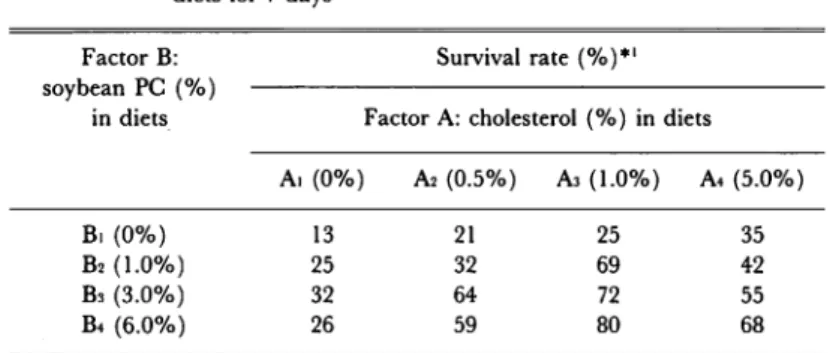
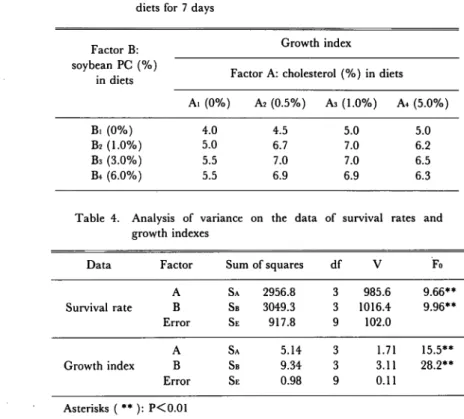
Tables 2 and 3 show the survival rates and growth indexes of P. japonicus larvae fed the test diets containing varying levels of cholesterol (0, 0.5, 1.0, and 5.0% in diets) and soybean PC (0, 1.0, 3.0, and 6.0% in diets). The prawn larvae had low survival rates when fed the test diets free
Table 2. Survival rate (%) of the prawn larvae reared with the test diets for 7 days
Factor B:
soybean PC (%)
in diets
Survivalrate (%)*'
Factor A: cholesterol (%) indiets
A. (0%) A2 (0.5%) As (1.0%) A4 (5.0%) B. (0%) B2 (1.0%) B3 (3.0%) B4 (6.0%) 13 25 32 26 21 32 64 59 25 69 72 80 35 42 55 68
*' Zoeai larvae were reared with the test diets for 7 days.
from cholesterol and/or soybean PC as observed in the previous studies (Kanazawa et al., 1982; Teshima et al., 1982b). The analysis of variance of the data on survival rates (Table 4) showed that both factors A and B are significant (P<0.01), indicating that the survival rates of P. japonicus larvae are affected by the dietary levels of cholesterol and soybean PC. Although the present experiment does not give a statistically reliable answer for the interaction between factors A and B, the effect of dietary cholesterol on the survival of P. japonicus larvae seemed not to vary with the soybean PC levels in the diets (Table 2). Hence, the population means of survival rates were infered providing that there is no interaction between factors A and B. Fig. 1 shows the
196 Mem. Fac. Fish., Kagoshima Univ. Vol. 31 (1982)
estimated population means and confidencelimits (P=0.95) of survival rates at 4 levels of factors A and B. The population means of survival rates were significantly (P<0.01 or 0.01) different between the pairs of following levels: A1-A2, Ai-As, A1-A4, A2-A3, B1-B2, B1-B3, B1-B4, and B2-B4. No significant difference (P>0.05) was observed between the levels A2-A4, A3-A4, B2-B3, and B2-B4. As shown in Fig. 1, the survival rates of P. japonicus larvae were increased with increasing levels of cholesterol from 0 to 1.0% and soybean PC from 0 to 3.0% in the diets, but the supplement of large amounts of cholesterol (5.0%) or soybean PC (6.0%) did not result in further improvement of survival rates. In terms of survival rates, therefore, the optimum levels
of cholesterol and soybean PC for P.japonicus larvae were estimated to be about 1.0% and 3.0% in the diets, respectively; the population mean and confidence limits of the survival rate were infered
to be 79 + 18% (P=0.95) when the prawnlarvae fed the diet containing 1.0% cholesterol, 3.0%
soybean PC, and 6.0% PLO as lipid sources.
Table 3. Growth index of the prawn larvae reared with the test diets for 7 days
Factor B: Growth index
soybean PC (%)
in diets Factor A: cholesterol (%) indiets
A. (0%) A2 (0.5%) A3 (1.0%) A4 (5.0%) Bi (0%) B2 (1.0%) B3 (3.0%) B4 (6.0%) 4.0 5.0 5.5 5.5 4.5 6.7 7.0 6.9 5.0 7.0 7.0 6.9 5.0 6.2 6.5 6.3
Table 4. Analysis of variance on the data of survival rates and growth indexes
Data Factor Sum of squares df V Fo
A Sa 2956.8 3 985.6 9.66** Survival rate B Sb 3049.3 3 1016.4 9.96** Error Se 917.8 9 102.0 A Sa 5.14 3 1.71 15.5** Growth index B Sb 9.34 3 3.11 28.2** Error Se 0.98 9 0.11 Asterisks ( ** ): P<0.01
Regarding growth indexes, factors A and B were also highly significant (P<0.01) by the
analysis of variance. Fig. 1 shows the estimated population means and confidence limits of
growth indexes at 4 levels of factors A and B. The population means of growth indexes were
significantly different between the levels of A1-A2 (P<0.01) and B1-B2 (P<0.01), but not between
Phospholipid Requirements of Prawn Larvae ^ 60 f \
S 40
r — <d > •i— > 5 20 i • r •> X 0) -a % 5 o 0 0.5 1.0 Cholesterol (%) -tf-0 0.5 1.0 Cholesterol (%) 5.0 5.0 4-> O S-CJ3 60 40 20 7 r 1 3 Soybean PC (%) 1 3 Soybean PC (%) 197Fig. 1. Effects of cholesterol and soybean PC levels in the diets on growth index and survival rate of P. japonicus larvae. Growth indexes 4, 5, 6, and 7 correspond Mi, M2, M3, and Pi stages, re spectively.
<—•: confidence limits (P=0.95).
addition of cholesterol and soybean PC. But, the increase of cholesterol from 0.5 to 5.0% in the diets did not result in further improvement of growth. The increaease of of soybean PC levels from 1.0 to 6.0% did not enhance further growth of P. japonicus larvae.
In terms of both growth and survival, P. japonicus larvae were shown to require 1.0% cholesterol and 3.0% soybean PC when the diet contained 6.0% PLO as other lipid sources.
198 Mem. Fac. Fish., Kagoshima Univ. Vol. 31 (1982)
Discussion
In the previous study (Teshima etal.a 1982b), we have shown that P.japonicus larvae require sterols for growth and survival as well as the juveniles (Kanazawa et al., 1971). As for the juvenile crustaceans, the optimum cholesterol levels have been reported to be 0.2% (Shudo etal., 1971), 0.5% (Kanazawa etal., 1971), and 2.0% (Deshimaru and Kuroki, 1974) for P.japonicus and 0.5% for H. americanus (Castell et al., 1975). However, the results of Shudo et al. (1971) should be critisized somewhat because the diet ingredients such as a squid meal probably contained cholesterol. Recently, phospholipids have also been demonstrated to be indispens able diet ingredients for P. japonicus larvae (Kanazawa, 1983; Kanazawa et al., 1982) and H.
americanus juveniles (Conklin et al., 1980; D'Abramo et al., 1981). These informations assume that cholesterol and phospholipids may interact in improving growth and survival of the above crustaceans, becausephospholipids possibly play an important role in the intestinal absorption of cholesterol (Lester et al., 1975) and also cholesterol transport in the hemolymph (Teshima and Kanazawa, 1980a, 1980b, 1980c).
The results of the present study suggest that the effectiveness of cholesterol in improving growth and survival of P. japonicus larvae is unlikely to be affected by the dietary levels of phospholipids such as soybean PC The effects of soybean PC on the prawn larvae also seemed not to vary with the dietary cholesterol levels. Under the experimental conditions adopted in this study, the optimum levels of cholesterol and soybean PC were determined to be 1.0% and 3.0% in the diets, respectively. The information available has shown that the efficacy of phospholipids in improvinggrowth and/or survival of P.japonicus larvae (Kanazawa etal., 1982) and H. americanus juveniles (D'Abramo et al., 1981) was variable with the kinds and sources of phospholipids, suggesting the high efficacy of phosphatidylcholine and/or phosphatidylinositol which contain <y3- and co6~ fatty acids as constituting fatty acids. The soybean PC used in the present study was the mixture of phosphatidylcholine (23.6%), phosphatidylethanolamine (30.4%), phosphatidylinositol (18.1%), and other polar lipids.
Considering the above facts, we think that the optimum phospholipid levels in diets for P.
japonicus and other crustacean larvae should be evaluated in connection with the kinds of
phospholipids used and coexistent other lipids. The feeding experiments using pure phospholi pids containing limited fatty acids will give a clear answer for the requirements of dietary phospholipids.
References
Castell, J.D., E.C. Mason, and J.F. Covey (1975): Cholesterol requirements of juvenile American lobster
(Homarus americanus). J. Fish. Res. Bd. Can., 38, 1431-1435.
Conklin, D.E., L.R. D'Abramo, C.E. Bordner, and N.A. Baum (1980): A successful purified diet for the
Teshima. Kanazawa•Sasada.Kawasaki : Cholesterol and Soybean igg Phospholipid Requirements of Prawn Larvae
D'Abramo, L.R., C.E. Bordner, D.E. Conklin, and N.A. Baum (1981): Essentially of dietary
phosphatidylcholine for the survival of juvenile lobsters. J. Nutr., Ill, 425-431.
DESHIMARU, O. and K. KUROKI (1974): Studies on a purified diet for prawn-II. Optimum contents of cholesterol and glucosamine in the diets. Bull. Japan. Soc. Sci. Fish., 40, 421-424.
HIRATA, H., Y. MORI, and M. Watanabe (1975): Rearing of prawn larvae, Penaeus japonicus, fed soy cake
particles and diatoms. Mar. Biol., 29, 9-13.
Hudinaga, M. (1942): Reproduction, development and rearing of Penaeusjaponicus Bate.. Japan.J. ZooL, 10,
305-393.
ISHIKAWA, H., T. FUJIMORI, and H. Kume (1967): "Experimental Designs for Chemists and Chemical
Technologist (in Japanese)", Upper Volume, Tokyo-Kagakudqjin, Tokyo, pp. 69-103.
Jones, D.A., A. Kanazawa, and S. Abdel Rahman (1979): Studies on the presentation of artificial diets for
rearing the larvae of Penaeus japonicus Bate. Aquaculture, 17, 33~43.
KANAZAWA, A. (1980): Nutritional requirements of lobsters, shrimps, and prawns.. Mar. Science, 12,
864-871.
Kanazawa, A. (1983): Penaeid nutrition. Proc. 2nd Int. Conf. Aquacult. Nutr. held at Delaware, U.S.A.
oct., 1981. in press.
Kanazawa, A., N. Tanaka, S. Teshima, and K. Kashiwada (1971): Nutritional requirements of
prawn-II. Requirement for sterols. Bull. Japan. Soc. Sci. Fish., 37, 211-215.
Kanazawa, A., S. Teshima, S. Tokiwa, M. Endo, and F.A. Abdel Razek (1979): Effects of short-necked clam phospholipids on the growth of prawn. Bull. Japan. Soc. Sci. Fish., 45, 961-965.
Kanazawa, A., S. Teshima, and M. Sakamoto (1982): Effects of dietary lipids, fatty acids, and phospholipids on growth and survival of the prawn (Penaeus japonicus) larvae. Aquaculture, in
contrbution.
LESTER, R., M.C. Carey, L.A. Cooperstein, and S.R. Dowd (1975): Crustacean intestinal detergent promotes sterol solubilization. Science, 189, 1098-1100.
New, M.B. (1976): A review of shrimp and prawn nutrition. Proc. World Maricult. Soc, 7, 277-287.
NEW, M.B. (1980): A bibliography of shrimp and prawn nutrition. Aquaculture, 21, 101-128.
Shudo, K., K. Nakamura, S. Ishikawa, and K. Kitabayashi (1971): Studies on formula feed for Kuruma prawn-IV. On the growth promoting effect of both squid liver oil and cholesterol. Bull. Tokai Reg.
Fish. Res. Lab., 65, 129-137.
Teshima, S. and A. Kanazawa (1980a): Transport of dietary lipids and role of serum lipoprotein in the prawn. Bull. Japan. Soc. Sci. Fish., 46, 51-55.
Teshima, S. and A. Kanazawa (1980b): Lipid constituents of serum lipoproteins in the prawn. Bull.Japan.
Soc. Sci. Fish., 46, 57-62.
TESHIMA, S. and A. Kanazawa (1980c): Lipid transport in crustaceans. Min. Rev. Data File Fish. Res.
Kagoshima Univ., 1, 1-25.
Teshima, S., A. Kanazawa, and M. Sakamoto (1982a): Microparticulate diets for the larvae of aquatic animals. Min. Rev. Data File Fish. Res. Kagoshima Univ., 2, 67-86.
TESHIMA, S., A. Kanazawa, and H. SASADA (1982b): Nutritional value of dietary cholesterol and other sterols to larval prawns, Penaeus japonicus Bate. Aquaculture, in press.
Van DEN OORD, A., H. Danielson, and R. Ryhage (1964): Absence of bile salts in the gastric juice of a
crab. Nature, 203, 301.
Van den Oord, A., H. Danielson, and R. Ryhage (1965): On the structure of the emulsifiers in gastric juice from the crab, Cancer pagurus. L. J. Biol. Chem., 240, 2242-2247.