Net in Eguchi Hama
著者
HIGO Nobio, MANDEY Cornelis F.T., KAMIMIZUTARU
Toyomi, NAKAMURA Masahiro, FUJISAKI Kentaro
journal or
publication title
南太平洋研究=South Pacific Study
volume
10
number
2
page range
253-261
On the Behavior of Net Fishing Gear Ascertained
by Diving Observation —II.
Gochi Net in Eguchi Hama
Nobio Higo*, Cornells F. T. Mandey', Toyomi Kamimizutaru**,
Masahiro Nakamura*, and Kentaro Fujisaki*
Abstract
The Gochi net is commonly operated off thewestcoast of Kagoshima Prefecture, Japan.
Its
construction can be divided into two types; with and without a bag. The net without a bag is
operated in areas with a rough bottom and complicate configuration. In operating this net,
factors which should be taken into consideration include the length of bottom contact, minimum distance between the net and artificial reef, and variation of net mouth. The net operation was
analyzed through data from underwater camera and video, tension, depth, and net mouth height
meters.
The net mouth height at the time of bottom contact was 10-16 m. During hauling it
decreased to 3-6 m. At the time of lift off the bottom, net mouth height ranged from 0.5-1.0 m. At this point, fishes werecaught in the net.
The tension during bottom contact was 10-20 kg. During hauling it increased to
25-50 kg. Upon lifting off it increased to 60-100 kg.
Wing distance became narrow after lifting off the bottom. This caused schools of fishes
which were in front of the net mouthto become frightened and entangled in the net bunt. Under
operating conditions, the net mouth looked like a"tongue", and the phase of hauling like ascoop.
Over all hauling rate of the net is shown to be 3-5 m/s, which were good condition of net
mouth height when the fishes were caught inthe front of net and over artificial reef area.
Key words: Net, Fishing method, Reef
'^Laboratory of Fishing Gear Science, Faculty of Fisheries, Kagoshima University,4-50-20 Shimoarata,
Kagoshima-shi, JAPAN890
In Kagoshima Prefecture the Gochi net is widely used, mainly to catch bottom fishes. The Gochi net is operated around Satsumapeninsula, especially off the west coast. This area has been enhanced with artificial reefs, and offers good environments for schooling fish.
The Gochi net is one type of fishing gear that has been operated in Japan and developed without any apparent influence from other countries, despite its similarity to the Danish seine (Thomson, 1981). The difference between the Danish seine and Gochi net is mainly in the operation. The Danish seine is considered anchor dragging while the Gochi net is tow dragging. Moreover, the Gochi net is also referred to as a Mhalftrawl-halfscoop" net (Nomura, 1985).
The Gochi net originally was developed in the Fukuoka area, and now the Gochi net is in widespread use in the Kyushu area. The Satsuma peninsula is the one part of Kagoshima Prefecture usingthis net. The fishing areas of this net are Fukiage and Eguchicoasts.
The construction of the net consists of two types: a net without a bag and with a bag. For the without a bag, hanging is used in the center of the net. The other type has a fixed bagwhich is cylindricalin form.
Operation of the Gochi net causes schooling fishes to be steered from both sides of the net towards the centerand herdedtowards the bunt. When the warp line and net are hauled, the fish school become frightened, and concentrated in bunt.
The operation of Gochi net resembles a trawl, but is used in area with rough bottom, around the artificial reefs.
This research was conducted in 1983 and 1988, off the Fukiage coast. The aim was to determine the operating condition of the net around reefs, and its ability to catch fishes under those conditions.
The fishing season for the Gochi net is from Februaryuntil November. The fishermen go to the fishing ground about 4 or 5 AM, but actual fishing operation occurs only 15 times per day. The boats used were about 5 tons with an engine power of 40 H. P.
The fishes that were caught include Japanese horse mackerel (Trachurus Japonicus), red sea
bream (Chrysophrys major), crimson sea bream (Evynnis japonicus), file fish (Stephanolepis
cirrhifer) andJapanese whiting (Sillago japonica).
Materials and Methods
The net is constructed of Amilan 210 D/6, of which wing part mesh and bag part mesh are 60.6 and 37.9 mm respectively. Cremona head rope is 6.9 mm in diameter and 27.0 in length. Cremona ground rope is 18.0 mm in diameter and 28.5 m in length. Floats are synthetic, while the sinkers are made of chinaware. The buoyancy is 7.14 kg and sinking power is 15.8 kg. More details of the net are shown in Table 1, and a strip plan of the net is shown in Figure 1.
Table 1. Description of net. Fishing location Materials Twine Mesh size Offshore of Eguchi Ami Ian 38~61mm
Offshore of Saga (Karatu)
Hizex
Nylon
23~38mm
Head rope 27m 27m
Materials Synthetic float Synthetic float
Float Mode] number Y-21 F-12
Amount Total buoyancy 32 7.14kg 23 Buoyancy 4.37kg Buoyancy/m 264g 161g Ground rope 28.5m 27m
Materials China ware Stone, Lead
Lead Unit weight 188g 338g
Amount 82 4(Stone)
5.6kg(Lead)
Sinking Total sinking force 15.8kg 6.0kg
force Sinking force/m 534g 219g
Warp line 250m 350m
Chain weight 49.8kg 35.5kg
Head rope 27 m Cremona rope did 6.9mm
h s 11.25 9m 9m iO <£ c g 1001001 1 [100 100
w
E n-6 8 E OJ 5Q5mm 8 i o o Ground rope 28.5m Cremona rope dio 18 mm18m 18m 18m 18m c E E fo 100 100 100 100
w
E OJ n-6 8 E 50.5mm § E OJ 8 n: nylonChain c8~15kg) Odoshi cPolyetylen strand >
^.Illl-IIII^IMI^IHI-, /;
llllm-llllff-Lead rope dia 15mm
water camera, tension meter, net mouth height meter, depth meter and television monitoring system. The research objectives were to know the distance of bottom contact, minimum distance of net and artificial reefs, net height mouth variation, tension variation, and effects of currents during setting hauling.
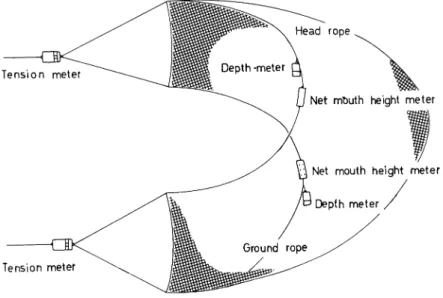
The research was conducted off Eguchi coast, Toshiki-cho, over 2 courses. The first course was used to determine the performance of the net from setting until hauling. The second course was used to determine the tension, net mouth height and depth. Other data from former experiments were also used. The apparatus that was used in this experiments consists of net mouth height meter, tension meter and depth meter. The arrangement of the net is shown in Figure 2.
Tension meter
Fig. 2. Layout of the setting apparatus at parts of net.
The television equipment (video) were set up on board, with an underwater camera handled by divers. The purpose was to observe the movement of the net and other phenomena which occurred between setting and hauling. The TV camera and control unit were connected by 300 m of cable.
Results and Discussion
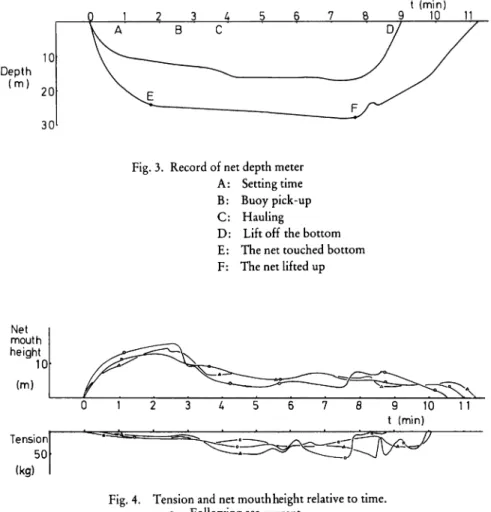
Data recorded from the instruments show some variation in tension, depth and net mouth height relative to the current direction as shown in Figures. 3. and 4.
The net mouth height upon bottom contact was 10-16 m. After that, the net mouth height decreased while sweeping the bottom. Under this condition the net moved continuously along the bottom and the net mouth height was 3-6 m. Upon lifting off the bottom, the net mouth height decreased.
Depth (m) Net mouth height 10 (m) Tension 50 (kg)
Fig. 3. Recordof net depth meter
A: Setting time
B: Buoy pick-up
C: Hauling
D: Lift off the bottom E: The net touched bottom
F: The net lifted up
0 1 2 3 4 5 6 7 8 9 10 11
t (min)
*^£jW
Fig. 4. Tension and net mouthheight relative to time,
-o— Following sea current ZfiZ Against seacurrent
The tension upon bottom contact was 10-20 kg. At hauling time it ranged from
25-50 kg. At the time of lift off, it increased to 60-100 kg. Sinking speed ranged from
0.2-0.3 m/s, while lift off ranged from 0.1-0.2 m/s.
When paid out, the net quickly sank to the bottom and developed into its full shape. The
net became larger when it touched the bottom. During hauling the body of the net was in
contact with the bottom. Then, the wing parts moved in slowly and functioned like that of a
trawl. The back parts of the netbecame catenary in shape. Afterlifting off the bottom, the wing
distance narrowed. The net passed over the reef by 0.3-0.5 m. At this stage, movement
suddenly became faster and the wingparts frightened the fishes in front of the reef.
Performance
of net during setting and hauling are shown in Plate I and II respectively. The setting steps are
the throwing of the buoy, warp rope, net and the second warp rope.
In this case, the boat is run
at full speed until it reaches the buoy. More details about the fishing method are shown in Figure
5. In setting, the net position must be against the current. The warp line is hauled after the buoy is picked up. At this stage, the boat slowly moves backward to the bouy position.
turn to port
towing rope
(1 ) set buoy
,J
net \ g f (2) set net
^
(5) net pullout
(2) net condition during setting
(3) buoy retrieval
(A) net hauling
(5) net pull out
mmmMmmmmmmmmsm
(A) net hauling (3) buoy retrieval
Fig. 5. Operation of Gochi net.
frightened and concentrated in front of the reef, while the area of net becomes narrow. When operated in a reef area, care must be taken because of the danger of entanglement.
The setting condition until hauling is shown in Figure 5. At setting time, the wing part opens wide while sinking and touching the bottom. This condition is maintained until lift off, when the wing part becomes narrow above the reef and rapidly makes a sharp angle (locus).
The net, when lifted off the bottom, looks like a scoop above the reef and catches the fish. The hauling distance to school position is important to the success of the operation. Highest success occurs when the net is about 0.5-1.0 m above the reef. This is further shown in Figure 6. One of the authors, (Higo 1977), formulated the following equation to show this relationship:
i£(i+^V(^+i)!-i
Conclusion
It was found that the hauling speed between bottom contact and lift off ranged from
0.8-1.0 m/s. At lift off, the tension increased to 60-100 kg, depending on the catch (yield) and tidal current. The net then passed over the reef with a clearanceof 0.5-1.0 m.
The net, when in operation, opens wide from the wing part, and drives the fishes to the center of the net. While the fish school is concentrated at the mouth area of the net, the warp ropes are pulled, the wing parts narrow and the fishes are trapped inside the net. The net is pulled over the reef, and scoops up in an arcing motion. The method of using the Gochi net in reef areas takes a lot of consideration because of high risks in its operation.
Boat
Fig. 6. The operation of the Gochi Net from bottom contact to hauling and above the reef.
L]: Locus of the net hauling
L : Length of the towing rope when the net lifts off the sea bottom(m)
1: Distance between the net and the reef when the net lifts off the sea bottom(m) D: Depth(m)
T: Tension of the rope at the stern (kg)
h: Distance between net and reef the net passed over the reef(m)
h': Reefheight
W: Warp weight when the net liftsoff the bottom (Kg/m)
Acknowledgment
I would like to express deep gratitude to the Eguchihama Fisheries Cooperative and the
fishermen who participated in this research. Particular thanks are due to Mr. Hiroshi Hashi who
was especially helpful with the underwater photography, Shizuo Tabata. David Plotner and to
all those involved in this research.
References
Anonymous, 1967. Gochi Ami Fisheries, comprehensive analysis reports. Japan Fisheries,
Conservation Organization. 53pp.
Higo, N., S. Fuwa and T. Imai 1977. Studies on Gochi Net - I. on moving pattern of the net. Memoirs of the Faculty of Fisheries, Kagoshima University. 26:137-145.
Higo, N., 1989. Fish behavior related with fishing gear. Fisheries Series, Koseisha
Press 73:9-25.
Kakimoto, M., Higo, N., et al., 1986. On the behavior of net fishing gearascertained
by diving observations- I. Memoirs of the Faculty of Fisheries, Kagoshima University,
35:1010-120.Masatsune, N. 1985. Fishing Technique 3. Japan International Cooperation Agency. 108pp. Thomson, D. B. 1981. Seine Fishing, Bottom fishing with rope warps and wing trawl. Fishing
News Books. Ltd. London. 208pp.
B
D
Plate I. Performance of net during setting. A : Setting net
B : Setting net
C : Tension meter
D : Down positition of net
E : Touched the bottom
H K
Plate II. Performance of net during hauling.
G : Hauling time (Ground rope)
H : Hauling time (Net mouth)
I : Lift off (Wing part) J : Before lift off the bottom
K : Before lift off the bottom (Lead line in the mouth part)