Effects of Dietary Phospholipids on Growth of
the Larval Red Sea Bream and Knife Jaw
著者
KANAZAWA Akio, TESHIMA Shin-ichi, INAMORI
Shigehiro, MATSUBARA Hikaru
journal or
publication title
鹿児島大学水産学部紀要=Memoirs of Faculty of
Fisheries Kagoshima University
volume
32
page range
109-114
別言語のタイトル
マダイおよびイシダイ仔魚の成長におよぼす食餌性
リン脂質の効果
Vol. 32 pp. 109-114 (1983)
Effects of Dietary Phospholipids on Growth of the
Larval Red Sea Bream and Knife Jaw
Akio Kanazawa*1, Shin-ichi Teshima*1, Shigehiro Inamori" and Hikaru Matsubara*1
Abstract
The effects of dietary phospholipids on growth and survival of the larval red sea bream
Chrysophrys major and knife jaw Oplegnathus fasciatus were investigated using the purified or formula diets. The inclusion of soybean lecithin (SBL) in the purified diet
improved growth and survival of the 10-day larvae of the red sea bream. The supplement of dietary SBL to the formula diet also improved growth and survival of the 19-day larvae of the knife jaw. These results suggest that the inclusion of some phosholipids in diets may be necessary for good growth of the larval red sea bream and knife jaw as pointed out with the larval Ayu Pleceglossus altivelis.
During the course of our continuing attempts to rear larval fish with micro-particulate diets1_3), we have found that the inclusion of phospholipids in diets is necessary for growth and survival of the 10-day larvae of the Ayu Plecoglossus altivelis3). The finding suggests that dietary sources of phosholipids are also indispensable for good growth of other species of larval fish. The red sea bream Chrysophrys major and knife jaw Oplegnathus fasciatus are important fish in the field of fish culture in Japan. In the present study, therefore, the feeding experiments were conducted to clarify the effects of dietary phospholipids on growth and survival of the larval red sea bream and knife jaw. As a result, both the fish were found to necessitate dietary sources of some phospholipids for their good growth and survival. This paper presents these results and
discussion.
Materials and Methods
Eggs of the red sea bream were obtained at the Ushibuka Fish-Culture Center, Kumamoto Prefecture, transported to this laboratory, and hatched at the Kamoike Marine Production Laboratory, Faculty of Fisheries, University of Kagoshima. The newly hatched larvae were reared with the rotifer Brachionus plicatilis at the feeding
rate of 3 rotifers/ ml of water for 9 days, divided into experimental groups, and then
* l Laboratory of Fisheries Chemistry, Faculty of Fisheries, University of Kagoshima, 4-50-20 Shimoarata, Kagoshima 890, Japan.
110 Mem. Fac. Fish., Kagoshima Univ. Vol. 32 (1983)
reared with the artificial diets (diets No. 1 to 3) and with the rotifers (diet No. 4) for 20 days under the conditions listed in Tables 1 and 2. The diets 1 to 3 are the micro -particulate diets (size, 125-250 vm) with a zein-coating (Zein-MCD)2) and prepared as follows : To the powdered diets (8.0 g), 25 ml of the zein solution (20 g zein/100 ml of 60 %ethanol) was added, mixed well, dried up in an oven at 30-40°C, and then crumbled to give the diets with adequate sizes.
Table 1. Rearing and feeding methods of the larval fish
Condition Red sea bream Knife jaw
Larvae used
Age (days after hatching) 10-day larvae 18-days larvae
Total length (mm) 4.8 6.0
Number of fish/tank 100 300
Rearing and feeding methods
Aquarium (capacity) 30 liters 100 liters
Supply of water Running water Running water
(120ml/min) (5 rounds/day)
Water temperature (°C) 20 20-25
Feeding rate Test diet: 0.5 g/day/tank Test diet: 3.0 g/day/tank
Rotifer : 3 rotifers/ml Rotifer : 6 rotifers/ml
Freque ncy of feediing 10 times/day 10 times/day
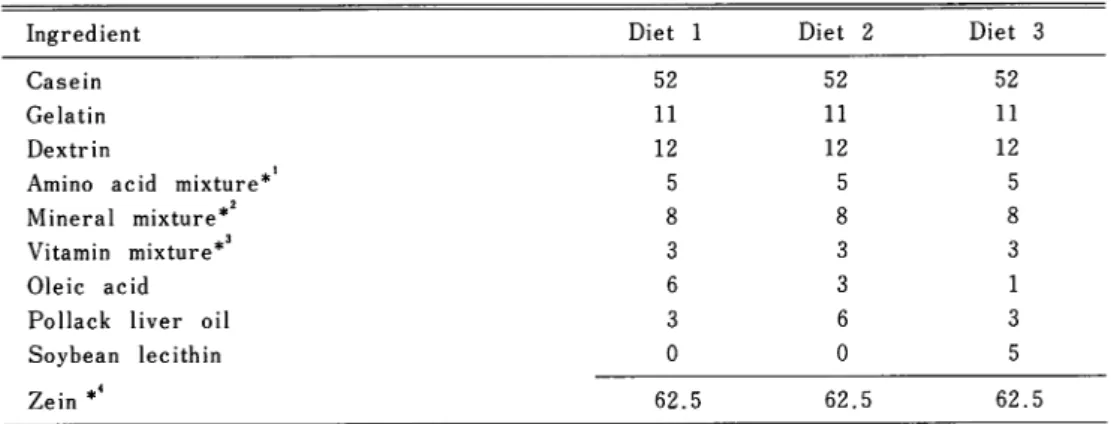
Table 2. Composition(%) of the diets (Zein-MCD) for the larval red sea bream.
Ingredient Diet 1 Diet 2 Diet 3 Casein
Gelatin Dextrin
Amino acid mixture* Mineral mixture*
. . . . . ,,.3
Vitamin mixture Oleic acid Pollack liver oil
Soybean lecithin Zein * 52 52 52 11 11 11 12 12 12 5 5 5 8 8 8 3 3 3 6 3 1 3 6 3 0 0 5 62.5 62.5 62.5
*l Amino acids (g/lOOgdry ingredients except zein): L-phenylalanine, 0.4 ; L-arginine HC1, 0.9; L-cystine, 0.5; L-tryptophan, 0.2; L-histidine HC1 • H20, 0.2; DL-alanine, 0.9; L-asparagine Na, 0.7; L-lysine HC1, 0.4; L-valine, 0.5; glycine, 0.3.
*2 USP XII salts and trace metals.
*3 Followed by HALVER (1957)8).
Phospholipids on Red Sea Bream and Knife Jaw 111
Eggs of the knife jaws were hatched and reared with the rotifes for 17 days at the Fish-Culture Center of Oita Prefecture. The 18-day larvae were divided into experi mental groups and reared with the artificial diets (diets No. 5 to 8) and with the live food (diet No. 9 : rotifers+larval fish for the period of 19-30 days after hatching and the paste of mysids and perch Ammodytes personatus (Japanese name, Ikanago) for the period of 31-40 days after hatching) for 20 days under the conditions given in Tables 1 and 3. The diets 5 to 8 are the micro-particulate diets with a cholesterol-lecithin coating (cholesterol-lecithin MCD)2) and prepared as follows: To 100m/ of the cyclohexane solution containing cholesterol (8.0 g) and chicken-egg lecithin (1.6 g), the powdered diet (100 g) was added, mixed well, dried, and then sieved to give the adequate sizes of diets (125-250 /um for 19-30 day larvae; 250-500 //m for 31-40 day larvae).
Table 3. Composition (%) of the diets (cholesterol-lecithin MCD) for the larval knife jaw.
Ingredient Diet 5 Diet 6 Diet 7 Diet 8
Egg yolk 15.5 15.5 15.5 15.2 Bonito extract* 7.7 7.7 7.7 7.5 Tapes extract 12.3 12.3 12.3 12.1 Squid meal* 23.2 23.2 23.2 22.6 Albumin 8.4 8.4 8.4 8.2 Gelatin 9.3 9.3 9.3 9.0
Amino acid mixture* 3.4 3.4 3.4 3.3
Mineral mixture 4.2 4.2 4.2 4.1 Vitamin mixture 4.2 4.2 4.2 4.1 Squid-liver oil 2.1 2.1 2.1 2.0 Pollack-liver oil 2.1 2.1 2.1 2.1 Agar 2.6 2.6 2.6 2.5 Soybean lecithin 0 2.5 5.0 7.4 Oleic acid 5.0 2.5 0 0 Cholesterol* 8.0 8.0 8.0 8.0
Chicken egg lecithin* 1.6 1.6 1.6 1.6
Riken Vitamin Co. Tapes extract: the extract of short-necked clam Tapes philippinarum.
Freeze-dried squid flesh.
The compositions of amino acids, minerals, and vitamins are given in Table 2. The preparation method for the microparticulate diets with a cholesterol-lecithin
coating is given in the text.
Results and Discussion
Figs. 1 to 3 show the results of the feeding trial with the red sea bream. The 10-day larvae of the red sea bream had better growth in terms of the increase in both total length and body weight when received the Zein-MCD containing 5 % soybean lecithin
112 Mem. Fac. Fish., Kagoshima Univ. Vol. 32 (1983)
(SBL) (diet 3) than those without supplemental phospholipids (diets 1 and 2). A similar result was also observed about the survival rates ; the larvae showed the lower surviv al rate on the diets without supplemental phospholipids than on the diets containing phospholipids (dits 3 and 4) and were dead within 30 days after hatching. These results show that the larval red sea bream also requires dietary sources of phosholipids for normal growth and survival as found in the larval Ayu previously. The larval red sea bream fed the Zein-MCD containing 5 %SBL had the total length similar to that of the larvae fed the rotifers (control group, diet 4), but the weight gain and survival rate on the Zein-MCD were lower than those on the control group.
20 30
Days after hatching
Fig. 1. The total length of the larval red sea bream fed the Zein-MCD.
Days after hatching
Fig. 2. The weight gain of the larval red sea bream fed the Zein-MCD.
Days after hatching
Fig. 3. The survival rate of the larval red
Phospholipids on Red Sea Bream and Knife Jaw 113
Fig. 4 and 5 show the results of the feeding trial with the knife jaw. The larval knife jaw had a poor growth in terms of the total length when received the chlesterol-lecithin MCD without supplemental SBL (diet 5). The total length of the larval knife jaw was increased with the increasing levels of supplemental SBL from 2.5 % to 7.4 % (diets 6, 7, and 8). The inclusion of phospholipids such as SBL in the ditets was thus found to be also necessary for growth of the larval knife jaw. However, the supplement of SBL to the diet did not improve the survival rates of the larval knife jaw significantly. As shown in Fig. 4, the cholesterol-lecithin MCD were effective in supporting growth of the larval knife jaw to some extent. However, growth and survival of the larval knife jaw receiving every cholesterol-lecithin MCD were inferior to those of the group receiving the control diet (diet 9).
As mentioned above, the larval red sea bream and knife jaw are probable to necessi
tate dietary phospholipids such as SBL for growth as well as the larval Ayu3,4). This
postulates that other species of larval fish may require dietary sources of some phos pholipids for their growth. On the other hand, larval crustaceans5,6) have also been found to require dietary phospholipids for normal growth and survival, with suggestion that dietary phospholipids may play an important role in transport of lipids through the hemolymph7). Regarding the larval fish, no information is available about the mechanism by which dietary phospholipids exert the growth-enhancing effects on larval fish.
s io.
Diet 6 Diet 5
10 20
Feeding period (days)
114 Mem. Fac. Fish., Kagoshima Univ. Vol. 32 (1983)
• Diet 9
(Control)
0 10 20
Feeding period (days)
Fig. 5. The survival of the larval knife jaw fed the cholesterol-lecithin MCD.
Acknowledgement
The authors wish to thank the members of the Fish-Culture Center, Oita Prefec ture, for their helpful advice. We are also grateful to the Fish-Culture Center, Kumamoto Prefecture and Riken Vitamin Co., Ltd., for supplying the eggs of red sea bream and bonito extract, short-necked clam extract and soybean lecithin.
References
1) Kanazawa, A., S. Teshima, S. Inamori, S. Sumida, and T. Iwashita : Mem. Fac. Fish.
Kagoshima Univ., 31, 185-192 (1982).
2) Teshima, S., A. Kanazawa, and M. Sakamoto : Min. Rev. Data File Fish. Kagsohima
Univ., 2, 67-86 (1982).
3) Kanazawa, A., S. Teshima, S. Inamori, T. Iwashita, and A. Nagao : Mem. Fac. Fish.
Kagoshima Univ., 30, 301-309 (1981).
4) Kanazawa, A., S. Teshima, T. Kobayashi, M. Takae.T. Iwashita, and R. Uehara :
Mem. Fac. Fish. Kagoshima Univ., 32,115-126 (1983).
5) Kanazawa, A., S. Teshima, and M. Sakamoto : Aquaculture, in press.
6) TESHIMA, S., A. KANAZAWA, H. SASADA, and M. KAWASAKI: Mem. Fac. Fish. Kagoshima
Univ., 31, 193-199 (1982).
7) TESHIMA, S. and A. KANAZAWA : Min. Rev. Data File Fish. Res. Kagoshima Univ., 1, 1-25