Acquisition of English Modals: An Interlanguage ● ● ●
Study in the Japanese Setting
Toshiaki
(1980年10月13日 受理)
1. The ai- of this study
The area we are interested in in the present paper is termed by Corder (1973) error analysis or interlanguage studies. Its basic assumption is that learners have their own language system at every developmental stage of learning, which is not the same as that of
●
the target language but rather a new `system'. The system is unstable and transitional in nature and comes to approximate the target language as learning develops. If we can describe in linguistic and/or psycholinguistic terms the nature of interlanguage and the process of its approximation to the target language, it will provide us with important
in-●
formation for structuring the syllabuses and teaching methods as well as a fuller
under-●
standing of language acquisition.
● ● ●
In the present study, we con丘ned the area of competence to the semantic、structure of English modals, and aimed to describe the characteristic features of the transitional systems
of Eng一ish modals which Japanese learners show at the intermediate learning stage. In
other words, we wanted to specify the interlanguage grammar ofmodals byJapanese learners of English.
2. Se-antic structure of English -odals
According to Cook (1978), there are three factors involved in the semantic structure of English modal verbs: (1) epistemic vs. root modals, (2) internal vs. external negation and (3) present vs. past meaning.
(1) Epistemic vs. root modals
Epistemic modals modify the propositional content of the sentence and deal with or assess the truth value of that propositional content. If a speaker utters a sentence which includes an epistemic modal, he is saying how true he thinks the proposition is. For example, when a speaker says "John can be lying", he is saying how possible the proposition "John is lying"is. More speci丘cally, epistemic modals deal with the possibility and necessity of the proposition. Root modals, on the other hand, relate an agent to an activity and deal with permission, obligation and ability. If a speaker utters a sentence including a root modal, he is attempting to direct the course of future events or to exercise control over people's
●
* This is a revised version ofa paper read at the 2nd Alumni Convention of the EasトWest Center which was
held in Honolulu,July 27-Augugt 3, 1980. The author is grateful to Miss Mariko Ohnishi for her dedicated
cooperation in the planning and administration of the experiment.
Acquisition of English Modals : An lnterlanguage Study in the Japanese Setting
behavior. When a speaker utters HYou can smoke in the lounge , he is permitting the
addressee to smoke in the lounge.
(2) External vs. internal negation
Since modal structures are semantically two verb structures which contain a modal verb
and a main verb, it is possible that either the modal verb or the main verb is negated. When
the main verb of a proposition component is negated, it is referred to as internal negation.
On the contrary, when the modal verb of a modal component is negated, it is called external negation. The following are examples of external and internal negation.
External neg: John cannot be lying.
Analysis: It is not possible thatJohn is lying. Internal neg: John may not be lyir唱.
Analysis: It is possible thatJohn is not lying.
(3) Present vs. past tense
English modal verbs have present and past tense forms・ The present tense forms have present tense meanings, but past forms have either past or present meanings. The past tense forms have a past time meaning and any ambiguity is usually resolved by the discourse
● ● ● context and the use of past time adverbials.
The semantic structure of English modals can be analyzed in terms of the combination of the components of these three factors. Diagram 1 shows every theoretically possible combinatibn of those components and Table 1 the surface realization of these underlyir唱 semantic structures of the English modals, May, Can, Have to and Mu∫t. (Asterisks indicate
that there are no liguistic realizations in English.)
Modals Diagram1 Ne奉-External Internal≡Present( Past( Present( Past(…,' (2) (4) Non-Neg Present (5) Past (6)
・車ニーExternal-Internal芸至resastresast;nt (7)(8)nt (9)
(8)
10) Present (ll) Past (12)Table 1 Semantic structures of English modals and their surface realizations Semantic structures May l (Ep+Ext-fPres) 2 (Ep+Ext+Past) 3 (Ep+Int+Pres) 4 (Ep-f-Inト十Past) 5 (Ep+Non-Neg+Pres) 6 (Ep+Non-Neg+Past) 7 (R+Ext+Pres) 8 (R+Ext+Past) 9 (R+Int+Pres) 10 (R+Int+Past) ll (R+Non-Neg+Pres) 12 (R+Non-Neg+Past) Can l (Ep+Ext+Pres) 2 (Ep+Ext+Past) 3 (Ep-flnt+Pres) 4 (Ep+Int1-Past 5 (Ep+Non-Neg+Pres 6 (Ep+Non-Neg+Past) 7 (Rj-fExt+Pres) 8 (Ri+Ext+Past) 9 (Rj+Int-fPres) 10 (Ri+Int+Past) ll (Rj+Non-Neg+Pres) 12 (Rt+Non-Neg+Past) 13 (R急-fExt-fPres) 14 (Ra+Ext+Past) 15 (R望-j-Int-fPres) 16 (R望+Int+Past) 17 (R2+Non-Neg-fPres) 18 (R2+Non-Neg+Past) Have to l (Ep-fExt+Pres) 2 (Ep+Ext+Past) 3 (Ep+Int+Pres) ヽ 4 (Ep+Int+Past) 5 (Ep+Non-Neg+Pres) 6 (Ep-j-Non-Neg+Past) 7 (R+Ext+Pres) 8 (R+Ext-fPast1 9 (R+Int+Pres) 10 (R+Int+Past) ll (R+Non-Neg+Pres 12 (R+Non-Neg一十Past) Must l (Ep+Ext+Pres)
Realizations Item No.
* *
He may not succeed.
John might not have been angry. He might be the winner.
It might have been raining.
● ●
You may not go swimming.
●
You might not have bought the bicycle. *
*
May I borrow your pen?
) ) ) ) ) ) h m c o ^ m ^ ( ( ( ( ( ( (7) The prisoners might leave the camp when they wished. ( 8)
He can't be dead.
It couldn t have been a lion, *
*
There could be trouble about the plan, Voyages could be dangerous in those days. You can't leave now.
You couldn't smoke there. *
*
Could I take the car? I could go out late yesterday. He can t stand on his hands.
He couldn t lift 100 pounds in his childhood. *
*
He can speak English.
I could swim 100 meters when I was younger.
John doesn t have to be in town. Mary didn t have to be wrong. *
*
Even the best of us has to die. Someone had to be the loser. I don't have to work on Sunday. He didn't have to take the examination. *
*
You have to obey the law. He had to refuse the offer.
) ) ヽ ノ ) -h ( N C O r j * = = H r = = U i - 川U IHr一川 p h H 一 p h u L l H 一 し ‖ " l H 一 i O ( D N C O = リ = U H H = リ 相 川 一 川 U Ⅷ l n H t p n H 一 p n H 一 O O ^ CM サ ー h C M C M ( M l J r L M L r 一 M u ) ) ) ヽ J m ^ m (D CM CM CM CM I " H 川 l 川 一 u p h H 一 一 7 8 2 2 J r t 相 川 U
82 Acquisition of English Modals: An Interlanguage Study in the Japanese Setting 2 (Ep+Ext+Past) 3 (Ep+Int+Pres 4 (Ep+Int+Past) 5 (Ep+Non-Neg+Pres) 6 (Ep+Non-Neg+Past) 7 (R+Ext+Pres) 8 (R+Ext+Past) 9 (R+Int+Pres) 10 (R+lnt+Past ll (R+Non-Neg+Pres) 12 (R+Non-Neg+Past) *
There mustn t be any water left. *
It must be twe】ve o'clock. *
*
*
You must not walk on the grass. *
I must go now. *
Notes
Can Rt : permission Can R2: ability
3. The outline of the experiment: test materials and the administration of the test In order to specify the nature of the approximative system of English modals for in-termediate learners of English, we prepared a test of English modals, and administered it to the students of Kagoshima University. The contents of the test were strictly based on the above description of English modals.
● ●
In preparing test materials, we constructed two different sets of the test, (1) an objective type where subjects are asked to choose a correct answer out of several choices, and (2) a subjective type where subjects are asked to write down their answers themselves. The objective test was intended to test the receptive competence of modals. The subjective one, contrastively, was made so as to check the learner's productive interlanguage strategies in
●
producing modal sentences.
●
The receptive test is an Lt to L^ translation type in which the subjects are asked to ●
choose the correct Japanese translation for the 32 English sentences of Table 1. In the productive test, the subjects are asked to translate into English the Japanese translation of the same English sentences as in the objective test. Thus, we aimed to find differences between reception and production.
●
The test was given to 126 students of Kagoshima University. The reception test (test 1, objective type) was given to 45 Technology majors and the prodction test (test 2, subjective type) to 62 Science students and t0 19 juniors majoring in English. The general English ability or pro丘ciency levels of the Technology students and Science students were judged to be almost the same on the basis of several criteria such as entrance examination
scores, etc. English majors were judged to be far superior in proficiency to the other two ●
groups. English mojors were called for to obtain clearer information about the interlanguage
●
strategies. (In order to be able to use transitional strategies, quite a high level of English pro丘ciency is required.) The test was given in June, 1980, during the regular class period.
4. Results and discussions (1) Reception
Table 2 Frequency of errors
読
Structures Reception Production
- N c o ^ ^ t r i ^ o o c ) 0 - ( N c o ' t i n t J i ^ c o a ) 0 - ( N c o ' < t i o ^ N o o a ) 0 ' -' ( N M (N (N (M (N CM (N M M (N Cn CO CO May (Ep+Irit+Pres) May (Ep+Int+Past) May (Ep+Non-Neg+ Pres) May (Ep+Non-Neg+Past) May (R一卜Ext-fPres) May (R+Ext+Past) May (R+Non-Neg+Pres May (R+Non-Neg+Past Can (Ep+Ext+Pres) Can (Ep+Ext+Past) Can (Ep+Non-Neg+Pres) Can (Ep+Non-Neg+Past) Can (Ri+Ext+Pres) Can (Rj+Ext+Past Can (Ri +Non-Neg+ Pres) Can Rx+Non-Neg+Past) Can (R8+Ext+Pres) Can (R2+Ext+Past) Can (R2+Non-Neg+Pres) Can (R2+Non-Neg1-Past Have to (Ep+Ext+Pres) Have to (Ep+Ext+Past) Have to (Ep+Non-Neg+Pres) Have to (Ep+Non-Neg+Past) Have to (R+Ext+Pres) Have to (R+、Ext+Past) Have to (R+Non-Neg+Pres Have to (R+Non-Neg-j-Past) Must (Ep-j- Int-fPres
Must (Ep+Non-Neg+ Pres Must (R+Int+Pres) Must (R+Non-Neg+Pres 0/ /0 2 4.2 18 (40.0 12 (26.7) 6 13.3 21 46.7 23 51.1 0(0 ll (24.4 3(6.7 6 (13.3 31 (68.9) 16 (35.6) 15 (33.3) 0(0 5 ll.1 7 (15.6) p J 一 p J 一 F J 1 0 0 o l H r L u l r L o 0 o 0 0 15 33.3) 10 22.2 8 (17.8 4( 8.9) 1(2.2 5(ll.1 0 0 1 2.2 8 (17.8 ヽ 2 9 2 ● ● ● 2 8 4 l f 相 川 Ⅶ ■ L U 1 4 2 % 8( 12.9 41 66.1) 8.1 47( 75.8 ( ( ( ( ( ( ( ( CO cO O O CM tH cM CD c o t j ォ m y -i T + t l O O . C O N C O O ) r f ( 」 > C O t -' ) ) ) ) ) ) ^ N O ^ 74.2) 7 11.3) 49 ( 79.0) 18 29.0 ∬u ^ (M CM a = H H H 22.6) cN^里) ●390 1 9 7 0 1 7 0 1 0 7 5 5 7 3 は L l 一 川 Ⅶ ■ L U 1 8 2 3 4 2 ) ) ) ) ) ) T * ^ H O ^ t ^ ) ) ) ) ) ) ) 3 4 」 m -h ■ ● ● C M C T > C O C O < 」 > C D 0 0 0 -* m " * * - y -< ( ( ( ( ( ( ( -' C M < O I * * * 0 0 0 m -h w cm
Table 3 Mean of total errors and means of errors for each modal (Reception)
N X
Mean of total errors
Means of errors of each modal May Can Have to Must 235 co co ^ m O) CO ^ ^ 32 7.3 (16.2) C O ( N O O ^ l to oi m co ● ● ● i - < 」 > l O C O = リ p n p n r C D C O C M ^ ● ● ● ● L O i O < M C O 2 1 1 i " ト ト ∬ 川 U
84 Acquisition of English Modals: An lnterlanguage Study in the Japanese Setting
Table 4 Mean of errors for the components offactors, for each modal (Reception) Modal Component 2 N X May Ep R Neg Non-Neg Int Neg Ext Neg Pres Past 00 m ^ ^ o ^ io co co m co cM CM T^ co m ^ ^ ^ ^ ( N M -t ^ tn oo o co o o co Ln ● ● ● ■ ● ● ● ● O ) c n t 」 ) t N O ( N C O ^ -< ォ ー ォ -h C M -h Can Ep R Neg Non-Neg Pres Past
No realizations of Int Neg.
C D h サ ^ O l t H f f l m (N (N in m in t J * c O t 」 > < T > C D C T J O t } ォ O 0 0 O 0 0 ● ● ● ● ● ● T h l C O ^ * O ^ O } ^ I (21.1 30.7 (35.6 16.2 22.2 (48.9 (19.6) (32.2 31.1 7.6) 8.9 (21.8) 20.0 10.7 Have to Ep R Neg Non-Neg Pres Past
No realizations of Int Neg.
h N -H CO ^ O e n ^ h c m c m t H * -* * * ^ * CO CO 00 CO O O ● ● ● ● ● ● o i ォ ー r ^ c o < 」 > m Must Ep R Neg Non-Neg
No realizations of Int Neg and Past.
C T > C T > C M C O l (N (N (N M m o o m ● ● ● ^ co co ^ ) ) ) ) ) ) r ^ o c o c o c o ォ ー < ● ● ● ● ● O t + < t ^ l ^ - C O サ ー < M -ォ -* -' ( ( ′ l l t 、 ( ( ( n r 川 " r O N CO CO ● ● ● ● O < 」 > C O C O 1 I 相 川 は Ⅶ 柑 u l " 川 l u
Table 5 Mean of errors for the components offactors, for all modals (Reception)
Component I N X Ep 氏 Neg Non-Neg Int Neg Ext Neg Pres Past O Ln -H ^ CM O OO t^ t J * < t > c o o c q o > c m o 1 1 1 1 1 T h C O C 」 ) ( D ^ C v l C O ^ 1 1 1 1 1 1 1 O c O C M t O O C O i -H t O ● ● ● ● ● ● ● ● o m oo cD oo oo t^ t^ 1 (16.1 8.5 13.2 (10.5) (13.0) (13.4) ll.5 (12.3
structure. Based on this frequency table, several indicator values were calculated so as to specify the aspects in which the subjects had di抗culty in the reception ofmodals. They are
(1) mean value of total errors (Table 3), (2) mean values of errors for each of the 4 modals, May, Can, Have to, and Mu∫t (Table 3), (3) for each modal, mean values of errors of each of the contrasting components of the 3 factors and one sub factor, Ep/R factor, Neg/Non-Neg factor, Int/Ext Neg factor, tense factor (Table 4) (some were impossible to calculate due to lack ofrealizations of structures), (4) Across the four modals, mean values of errors for each of the contrasing components of the 3 factors, and one sub factor (Table 5).
As is shown in Table 3, the mean values of error frequency for each modal are 25.8%
for May, 15.3% for Can, 12.2% for Have to, and 8.4% for Mu∫t making the mean value for
total errors 16.2%. This means that May is a difficult modal verb while the others are
relatively easy in reception. As is evident from Table 4, the difficulty of May was caused
by the components of Root (30.7%), Negative (35.6%) and Past (32.2%) and, in the case
of negation, especially by the component of External Negation (48.9%). The contribution
of Root component contradicts a general tendency, for across modals the Epistemic com-ponent is far more difficult than the Root comcom-ponent (See Table 5). The difficulty ofRoot May could be attributed to the fact that, in the case ofMqy9 the Root modal combines
● only with External Negation and the Epistemic modal only 、vith Internal Negation and External Negation is much more difficult than Internal. Can is a relatively easy one butstill Ep (31.1%), Non-Neg (21.8%) and Pres (20.0%) components seem to be difficult, and,
contrary to general tendency, Pres and Non-Neg components seem more di氏cult than Past
and Neg, respectively. The Non-Neg case could be partly accounted for by the fact that
there are only realizations of Ext Neg in the surface structure and the negation structure is
●
rather simple in that sense. The case of the Pres component remains to be solved. Have
●
to and Mu∫t are also easy modals and the more difficult components are Ep and Neg in each
case, which is consistent with the general tendency.As for the effects of each component across all four modals, Ep seems to have more strong-ly affected the learner's learning of modals than Root. (See Table 5). In other words, the Ep component (16.1%) was more di氏cult than Root (8.5%) for all the modals. As for the difference of effect in Neg and tense factor, there is a general tendency that Neg (13.2%) and Past (12.3%) are more di侃cult but the difference is not great enough to be significant.
In order to check the statistical significance of the difference of errors between the con-trasting components of the three factors and one sub factor, we used the chi-squared test.
●
Table 7 is the chi-squared statistics and the interpretation of the results. The x2 test showed that there were significant differences in proportion between those pairs of contrasting
● ● ●
components except for between Pres and Past in Have to, Ep and Root in Mu∫ty and Neg and
Non-Neg, IntNeg and ExtNeg, and Pres and Past across modals.
Production
Table 2 (right column) shows the error frequency in the production test in which subjects were asked to translate Japanese into English. Since the target English sentences were the same as those of the reception test and the subjects of this test werejudged by several
●
Acquisition of English Modals: An Interlanguage Study in the Japanese Setting
to compare these two sets of data. In scoring the production test, only the modal part was evaluated to keep balance between reception and production since in the reception test only
● ●
the understanding of modals was checked.
As is clear from the comparative results of Table 2, production is much more difficult than reception. As is shown in Table 6, the mean value of errors in production is 25>5
(41.1%) in contrast with the mean of 7.3 (16.2%) for reception. The difference is
signifi-cant.at the 0.01 level (Table 7, No. 17). This means about two and half times as many
students made errors in production as in reception. A comparison of each item shows that
with a few exception (item 3, 5, ll, 13, 32) most of structures were more di氏cult in produo
tion than in reception.
●
Table 6 Mean of total errors and means of errors for each modal (Production)
ど N %
Mean of total errors
Means of errors for each modal May Can Have to Must 817 32 蝣25.5 (N CO O N O i C 」 > 1 2 3 0 0 ( N O O ^ l O C O C O 0 0 ● ● ● r}< CM 00 -h C M C M C O 1 -h
Table 7 The Chi-squared Test by the 2×2 Contingency Table represents: P<0.05 represents: P<0.01 N.S. represents: No Signi丘cance 1. May: Epvs.R Ep Pass 1 42 Failure 38 72-4.1899* with 1 d.f.
2. May: Negvs. Non-Neg
Neg Non-Neg Pass 1 16 151 Failure 64 29
f-17.7600** with 1 d.f. 3. May: IntNegvs. ExtNeg
I ntNeg ExtNeg Pass 70 46 Failure 20 44 x2-13.9655** with 1 d.f. 4. May: Presvs.Past Pres Pass 1 45 Failure 35 ya-7.6694** with 1 d.f. 5. Can: Epvs.R Ep 氏 Pass 1 24 333 Failure 56 27 ya-51,4289** with 1 d.f.
6. Can Negvs. Non-Neg
Neg Non-Neg Pass 246 Failure 24 x2-17.4395** with 1 d.f. 7. Can: Pres vs.Past Pres Past Pass 216 241 Failure 54 蝣.一蝣 29 x窒=8.8977** with 1 d.f.
8. Haveto: Epvs.R
Pass
Failure 37
72-23.3026** with 1 d.f.
9. Haveto: Negvs. Non-Neg
Neg Pass 1 49 Failure 3 1
y2-8.3889** with 1 d.f. 10. Have to: Pres vs.Past
Pres Past Pass 156 160 Failure 24 2 0 72-0.4142 with 1 d.f. (N.S.) ll. Must: Epvs.R Pass Ep 氏 81 84 Failure Z2-0.6545 with 1 d.f. (N.S.)
12. Must: Negvs. Non-Neg
Neg Non-Neg Pass 78 87 Failure 1 2 %2-5.8909* with 1 d.f. 13. AcrossModals: Epvs. R Ep 臥 Pass 490 7 1 5 Failure 1 40 95 y2-28.5759** with 1 d.f.
14. Across Modals: Neg vs. Non-Neg
Neg Non-Neg Pass 589 6 16 Failure 13 1 104
y*-3.7071 with 1 d.f. (N.S.)
15. Across Modals: IntNeg vs. ExtNeg
IntNeg ExtNeg Pass 1 48 44 1 Failure 32 99
v2-0.0279 with 1 d.f. (N.S.) 16. Across Modals: Pres vs. Past
Pres Past Pass 682 523 Failure 1 28 1 07
y2-0.3623 with 1 d.f. (N.S.)
17. Reception vs. Production for All Modals
Reception Production Pass 1,205 1,167 Failure 235 81 7 x2-242.2754** with 1 d.f.
● The relative difficulty of modals is a little different in production from in reception.
In production, the order of difficulty is Have to (62.6%), May (38.7%), Can (40.0%) and
Mu∫t (19.0%) (Table 6) while in reception it is May (25.8%), Can (15.3%), Have to (12.2%)
and Mu∫t (8.4%) (Table 3). Have to is the only modal to have changed its position in the
order. This could be accounted for by the fact that the:Epistemic -Have to is a rather
unfa-miliar item to Japanese students, rarely dealt with in formal English courses. Possibly,
tHey could◆not m^riage this without any clues iri produ
・4 - +
perhaps able to make a guess using -translation based -on the-rootinterpretation.
●
In the production (Lt to Lx translation) test, we cannot and should not expect the sub-jects to respond to the question with the same, desired target modals: it is quite possible and
● ●
natural for them to answer with different modals from the expected ones.. (When the expected
answer is "you may watch television", students can answer "you can watch television".)88 Acquisition of English Modals: An Interlanguage Study in the Japanese Setting
For this reason, it was impossible to make a further analysis of the effects of the components
● ●
of the factors involved in the modal structures,
(3) Interlanguage strategies
So far we have been primarily concerned with what are called the 'trouble spots'of
●
modals. It is important in interlanguage studies to locate the aspects of competence in which students make errors, but it is theoretically signi丘cant also to discover what strategies
4 ● ′■■ヽ
they use to supplement this lack of competence. For it will cast light on the nature of the interlanguage systems between Japanese and English. Furthermore, the transitional
strat-●
egies thus developed could systematized and incorporated into a new type of syllabus. In order to discover these interlanguage strategies, 19 English majors production
● ●
responses were analyzed. In this test subjects were instructed to write down as many sentences as possible using modal verbs. In other words, in this test subjects were not allowed to use parts of speech other than modals, such as adjectives and adverbs. Because of this limitation, there are not many examples of strategies observed in this experiment as
●
might generally be expected. Nonetheless, some interesting techniques of expression were observed.
Firstly, there were various modal verbs used other than the expected modal verb. A modal meaning can often be experessed by more than one modal, and the subjects used a
●
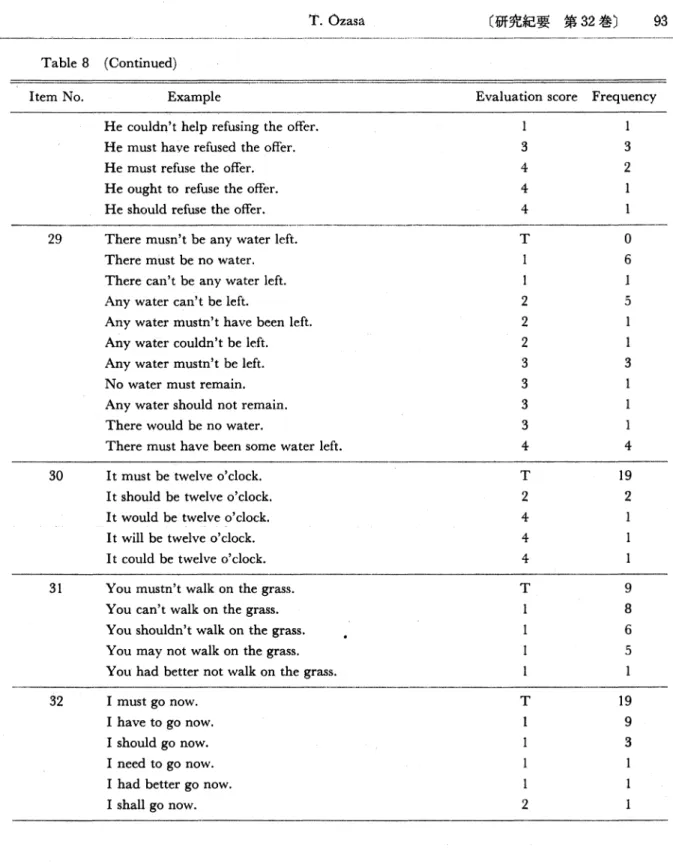
variety of modals in making English sentences the appropriateness of which varies from 'perfect5 to 'comprehensible5. Table 8 is a list of all of these examples, each of which was evaluated in terms of communicative appropriateness and given an evaluation score. Score
● ●
1 was given to those sentences which were indistinguishable from native speech, Score 2 to those which were recognizably not natural but not importantly unnatural, Score 3 to those
●
which were importantly unnatural, and Score 4 to those different in meaning and/or tense.
We could say that the score indicates the degree of interlanguage of the modal sentences
with score 1 closest to the target language, and, for this reason, this list could be used to measure the interlanguage of modal sentences.
Table 8 Interlanguage strategies
●
Score Description
Indistinguishable from native speech
Recognizably not natural but not importantly unnatural
Importantly unnatural, e. g., requiring context to resolve ambiguity Different in meaning and/or tense
Target sentence
Item No. Example Evaluation scoree Frequency He may not succeed.
He might not succeed. He might fail. He may fail. He couldn't succeed. H -. -6 3 1 ▲ l I = U
Table 8 (Continued)
Item No. Example He can t succeed. He can't fail. He won t succeed.
2 John might not have been angry.
John may not have been angry. John might not be angry. John mustn t have been angry. John wouldn t be angry.
He might be the winner. He may be the winner. He can be the winner. He will be the winner. He would be the winner.
■
It might have been raining.
● ■
It may have been rainir唱.
● ●
It can have been raining. It might be raining.
● ●
It could be raining.
● ●
Evaluation score Frequency
4 4 4 H - ^ ^ ^ h - cm ^ ^ 1 1 4 3 Er) OD ^ -h CO CO CM CO r-H = リ H ' - C M t J * t * < ●
You may not go swimming. You mustn t go swimmir唱.
● ●
You can t go swimming.
I
You shouldn t go swimming.
●
You ought not to go swimming. You don't have to go swimming.
●
You might not have bought the bicycle. You shouldn t have bought the bicycle. You may not have bought the bicycle. You might not buy the bicycle. You couldn't buy the bicyc一e.
May I borrow your pen? Can I borrow your pen?
Would you mind lending me your pen? Could you lend me your pen?
Could I borrow your pen? Might I borrow your pen? Will you lend me your pen? Would you lend me your pen? Might you lend me your pen?
H * t O t O ' -< C M ^ l ^ r ^ ( 」 > c o -* t -4 1 h <n ^ ^ ^ U -{ サ ー H i -ォ サ ー I * -ォ i -I * -I ォ -i -^ c o * -i r - t o -ォ tN ^ CO ^ SO CM M -t -H = H = リ ◆
The prisoners might leave the camp 、vhen they wished.
●
The prisoners could leave the camp when也ey wished. The prisoners could have le托the camp when they wished.
● ●
The prisoners may leave the camp when they wished.
H C M 9 2 1 1 1 日U
90 Acquisition of English Modals : An Interlanguage Study in the Japanese Setting
Table 8 (Continued)
Item No. Example Evaluation score Frequency
The prisoners need not have been in the camp when they wished.
He can t be dead. He must be alive. He can't have died. He mustn t be dead. He couldn t be dead. He can t have been dead. He can't die. He shouldn t be dead. L -, t -h - -n : ( M C O ^ T f
It couldn't have been a lion. It can t have been a lion. It mustn't have been a lion. It couldn't be a lion. It cantbe a lion. H - -' C M C M O CO N -h M -h N ^ 1 CO (0 -' i-x O4 1
There could be trouble about the plan. There may be trouble about the plan. There might be trouble about the plan. There can be trouble about the plan. There would be trouble about the plan. There will be trouble about the plan. There shall be trouble about the plan.
H -< -' c M C M ^ * J < C O I O C M O * -h l 1
Voyages could be dangerous in those days. Voyages can t have been safe in those days. Voyages might be dangerous in those days. Voyages must have been dangerous in those days. Voyages must be dangerous m those days. Voyages would be dangerous in those days. Voyages would have been dangerous in those days. Voyages might have been dangerous in those days. Voyages could have been dangerous in those days.
13 You can t leave now.
You mustn t leave now. You may not leave now. You shouldn t leave now. You ought not to leave now. You need to leave now.
h - ( N ( N C ^ C O C O C O ^ H H t O ' t N ^ * H - -ォ ー ー ^ ^o (D h m -h h l
14 You couldn t smoke there.
You might not smoke there.
You shouldn't have smoked there..ど ・
You miistn t have smoked. there, You shouldn t smoke there;
You had better not smoke there. ・
・,-M C M i c o ^ : ^ ! t ^ C O o I : O C O C M -h
Tab】e 8 (Continued)
Item No. Example
15
Evaluation score Frequency You ought not to have smoked there.
You may not have smoked there. You didn't have to smoke there.
Could I take the car? May I take the car? Can I take the car?
Would you mind ifI take the car? Will you mind ifI take the car? Might I take the car?
Don't you mind ifI take the car?
16 T h ^ T + --I -I - CM C M C 」 > -' t ^ C O i -< -* l 1
I could go out late yesterday. I could have gone out late yesterday. I could have left late yesterday. I might go out late yesterday.■
I had better go out late yesterday.
h - w ^ O > ォ ー h ^ C O -H = り
He can t stand on his hands. He must stand on his hands.
He couldn't li托100 pounds in his childhood. None.
He can speak English. ・. T
He may speak English. 一
8 1
1
I could swim 100 meters when I was younger.
I would be able to swim 100 meters when I was younger. I would swim 100 meters when I was younger.
6 1 1 = リ
21 John doesn t have to be in town.
John needn t be in town. John might not be in town. John may ilot be in town. John mustn't be in town. John wouldn't be in town. John may be in town. John couldn't be in town. John couldn't have been in town. John might nらt have b占en in twon. John may not have been in town. John didn t have to be in town. John didn t need to be in town,
= り = リ I N W C O * * ; 蝣 * ・ 4 0 -H ^ M - C O -H m f ソ ー C M ' -I -I r -I
Mary didn't have to be wrong. Mary may not have been wrong. Mary might not be wrong. Mary may not be w′rong.
- -' C O C M 一
92 Acquisition of English Modals: An Interlanguage Study in the Japanese Setting
Table 8 (Continued) Item No. Example
Mary can t be wrong. Mary couldn't be wrong. Mary might have been wrong. Mary might be wrong.
Evaluation score Frequency
CM CM -< -h
Even the best of us has to die. Even the best of us must die. Even the best of us will die.
Even the best of us can't escape death. Even the best of us would die.
Even the best of us will be mortal. Even the best of us may well die. Rヽren the best of us could die.
Even the best of us should die. Someone had to be the loser. Someone must have been the loser. Someone needed to be the loser Someone would be the loser. Someone must be the loser, Someone has to be the loser. Someone couldn t be the loser*.
I don t have to work on Sunday. I need not work on Sunday. I may not work on Sunday. I can work on Sunday. I mustn t work on Sunday.
26 He dicln t have to take the examination.
He needn t have taken the examination. He needed not to take the examination. He might not take the examination. He needn't take the examination.
He might not have to take the examination. He needn t take the examination.
He 、hadn t taken the txamination. He may not have taken the examination.
27 You have to obey the law.
You must obey the law. You should obey the law. You ought to obey the law. You need to obey the law. You can t ignore the law.
i -i < M C M " * T ^ r h l -i (D ォ iH N rt H tH iH F h < m c m c o -* 蝣 -* ^ G ) ( O * -* i -t c * ォ ー * -h -. ォ ォ * L ^ - ^ -, ^ ^ ^ ^ ^ ^ C h , , - - < m < y > o > c m -* ォ * t^ Tf r-< Tt< CO ^ -< ^ ,-. t O ^ 0 0 < * ォ ー サ ー * = H
28 He had to refuse the offer.
He couldn t accept the offer.
T 1 4
2
Table 8 (Continued) Item No. Example
29
Evaluation score Frequency
He couldn't help refusing the offer. He must have refused the offer. He must refuse the offer. He ought to refuse the offer. He should refuse the offer.
There musn't be any water left. There must be no water. There can t be any water le氏. Any water can t be le氏.
Any water mustn t have been left. Any water couldn't be left. Any water mustn t be le氏. No water must remain. Any water should not remain.
There would be no water.
There must have been some water left. It must be twelve o'clock.
It should be twelve o clock. It would be twelve o clock. It will be twelve o clock. It could be twelve o clock.
・ - C O r f * " * 3 * ^ h -i - M M M c o e o e o e o ^ ・ -* C O C n I サ ー 蝣 < サ ー ォ 0 6 1 1 i o - ^ c o -* -H -ォ T h H cM ^ ^ ^ < J i C M -ォ * -ォ * -< 1
You mustn't walk on the grass. You can't walk on the grass. You shouldn't walk on the grass. You may not walk on the grass. You had better not walk on the grass. I must go now.
I have to go now. I should go now. I need to go now. I had better go now. I shall go now. H - - - -Oi co 5D m -< L H -4 -ォ ー H -. C N J O ^ Q } C O ォ ー * -ォ 詛
-Secondly, it was proved that students have unconsciously developed an ability to make
●
logically equivalent sentences by choosing proper modals and negation types. For example,
instead of the target sentence "It couldn't have been a lion (Possibility+Ext Neg) , one student wrote "It must not have been a lion (Necessity+Int Neg)". All of these examples are listed in Table 9.
94 Acquisition of English Modals: An lnterlanguage Study in the Japanese Setting
● ●
Table 9 Logically equivalent sentences observed in production
Item No. Logically equivalent sentence Structure
5 9 10 13 21 22 28 ●
You may not go swimming. You mustn t go swimming.
●
He can t be dead. He must be alive.
It couldn t have been a lion. It must have been a lion. You can t leave now. You mustn t leave now.
John doesn t、have to be in town. John may not be in town.
Mary didn t have to be wrong. Mary may not have been wrong. He had to refuse the offer. He couldn't accept the offer. He couldn t help refusing the offer.
There mustn't be any water left. There can't be any water le氏. You mustn t walk on the grass. You can t walk on the grass.
- permission,寸- proposition) ( -f- obligation, - proposition) - possibility, - proposition) ( -[- necessity, -j- proposition) - possibility, 4-- proposition) ( +necessity, -proposition) -permission, + proposition) トトobligation, - proposition) ( r necessity, + proposition) (-f possibility, - proposition) - necessity, + proposition) ( +possibility, - proposition) ( + obligation, -proposition) - permission, + proposition) - permission, + proposition) (-Px-P) ( + necessity, -proposition) - possibility, -[- proposition) ( + obligation, - proposition) - permission, + proposition)
5. Implications of this study for English language teaching in Japan: a conclusion The present study revealed several interesting facts about the acquisition of English
● ● ● ●
modals by Japanese learners. Among them, three points should be made with regard to ●
improving Japanese English language teaching. They are :
(1) The semantic structures of English modals are not satisfactorily acquired by intermediate learners in Japan. Although modals are considered to be basic items in the elementary course, quite a few students have not completely mastered them yet. Especially,
in production, more than 40% learners showed incompetence. This is due to the inherent
de丘ciencies of the syntax-based English courses in use in Japan. To improve this, every effort should be made to switch from syntactic to semantic courses.
(2) There were some modals which were especially di侃cult for the learners. They were May in reception and Have to in production. As for the components ofmodals, Epis-temic and Negation were difficult for the learners to understand. In the teaching ofmodals, special care should be taken so that they could understand these aspects of modals. In this respect stress must be placed on dealing with Epistemic usage orHave to in the formal Japanese English courses.
(3) There is a striking di恥rence of competence between reception and production. Production was about two and half times as di侃cult as reception. Although this is a uni-versal tendency, this seems to be especially the case in Japan. In teaching every e斤brt should be made to encourgae the productive aspect of English learning.
References
Austin,John L. How to Do Things with Words. Cambridge: Harvard University Press, 1962.
Boyd, Julian & J. P. Thorne. "The Semantics of Modal Verbs," Journal of Linguistics. Vol. 5 (1969), 57-74. Cook, Walter A. "Semantic Structure of the English Modals," TESOL Quarterly. 12, No. 1 (1978), 5-15. Corder, S. Pit. "The Significance ofLearner's Errors," IRAL, 5, No. 4 (1967), 161-70.
HIdiosyncratic Dialects and Error Analysis," IRAL, 9, No. 2 (1971), 147-60.
"Error Analysis," Technique∫ in Applied Lingui∫tic∫ Eds. J. P. B. Allen & S. Pit Corder, London:
O.U.P.,1974蝣122-54. IntroducingAppliedLinguistics.Harmondsworth,Middlesex:Penguin,1973. Coulthard,MalcolmR.AnIntroductiontoDiscour∫eAnaly∫is.London:Longman,1977. Lyons,John.Semantic∫Vol.2,Cambri軸e:CambridgeUniversityPress,1977. Mitchell."EnglishModels,"Unpublished,1973. Nemser,W."ApproximativeSystemsofForeignLanguageLearners,"IRAL,9,No.り2(1971),115-23. Ney,JamesW."TheModalsinEnglish:AFloatingSemanticFeatureofAnalysis,"JournalofEnglish Language.10,(1976),8-17. Oiler,JohnW.,Jr.&JackC.Richards.FocusontheLearner:PragmaticPerspective∫fortheLanguageTeacher. Rowley,Mass:NewburyHouse,1973. Quirk,R.,S.Greenbaum,G.Leech&J.Svartvik.AGrammarofContemporaryEngli∫h.London:Longman, 1972. Richards,JackC.ErrorAnalysis'.PerspectivesonSecondLanguageAcquisition.London:Longman,1974. Richards,Jack."Simplification:AStrategyintheAdultAcquisitionofaForeignLanguage:AnExample ・fromIndonesianMalay,"LL.25,No.1(1975),115-26. Ross,JohnB."OnDeclarativeSentences,"ReadingsinEnglishTransformationalGrammar.Eds.Jacobs. RoderickA.&Rosenbaum,PeterS.Waltham,Mass:Ginn&Company,1970. Searle,JohnR.SpeechActs.London:CambridgeUniversityPress,1969. Selinker,Larry,"Iriterlanguagei'*---7/MZ,10,No.3(1972),209-31. Valdman,A."ErrorAnalysisandtheNatureofSimplificationinSecond-LanguageAcquisition,"Bulletin CILA,No.23(1976),45-73. Widdowson,H.G.TheSignificanceofSimpl拘ation.Unpublished. ヽ
96 Acquisition of English Modals : An Ⅰnterlanguage Study in the Japanese Setting
Appendix I Reception Test in English Modals
次の文の訳としていちばん適当と思われるものを選び, ○印をつけなさい。
1. I could go out late yesterday.
( )私は昨日遅く外出していたかもしれない ( )私は昨日遅く外出していたにちがいない ( )私は昨日遅く外出してもよかった ( )私は昨日遅く外出しなければならなかった
2. He may not succeed.
( )彼は成功しないかもしれない ( )彼は成功しないにちがいない ( )彼は成功できない
( )彼は成功するはずがない 3. It couldn't have been a lion.
\
( )それはライオンであったはずがない ( )それはライオンでなかったにちかいない ( )それはライオンであってはいけなかった ( )それはライオンである必要はなかった
4. He had to refuse the offer.
( )彼はその申し出を断ったかもしれない ( )彼はその申し出を断ったにちがいない ( )彼はその申し出を断ってもよかった ( )彼はその申し出を断らぬばならなかった 5・ It might have been raining.
( )雨が降っていたかもしれない ( )雨が降っていたにちかいない ( )雨が降っていてもかまわなかった ( )雨は必ず降っていなければならなかった
6. There mustn't be any water left.
( )水は残っていないかもしれない ( )水は残っていないにちがいない ( )水を残してはいけない ( )水を残す必要はない
7. He can speak English.
( )彼は英語を話せるかもしれない ( )彼は英語を話すことができる ( )彼は英語を話してもよい { ( )彼は英語を話さなければならない
8. John doesn't have to be in town.
( )ジョンが町にいることはないかもしれない ( )ジョンは町にいてはいけない
( )ジョンは町にいないほうがよい
( )ジョンが必ず町にいるというわけではない 9. The prisoners might leave the camp when
they wished.
( )捕藤たちは好きな時にその収容所を出たかった
14. You may not即swimming.
( )あなたは泳ぎに行きたくなかった ( )あなたは泳ぎに行かないにちかいない ( )あなたは泳ぎに行ってはいけない ( )あなたは泳ぎに行く必要はない
15. There could be trouble about the plan, ( )その計画には問題があるだろう
( )その計画には間者があるにちかいない ( )その計画には問題があったにちかいない ( )その計画には必ず間者がある
16・ I don't have to work on Sunday.
( )私は日曜日に働かないにちがいない ( )私は日曜日に働かないでいなければならない ( )私は日曜日に働いてはいけない
( )私はE日雀日に働く必要はない 17. You might not have bought the bicycle.
( )あなたはその自転車を買いたくなかった ( )あなたはその自転車を買わなかったにちかいない ( )あなたはその自転車を買ってはいけなかった ( )あなたはその自転串を買う必要はなかった 18. It must be twelve o'clock.
) 12時かもしれない ( ) 12時にちかいない 12時であってもよい 12時でなければならない
19. He didn't have to take the examination.
( )彼はその試験を受けなかったにちかいない ( )彼はその試験を受けないでいなければならなかった ( )彼はその試験を受けてはいけなかった
( )彼はその拭験を受ける必要古事なかった 20. Voyages could be dangerous m those days.
( )航海は当時危険であっただろう ( )航海は当時危険だったにちかいない ( )航海は当時危険だと思われていた ( )航海は当時危険必ずであった
21. May I borrow your pen?
( )私はあなたのペンを借りるでしょうか ( )私はあなたのペンを借りる必要はありませんか ( )私はあなたのペンを借りてもよいでしょうか ∫ ( )私はあなたのペンを借りなければなりませんか 22. Mary didn't have to be wrong.
( )メアリーは必ずまちかっていたわけではなかった ( )メアリーはまちがっていてはいけなかった )輔慮たちは好きな時にその収容所を出たにちかいない ( )メアリーはまちがっていたことはか、かもしれない )捕慮たちは好きな時にその収容所を出てもよかった ( )メアリーはまちがっている必寮はなかった )捕慮たちは好きな時にその収容所を出なければならなかった 23. Could I take the car?
0. You can't leave now.
( )あなはたすぐ出発することはないかもしれない ( )あなたはすぐ出発しないにちがいない ( )あなたはすぐ出発巴てはいけない ( )あなたはすぐ出発する必要はない 1. Someone had to be the loser.
( )維かが敗者になっただろう
( )維かが必ず敗者にならなければならなかった ( )誰かが敗者であったにちがいない
( )誰かが敗者になってもよかった
2. He can't stand on his hands.
( )牧は逆立ちしないかもしれない ( )彼は逆立ちすることができない ( )彼は逆立ちしてはいけない ( )彼は逆立ちする必要はない 3. I mustgo now. ( )私は今行くかもしれない ( )私は今行くにちかいない ( )私は今行ってもよい ( )私は今行かなければならない n 1 0 ( ( ( ( ー ( ( 4 2 私が単にのることはあるでしょうか 私が単にのることは必要ありませんか 私が単にのってもかまいませんか 私が単にのらなければいけませんか might not have been angry.
)ジョンは怒っていなかったかもしれなし )ジョンは怒っていなかったにちかいなし ( )ジョンは怒ることができなかった ( )ジョンは怒っていたはずがない 25. He couldn't lift 100 pounds in his child-hood.
u O ^^-^^> ^-_ ^-^ ′hU 2 )彼は子供の頃100ポンドもち上げなかったかもしれない )彼は子供の頃は100ポンドもち上げられなかった )彼は子供の頃は100ポンドもち上げてはいけなかった )彼は子供の頃は100ポンドもち上げる必要はなかった have to obey the law.
あなたはその法に従うかもしれない あなたはその法に従うにちがいない あなたはその法に従ってもよい あなたはその法に従わねばならない
27. He can't be dead.
( )彼は死んでいるはずがない ( )彼は死んでいないにちがいない ( )彼は死んではいけか、 ( )彼は死ぬ必要はない 28. Even the best of us has to die.
( )我々の中でいちばん良い人でさえ死ぬかもしれない ( )我々の中でいちばん良い人でさえ死ぬにちがいない ( )我々の中でいちばん良い人でさえ死んでもよい ( )我々の中でいちばん良い人でさえ必ず死ぬものである
29. You couldnt smoke there,
あ あ あ あ I 川 " u l 川 " " l u t 川 l m H 一 ( ′ t . . / _ _ \ / _ \ なたはそこでたばこをすうことはなかったかもしれなし なたはそこでたばこをすわなかったにちがいないなな たはそこでたばこをすってはいけなかった たはそこでたばこをすう必要はなかった
30. You must not walk on the grass. ) 、 ノ ) ) d l u O C ( ( ( ( 1 3 た な あ は芝生の上を歩いていないかもしれない あなたは芝生の上を歩いていないにちがいなし あなたは芝生の上を歩いてはいけない あなたは芝生の上を歩く必要はない swim 100 meters when I was younger. ( )私は若かった頃100メーター泳いだかもしれない ( )私は若かった頃100メーター泳げた
( )私は若かった頃100メーター泳いでもよかった ( )私は若かった頃100メーター泳がなければならなかった
32. He might be the winner.
( )彼は勝者になるかもしれない ( )彼は勝者になるにちがいない ( )彼は勝者になれる
( )彼は勝者にならなければならない
Appendix II Production Test in English Modals 助動詞をつかってできるだけ多くの英語を書きなさい。 1.私は昨日遅く外出してもよかった 2.彼は成功しないかもしれない 3.それはライオンであったはずがない 4.彼はその申し出を断らなければならなかった 5.雨が降っていたかもしれない 6.水は残っていたにちがいない 7.彼は英語を話すことができる 8. Johnが必ず町にいるとはかぎらない 9.捕虜(prisoners)は望んだ時にその収容所(camp)を出てもよかっだ 10.あなたはすぐに出発してはいけない 11.誰かが必ず敗者にならなければならなかった
12.彼は逆立ちする(stand on one's hands)ことができない 13.私は今行かなければならない 14.あなたは泳ぎに行ってはいけない 15.その計画には問題があるだろう 16.私は日曜日に働く必要はない 17.あなたはその自転車を買ってはいけなかった 18. 12時にちがいない 19.彼はその試験を受ける必要はなかった 20.航海(voyage)は当時危険であっただろう 21.あなたのペンを借りてもよいですか 22. Maryは必ずまちがっているとはかぎらない 23.その単にのってもかまいませんか 24. Johnは怒っていなかったかもしれない 25.彼は子供の頃100ポンド(pounds)もちあげられなかった 26.あなたはその法に従わなければならない 27.彼は死んでいるはずがない 28.我々の中でいちだん良い人でさえ必ず死ぬものである 29.あなたはそこでたばこをすってはいけなかった 30.あなたは芝生の上を歩いてはいけない 31.私は若かった頃100、メーター泳げた 32.彼は勝者になるかもしれない