Effects of Phospholipids on Growth, Survival
Rate, and Incidence of Malformation in the
Larval Ayu
著者
KANAZAWA Akio, TESHIMA Shin-ichi, INAMORI
Shigehiro, IWASHITA Toru, NAGAO Akinori
journal or
publication title
鹿児島大学水産学部紀要=Memoirs of Faculty of
Fisheries Kagoshima University
volume
30
page range
301-309
別言語のタイトル
アユ仔魚の成長, 生残および奇形に及ぼすリン脂質
の効果
Effects of Phospholipids on Growth, Survival Rate, and
Incidence of Malformation in the Larval Ayu*1
Akio Kanazawa*2, Shin-ichi Teshima*2, Shigehiro Inamori*2, Toru Iwashita*3 and Akinori Naoao*4
Abstract
The effects of dietary phospholipids on the growth, survival, and incidence of malformation were investigated on the larvae of Ayu, Plecoglossus altivelis, with the purified diets. The in clusion of lecithin, soybean-lecithin (SB-lecithin) or chicken-egg lecithin (CE-lecithin) in the diets markedly improved the survival rate of the 10-day larvae, indicating that SE-lecithin was more effective than CE-lecithin. Also, the incidence of malformation, especially scoliosis and twist of jaw, was reduced by the supplementof lecithin. Furthermore, the weight gain of the 100-day larvae was also improved by the supplement of 3% SB-lecithin or bonito-egg lecithin to the diet containing 6% refined pollack liver oil-oleic acid (1:1, w/w). These results suggest that the addition of lecithin is indispensable for growth and survival of the larval Ayu.
The seedling of Ayu, Plecoglossus altivelis, has been produced by using the rotifer,
Brackionus plicatilisU.
The juveniles of Ayu have been successfully reared with the
formula diets.
As for the early stages of Ayu larvae, however, none have developed
the formula diets with a high dietary value comparable to the rotifer, a live food.Recently, we have succeeded in rearing the prawn, Penaeus japonicus, from zoeax to
postlarvaex (P-l) on the microparticulate diets with zein as a binder (Zein-MCD)2>.
The success encouraged us to attempt rearing larvae of the Ayu with a similar type of
diet (Zein-MBD) consisting of all chemically known substances and zein as a binder.The present study was planned as a part of investigating the nutritional requirements
of the larval Ayu by using the Zein-MBD.
Now, we report that the addition of
phospholipids, especially soybean-lecithin
(SB-lecithin) and bonito-egg lecithin
(FE-lecithin), to the diet markedly improved growth and survival rate and also
reduced the incidence of malformation in the larval Ayu.
** A part of this study was orally presented at the spring meetingof the Japanese Societyof Scientific Fisheries, Tokyo, Japan, 1981.
*2 Laboratory of Fisheries Chemistry, Faculty of Fisheries, University of Kagoshima, 4-50-20
Shimoarata, Kagoshima, Japan.
*8 Oyano Branch, Fisheries Experimental Station of Kumamoto Prefecture, 2-435-2 Naka,
Oyano-cho, Amakusa-gun, Kumamoto, Japan.
302 Mem. Fac. Fish., Kagoshima Univ. Vol. 30 (1981)
Materials and Methods
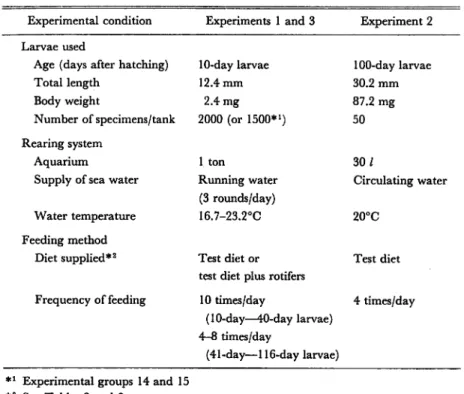
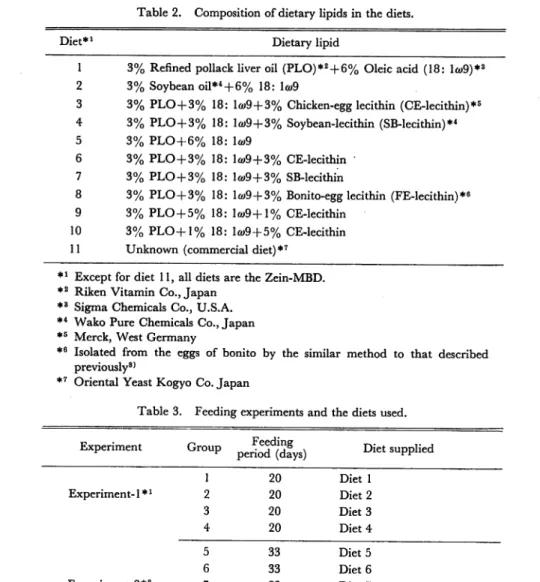
Eggs of the Ayu were hatched at the Oyano Branch, Fisheries Experimental Station of Kumamoto Prefecture. Feeding trials (experiments 1, 2, and 3) were carried out under the conditions listed in Table 1. Ten test diets (Zein-MBD) contained all chemically defined ingredients and 9% level of various lipids (Table 2). The basal diet was the essentially same as reported previously3) and contained the following ingredients (g/100 g): casein 52, dextrin 8, amino acids 10, minerals 8, vitamins 6, cel lulose 7, and lipids 9. To the basal diet, zien (5%) was added, mixed well, and heated at 100°C. The diets were dried in an oven and then powdered to give the Zein-MBD (125-250 /mi diameters).
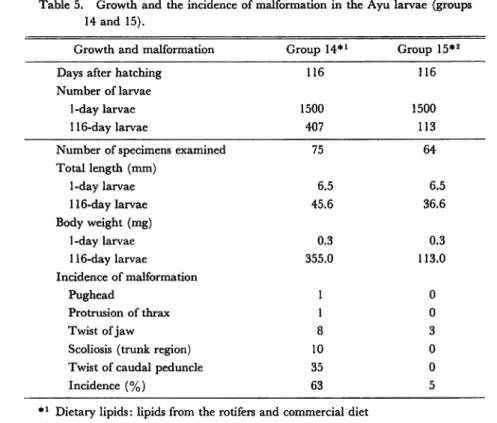
Fifteen groups of the larval Ayu were fed the diets as shown in Table 3 and the dietary values were evaluated in terms of total length, body weight gain, survaival rate, and index of dietary value. Regarding groups 14 and 15, the incidence of malformation was checked 116 days after hatching.
Fatty acid composition (%) of lipids was determined by gas-liquid chromatography (GLC) on 10% DEGS4>.
Table 1. Rearing and feeding methods of the Ayu larvae.
Experimental condition Experiments 1 and 3 Experiment 2 Larvae used
Age (days after hatching) 10-day larvae 100-day larvae
Total length 12.4 mm 30.2 mm
Body weight 2.4 mg 87.2 mg
Number of specimens/tank 2000 (or 1500*1) 50 Rearing system
Aquarium 1 ton 30/
Supply of sea water Running water
(3 rounds/day)
Circulating water
Water temperature 16.7-23.2°C 20°C
Feeding method
Diet supplied*2 Test diet or
test diet plus rotifers
Test diet
Frequency of feeding 10 times/day
(10-day—40-day larvae)
4-8 times/day
(41-day—116-day larvae)
4 times/day
** Experimental groups 14 and *2 See Tables 2 and 3
Diet*1 Dietary lipid
1 3% Refined pollack liver oil (PLO)*2+6% Oleic acid (18: I<w9)*3 2 3% Soybean oil*4+6% 18: 1<m9
3 3% PLO+3% 18: lo>9+3% Chicken-egg lecithin (CE-lecithin)*5 4 3% PLO+3% 18: 1<w9+3% Soybean-lecithin (SB-lecithin)*4
5 3% PLO+6% 18: lo>9
6 3% PLO+3% 18: lo>9+3% CE-lecithin ' 7 3% PLO+3% 18: 1<w9+3% SB-lecithin
8 3% PLO+3% 18: 1g>9+3% Bonito-egg lecithin (FE-lecithin)*6 9 3% PLO + 5% 18: lei9+l% CE-lecithin
10 3% PLO+1% 18: lft>9+5% CE-lecithin 11 Unknown (commercial diet)*7
#1 Except for diet 11, all diets are the Zein-MBD. *2 Riken Vitamin Co., Japan
*3 Sigma Chemicals Co., U.S.A. *4 Wako Pure Chemicals Co., Japan *5 Merck, West Germany
*6 Isolated from the eggs of bonito by the similar method to that described previously8}
*7 Oriental Yeast Kogyo Co. Japan
Table 3. Feeding experiments and the diets used.
Experiment Group period (days)Feeding Diet supplied
1 20 Diet 1 Experiment-1*1 2 20 Diet 2 3 20 Diet 3 4 20 Diet 4 5 33 Diet 5 6 33 Diet 6 Experiment-2*2 7 33 Diet 7 8 33 Diet 8 9 33 Diet 9 10 33 Diet 10 11 50 Commercial diet+Rotifers 12 50 Diet 1+Rotifers
Experiment-3*1 13 50 Diet 3+Rotifers
14 106 Commercial diet+Rotifers
15 106 Diet 3 +Rotifers
After hatching, the Ayu larvae were maintained on the rotifers cultured with a marine Chlorella for 10 days. Subsequently, the larvae were fed the parti culate diet (1-3 g/tank/day) and a combination of particulate diet and rotifer (500-1500 individuals/larva/day) in experiments 1 and 3, respectively. After hatching, the Ayu larvae weremaintained on the rotifers for 100 days and then the particulate diet (feeding level; 10% of body weight per day).
304 Mem. Fac. Fish., Kagoshima Univ. Vol. 30 (1981)
Results
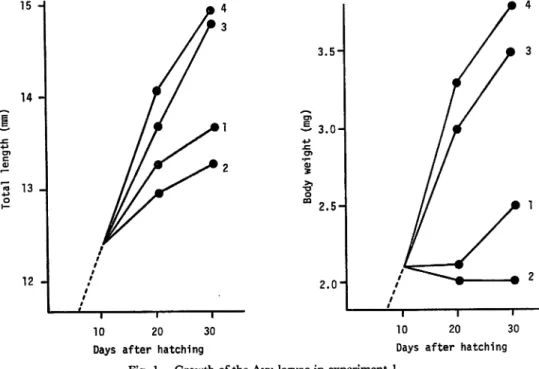
In experiment 1, the feeding trials were carried out by using the 10-day larvae.
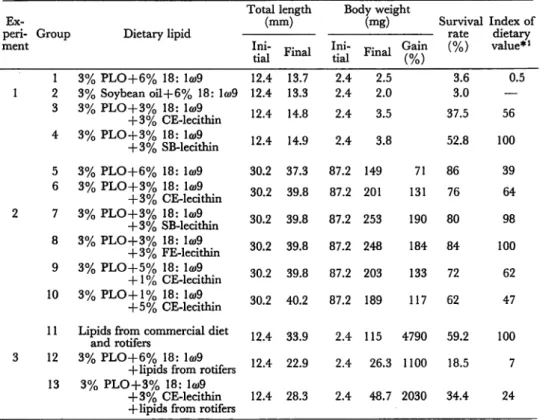
The results are shown in Table 4 and Fig. 1. When the 10-day larvae were main tained on the artificial diets (groups 1, 2, 3, and 4), the high values on the total length,
body weight, survival rate, and index of dietary value were obtained on the diets
containing 3% levels of SB-lecithin (group 4) and chicken-egg lecithin (CE-lecithin)
(group 3) besides 3% refined pollack liver oil (PLO) and 3% oleic acid (18: l<y9).
Especially, the survival rate of larvae were markedly improved by the supplement of
SB-lecithin or CE-lecithin. SB-lecithin was shown to be more effective in the im
provement of survival rate than CE-lecithin.
Presumably, the superior growth and
survival rate on groups 3 and 4 were attained by some effects of lecithin itself.
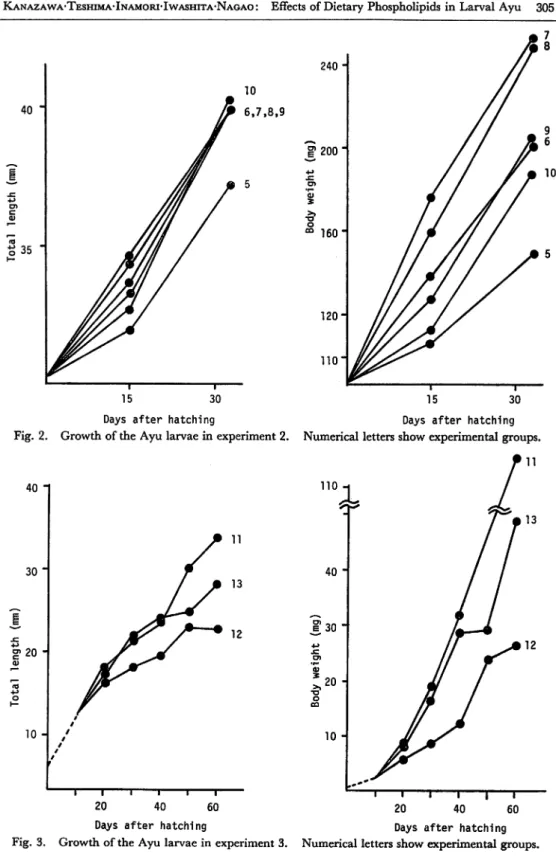
This
assumption was alsosupported by the results on groups 11, 12, and 13in experiment 3.
When the 10-day larvae were maintained on both the artificial diets and rotifers, the
larvae receiving 3% CE-lecithin (group 13) gave the higher values on the total length,
body weight gain, survival rate, and index of dietary value than that receiving the
diet supplemented no phospholipid (group 12) (Table 4 and Fig. 3).
In experiment 2, the feeding trials were carried out by using the 100-day larvae.
The results are given in Table 4 and Fig. 2. The weight gain of larvae were notably
15 H 14 -5 13 -12 3.5-£> 3.0- 2.5-2.0" —I 1 1 10 20 30
Days after hatching
Fig. 1. Growth of the Ayu larvae in experiment 1. Numerical letters show experimental groups.
t 1 r "
10 20 30
40
35
Days after hatching
15 30
Days after hatching
Fig. 2. Growth of the Ayu larvae in experiment 2. Numerical letters show experimental groups.
40 30 I s z 4-> £20 1 4-> O \— 10 T 1 I T— 20 40 —T-60
Days after hatching
Fig. 3. Growth of the Ayu larvae in experiment!
n o h 40 IT 30 20 10 -20 T T" 40 T" 60
Days after hatching
306 Mem. Fac. Fish., Kagoshima Univ. Vol. 30 (1981)
increased by the supplement of 3% levels of SB-lecithin (group 7) and FE-lecithin (group 8) to the diet containing 6% PLO-18: l<y9 (1: 1, w/w). The supplement of CE-lecithin also improved the weight gain, but the growth-promoting effect of it was inferior to those of SB-lecithin and FE-lecithin.
Table 5 shows the incidence of malformation, together with the growth and survival rate, 116 days after hatching in groups 14 and 15. The larval Ayu receiving both the rotifers and commercial diet (group 14) showed a superior growth and survival rate to those receiving both the rotifers and diet 3 containing 3% CE-lecithin and 6% PLO-18: lo>9 (group 15). But, the incidence (%) of malformation was clearly lower in group 15 than in group 14. Especially, the incidence of scoliosis and twist of caudal region was low in the Ayu larvae fed the diet containing 3% CE-lecithin and 6% PLO-18: lo)9 besides the rotifers. These results suggest that the lack of pho spholipids, especially lecithin, in the diet is related to the incidence of scoliosis and twist ofjaw in the larval Ayu.
Table 4. Effects of dietary lipids on growth and survival rate of the Ayu larvae.
Ex-Total length (mm) Body weight (mg) Survival Index of _ „ „ •
Group Dietary lipid rate
(%) dietary value*1 ment Ini tial Final Ini tial Final Gain (%) 1 3% PLO+6% 18: la>9 12.4 13.7 2.4 2.5 3.6 0.5
1 2 3% Soybean oil+6% 18: la>9 12.4 13.3 2.4 2.0 3.0 —
3 3% PLO+3% 18: 1<«9 + 3% CE-lecithin 12.4 14.8 2.4 3.5 37.5 56 4 3% PLO+3% 18: lo>9 + 3% SB-lecithin 12.4 14.9 2.4 3.8 52.8 100 5 3% PLO+6% 18: \w9 30.2 37.3 87.2 149 71 86 39 6 3% PLO+3% 18: lo9 +3% CE-lecithin 30.2 39.8 87.2 201 131 76 64 2 7 3% PLO+3% 18: lo>9 +3% SB-lecithin 30.2 39.8 87.2 253 190 80 98 8 3% PLO+3% 18: la>9 +3% FE-lecithin 30.2 39.8 87.2 248 184 84 100 9 3% PLO+5% 18: la>9 + 1% CE-lecithin 30.2 39.8 87.2 203 133 72 62 10 3% PLO+1% 18: lo9 +5% CE-lecithin 30.2 40.2 87.2 189 117 62 47
11 Lipids from commercial diet
and rotifers 12.4 33.9 2.4 115 4790 59.2 100
3 12 3% PLO+6% 18: le»9
+lipids from rotifers 12.4 22.9 2.4 26.3 1100 18.5 7
13 3% PLO+3% 18: lo>9 +3% CE-lecithin +lipids from rotifers
12.4 28.3 2.4 48.7 2030 34.4 24
** Survival and growth indices are the relative values when the maximum values of survival rate
and weight gain are expressed as 100, respectively. Index ofdietary value is the relative value when the product of survival index by growth index were expressed as the relative value to
14 and 15).
Growth and malformation Group 14*1 Group 15*2
Days after hatching 116 116
Number of larvae
1-day larvae 1500 1500
116-day larvae 407 113
Number of specimens examined 75 64
Total length (mm) 1-day larvae 6.5 6.5 116-day larvae 45.6 36.6 Body weight (mg) 1-day larvae 0.3 0.3 116-day larvae 355.0 113.0 Incidence of malformation Pughead 1 0 Protrusion of thrax 1 0 Twist of jaw 8 3
Scoliosis (trunk region) 10 0
Twist of caudal peduncle 35 0
Incidence (%) 63 5
** Dietary lipids: lipids from the rotifers and commercial diet
*2 Dietary lipids: 3% PLO+3% 18: la>9+3% CE-lecithin and lipids from the rotifers
Table 6. Composition (%) of main fatty acids of lipids used. Fatty acid Soybean
oil PLO*1 CE-lecithin*2 SB-lecithin*3
FE-lecithin- JSHSSdlct
14:0 0.2 2.3 0.2 0.2 3.5 3.1 16:0 14.8 6.7 36.4 20.0 9.7 21.4 16: 1 _*5 1.3 1.3 0.3 2.8 5.0 18:0 3.2 2.4 13.1 3.9 10.5 4.8 18: l<y9 22.9 12.8 26.0 11.0 9.5 25.7 18: 2g>6 51.4 0.9 13.9 55.7 1.2 11.9 18: 3o>3 6.6 0.4 — 5.4 0.5 0.9 20: 1g>9 — 18.3 — 0.4 0.4 8.4 20: 4<w6 0.4 1.1 3.9 — 3.4 1.0 20: 5a>3 — 38.0 0.7 0.7 6.7 10.0 22:4o>6 — 2.2 0.3 — 1.7 0.4 22:5a>3 — 3.3 0.2 0.2 1.8 1.0 22:6o>3 — 7.4 1.8 — 39.8 5.3 ^otf-HUFA — 48.7
** Refined pollack liver oil
*4 Bonito-egg lecithin 2.7 0.9 *2 Chicken-egg lecithin *5 Less than 0.1% 48.3 16.3 *8 Soybean-lecithin
Mem. Fac. Fish., Kagoshima Univ. Vol. 30 (1981)
Table 7. Fatty acid composition (%) of polar lipids from the whole bodies of Ayu larvae after the feeding trials in experiment 2.
Experimental group JC ally dUlU ~ 5 6 7 8 14:0 1.4 1.0 1.4 1.3 16:0 24.2 18.5 16.2 15.1 16: 1 4.2 2.1 5.1 5.3 18:0 6.2 7.5 7.7 7.6 18: lo>9 26.6 27.0 24.8 22.5 18: 2<o6 3.5 5.8 8.1 4.9 18: 3a>3 0.1 0.2 0.6 0.1 20: la>9 1.2 1.2 1.1 1.4 20: 4a6 2.5 5.0 2.6 3.2 20: 5a>3 5.2 5.8 5.2 6.4 22:4cw6 0.3 0.4 0.3 0.4 22:5a>3 3.8 3.9 3.4 3.8 22:6o>3 20.3 20.0 22.5 25.4
Table 6 and 7 show the fatty acid compositions of dietary lipids and body lipids isolated from the Ayu larvae after feeding trials.
Discussion
Several workers5-7) have shown that the larval Ayu grew well when they were fed
Artemia salina containing high levels of <w3-highly unsaturated fatty acids (HUFA),
suggesting the necessity of <w3-HUFA for growth. Quite recently, we have demon
strated by using the purified diets that the Ayu larvae (90 days after hatching) required <y3-fatty acids such as linolenic acid (18: 3a>3) and eicosapentaenoic acid (20: 5o>3) but not linoleic acid (18: 2<y6) as essential fatty acids (EFA), indicating
that the EFA-activity of 18: 3<o3 almost equal to that of 20: 5o>33>.
The results of the present study show that the addition of SB-lecithin improved the growth and survival rate of the 10-day larvae, and also that both SB-lecithin and FE-lecithin were effective in the improvement of weight gain of the 100-day larvae.
Especially, the inclusion of lecithin in the artificial diets is likely to be essential for the survival of early stages of larval Ayu. Furthermore, the present study suggests
that the lack of phospholipids, lecithin, is one of possible causes for the incidence of
malformation such as scoliosis and twist of jaw.
We assume that the effectiveness of SB-lecithin and probably FE-lecithin is related to some effect of lecithin itself rather than to the increase in amounts of EFA, because SB-lecithin contained only low levels of o>3-fatty acids such as 18: 3<w3, 20: 5<y3, and docosahexaenoic acid (22: 6a>3) as shown in Table 6. As shown in Table 7, polar
contain high levels of <o3-fatty acids such as 20: 5g>3 and 22: 6a>3. This may imply that every diet contained satisfying amounts of EFA for the larvae.
Regarding the crustaceans, we have shown the growth-promoting effect of lecithin and cephalin from the short-necked clam, Tapes phillipinarum, for juveniles of the prawn, P. japonicus*). Also, Conklin et al*\ and D'Abramo et a/.10> have demonstrated the necessity of phophatidyl choline for the survival of juvenile lobster, Homarus
americanus, indicating that phosphatidyl choline molecules containing polyunsaturated
fatty acids were the most effective. In the crustaceans, the physiological role of
lecithin has been assumed to be associated with hemolymph lipoproteins and the
transport of lipids10*n). In the case of the larval Ayu, however, the role of lecithin
is obscure.
References
1) Fujita, S.: in "Feeding and Growth of Larval Fish" (ed. by Japan. Soc. Sci. Fish.), Suisangaku
Series No. 8, Koseisha-Koseikaku, Tokyo, 1975, pp. 100-113.
2) Kanazawa, A., S. Teshima, H. Sasada and S. Abdel Rahman: Bull. Japan. Soc. Sci. Fish.,
in press.
3) Kanazawa, A., S. Teshima and M. Sakamoto: Bull. Japan. Soc. Sci. Fish., in press.
4) Teshima, S., A. Kanazawa and H. Okamoto: Mem. Fac. Fish. Kagoshima Univ., 25, 41-46
(1976).
5) Oka, A.: The Aquiculture, 27, 202-208 (1980).
6) Kitajima, C, M. Yoshida and T. Watanabe: Bull. Japan. Soc. Sci. Fish., 46, 47-50 (1980). 7) Oka, A., N. Suzuki and T. Watanabe: Bull. Japan. Soc. Sci. Fish., 46, 1413-1418 (1980). 8) Kanazawa, A., S. Teshima, S. Tokiwa, M. Endo and F. A. Abdel Razek: Bull. Japan. Soc.
Sci. Fish., 45, 961-965 (1979).
9) Conklin, D. E., L. R. D'Abramo, C. E. Bordner and N. A. Baum: Aquaculture, 21, 243-250
(1980).
10) D'Abramo, L. R., C. E. Bordner, D. E. Conklin and N. A. Baum: /. Nutrition, 111, 425-431
(1981).