Doripenem(DRPM)は,塩野義製薬株式会社研究所で合成 された新しい注射用カルバペネム系抗菌薬である。本薬は,好 気性および嫌気性のグラム陽性,陰性菌(緑膿菌を含む)に対 して広範囲の抗菌スペクトルを有している1) 。さらに,本薬は 他のカルバペネム系抗菌薬と同様に Stenotrophomonas mal-tophilia等の産生するメタロ型β ―ラクタマーゼ以外の β ―ラ クタマーゼに安定である2) 。また,各種動物の腎デヒドロペプ チ ダ ー ゼ―I(DHP-I)に 対 し て も,imipenem, meropenem
【臨床試験】
Doripenem
の前期第 II 相臨床試験
嶋田甚五郎
1)・山口
惠三
2)・柴
孝也
3)・斎藤
厚
4)・守殿
貞夫
5)・稲松
孝思
6) 1)聖マリアンナ医科大学難病治療研究センター* 2)東邦大学医学部微生物学 3)東京慈恵会医科大学内科学(感染制御部) 4)琉球大学医学部第 1 内科 5)神戸大学医学部泌尿器科 6)東京都老人医療センター感染症科 (平成 17 年 1 月 11 日受付・平成 17 年 3 月 17 日受理)新規注射用カルバペネム系抗菌薬 doripenem(DRPM)の内科および泌尿器科領域における感染症患者
を対象とした前期第 II 相試験を,全国 41 医療機関による多施設共同研究として実施し,本薬の有効性,
安全性の検討を行うとともに,本薬の適応疾患と用法・用量の瀬踏み的評価を行った。
総症例数 106 例のうち,有効性評価は 75 例(内科:41 例,泌尿器科:34 例)
,安全性評価は 106 例
(症状)および 105 例(臨床検査値)
,有用性評価は 75 例を解析対象とした。なお,評価の参考として喀
痰中 DRPM 濃度(5 例)を測定した。
DRPM
の投与量は,125 mg×2 回!日,250 mg×2 回!日,250 mg×3 回!日あるいは 500 mg×2 回!日の
点滴静注(30∼60 分)とした。得られた成績は以下のとおりであった。
1.有効性の結果(評価対象 75 例)
!臨床効果(著効および有効):内科 95.1%(39!41 例),泌尿器科 97.1%(33!34 例),全体 96.0%(72!
75
例)
"細菌学的効果(消失および菌交代):内科 86.4%(19!22 例),泌尿器科 97.1%(33!34 例),全体 92.9%
(52
!56 例)
2.安全性の結果
!副作用(症状:評価対象 106 例)は 3 例に 3 件(舌のしびれ感,頭痛,発疹)発現したが重篤なも
のはなく,いずれも投与終了後に消失した。
"副作用(臨床検査値:評価対象 105 例)は 25 例(45 件)に発現し,その主なものは GPT 上昇 10.6%
(11
!104 例),GOT 上昇 5.8%(6!104 例),好酸球増多 7.4%(7!95 例)などであった。変動の程度
はいずれも軽度であり,投与終了後に正常化または前値に復した。
#概括安全度(評価対象 105 例)の安全率は 98.1%(103!105 例)であった。
3.有用性の結果(評価対象 75 例)
・有用率:内科 92.9%(39
!42 例),泌尿器科 93.9%(31!33 例),全体 93.3%(70!75 例)
慢性気道感染症と複雑性尿路感染症を対象に行った前期第 II 相臨床試験において,DRPM の有効性に
ついては非臨床の抗菌力から期待されたとおりの成績が得られ,安全性についても臨床上問題となるよ
うな副作用は認められず,本薬は感染症の治療において有用な薬剤であることが示唆された。
Key words
: carbapenem,doripenem,respiratory tract infection,urinary tract infection,early phase
II clinical study
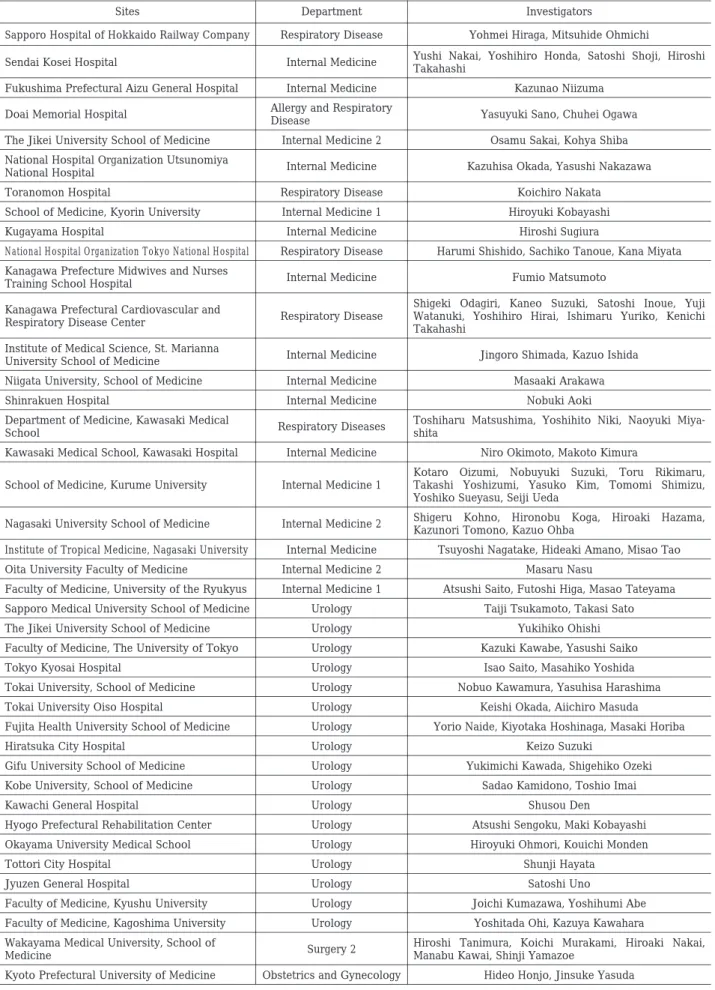
Table 1. Clinical sites and investigators
Investigators Department
Sites
Yohmei Hiraga, Mitsuhide Ohmichi Respiratory Disease
Sapporo Hospital of Hokkaido Railway Company
Yushi Nakai, Yoshihiro Honda, Satoshi Shoji, Hiroshi Takahashi
Internal Medicine Sendai Kosei Hospital
Kazunao Niizuma Internal Medicine
Fukushima Prefectural Aizu General Hospital
Yasuyuki Sano, Chuhei Ogawa Allergy and Respiratory
Disease Doai Memorial Hospital
Osamu Sakai, Kohya Shiba Internal Medicine 2
The Jikei University School of Medicine
Kazuhisa Okada, Yasushi Nakazawa Internal Medicine
National Hospital Organization Utsunomiya National Hospital Koichiro Nakata Respiratory Disease Toranomon Hospital Hiroyuki Kobayashi Internal Medicine 1
School of Medicine, Kyorin University
Hiroshi Sugiura Internal Medicine
Kugayama Hospital
Harumi Shishido, Sachiko Tanoue, Kana Miyata Respiratory Disease
National Hospital Organization Tokyo National Hospital
Fumio Matsumoto Internal Medicine
Kanagawa Prefecture Midwives and Nurses Training School Hospital
Shigeki Odagiri, Kaneo Suzuki, Satoshi Inoue, Yuji Watanuki, Yoshihiro Hirai, Ishimaru Yuriko, Kenichi Takahashi
Respiratory Disease Kanagawa Prefectural Cardiovascular and
Respiratory Disease Center
Jingoro Shimada, Kazuo Ishida Internal Medicine
Institute of Medical Science, St. Marianna University School of Medicine
Masaaki Arakawa Internal Medicine
Niigata University, School of Medicine
Nobuki Aoki Internal Medicine
Shinrakuen Hospital
Toshiharu Matsushima, Yoshihito Niki, Naoyuki Miya-shita
Respiratory Diseases Department of Medicine, Kawasaki Medical
School
Niro Okimoto, Makoto Kimura Internal Medicine
Kawasaki Medical School, Kawasaki Hospital
Kotaro Oizumi, Nobuyuki Suzuki, Toru Rikimaru, Takashi Yoshizumi, Yasuko Kim, Tomomi Shimizu, Yoshiko Sueyasu, Seiji Ueda
Internal Medicine 1 School of Medicine, Kurume University
Shigeru Kohno, Hironobu Koga, Hiroaki Hazama, Kazunori Tomono, Kazuo Ohba
Internal Medicine 2 Nagasaki University School of Medicine
Tsuyoshi Nagatake, Hideaki Amano, Misao Tao Internal Medicine
Institute of Tropical Medicine, Nagasaki University
Masaru Nasu Internal Medicine 2
Oita University Faculty of Medicine
Atsushi Saito, Futoshi Higa, Masao Tateyama Internal Medicine 1
Faculty of Medicine, University of the Ryukyus
Taiji Tsukamoto, Takasi Sato Urology
Sapporo Medical University School of Medicine
Yukihiko Ohishi Urology
The Jikei University School of Medicine
Kazuki Kawabe, Yasushi Saiko Urology
Faculty of Medicine, The University of Tokyo
Isao Saito, Masahiko Yoshida Urology
Tokyo Kyosai Hospital
Nobuo Kawamura, Yasuhisa Harashima Urology
Tokai University, School of Medicine
Keishi Okada, Aiichiro Masuda Urology
Tokai University Oiso Hospital
Yorio Naide, Kiyotaka Hoshinaga, Masaki Horiba Urology
Fujita Health University School of Medicine
Keizo Suzuki Urology
Hiratsuka City Hospital
Yukimichi Kawada, Shigehiko Ozeki Urology
Gifu University School of Medicine
Sadao Kamidono, Toshio Imai Urology
Kobe University, School of Medicine
Shusou Den Urology
Kawachi General Hospital
Atsushi Sengoku, Maki Kobayashi Urology
Hyogo Prefectural Rehabilitation Center
Hiroyuki Ohmori, Kouichi Monden Urology
Okayama University Medical School
Shunji Hayata Urology
Tottori City Hospital
Satoshi Uno Urology
Jyuzen General Hospital
Joichi Kumazawa, Yoshihumi Abe Urology
Faculty of Medicine, Kyushu University
Yoshitada Ohi, Kazuya Kawahara Urology
Faculty of Medicine, Kagoshima University
Hiroshi Tanimura, Koichi Murakami, Hiroaki Nakai, Manabu Kawai, Shinji Yamazoe
Surgery 2 Wakayama Medical University, School of
Medicine
Hideo Honjo, Jinsuke Yasuda Obstetrics and Gynecology
Table 2. Exclusion criteria Subjects should not meet any of the following exclusion criteria:
1. Subjects who are suspected to indicate a bad prognosis due to severe symptoms 2. Subjects with severe cardiac disturbance, hepatic dysfunction, or renal dysfunction
3. Subjects where the assessment of efficacy and safety of antibiotics is difficult due to severe or progressive underlying diseases and/or complications
4. Subjects with a history of epilepsy or with central nervous system disorders
5. Subjects whose intracutaneous reaction to DRPM is “Positive” or “Impossible to determine whether it is positive or negative” 6. Subjects with a history of hypersensitivity to beta-lactam antibiotics(carbapenems, cephems, penicillins, etc.)
7. Subjects who are pregnant women, lactating women, or women suspected of being pregnant
8. Subjects where, prior to administration of DRPM, causative organisms are obviously resistant to DRPM(S. maltophilia, Mycoplasma, fungi, etc.)
9. Subjects who need diuretics(bumetanide, furosemide, etc.)
10. Subjects who have taken other investigational drugs just prior to administration of DRPM
11. Subjects who are getting better due to the treatment with other antibiotics prior to administration of DRPM 12. Aged subjects who have or may have disorders that might affect the assessment of efficacy of DRPM 13. Subjects who, in the opinion of the investigator, are otherwise unsuited for participation in this study
より安定3) であり,各種動物の体内動態において良好な血中濃 度および各組織への移行が認められた。 健常成人を対象とした本薬の第 I 相試験4) の単回投与試験 (30 分間点滴)の結果,1,000 mg までの忍容性が確認された。 また,125,250,500 および 1,000 mg 単回投与時の最高血中 濃度はそれぞれ 8.09,18.1,33.1 および 63.0µ g!mL と用量 相関性が認められた。さらに,反復投与試験(500 mg×2!日, 1回 30 分間点滴,6 日間)において蓄積性は認められなかっ た。単回投与試験および反復投与試験のいずれにおいても,血 中半減期は約 1 時間,尿中排泄率は投与後 24 時間で約 75% であった。 以上の成績をふまえ,今回,DRPM 感性のグラム陽性菌およ びグラム陰性菌による感染症患者(慢性気道感染症および複 雑性尿路感染症)を対象に本薬の有効性,安全性および有用性 を探索的に検討した。 本治験は「医薬品の臨床試験の実施に関する基準(薬発第 874号平成元年 10 月 2 日,旧 GCP)」を遵守するとともに,治 験実施計画書等は,各医療機関の治験審査委員会の承認を得 たうえで実施した。
I
. 対 象 と 方 法
1.対象
1995
年 4 月から 1996 年 3 月までに参加 41 医療機関
(Table 1)
を受診した患者のうち,内科では慢性気道感染
症(慢性気管支炎の急性増悪,気管支拡張症の感染時,
慢性呼吸器疾患の二次感染,ただし,びまん性汎細気管
支炎を除く)および泌尿器科領域では複雑性尿路感染症
(カテーテル留置例,
前立腺手術後 6 カ月未満の症例は除
く)の患者で,本薬および試験の内容を説明し,同意を
得た 106 例を対象とした。
患者条件は,20 歳以上 70 歳未満の入院患者で,感染症
状として症状・所見が明確な中等症患者[尿路感染症に
おいては UTI 薬効評価基準
(第 3 版)
5)適合患者]
とした。
ただし,除外基準(Table 2)に該当する患者は対象から
除外した。
2.患者の同意
治験担当医師は本治験の実施に先立ち,下記事項につ
いて説明し,患者の自由意思による治験参加の同意を本
人から原則として文書で得ることとした。
3.治験薬
被験薬として DRPM 250 mg(力価)
!バイアルおよび
DRPM 500 mg
(力価)
!バイアルを,皮内反応検査薬とし
て DRPM 300
µ
g(力価)
!アンプルを用いた。
4.投与方法および投与期間
本薬を日局生理食塩液で希釈して 100 mL 以上とし,
それを 1 回量とした。
治験薬の投与開始前に皮内反応検査を必ず実施し,陰
性であることを確認したうえで投与を開始した。
投与方法は,基礎的検討および第 I 相試験の成績より
本薬の常用量と推定された 250 mg×2
!日と,投与回数を
増やした 250 mg×3
!日を中心とし,効果が得られると予
測される最少量(125 mg×2
!日)および第 I 相試験で忍容
性が確認された最大安全量(500 mg×2
!日)についても
検討した。点滴時間は 30∼60 分とした。投与期間は,本
薬の薬効の判定に最低 3 日間(72 時間)は必要と判断し
たこと,また,第 I 相試験の反復投与試験において蓄積性
がないことが確認されたこと,および対象が慢性疾患で
あることを考慮し,14 日以内の連続投与とした。ただし,
担当医師が治療目的を達成したと判断した場合は,投与
期間内であっても投与を終了した。
5.併用薬および処置
他の抗菌薬
(erythromycin の少量長期投与を含む)
,副
腎皮質合成ステロイド薬(少量長期投与中のものも含
む)
,ヒト免疫グロブリン製剤,コロニー刺激因子製剤な
らびに他の治験薬は併用しないこととした。また,非ス
テロイド性消炎鎮痛薬,消炎酵素薬,解熱薬および吸入
用 beclometasone dipropionate は,有効性の評価に影響
を及ぼす可能性が考えられるため,本薬投与開始後に新
たに併用することを避けることとした。しかし,治験開
始前からの使用または頓服使用であれば影響はないと判
断し,併用を認めることとした。これらの薬剤を使用し
た場合には,薬剤名,投与量および投与期間を症例記録
に記載することとした。去痰薬,鎮咳薬,気管支拡張薬,
消炎効果を有さない喀痰融解薬などは併用を認めること
とし,その他基礎疾患ならびに合併症に対する治療薬を
併用した場合,または何らかの処置をした場合には,そ
の内容を症例記録に記載することとした。
6.検査,観察項目および実施時期
1) 患者の背景
治験開始前に,年齢,性別,体重,妊娠の有無,感染
症診断名,感染症重症度,基礎疾患・合併症とその重症
度,アレルギー既往歴,現病歴,前治療薬,治験薬投与
直前の化学療法,皮内反応試験の結果について調査し,
症例記録に記載した。
2) 自覚症状・他覚所見および検査
! 内科
体温ならびに咳嗽の程度,喀痰量,喀痰性状,呼吸困
難の程度,胸痛の有無,胸部ラ音の程度,脱水症状の有
無,チアノーゼの有無等を毎日観察し症例記録に記載し
た。また,白血球数,白血球分画,赤血球沈降速度およ
び CRP を投与開始前と投与終了後に測定し,症例記録に
実測値を記載した。さらに,投与開始前と投与終了後に
胸部 X 線撮影を行い, 症例記録にスケッチを記載した。
" 泌尿器科
最高体温,排尿痛,頻尿および残尿感について,また,
尿沈渣中(原則として男性:中間尿,女性:カテーテル
尿)の白血球および細菌(鏡検)について,少なくとも
投与開始日,3 日後,5 日後および投与終了時に観察・検
査した。
3) 細菌学的検査
! 内科
投与開始前および投与終了時に細菌の分離・同定,菌
数測定および感受性測定を実施し,投与中
(投与開始 1,
3,5 および 7 日後)も可能な限り実施した。塗抹標本に
ついては,
集中細菌検査機関
(株式会社三菱化学ビーシー
エル治験事業部および東邦大学医学部微生物学教室)に
おいて,鏡検所見を確認した。
" 泌尿器科
投与開始日および投与終了日に尿中細菌の分離同定と
菌数測定を実施し,可能な限り 1 日後
(投与開始 24 時間
後)および UTI 薬効評価基準に定める検査実施日にも実
施することとした。各医療機関において dip slide 法(ウ
リカルト)により総菌数を測定した。なお,尿検体を集
中細菌検査機関(株式会社三菱化学ビーシーエル治験事
業部)に送付し,細菌の分離同定(再同定)および感受
性測定を化学療法学会標準法(10
6CFU
!mL)により集中
的に実施した。
4) 臨床検査
投与開始前および終了時に
(可能な場合には投与中も)
下記の検査を実施した(
[
]項目は可能な限り実施し
た)
。
!血液検査:赤血球数,ヘモグロビン,ヘマトクリッ
ト,白 血 球 数,白 血 球 分 画,血 小 板 数,
[動 脈 血
(PaO
2,PaCO
2,pH)
,プロトロンビン時間]
"肝機能 検 査:GOT,GPT,ALP,総 ビ リ ル ビ ン,
γ
-glutamyl transpeptidase(
γ
-GTP),[lactate
dehy-drogenase
(LDH),leucine aminopeptidase(LAP)]
#腎機能検査:BUN,Cr,[Ccr,
β
2―マイクログロブ
リン]
$尿所見:沈渣,蛋白,糖,ウロビリノゲン
%その他:[血清電解質(Na,K,Cl),赤血球沈降速
度,CRP,寒冷凝集反応,マイコプラズマ
(CF 抗体,
IHA
抗体)
]
5) 有害事象および副作用
有害事象(症状・臨床検査値異常変動)が発現した場
合には,原則として有害事象が消失あるいは正常値また
は投与前値に復するまで可能な限り追跡調査し,有害事
象の種類,程度(日本化学療法学会「抗菌薬による治験
症例における副作用,臨床検査値異常の判定基準」
6)に準
拠)
,発現日,処置,転帰および転帰確認日を症例記録に
記載した。なお,有害事象と本薬との因果関係について,
患者の状態,基礎疾患・合併症,既往歴,併用薬剤,投
与との時間的関係などを勘案して
「明らかに関係あり」
,
「多分関係あり」
,
「関係あるかもしれない」
,
「関係ないら
しい」
,
「関係なし」に判定し,その根拠を症例記録に記
載した。なお,
「明らかに関係あり」
,
「多分関係あり」
,
「関係あるかもしれない」
と判定されたものを副作用とし
た。
6) 血中および喀痰中濃度
本薬 250 mg を 60 分間で点滴静注した後,1
(点滴終了
時)
,2,3,4,5,6 および 8 時間目に血液と喀痰を採取
した。測定は,Bioassay 法により塩野義製薬株式会社研
究所で実施した。
7.臨床評価
1) 臨床効果
自覚症状,
他覚所見および検査所見の推移をもとに
「著
効」
,
「有効」
,
「やや有効」
,
「無効」と「判定不能」に判
定した。また,泌尿器科領域の尿路感染症については,
UTI
薬効評価基準(第 3 版)
5)に準拠した判定も併せて実
施した。
2) 細菌学的効果
起炎菌の消長をもとに「消失(陰性化)」,「減少(部分
消失)
」
,
「菌交代」
,
「不変」と「不明」に判定した。
3) 概括安全度
副作用(症状・臨床検査値)の有無を勘案して「安全
である[副作用(症状・臨床検査値)が認められなかっ
た場合]」
,
「ほぼ安全である
[副作用
(症状・臨床検査値)
の程度が軽度の場合]
」
,
「やや問題がある
[副作用
(症状・
臨床検査値)の程度が中等度の場合]」,「問題がある[副
作用(症状・臨床検査値)の程度が重度の場合]」と「判
定不能」で判定した。
4) 有用性
臨床効果および概括安全度をもとに
「きわめて有用」
,
「有用」,「やや有用」,「有用でない」と「判定不能」で判
定した。
II
. 試 験 成 績
1.症例
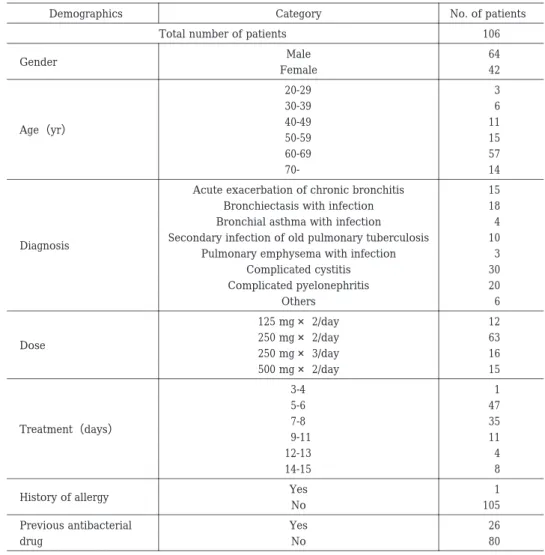
集積症例 106 例(Table 3)の各評価項目における評価
対象例数(Table 4)をみると,有効性の評価対象から除
外されたのは,対象外疾患 6 例,年齢違反 13 例,中等症
患者に該当せず 7 例,除外基準に相当 3 例,基礎疾患重
篤化 1 例,併用禁止薬剤使用 1 例の計 31 例であった。同
様に評価対象から除外されたのは,副作用(臨床検査
値)
・概括安全度で検査時期違反の 1 例,
有用性では有効
性と概括安全度の除外症例を勘案した計 31 例であった。
なお,投与中止症例は 10 例であった。
最終的に,有効性・有用性の評価対象として 75 例,副
作用(症状)の評価対象として 106 例,副作用(臨床検
査値)・概括安全度の評価対象として 105 例が採用され
た。
2.臨床効果
1) 疾患別臨床効果
慢性気道感染症(慢性気管支炎の急性増悪,気管支拡
張症の感染時,慢性呼吸器疾患の二次感染)
41
例および
複雑性尿路感染症
(膀胱炎,腎盂腎炎)
34
例が有効性の評
価対象であった。気管支拡張症の感染時で
「やや有効」
例
が 1 例,
陳旧性肺結核+感染および腎盂腎炎において
「無
効」例がそれぞれ 1 例ずつ認められたが,他の疾患にお
いては全例有効以上であり,全体の有効率は 96.0% で
あった(Table 5)
。
2) 1 日投与量別臨床効果
対象患者の状態に合わせて用法・用量を選択すること
を可能としていたが,最も多く選択された用法・用量は
250 mg×2
!日であり,有効率 93.5%(43!46 例,内科:20!
22
例,泌尿器科:23!24 例)と良好な臨床効果が得られ
た。他の投与量(125 mg×2
!日:内科 5 例,泌尿器科 3
例,250 mg×3
!日:内科 9 例,泌尿器科 5 例,500 mg×
2
!日:内科 5 例,泌尿器科 2 例)の計 29 例においては全
例有効以上であった(Table 6)
。
いずれの投与量,疾患においても良好な臨床効果が得
られたが,それぞれの症例数が均等でなかったため,投
与量と疾患と臨床効果の関係については明らかにできな
かった。
3) UTI 総合臨床効果
泌尿器科領域においては,前述の臨床効果に併せて
UTI
薬効評価基準(第 3 版)
5)に準拠した UTI 総合臨床効
果判定を実施した。有効性評価対象例 34 例のうち,膿尿
の検査日ずれ(投与終了 3 日後),投与日数不足(3 日)に
より 2 例が不採用となった。UTI 総合臨床効果の判定が
できた 32 例における有効率は,93.8%(30
!32 例)と良
好な結果が得られた(Table 7)
。
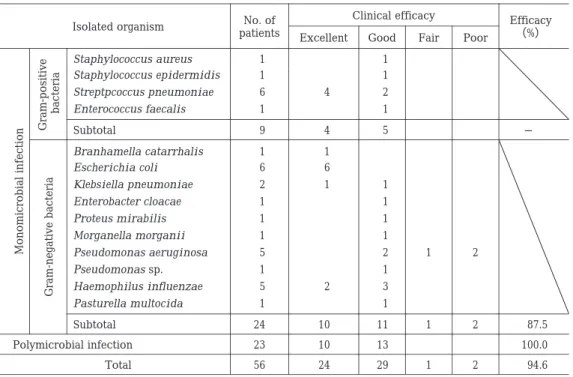
4) 分離菌別臨床効果
グラム陽性菌単数菌感染,グラム陰性菌単数菌感染に
対する有効以上の割合は,それぞれ 9!9 例,21!24 例であ
り,複数菌感染に対しては 23
!23 例であった。「やや有
効」
,
「無 効」と 判 定 さ れ た 3 症 例 は い ず れ も
Pseudo-monas aeruginosa
単数菌感染例であった(Table 8)
。
5) 疾患別細菌学的効果
疾患別(領域別)の細菌学的効果(消失および菌交代)
は,慢性気道感染症で 86.4%(19
!22 例),複雑性尿路感
染症で 97.1%(33
!34
例)と良好な結果が得られた(Ta-ble 9)
。
6) 分離菌別細菌学的効果
グラム陽性菌単数菌感染,グラム陰性菌単数菌感染に
対する消失および菌交代の割合は,それぞれ 9
!9 例,22!
24
例であり,複数菌感染に対しては 21
!23 例であった
(Table 10)。臨床効果が「やや有効」,「無効」であった P.
aeruginosa
単数菌感染 3 例中 1 例において同菌は消失
した。
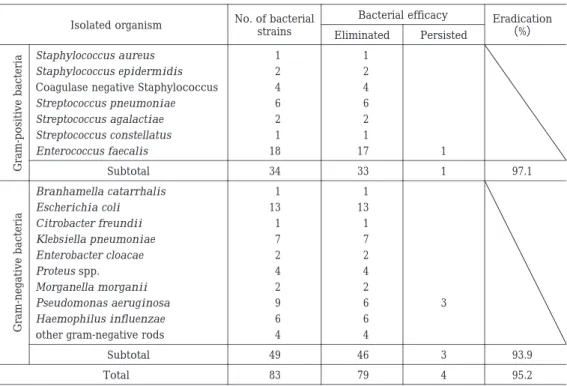
7) 分離菌の消長
グラム陽性菌(34 株)で 97.1%,グラム陰性菌(49
株)で 93.9%,全体(83 株)で 95.2% の消失率が得られ
た。存続した株は,Enterococcus faecalis が 1 株,P.
aeru-ginosa
が 3 株であった(Table 11)
。
各領域において多く分離された菌種における消失の割
合は,慢性気道感染症においては肺炎球菌が 6
!6 株,
Haemophilus influenzae
が 6
!6 株と良好ではあったが,
P. aeruginosa
は 2
!5 株であった。また,複雑性尿路感染
症においては,Escherichia coli で 13!13
株,Staphylo-coccus
spp.
で 7
!7 株,Klebsiella pneumoniae で 6!6 株,
P. aeruginosa
で 4
!4 株と優れた細菌学的効果を示した。
8) 投与後出現菌
細菌学的効果判定の評価対象 56 例中 7 例(発現率:
12.5%)で 9 株が投与後に出現した(Table 12)。なお,こ
のうち 4 株は
「起炎性なし」
と判定されたものであった。
3.安全性
1) 副作用(症状)
集積された 106 例全例を評価対象とした。
「本薬との因
果関係があり」と判定された副作用(症状)は 3 例に認
められ,発現頻度は 2.8% であった。副作用(症状)の内
容は発疹(中等度)
,舌のしびれ感(軽度)および頭痛
(軽度)
であり,いずれも投与開始 3 日以内に発現したが
Table 3. Patients profiles
No. of patients Category
Demographics
106 Total number of patients
64 Male Gender 42 Female 3 20-29 Age(yr) 6 30-39 11 40-49 15 50-59 57 60-69 14 70-15 Acute exacerbation of chronic bronchitis
Diagnosis
18 Bronchiectasis with infection
4 Bronchial asthma with infection
10 Secondary infection of old pulmonary tuberculosis
3 Pulmonary emphysema with infection
30 Complicated cystitis 20 Complicated pyelonephritis 6 Others 12 125 mg× 2/day Dose 250 mg× 2/day 63 16 250 mg× 3/day 15 500 mg× 2/day 1 3-4 Treatment(days) 47 5-6 35 7-8 11 9-11 4 12-13 8 14-15 1 Yes History of allergy 105 No 26 Yes Previous antibacterial 80 No drug
Table 4. Patients assessed for efficacy and safety of DRPM
Number of patients No. of patients Diagnosis Usefulness Safety rate Safety (Laboratory data) Safety (Symptom) Efficacy 42 54 54 54 41 54 Respiratory infection 42 50 50 50 41 50
Chronic respiratory tract infection
14 15 15 15 14 15
Acute exacerbation of chronic bronchitis
16 18 18 18 15 18
Bronchiectasis with infection
12 17 17 17 12 17
Secondary infection of chronic respiratory disease 4 4 4 4 4 4
Bronchial asthma with infection
2 3 3 3 2 3
Pulmonary emphysema with infection
6 10 10 10 6 10
Secondary infection of old pulmonary tubercu-losis 0 4 4 4 0 4
Other respiratory infection
33 51 51 52 34 52
Urinary tract infection
33 49 49 50 34 50
Complicated urinary tract infection
18 30 30 30 18 30 Cystitis 15 19 19 20 16 20 Pyelonephritis 0 2 2 2 0 2
Other urinary tract infection
75 105 105 106 75 106
Total number of patients
31 1 1 0 31 ―
Table 5. Correlation between diagnosis and clinical response Efficacy (%) Clinical evaluation No. of patients Diagnosis Poor Fair Good Excellent 95.1 1 1 22 17 41
Chronic respiratory tract infection
100.0 7
7 14
Acute exacerbation of chronic bronchitis
93.3 1
8 6
15 Bronchiectasis with infection
91.7 1
7 4
12 Secondary infection of chronic respiratory disease
1 3
4 Bronchial asthma with infection
2 2
Pulmonary emphysema with infection
1 4
1 6
Secondary infection of old pulmonary tuberculosis
97.1 1
16 17
34 Complicated urinary tract infection
100.0 7 11 18 Cystitis 93.8 1 9 6 16 Pyelonephritis 96.0 2 1 38 34 75 Total
Efficacy:(Excellent + Good)/No. of patients
Table 7. Overall clinical efficacy of DRPM in complicated UTI at end of treatment
Effect on bacteriuria Unchanged Decreased Cleared Pyuria Bacteriuria 28(87.5 %) 10 3 15 Eliminated 0(0 %) Decreased 3(9.4 %) 1 1 1 Replaced 1(3.1 %) 1 Unchanged 32(No. of patients) 11(34.4%) 5(15.6%) 16(50.0%) Effect on pyuria Overall effectiveness 30/32(93.8%) 15(46.9%) Excellent 15 Moderate 2 Poor
Table 6. Correlation between daily dose and clinical response Daily dose Diagnosis 500 mg× 2 250 mg× 3 250 mg× 2 125 mg× 2 5/5 9/9 20/22 5/5
Chronic respiratory tract infection
1/1 6/6
5/5 2/2
Acute exacerbation of chronic bronchitis
1/1 1/1
11/12 1/1
Bronchiectasis with infection
3/3 2/2
4/5 2/2
Secondary infection of chronic respiratory disease
1/1 1/1
2/2 Bronchial asthma with infection
1/1 1/1
Pulmonary emphysema with infection
3/3 2/3
Secondary infection of old pulmonary tuberculosis
2/2 5/5
23/24 3/3
Complicated urinary tract infection
2/2 3/3 10/10 3/3 Cystitis 2/2 13/14 Pyelonephritis 7/7 14/14 (100.0) 43/46 (93.5) 8/8 Total
(Excellent + Good)/No. of patients ( )Efficacy(%)
治験中止にはいたらず,最終的には消失が確認された。
いずれの副作用(症状)も 1 日投与量が 250 mg×2
!日で
あり,用量相関性は認められなかった(Table 13)
。
これらの他に頭重感,基礎疾患(肺線維症)の悪化が
有害症状として報告されたが,いずれも「本薬との因果
関係なし」と判断された。
また,重篤な副作用(症状)の報告はなかった。
Table 9. Correlation between infection and bacteriological response Eradication (%) Bacterial effects No. of patients Disease group Unchanged Replaced Decreased Eliminated 86.4 2 1 1 18 22
Chronic respiratory tract infectiona
97.1 1
3 30
34 Complicated urinary tract infectionb
92.9 3 4 1 48 56 Total
Eradication:(Eliminated + Replaced)/No. of patients
Bacterial effects of complicated UTI diverted results of bacteriuria(eliminated, decreased, replaced, unchanged).
aAcute exacerbation of chronic bronchitis, Bronchiectasis with infection, Bronchial asthma with infection, Pulmonary emphysema
with infection
bCystitis, Pyelonephritis
Table 8. Correlation between isolated organism and clinical response
Efficacy (%) Clinical efficacy No. of patients Isolated organism Poor Fair Good Excellent 1 1 Staphylococcus aureus 1 1 Staphylococcus epidermidis 2 4 6 Streptpcoccus pneumoniae 1 1 Enterococcus faecalis ― 5 4 9 Subtotal 1 1 Branhamella catarrhalis 6 6 Escherichia coli 1 1 2 Klebsiella pneumoniae 1 1 Enterobacter cloacae 1 1 Proteus mirabilis 1 1 Morganella morganii 2 1 2 5 Pseudomonas aeruginosa 1 1 Pseudomonas sp. 3 2 5 Haemophilus influenzae 1 1 Pasturella multocida 87.5 2 1 11 10 24 Subtotal 100.0 13 10 23 Polymicrobial infection 94.6 2 1 29 24 56 Total
Efficacy:(Excellent + Good)/No. of patients
Monomicrobial infection Gram-positive bacteria Gram-negative bacteria
2) 副作用(臨床検査値)
検査日がずれた症例(1 例)を除いた 105 例を対象とし
た。「本薬との因果関係があり」と判定された副作用(臨
床検査値)
は 25 例に認められ,発現頻度は 23.8% であっ
た(Table 14)
。
副作用(臨床検査値)と判定された検査項目としては
GPT,GOT 等の肝機能検査項目と好酸球増多(症)での
発現症例が多かったが,本薬特有と考えられる異常変動
項目は認められなかった。1 日投与量との関係では,250
mg×2!日投与症例において 17 例(27.4%)発現したが,
500 mg×2
!日では 1 例(6.7%)であり,用量相関性は認
められなかった(Table 14)
。また検査項目別に件数の多
いものをみると,GPT 上昇が 11 件(10.6%,11
!104 例)
と最も多く,次いで好酸球増多(症)が 7 件(7.4%,7
!
95
例),ALP 上昇が 6 件(6.3%,6
!95 例),GOT 上昇が
6
件(5.8%,6
!104 例)などであった(Table 15)。
これらの他に「因果関係なし」と判断された臨床検査
値異常変動が 11 例に認められた。
また,重篤な副作用
(臨床検査値)
の報告はなかった。
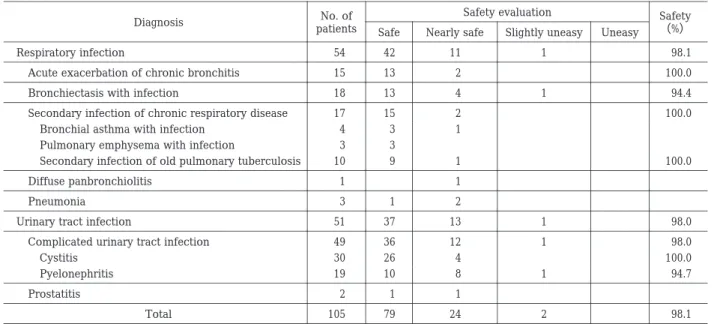
3) 概括安全度
副作用(症状)および副作用(臨床検査値)のいずれ
もが評価対象として採用された 105 例を対象とした。
「安
全である」と「ほぼ安全である」を合わせた安全率は全
体で 98.1% であり,
「やや問題あり」
と判定された症例は
2
例であった。そのうち 1 例は副作用(発疹)に対して治
療薬が施されたために副作用の程度が「中等度」となっ
た症例であり,治験実施計画どおりに概括安全度が判定
されたものであった。他の 1 例は副作用(症状)および
副作用(臨床検査値)が両方発現した症例であり,いず
れも軽度ではあったが,副作用(症状)および副作用(臨
Table 10. Correlation between isolated organism and bacteriological response Eradication (%) Bacterial effects No. of patients Isolated organism Unchanged Replaced Decreased Eliminated 1 1 Staphylococcus aureus 1 1 Staphylococcus epidermidis 1 5 6 Streptococcus pneumoniae 1 1 Enterococcus faecalis ― 1 8 9 Subtotal 1 1 Branhamella catarrhalis 6 6 Escherichia coli 2 2 Klebsiella pneumoniae 1 1 Enterobacter cloacae 1 1 Proteus mirabilis 1 1 Morganella morganii 2 3 5 Pseudomonas aeruginosa 1 1 Pseudomonas sp. 5 5 Haemophilus influenzae 1 1 Pasturella multocida 91.7 2 22 24 Subtotal 91.3 1 3 1 18 23 Polymicrobial infection 92.9 3 4 1 48 56 Total
Eradication:(Eliminated + Replaced)/No. of patients
Gram-positive
bacteria
Gram-negative bacteria
Monomicrobial infection
Table 11. Eradication of isolated organism
Eradication (%) Bacterial efficacy No. of bacterial strains Isolated organism Persisted Eliminated 1 1 Staphylococcus aureus 2 2 Staphylococcus epidermidis 4 4
Coagulase negative Staphylococcus
6 6 Streptococcus pneumoniae 2 2 Streptococcus agalactiae 1 1 Streptococcus constellatus 1 17 18 Enterococcus faecalis 97.1 1 33 34 Subtotal 1 1 Branhamella catarrhalis 13 13 Escherichia coli 1 1 Citrobacter freundii 7 7 Klebsiella pneumoniae 2 2 Enterobacter cloacae 4 4 Proteus spp. 2 2 Morganella morganii 3 6 9 Pseudomonas aeruginosa 6 6 Haemophilus influenzae 4 4
other gram-negative rods
93.9 3 46 49 Subtotal 95.2 4 79 83 Total Gram-positive bacteria Gram-negative bacteria
床検査値)がともに発現したことを考慮し,担当医師が
「やや問題あり」と判定した症例であった(Table 16)
。
なお,この「やや問題あり」の 2 症例はいずれも 250
mg×2
!日 投 与 の 症 例 で あ り,高 用 量 で は 安 全 率 が
100.0% であったことから,
投与量と概括安全度の相関性
は認められなかった(Table 17)
。
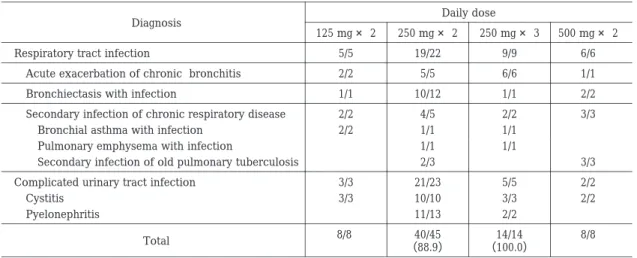
4.有用性
臨床効果が得られなかった症例(無効 2 例,やや有効
1
例)もしくは概括安全度が「やや問題あり」であった
2
症例の合計 5 例においては,有用性が
「やや有用」
,
「有
用でない」と判定された(Table 18)
。
なお,この 5 例は,いずれも 250 mg×2
!日投与の症例
Table 14. Correlation between daily dose and adverse drug reaction (abnormal laboratory findings)
Daily dose No. of patients
Adverse drug reaction
(laboratory data) 125 mg× 2 250 mg× 2 250 mg× 3 500 mg× 2 15 16 62 12 105 No. of observed patients
1 5
17 2
25 No. of patients seen
6.7 31.3 27.4 16.7 23.8 Appearance(%)
Table 15. Correlation between daily dose and adverse drug reaction (abnormal laboratory findings)(by test item)
Incidence (%) No. of observed patients Total (No. of event) Daily dose
Adverse drug reaction
(laboratory findings) 125 mg× 2 250 mg× 2 250 mg× 3 500 mg× 2 1.1 95 1 1 Basophilia 7.4 95 7 3 3 1 Eosinophilia 2.9 35 1 1 Neutropenia 1.7 59 1 1 Neutropenia(Segmented) 2.9 102 3 1 2 Thrombocytosis 5.8 104 6 1 2 3 GOT increased 10.6 104 11 1 1 8 1 GPT increased 6.3 95 6 6 ALP increased 1.3 78 1 1 LDH increased 5.6 90 5 5 γ -GTP increased 5.0 40 2 2 LAP increased 1.3 79 1 1
Serum potassium increased
Table 12. Isolated organisms after DRPM treatment
No. of bacterial strains Isolated organism 1 Staphylococcus aureus 1 γ -Streptococcus 1 α -non-Streptococcus 1 Enterococcus faecalis 1 Enterococcus faecium 1 Pseudomonas aeruginosa 1 Flavobacterium sp. 1 Stenotrophomonas maltophilia 1 Fungi 9 Total 7/56(12.5%) No. of patients with organisms/No. of observed patients
Table 13. Correlation between daily dose and adverse drug reaction (symptoms)
Daily dose No. of patients
Adverse drug reaction
(symptom) 125 mg× 2 250 mg× 2 250 mg× 3 500 mg× 2 15 16 63 12 106 No. of observed patients
0 0
3 0
3 No. of patients seen
0.0 0.0 4.8 0.0 2.8 Appearance(%) 1 1 Eruption 1 1 Tongue numbness 1 1 Headache
Table 16. Correlation between diagnosis and DRPM safety profile Safety (%) Safety evaluation No. of patients Diagnosis Uneasy Slightly uneasy Nearly safe Safe 98.1 1 11 42 54 Respiratory infection 100.0 2 13 15 Acute exacerbation of chronic bronchitis
94.4 1
4 13
18 Bronchiectasis with infection
100.0 2
15 17 Secondary infection of chronic respiratory disease
1 3
4 Bronchial asthma with infection
3 3 Pulmonary emphysema with infection
100.0 1
9 10 Secondary infection of old pulmonary tuberculosis
1 1 Diffuse panbronchiolitis 2 1 3 Pneumonia 98.0 1 13 37 51 Urinary tract infection
98.0 1
12 36
49 Complicated urinary tract infection
100.0 4 26 30 Cystitis 94.7 1 8 10 19 Pyelonephritis 1 1 2 Prostatitis 98.1 2 24 79 105 Total
Safety:(Safe + Nearly safe)/No. of patients
Table 17. Correlation between daily dose and DRPM safety profile Daily dose Diagnosis 500 mg× 2 250 mg× 3 250 mg× 2 125 mg× 2 12/12 10/10 26/27 5/5 Respiratory infection 1/1 6/6 6/6 2/2
Acute exacerbation of chronic bronchitis
4/4 1/1
11/12 1/1
Bronchiectasis with infection
7/7 2/2
6/6 2/2
Secondary infection of chronic respiratory disease
1/1 1/1
2/2 Bronchial asthma with infection
1/1 1/1
1/1 Pulmonary emphysema with infection
6/6 4/4
Secondary infection of old pulmonary tuberculosis
1/1 Diffuse panbronchiolitis 1/1 2/2 Pneumonia 3/3 6/6 34/35 7/7
Urinary tract infection
3/3 6/6
32/33 7/7
Complicated urinary tract infection
3/3 3/3 17/17 7/7 Cystitis 3/3 15/16 Pyelonephritis 2/2 Prostatitis 15/15 (100.0) 16/16 (100.0) 60/62 (96.8) 12/12 (100.0) Total
(Safe + Nearly safe)/No. of patients ( )Safety(%)
であり,
「きわめて有用」
と
「有用」
を合わせた有用率は,
他の投与量においてはいずれも 100.0% であった(Table
19)
。
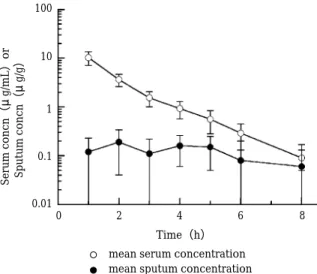
5.喀痰中濃度
本薬の 250 mg,60 分点滴静注時の最高喀痰中濃度は
0.14∼0.40
µ
g
!g であり,その最大移行比(最高喀痰中濃
度!最高血清中濃度)は 1.1∼4.9% であった(Table 20,
Fig. 1)
。
III
. 考
察
カルバぺネム系抗菌薬の新薬開発方針としては DHP-I
に安定なことと,痙攣誘発作用等の中枢神経系への作用
を低減化する方向,さらには従来本系統の薬剤が比較的
有効とされている P. aeruginosa に対する抗菌力の増強
等の条件があげられる。DRPM もこれらの目的を達成す
べく開発されたものである。
前期第 II 相試験において,本薬は慢性気道感染症およ
Table 20. Pharmacokinetic profiles in determining DRPM sputum level (DRPM: 250 mg, Infusion time: 60 minutes)
Cmax Ratiof (%) Cmaxsputume ( μ g/g) Cmaxserumd ( μ g/mL) T1/2( β )c (h) CLb (L/h) AUCa ( μ g・h/mL) Subject No. 1.1 0.14 12.4 1.09 13.52 18.49 1 3.1 0.25 8.03 1.41 17.37 14.39 2 1.7 0.25 15.0 1.32 9.65 25.91 3 4.9 0.40 8.23 1.06 19.78 12.64 4 2.5 0.20 7.95 1.61 16.07 15.56 5 2.7 0.25 10.3 1.30 15.28 17.40 Mean 1.5 0.10 3.2 0.23 3.87 5.21 SD
aAUC: calculated by trapezoidal method bCL(clearance): calculated by dose/AUC cT
1/2( β ): half-life at β phase dCmax
serum: observed values at 1 h eCmax
sputum: obtained from observation
fCmax Ratio(%):(Cmax
sputum/Cmaxserum)× 100
Table 19. Correlation between daily dose and DRPM usefulness Daily dose Diagnosis 500 mg× 2 250 mg× 3 250 mg× 2 125 mg× 2 6/6 9/9 19/22 5/5
Respiratory tract infection
1/1 6/6
5/5 2/2
Acute exacerbation of chronic bronchitis
2/2 1/1
10/12 1/1
Bronchiectasis with infection
3/3 2/2
4/5 2/2
Secondary infection of chronic respiratory disease
1/1 1/1
2/2 Bronchial asthma with infection
1/1 1/1
Pulmonary emphysema with infection
3/3 2/3
Secondary infection of old pulmonary tuberculosis
2/2 5/5
21/23 3/3
Complicated urinary tract infection
2/2 3/3 10/10 3/3 Cystitis 2/2 11/13 Pyelonephritis 8/8 14/14 (100.0) 40/45 (88.9) 8/8 Total
(Extremely useful + Useful)/No. of patients ( )Usefulness(%)
Table 18. Correlation between diagnosis and DRPM usefulness
Usefulness (%) Usefulness No. of patients Diagnosis Not useful Slightly useful Useful Extremely useful 92.9 1 2 24 15 42
Respiratory tract infection
100.0 7
7 14
Acute exacerbation of chronic bronchitis
87.5 2
9 5
16 Bronchiectasis with infection
91.7 1
8 3
12 Secondary infection of chronic respiratory disease
2 2
4 Bronchial asthma with infection
2 2
Pulmonary emphysema with infection
1 4
1 6
Secondary infection of old pulmonary tuberculosis
93.9 1 1 15 16 33
Complicated urinary tract infection
100.0 7 11 18 Cystitis 86.7 1 1 8 5 15 Pyelonephritis 93.3 2 3 39 31 75 Total
100 10 1 0.1 0.01 0 2 4 6 8 Serum concn (μ g/mL ) or Sputum concn (μ g/g ) Time(h) mean serum concentration mean sputum concentration
び複雑性尿路感染症のいずれにおいても良好な治療成績
(95.1%,97.1%)を示した。本治験は,前期第 II 相試験
であることを考慮して年齢の条件を 70 歳未満とし,
重症
例やカテーテル留置症例を除外するなど,対象を絞って
実施した。これによって難治性の症例が評価より除外さ
れ,その結果として有効率が高くなった可能性は否定で
きない。しかし,今回対象とした慢性気道感染症および
複雑性尿路感染症に対して十分な効果が得られたことよ
り,本薬の抗菌薬としての優れた資質が認められた。
副作用(症状)の発現率は 2.8%(3
!106 例)で,従来
の抗菌薬と同程度の頻度であり,その種類に関しても本
薬特有のものは認められなかった。副作用
(臨床検査値)
に関しては,発現項目としては他薬剤と同様であったも
のの,その発現頻度は 23.8%(25
!105 例)を示し,中で
も GPT 上昇は 10.6%(11
!104 例)であった。これに関し
ては患者背景別等の検討を加え,泌尿器科領域で高頻度
であったこと,膀胱炎よりも腎盂腎炎で多いことが判明
したが,その原因については明確にできなかった。なお,
臨床検査値異常変動の判定には化学療法学会の基準
6)に
従った。発現した異常変動はいずれも軽度であり,また,
投与終了後にはいずれも正常化もしくは前値に復してお
り,臨床的には問題ないと判断した。
概括安全度については,安全率が全体で 98.1% と良好
な成績であり,
「やや問題あり」
と判定された 2 症例がい
ず れ も 250 mg×2
!日 で あ り,高 用 量 で は 安 全 率 が
100.0% であったことから投与量と概括安全度の相関性
は認められなかった。
有用性については,臨床効果の
「無効」
2
例,
「やや有効」
1
例,概括安全度の「やや問題あり」の 2 例の合計 5 例に
おいて,
「やや有用」
,
「有用でない」
と判断されたものの,
有用率は 93.3%(70
!75 例)と非常に良好な成績が得ら
れ,有用性は期待できると考えられた。
本試験の目的は「適応疾患と用法・用量の瀬踏み的評
価」
であり,基礎的検討および第 I 相試験までの各成績よ
り本 薬 の 用 法・用 量 と 推 定 さ れ た 250 mg×2
!日,250
mg×3
!日を中心の投与量とし,その有効性,安全性を考
慮しながら 125 mg×2!日,500 mg×2!日の投与量も併せ
て検討を行った。対象とした慢性気道感染症,複雑性尿
路感染症に対し,いずれの投与量でも効果を有すること
が認められた。また,安全性の面においても副作用(症
状・臨床検査値)の発現率に用量相関性を認めず,今回
用いた範囲の投与量の安全性が確認された。
以上のことより,DRPM は感染症の治療において有効
な薬剤であり,安全性においても大きな問題はないと考
えられ,抗菌力を反映した有用な薬剤であることが示唆
された。
文 献 1) 藤村享滋,木村美司,吉田 勇,他:Doripenem の in vitro抗菌力。日化療会誌 53(Suppl 1): 57∼70, 2005 2) 岡本了一,中野竜一,佐藤優子,他:β ―ラクタマーゼ 産生菌に対する doripenem の抗菌力。日化療会誌 53 (Suppl 1): 47∼51, 2005 3) 山野佳則,川井悠唯,湯通堂隆:Doripenem のヒト dehydropeptidase-Iに対する安定性。日化療会誌 53 (Suppl 1): 92∼95, 2005 4) 中島光好,尾熊隆嘉:Doripenem の健康成人における 第 I 相臨床試験。日化療会誌 53(Suppl 1): 104∼123, 2005 5) UTI 研究会(代表,大越正秋):UTI 薬効評価基準(第 3版)。Chemotherapy 34: 408∼441, 1986 6) 日本化学療法学会副作用判定基準検討委員会(国井乙 彦):抗菌薬による治験症例における副作用,臨床検 査 値 異 常 の 判 定 基 準。Chemotherapy 39: 687∼689, 1991Fig. 1. DRPM concentration in serum and sputum (DRPM: 250 mg, Infusion time: 60 minutes).
Early phase II study of doripenem, a new carbapenem antibiotic for injection
Jingoro Shimada
1), Keizo Yamaguchi
2), Kohya Shiba
3), Atsushi Saito
4),
Sadao Kamidono
5)and Takeshi Inamatsu
6)1)Institute of Medical Science, St. Marianna University School of Medicine, 2―16―1 Sugao Miyamae-ku, Kawasaki, Kanagawa, Japan
2)Department of Microbiology, Toho University School of Medicine
3)Department of Internal Medicine(Department of Infection Control), Jikei University 4)Faculty of Medicine, University of the Ryukyus
5)Kobe University, School of Medicine 6)Tokyo Metropolitan Geriatric Medical Center