博士論文(要約)
論文題目
認知言語学を英語教育に生かす氏名
長 加奈子【目次】
第1章 序論 1
第2章 認知言語学と外国語教育 7
第1節 認知言語学以前の近代言語学と外国語教育への影響 7 第2節 認知言語学の言語観 12
2.1 言語の記号的性質 13
2.2 言語に表れる認知能力 16
2.2.1 ベースとプロファイル 16
2.2.2 図と地 18
2.2.3 トラジェクターとランドマーク 20
2.2.4 心的走査と参照点の関係 21
2.2.5 抽象化とカテゴリー化 24
2.3 用法基盤モデル 26
第3節 認知文法における品詞 28 3.1 プロファイルと品詞 30
3.2 前置詞 33
第4節 認知言語学の外国語教育への応用 37
第5節 まとめ 41
第3章 母語による意味カテゴリーの違い 43
第1節 理論的背景 43
第2節 調査 50
2.1 参加者 50
2.2 調査資材 50
2.3 調査・分析方法 52
第3節 結果と考察 52
3.1 多次元尺度法の結果と考察 53 3.2 クラスター分析の結果と考察 68
第4節 まとめ 75
第4章 教授法開発:前置詞 79 第1節 英語の前置詞の多義性とイメージスキーマ 79 1.1 前置詞の多義性と第二言語習得 79 1.2 前置詞表現に対するイメージスキーマ・アプローチ 80 1.3 英語の前置詞と日本語の助詞 81 第2節 教授法の開発と効果の検証 86
2.1 調査対象者 87
2.2 調査手順および調査資材 87
2.3 分析方法 94
第3節 結果および考察 95
3.1 意味用法による教育効果の違い:多変量解析の結果 95 3.2 項目による教育効果の違い:クラスター分析の結果 100
3.2.1 事前テストのクラスタリング 101
3.2.2 指導の前後のクラスタリングの変化 106
第4節 まとめ 117
第5章 認知言語学の知見に基づく英語教育:総括と今後の課題 121
第1節 研究の総括 121
第2節 教育への示唆 124
第3節 今後の課題 125
参考文献 128
付録 139
索引 173
図表一覧
図1 音と意味のシンボリックな関係 13
図2 円弧のベースとプロファイル 17
図3 ルビンの壺 18
図4 starとtableの客観的位置 20
図5 aboveとbelowのトラジェクター・ランドマーク 21
図6 言語化の対象となるカテゴリー 31
図7 時間軸のプロファイルの違い 32
図8 Dewell (1994)のCentral Schema 35
図9 イメージスキーマの変換 36
図10 位置関係を表す言語表現の違い 46
図11 日本語話者の三次元モデル 54
図12 中国語話者の三次元モデル 54
図13 英語話者の三次元モデル 55
図14 英語話者のデンドログラム 69
図15 日本語話者のデンドログラム 71 図16 中国語話者のデンドログラム 74 図17 英語前置詞と日本語の相当句の関係 85 図18 前置詞inのCIS 89 図19 前置詞onのCIS 90 図20 前置詞atのCIS 91 図21 教育効果を測定する資材の出題例 94
図22 位相用法の教育効果 97
図23 時間用法の教育効果 97
図24 機能用法の教育効果 98
図25 比喩用法の教育効果 98
図26 事前テストのデンドログラム 101 図27 伝統型グループの事前・事後のデンドログラムの変化 107 図28 認知言語学グループの事前・事後のデンドログラムの変化 109
表1 前置詞inの刺激文 51
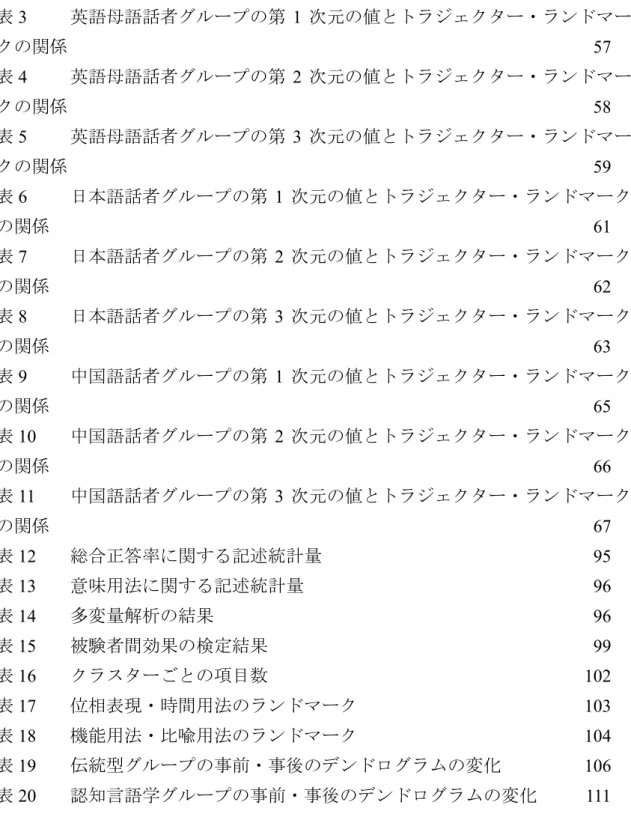
表2 多次元尺度法の分析結果 53 表3 英語母語話者グループの第 1 次元の値とトラジェクター・ランドマー
クの関係 57
表4 英語母語話者グループの第 2 次元の値とトラジェクター・ランドマー
クの関係 58
表5 英語母語話者グループの第 3 次元の値とトラジェクター・ランドマー
クの関係 59
表6 日本語話者グループの第 1 次元の値とトラジェクター・ランドマーク
の関係 61
表7 日本語話者グループの第 2 次元の値とトラジェクター・ランドマーク
の関係 62
表8 日本語話者グループの第 3 次元の値とトラジェクター・ランドマーク
の関係 63
表9 中国語話者グループの第 1 次元の値とトラジェクター・ランドマーク
の関係 65
表10 中国語話者グループの第 2 次元の値とトラジェクター・ランドマーク
の関係 66
表11 中国語話者グループの第 3 次元の値とトラジェクター・ランドマーク
の関係 67
表12 総合正答率に関する記述統計量 95 表13 意味用法に関する記述統計量 96
表14 多変量解析の結果 96
表15 被験者間効果の検定結果 99
表16 クラスターごとの項目数 102
表17 位相表現・時間用法のランドマーク 103 表18 機能用法・比喩用法のランドマーク 104 表19 伝統型グループの事前・事後のデンドログラムの変化 106 表20 認知言語学グループの事前・事後のデンドログラムの変化 111
【本文】
本博士論文は,2015年度公立大学法人北九州市立大学学長選考型研究費B(出 版助成)を受けて,長 加奈子『認知言語学を英語教育に生かす』(金星堂,2016
年,ISBN978-4764711570)として出版されているため,全文をインターネット公
開することができない。
【参考文献一覧】
【英文文献】
Archard, M. (2008). Teaching construal: Cognitive pedagogical grammar. In P. Robinson
& N. Ellis (Eds.), Handbook of cognitive linguistics and second language acquisition (pp. 432-455). London: Routledge.
Athanasopoulos, P. (2006). Effects of the grammatical representation of number on cognition in bilinguals, Bilingualism. Language and Cognition, 9, 89-96.
Bennet, D. C. (1975). Spatial and temporal uses of English prepositions: An essay in stratificational semantics. London: Longman.
Boers, F. (2004). Expanding learners’ vocabulary through metaphor awareness: What expansion, what leaners, what vocabulary? In M. Achard & S. Niemeier (Eds.).
Cognitive linguistics and foreign language teaching (pp. 211-232). Berlin: Mouton de Gruyter.
Bolinger, D. (1977). Meaning and form. London: Longman.
Bowerman, M., & Choi, S. (2001). Shaping meanings for language: Universal and language-specific in the acquisition of spatial semantic categories. In M. Bowerman
& S. C. Levinson (Eds.), Language acquisition and conceptual development (pp.
475-511). Cambridge: Cambridge University Press.
Brugman, C. M. (1988). The story of over: Polysemy, semantics, and the structure of the lexicon. New York: Garland.
Cho, K. (2002). A cognitive linguistic approach to the acquisition of English prepositions.
JACET Bulletin, 35, 63-78.
Cho, K. (2010). Fostering the acquisition of English prepositions by Japanese learners with networks and prototypes. In S. D. Knop, F. Boers & T. D. Rycker (Eds.), Fostering language teaching efficiency through cognitive linguistics (pp. 259-275).
Berlin: Mouton de Gruyter.
Cho, K., & Kawase, Y. (2011). Effects of a cognitive linguistic approach to teaching
countable and uncountable English nouns to Japanese learners of English. ARELE:
Annual review of English language education in Japan, 22, 201-215.
Cho, K., & Kawase, Y. (2012). Developing a pedagogical cognitive grammar: Focusing on the English prepositions, in, on, and at. ARELE: Annual review of English language education in Japan, 23, 153-168.
Chomsky, N. (1957). Syntactic structures. The Hague: Mouton.
Chomsky, N. (1965). Aspects of the theory of syntax. Cambridge: M.I.T. Press.
Chomsky, N. (1981). Lectures on government and binding. Dordrecht: Foris Publications.
Cook, V. (1991). Second language learning and language teaching. London: Edward Arnold.
Cook, V., Bassetti, B., Kasai, C., Sasaki, M., & Takahashi, J. (2006). Do bilinguals have different concepts? The case of shape and material in Japanese L2 users of English.
International Journal of Bilingualism, 10 (2): 137-152.
Croft, W. (2001). Radical construction grammar: Syntactic theory in typological perspective. Oxford: Oxford University Press.
Croft, W., & Cruse, D. A. (2004). Cognitive linguistic. Cambridge: Cambridge University Press.
De Knop, S., Boers, F., & De Rycker, T. (Eds.). (2010). Fostering language teaching efficiency through cognitive linguistics. Berlin: Mouton de Gruyter.
De Knop, S., & De Rycker, T. (Eds.). (2008). Cognitive approaches to pedagogical grammar. Berlin: Mouton de Gruyter.
Dewell, R. (1994). Over again: Image-schema transformations in semantic analysis.
Cognitive Linguistics, 5 (4), 351-380.
Dirven, R. (1989). Cognitive linguistic and pedagogic grammar. In G. Graustein & G.
Leitner (Eds.), Reference grammar and modern linguistic theory (pp. 56-75).
Tübingen: Max Niemeyer Verlag.
Dirven, R. (1993). Dividing up physical and mental space into conceptual categories by means of English prepositions. In C. Zelinsky-Wibbelt (Ed.), The semantics of prepositions: From mental processing to natural language processing (pp. 73-97).
Berlin: Mouton de Gruyter.
Doughty, C. (2003). Instructed SLA: Constraints, compensation and enhancement. In C.
J. Doughty and M. Long (Eds.) The handbook of second language acquisition (pp.
256-310). Malden: Blackwell.
Ellis, N. (2002). Frequency effects in language processing: A review with implications for theories of implicit and explicit language learning. Studies in Second Language Acquisition, 24, 143-188.
Ellis, N. (2006a). Language acquisition as a rational contingency learning. Applied Linguistics, 27 (1), 1-24.
Ellis, N. (2006b). Selective attention and transfer phenomena in L2 acquisition:
Contingency, cue competition, salience, interference, overshadowing, blocking, and perceptual learning. Applied Linguistics, 27 (2), 164-194.
Ellis, N. (2006c). Cognitive perspectives on SLA. AILA Review, 19, 100-121.
Elston-Guttler, K. E. & Williams, J. N. (2008). First language polysemy affects second language meaning interpretation: Evidence for activation of first language concepts during second language reading. Second Language Research, 24 (2), 167-187.
Evans, V. (2007). A glossary of cognitive linguistics. Salt Lake City: The University of Utah Press.
Evans, V., & Green, M. (2006). Cognitive linguistics: An introduction. Edinburgh:
Edinburgh University Press.
Farah, I. (1998). The ethnography of communication. In N. H. Hornberger & P. Corson (Eds.), Encyclopedia of language and education: volume 8: Research methods in language and education (Vol. Kluwer, pp. 125-127). Dordrecht: Springer.
Fauconnier, G. (1985). Mental spaces: Aspects of meaning construction in natural language. Cambridge, MA: MIT Press.
Fauconnier, G. (1997). Mapping in thought and language. Cambridge: Cambridge University Press.
Fauconnier, G., & Sweetser, E. (Eds.). (1996). Spaces, worlds, and grammar. Chicago:
Chicago University Press.
Fillmore, C. J. (1988). The mechanisms of “construction grammar”. Proceedings of the Annual Meeting of the Berkeley Linguistics Society, 14, 35-55.
Gentner, D., & Goldin-Meadow, S. (2003). Whither Whorf. In D. Gentner & S. Goldin- Meadow (Eds.) Language in minds: Advances in the study of language and thought (pp. 3-14). Cambridge: MIT Press.
Goldberg, A. E. (1995). Constructions: A construction grammar approach to argument structure. Chicago: University of Chicago Press.
Hawkins, B. W. (1984). The semantics of English spatial prepositions. Ph.D. dissertation,
University of California, San Diego.
Hawkins, B. W. (1988). The category MEDIUM. In B. Rudzka-Ostyn (Ed.), Topics in cognitive linguistics (pp. 231-270). Amsterdam: John Benjamins.
Hawkins, B. W. (1993). On universality and variability in the semantics of spatial adpositions. In C. Zelinsky-Wibbelt (Ed.), The semantics of prepositions (pp. 327- 349). Berlin: Mouton de Gruyter.
Hayashi, I. (2005). Identifying different motivational transitions of Japanese ESL learners using cluster analysis: Self-determination perspectives. JACET Bulletin, 41, 1-17.
Herskovits, A. (1986). Language and spatial cognition: An interdisciplinary study of the prepositions in English. Cambridge: Cambridge University Press.
Herskovits, A. (1988). Spatial expressions and the plasticity of meaning. In B. Rudzka- Ostyn (Ed.), Topics in cognitive linguistics (pp. 271-297). Amsterdam/Philadelphia:
John Benjamins.
Hunt, E., & Agnoli, F. (1991). The Whorfian hypothesis: A cognitive psychology perspective. Psychological Review, 98 (3), 377-389.
Hymes, D. (1974). Foundations of sociolinguistics: An ethnographic approach.
Philadelphia: University of Pennsylvania Press.
Ikegami, Y. (2005). Indices of a ‘subjectivity-prominent’ language. Annual Review of Cognitive Linguistics, 3, 132-164.
Ijaz, I. H. (1986). Linguistic and cognitive determinants of lexical acquisition in a second language. Language Learning, 36, 401-451.
Imai, M. (2000). Universal ontological knowledge and a bias toward language-specific categories in the construal on individuation. In S. Niemeier and R. Dirven (Eds.) Evidence of linguistic relativity (pp. 139-160). Amsterdam: John Benjamins.
Isral, M. (1996). The way constructions grow. In A. Goldberg (Ed.), Conceptual structure, discourse and language (pp. 217-230). Stanford, CA: CSLI Publishing.
Jackendoff, R. (1994). Patterns in the mind: Language and human nature. Basic Books.
Johnson, M. (1987). The body in the mind: The bodily basis of meaning, imagination, and reason. Chicago: University of Chicago Press.
Kemmer, S. (2003). Human cognition and the elaboration of events. In M. Tomasello (Ed.), The new psychology of language (Vol. 2, pp. 89-118). Mahwah: Lawrence Erlbaum.
Krashen, S. D. (1982). Principles and practice in second language acquisition. Oxford:
Pergamon.
Kreizer, A. (1997). Multiple levels of schematization: A study in the conceptualization of space. Cognitive Linguistics, 8 (4), 291-325.
Kunihiro, T. (1974). Culture and system of expression in patterns: A contrast of English and Japanese. In B. Hoffer (Ed.), Proceedings of a U.S.-Japan Sociolinguistics Meeting (pp. 46-52). San Antonio: Trinity University.
Labov, W. (1973). The boundaries of words and their meanings. In C. N. Bailey & R. W.
Shuy (Eds.), New ways of analyzing variation in English (pp. 340-373). Washington, D.C.: Gerogetown University Press.
Lakoff, G. (1987). Women, fire, and dangerous things: What categories reveal about the mind. Chicago: University of Chicago Press.
Lakoff, G., & Johnson, M. (1980). Metaphors we live by. Chicago: University of Chicago Press.
Lakoff, G., & Turner, M. (1989). More than cool reason: A field guide to poetic metaphor.
Chicago: University of Chicago Press.
Langacker, R. W. (1987). Foundations of cognitive grammar, vol. 1: Theoretical prerequisites. Stanford.: Stanford University Press.
Langacker, R. W. (1988). An overview of cognitive grammar. In B. Rudzka-Ostyn (Ed.), Topics in cognitive linguistics (pp. 1-48). Amsterdam: John Benjamins.
Langacker, R. W. (1991). Foundations of cognitive grammar, vol. 2: Descriptive application. Stanford: Stanford University Press.
Langacker, R. W. (2000). A dynamic usage-based models of language. Stanford: CSLI Publications.
Langacker, R. W. (2008a). Cognitive grammar: A basic introduction. Oxford: Oxford University Press.
Langacker, R. W. (2008b). Cognitive grammar as a basis for language instruction. In P.
Robinson & N. Ellis (Eds.), Handbook of cognitive linguistics and second language acquisition (pp. 66-88). New York: Routledge.
Lee, D. (2001). Cognitive linguistics: An introduction. Oxford: Oxford University Press.
Lindstromberg, S. (2010). English prepositions explained. Amsterdam: John Benjamins.
Littlemore, J. (2009). Applying cognitive linguistics to second language learning and teaching. Basingstoke: Palgrave Macmillan.
MacWhinney, B. (1997). Second language acquisition and the competition model. In A.
M. B. De Groot & J.F. Froll (Eds.), Tutorials in bilingualism: Psycholinguistic perspectives (pp. 113-142). Mahwah: Lawrence Erlbaum.
Majid, A., Bowerman, B., Van Staden, M., & Boster, J. S. (2007). The semantic categories of cutting and breaking events: A crosslinguistic perspective. Cognitive Linguistics, 18 (2), 133-152.
Mandler, G. (1985). Cognitive psychology: An essay in cognitive science. Hillsdale:
Lawrence Erlbaum.
Miller, G. A. (1969). A psychological method to investigate verbal concepts. Journal of Mathematical Psychology, 6, 169-191.
Morimoto, S., & Loewen, S. (2007). A comparison of the effects of image-schema-based instruction and translation-based-instruction on the acquisition of L2 polysemous words. Language Teaching Research, 11 (3), 347-372.
Nakao, K.(1998). The state of bilingual lexicography in Japan: Learners’ English- Japanese/Japanese-English dictionaries, International Journal of Lexicography, 11, 35-50.
Pütz, M., Niemeier, S., & Dirven, R. (Eds.). (2001a). Applied cognitive linguistics I:
Theory and language acquisition. Berlin: Mouton de Gruyter.
Pütz, M., Niemeier, S., & Dirven, R. (Eds.). (2001b). Applied cognitive linguistics II:
Language pedagogy. Berlin: Mouton de Gruyter.
Rice, S. (1996). Prepositional prototypes. In M. Pütz & R. Dirven (Eds.), The construal of space in language and thought (pp. 135-165). Berlin: Mouton de Gruyter.
Rivers, W. M. (1964). The psychologist and the foreign language teacher. Chicago:
University of Chicago Press.
Robinson, P., & Ellis, N. C. (Eds.). (2008). Handbook of cognitive linguistics and second language acquisition. New York: Routledge.
Rosch, E. (1973). On the internal structure of perceptual and semantic categories. In T. E.
Moore (Ed.), Cognitive development and the acquisition of language (pp. 111-144).
New York: Academic Press.
Rosch, E., & Mervis, C. B. (1975). Family resemblances: Studies in the internal structure of categories. Cognitive Psychology, 7, 573-605.
Sinha, C., & Jensen de López, K. (2000). Language, culture and the embodiment of spatial cognition. Cognitive Linguistics, 11, 17-41.
Talmy, L. (1978). Figure and ground in complex sentences. In J. H. Greenberg (Ed.),
Universals of human language (Vol. 4, pp. 625-629). Stanford: Stanford University Press.
Talmy, L. (2000). Toward a cognitive semantics (Vol. 1). Cambridge, MA: The MIT Press.
Taylor, J. (1993). Some pedagogical implications of cognitive linguistics. In R.A. Geiger
& B. Rudzka-Ostyn (Eds.) Conceptualizations and mental processing in Language (pp. 201-223). Berlin: Mouton de Gruyter.
Taylor, J. (2002). Cognitive grammar. Oxford: Oxford University.
Taylor, J. (2003). Linguistic categorization. Oxford: Oxford University Press.
Taylor, J. (2008). Prototypes in cognitive linguistics. In P. Robinson & N. Ellis (Eds.) Handbook of cognitive linguistics and second language acquisition (pp. 39-65).
New York: Routledge.
Tomasello, M. (2003). A usage-based theory of language acquisition. Cambridge:
Harvard University Press.
Tyler, A. (2012). Cognitive linguistics and second language learning: Theoretical basics and experimental evidence. New York: Routledge.
Tyler, A., & Evans, V. (2001). Reconsidering prepositional polysemy networks: The case of over. Language Learning, 77, 724-765.
Tyler, A., & Evans, V. (2003). The semantics of English prepositions: Spatial scenes, embodied meaning, and cognition. Cambridge: Cambridge University Press.
Vandeloise, C. (1991). Spatial prepositions: A case study from French. Chicago:
University of Chicago Press.
Vandeloise, C. (1994). Methodology and analyses of the preposition in. Cognitive Linguistics, 5 (2), 157-184.
Van Hoek, K. (1997). Anaphora and conceptual structure. Chicago: University of Chicago Press.
Wierzbicka, A. (1996). Semantics: Primes and universals. Oxford: Oxford University Press.
Wittegenstein, L. (1953). Philosophical investigations (B. E. M. Anscombe, Trans.):
Basil Balckwell/Macmillan.
Ying-Huseh, H., & Yi-Chen, H. (2009). Prepositions we live by: Implications of the polysemy network in teaching English prepositions in and on. In B. Lewandowska- Tomaszczyk & K. Dziwirek (Eds.), Studies in cognitive corpus linguistics.
Frankfurt am Main: Peter Lang.
【和文文献】
尼ヶ崎彬(1990)『ことばと身体』東京:勁草書房.
池上嘉彦(1981)『「する」と「なる」の言語学―言語と文化のタイポロジー』東 京: 大修館書店.
池上嘉彦(2003)「言語における<主観性>と<主観性>の言語的指標(1)」『認 知言語学論考 No. 3』,1-49,東京:ひつじ書房.
池上嘉彦(2004)「言語における<主観性>と<主観性>の言語的指標(2)」『認 知言語学論考 No. 4』, 1-60,東京:ひつじ書房.
池上嘉彦(2006)『英語の感覚・日本語の感覚―“ことばの意味”のしくみ』東 京:日本放送出版協会.
池上嘉彦(2007)『日本語と日本語論』東京:ちくま学芸文庫.
池上嘉彦・守屋三千代(編著)(2009)『自然な日本語を教えるために―認知言語 学をふまえて』東京:ひつじ書房.
今井むつみ(1993)「外国語学習者の語彙学習における問題点:意味表象の見地 から」『教育心理学研究』,41,243-253.
岡田伸夫 (2010) 「教育・学習英文法の内容と指導法の改善」 岡田伸夫・南出康
世・梅咲敦子(編)『英語研究と英語教育―ことばの研究を教育に活かす (pp. 22-39)』 東京: 大修館書店.
大津由紀雄 (編) (2012)『学習英文法を見直したい』東京: 研究社.
大堀壽夫(2002)『認知言語学』東京:東京大学出版会.
斎藤兆史 (2007) 『これが正しい!英語学習法』 東京: 筑摩書房.
斎藤兆史 (2012) 「足場としての学習英文法」大津由紀雄 (編), 『学習英文法を
見直したい (pp. 26-37)』 東京: 研究社.
佐久間 鼎 (1941)『日本語の特質』東京:育英書院.
高根芳雄(1980)『多次元尺度法』東京:朝倉書店.
田中茂範・松本曜 (1997) 『空間と移動の表現』 東京: 研究社.
田中茂範・佐藤芳明・阿部一(2006)『英語感覚が身につく実践的指導―コアと チャンクの活用法』東京:大修館書店.
早瀬尚子(2002)『英語構文のカテゴリー形成:認知言語学の視点から』東京:
勁草書房.
深田智・仲本康一郎(2008)『概念化と意味の世界』東京:研究社.
堀江薫・プラシャント, パルデジ (2009) 『言語のタイポロジー―認知類型論の アプローチ―』 東京: 研究社.
森山新(2006)「多義語としての格助詞デの意味構造と習得過程」『認知言語学論 考 No. 5』,1-47,東京:ひつじ書房.
森山新(2008)『認知言語学からみた日本語格助詞の意味構造と習得:日本語教 育に生かすために』東京:ひつじ書房.
文部科学省(1986)『臨時教育審議会第二次答申』(1986年4月答申). 文部科学省(2003)『「英語が使える日本人」の育成のための行動計画』
http://www.mext.go.jp/b_menu/shingi/chukyo/chukyo3/004/siryo/04031601/005.p dfより取得.
安井稔 (2011) 『20世紀言語学は何をもたらしたか』 東京: 開拓社.
山梨正明(2004)『ことばの認知空間』東京:開拓社.
吉村公宏(1995)『認知意味論の方法』京都:人文書院.
【論文内容の要旨】
理論言語学の分野は戦後大きな進展を見せ,言語,特に英語の仕組みについて 多くのことが明らかとなっている。しかし外国語教育の現場で教えられる文法 は,戦前の伝統文法から大きな変化を遂げているとは言いがたい。そのような問 題意識のもと,本研究は1980年代以降進化を遂げてきた言語理論の1つである 認知言語学の知見を,いかに外国語教育の現場に持ち込むかという課題に対し て取り組んだ。本書は特に,日本語を母語とする英語学習者の前置詞 in,on, at の習得に焦点を当て,2 つの実証研究を中心とし,以下の全 5 章から構成さ れるものである。
第1章 序論
第2章 認知言語学と外国語教育
第3章 母語による意味カテゴリーの違い 第4章 教授法開発:前置詞
第5章 認知言語学に基づく英語教育:総括と今後の課題
第1章では,本研究の背景およびその目的について述べた。1970年代後半以 降,日本の英語教育の現場では,文法教育はあたかも日本人英語学習者のコミュ ニケーション能力を阻害する要因であるかのように見なされ,教育現場ではオ ーラルコミュニケーションを重視するようになった。しかし近年,日本のような EFL 環境では,限られたインプットから自然に文法を習得することは不可能で あり,文法を指導する必要があることが再認識されている。しかしその一方,理 論言語学は発展しているにもかかわらず,教室内において英語学習者に提示さ れている学習英文法は十分に言語理論の恩恵を受けておらず,伝統文法の枠組 みから脱却できていない。そのような中,1980年代以降隆盛を極めている認知 言語学に対して,教育現場から大きな期待が寄せられていることについて言及 した。
第 2章では,まず第 1 節において認知言語学以前の近代言語学理論と外国語 教育現場への影響,および教育現場で生じた課題について概観した。そして近 年,外国語教育への応用に期待を集めている認知言語学について,その言語観お よび重要な概念を紹介した。認知言語学は言語というものを,人間の認知能力の 現れとしてとらえている。そのため,言語には認知主体である人間が持つ認知能
力が反映していると考え,生物としての人間の身体感覚に起因する能力を基盤 に置き,言語の体系的な記述を行っている。そこで第 2 節では,このような認 知言語学の中でも,本研究が立脚する認知文法(Langacker, 1987, 1991)に詳 述されている,言語に表れる認知能力として,ベースとプロファイル,図と地,
トラジェクターとランドマーク,心的走査と参照点の関係,抽象化とカテゴリー 化の能力について概観した。また,言語形式と意味構造との関係のあり方として 認知文法が立脚する,用法基盤モデルについても見た。さらに第 3 節では,認 知文法における品詞の定義と本研究で研究対象とした前置詞がどのように説明 されているかについて見た。認知文法では,「何をプロファイルするか」によっ て品詞を定義する。本研究で取り扱う前置詞は,トラジェクターとランドマーク の非時間的関係をプロファイルするものであるということを確認した。そして 最後に,認知言語学と外国語教育の関係について議論した。
次に第 3 章では,母語によって意味カテゴリーがどのように異なるのかにつ いて検証を行った。母語と学習対象言語の意味カテゴリーがまったく同じであ れば,外国語を学習するという行為は,ジャムのラベルを貼り替える作業に似て いる。しかし現実はそんなに単純ではない。そこで第3章では,英語,日本語,
中国語のそれぞれの母語話者を対象として,英語の前置詞inの意味構造につい て定量的な調査を行った。その結果,英語話者,日本語話者,中国語話者のいず れにおいても,空間用法,時間用法,比喩用法という大きな 3 つのクラスター が存在し,その中でも時間用法の独立性が高いことが確認された。しかし各用法 の下位分類については,言語間に違いが見られた。これらのことから,英語学習 者と英語母語話者の間には概念構造のずれが存在し,これらのずれを修正する ような指導が必要であることを主張した。
第 3章の調査結果を受け,第 4 章では学習者の母語と外国語の概念構造の差 を埋めることが可能な教授法および教材というものを,認知言語学の知見に基 づき開発し,その教育効果について検証を行った。認知言語学では前置詞の多義 性について,イメージスキーマ・アプローチというものが取られている。1つの 前置詞が表すことができる様々な意味用法というものは,すべて 1 つのイメー ジスキーマから認知操作による派生によって生じるものであるとする。そこで 本書では,前置詞の中心義として「セントラル・イメージスキーマ(CIS)」を 設定した。これはプロトタイプからトラジェクターとランドマークの具体的な 情報を省き,図示したものである。そしてこの CISをベースに,認知言語学の
知見に基づいた教材を作成した。教育効果について検証を行うために,学習者を 認知言語学の知見に基づき指導するグループと,従来型の学習を行うグループ とに分け,指導の 1週間前に事前テストを,指導の 6 週間後に事後テストを実 施した。2つのグループの事前テスト,事後テストの結果を分析したところ,認 知言語学の知見に基づいて教えたグループにおいて,位相用法と機能用法にお いて統計的に有意な教育効果を示した。さらに事前テストと事後テストの結果 についてクラスター分析を行った。そこから見えてきた,教育効果に差が生じた 項目を詳細に検討した結果,意味用法による違いというよりは,CIS のランド マークに対する認知操作の複雑さが影響を与えていることが明らかとなった。
つまり,CIS のランドマークに対して,複雑な認知操作が必要な項目は教育効 果が現れにくく正答率が低い一方,認知操作が単純なものに対しては教育効果 が現れやすいという結果となった。以上のことから,認知言語学に基づき開発し た教授法および教材は,長期的な教育効果があるということが結論づけられる 一方,複雑な認知操作が必要な項目については,さらなる教材の修正および開発 が必要であることが分かった。
最終章である第 5 章では,ここまでの研究全体の総括および教育への示唆を 行うとともに,当該研究の問題点や限界点を指摘しながら認知言語学に基づく 英語教育をさらに進める上での今後の課題について述べた。認知言語学の知見 を外国語教育に活かすという研究は,まだまだ始まったばかりであるが,このよ うなアプローチは,母語話者および学習者の認知活動を考慮に入れた外国語教 育が可能となるということを意味する。今後,関連する研究をさらに蓄積するこ とにより,より良い英文法教育のために教育現場に応用される必要性があるこ とを訴えた。