THE ROLE OF IMPLICIT MEMORY IN SECOND-LANGUAGE
SPEECH PROCESSING: AUDITORY PRIMING IN
JAPANESE LEARNERS OF ENGLISH
著者(英)
Noriko Matsuda
学位名
博士(言語コミュニケーション文化)
学位授与機関
関西学院大学
学位授与番号
34504甲第643号
THE ROLE OF IMPLICIT MEMORY IN SECOND-LANGUAGE SPEECH PROCESSING: AUDITORY PRIMING IN JAPANESE
LEARNERS OF ENGLISH by Noriko Matsuda 松田 紀子 A Dissertation Presented to
The Graduate School of Language, Communication, and Culture Kwansei Gakuin University
In Partial Fulfillment of the Requirements for the Degree
Doctor of Philosophy
i
Doctor of Philosophy Dissertation
The Role of Implicit Memory in Second-language Speech Processing: Auditory Priming in Japanese Learners of English
by
Noriko Matsuda
Members of Evaluation Committee
Major Advisor:
Associate Advisor:
Associate Advisor:
ii
ACKNOWLEDGMENTS
I would like to extend my appreciation to all the instructors at the Graduate School of Language, Communication and Culture at Kwansei Gakuin University.
First and foremost, I would like to thank Professor Shuhei Kadota, my mentor, for his continuous support, patience and
encouragement. He has been a great role model for me. Without his instruction, invaluable advice, and constructive feedback, this dissertation would not have been possible.
I would also like to thank Professor Naoya Hase, who provided me emotional support during this research, as well
assisted me in the always challenging task of finding participants for this study. I am also grateful to Professor Hiromi Otaka for his valuable tips regarding phonetic analyses and his ability to
encourage me in my work as a researcher. My sincere thanks also goes to Professor Keiichi Ishikawa for his insightful comments and questions which inspired me to widen my research.
I’d also like to extend many thanks to the doctoral and master course students in Professor Kadota’s seminar.
In addition, I wish to thank Hope Kron, an English
conversation school instructor for spending a considerable amount of time and effort on checking my thesis and giving me feedback.
I also want to show my appreciation to the participants of my experiments: undergraduate and graduate students at Kwansei Gakuin University and Kindai University.
iii
their eagerness to learn inspired me to do research in the SLA field. There are many others whom I cannot name individually who contributed directly and indirectly to my dissertation. I would like to express my sincere appreciation to all of them, because without their help, this dissertation would not have seen completion.
Last but certainly not least, I would like to express my gratitude to Kwansei Gakuin University for granting me a
scholarship which has provided me an opportunity to thrive in a rich academic environment.
iv
ABSTRACT
The Role of Implicit Memory in Second-language Speech Processing: Auditory Priming in Japanese Learners of English
by
Noriko Matsuda
The present study investigated the role of implicit memory in speech processing of Japanese EFL learners using auditory
priming experiments. In addition, perceptual learning training was conducted based on the outcomes of the auditory priming experiments to explore efficient ways of enhancing second language (L2) perceptual processing.
Implicit memory is closely related to language learning and acquisition as it is said to be the foundation of language.
Moreover, the use of implicit memory, the ability to derive what one has learned without conscious recollection, is indispensable in real world situations. Three auditory priming experiments were
conducted based on previous research to verify the involvement of implicit memory in L2 word perception and to examine the
application of the exemplar-based language model (EBM). The goal of Experiment 1 was to investigate auditory word priming in Japanese EFL learners and native English speakers and decipher the features of the L2 priming effect. Both groups
v
mechanism for acquisition or learning of both L1 and L2.
Experiment 2 aimed to examine the influence of speaker variability on the priming effect in Japanese EFL learners. The results showed that L2 learners could not process linguistic information and paralinguistic information separately, suggesting the
possibility of a mechanism that allocates larger amounts of cognitive resources to processing meaning, as in L1 speech perception development. Experiment 3 compared the priming effect using natural human speech versus synthetic speech. Results showed that lower proficiency learners of L2 can gain a certain perceptual learning effects with using synthetic speech; however, great learning effects were seen when participants were exposed to the same natural human voice.
In order to shed some light on effective repetition methods that would help Japanese EFL learners in gaining L2 speech knowledge, Experiment 4 examined the effects of auditory word repetition on online performance and Experiment 5, on offline performance. The results revealed that more repetition led to swifter responses of L2 words, and that vocal repetition rather than subvocal repetition following semantic tasks helped learners to produce each word more accurately and rapidly in both the priming experiment (online) and recognition task (offline).
The results of Experiments 1 through 3 verified the
involvement of implicit memory in L2 language learning and the possible application of EBM. Moreover, the overall findings of Experiments 4 and 5 consistently underscored the importance of well-planned perceptual learning for Japanese EFL learners. The results of this study consistently showed L2 learners’ sensitivity to
vi
perceptual information. As this might be due to lack of exemplars in L2 speech knowledge, learners should expose themselves to a large amount of L2 input and it should be varied in order to build a robust representation of L2 speech. This study suggests that the need for accumulating a wide base of exemplars is likely to have a significant influence on L2 learning. Therefore, providing
opportunities for acquiring a variety of exemplars with efficient perceptual learning methods should be considered a critical issue for English education in Japan.
vii
Contents
Members of Evaluation Committee...i
Acknowledgments...ii
Abstract... iv
Introduction………..……1
Chapter 1 Previous Studies....…...………..…9
1.1 Implicit Memory Research and Theoretical Implications ………...9
1.2 Auditory Word Priming...……….11
1.2.1. Implicit Memory and Auditory Word Priming……...11
1.2.2. Auditory Word Priming in L1…………...……….14
1.2.3. Auditory Word Priming in L2……….…...15
1.2.4. Auditory Word Priming in Japanese EFL Learners ……….17
1.2.5. Auditory Word Priming in Speaker Variability.……18
1.2.5.1. Previous studies of Speaker Variability in L1...19
1.2.5.2. Previous studies of Speaker Variability in L2...21
1 . 2 . 6 . A u d i t o r y Wo r d P r i m i n g i n N a t u r a l H u m a n Speech and Synthetic Speech………24
1.2.6.1. Background………..……24
1.2.6.2. Previous Studies on Priming………..25
1.2.6.3. Previous Studies on Synthetic Speech……….…27
1.3 Perceptual Learning and Repetition...29
1.3.1. Decoding and Automatization………31
1.3.2. Empirical Studies of Repetition……….…...33
viii
1.3.2.2. Effects of the Repetition Method………34
1.3.2.3. Effects of the Processing Orientation……..……35
1.3.3. Repetition and Word Memory Retrieval………..35
1.4 Summary……….…….37
Chapter 2 Purposes and Hypotheses of the Study...40
2.1 Purpose and Hypotheses of Experiment 1……….…40
2.2 Purpose and Hypotheses of Experiment 2………....41
2.3 Purpose and Hypotheses of Experiment 3………....41
2.4 Purpose and Hypotheses of Experiment 4………..…..42
2.5 Purpose and Hypotheses of Experiment 5…………..……..43
Chapter 3 Auditory Word Priming Effect in L1 and L2...45
3.1 Experiment 1………...45 3.1.1. Participants………...45 3.1.2. Materials...46 3.1.3. Procedure...48 3.1.4. Data Analyses...53 3.2 Results of Experiment 1………...55 3.2.1. RT Data……….…55 3.2.2. Priming Effect……….……57 3.3 Discussion of Experiment 1………..….58 3.4 Conclusion of Experiment 1………59
Chapter 4 Auditory Word Priming Effect in Talker Variability...61
4.1 Experiment 2………...61 4.1.1. Participants………...61 4.1.2. Materials...61 4.1.3. Procedure...62 4.1.4. Data Analyses...63 4.2 Results of Experiment 2………...63
ix
4.3 Discussion of Experiment 2………...66
4.4 Conclusion of Experiment 2………68
Chapter 5 Auditory Word Priming Effect in Natural Human Speech and Synthetic Speech..…..69
5.1 Experiment 3……….….69 5.1.1. Participants………...69 5.1.2. Materials...69 5.1.3. Procedure...71 5.1.4. Data Analyses...71 5.2 Results of Experiment 3………...72
5.2.1. Learning Effect when using Natural Human Speech and Synthetic Speech………72
5.2.2. Proficiency-Based Analysis……….………..……74
5.2.2.1. Effect of proficiency of learners when using natural human speech………77
5.2.2.2. Effect of proficiency of learners when u sing synthetic speech……….…..79
5.3 Discussion of Experiment 3………...81
5.3.1. Natural Human Speech versus Synthetic Speech..81
5.3.2. Task Differences in the Study Phase………...81
5.3.3. The Effect of Proficiency Levels on Research Outcomes………82
5.4 Conclusion of Experiment 3………84
Chapter 6 Effects of Auditory Word Repetition...86
6.1 Experiment 4………..86
6.1.1. Participants………...86
6.1.2. Materials...86
x
6.1.4. Data Analyses...92
6.2 Results of Experiment 4………...92
6.2.1. The Effects of Number of Repetitions and Processing Orientation………..92
6.2.1.1. RT Data……….……92
6.2.1.2. Error Rate Data………..……94
6.2.2. The Effects of Repetition Method and Processing Orientation………..………94
6.2.2.1. RT data……….……….94
6.2.2.2. Error Rate Data………..…97
6.3 Discussion of Experiment 4………98
6.3.1. Effects of the Number of Repetitions………...98
6.3.2. Effects of the Repetition Method………..……99
6.3.3. Effects of Processing Orientation………100
6.4 Conclusion of Experiment 4……….…………101 6.5 Experiment 5………103 6.5.1. Participants………...103 6.5.2. Materials...103 6.5.3. Procedure...104 6.5.4. Data Analyses...107 6.6 Results of Experiment 5………..….107 6.6.1. Error Rate………..…107 6.6.2. RT Data………..109 6.7 Discussion of Experiment 5………...111 6.8 Conclusion of Experiment 5……….………113
Chapter 7 General Discussion………..……115
Chapter 8 Conclusion...119 8.1 Summary of Key Findings and Pedagogical Implications
xi
………..……119 8.2 Limitation of the Study and Further Research…………120 Relevant Research……….……….122 References...………...123 Appendices...………143
1
Introduction
The main purpose of the present study is to explore the
cognitive processes related to implicit memory, which serves as the basis of language, examine its role in second language (L2)
acquisition, and discuss pedagogical implications. In this paper, L2 language processing in Japanese learners of English is analyzed from the perspective of perceptual learning, especially as it is important in relation to implicit memory. In foreign language education, particularly English, the attainment of proficiency centered on speaking has taken on new urgency with the advancement of globalization. This study focused on speech processing involving the auditory priming effect, which is thought
to be a universal mechanism facilitating speech acquisition.
By repeating a particular action, one is able to do it quicker, more naturally, and more efficiently. This is a function of implicit memory. It has long been known that this is the type of memory that serves as the basis of language acquisition and learning (Schacter & Tulving, 1994). For this reason, the researcher believes that research into implicit memory has the potential for important implications not only in one’s mother-tongue (L1), but also regarding L2 learning. For better understanding, an
overview of the classification of types of memory is given.
According to an information processing concept in cognitive psychology, the memory process can be divided into three stages: encoding, storage and retrieval (Melton, 1963). At the encoding stage, the information that comes into our memory system by
2
sensory input is changed into a form that can be stored. The next stage, which can be called memory storage, is information
retention in sensory, short-term and long-term memory. Memory retrieval is the final stage of the process where previously stored and encoded information is accessed again.
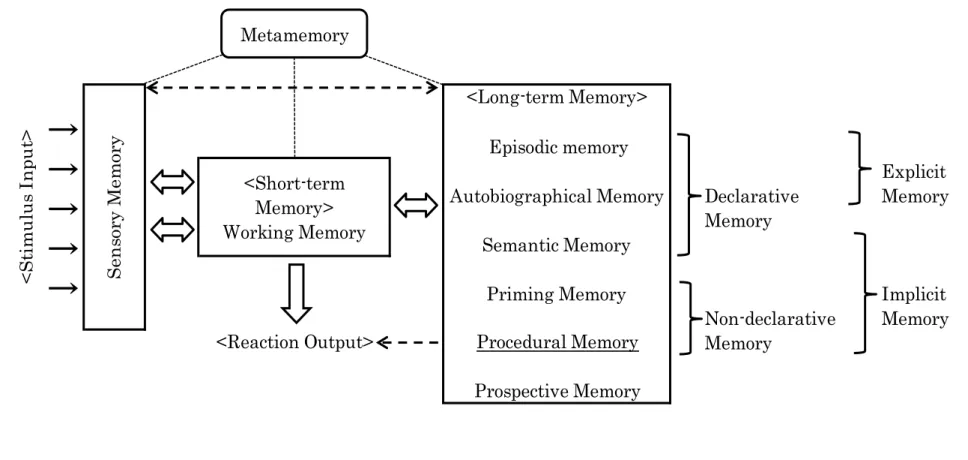
Ohta (2011) showed various types of memory based on
multiple memory systems theory (e.g., Tulving, 1987) (Figure 1). When a stimulus from the outside world enters the sensory memory, it is retained for only a very short length of time (at most a few seconds). Information to which one’s attention is drawn is entered into the short-term memory store, where it is retained for a short length of time. The retention period is usually around one minute, but can be extended slightly longer through rehearsal or
elaboration.1 The information is stored and processed by the
working memory (short-term memory). From here, part of the information is transferred to the long-term store, where it will be retained for anywhere from several minutes to the rest of one’s life. There are two kinds of long-term memory: episodic and semantic, and an overlap of these two types is autobiographical memory. These are also called declarative memories as they can be
expressed linguistically. Non-declarative memory contains
priming memory2 (from the perception to semantic levels) and
procedural memory (memory of processes related to skill learning). Semantic memory, priming memory and procedural memory
1Elaboration means using knowledge already possessed to
give meaning to something (Craik & Tulving, 1975).
2Tulving and Schacter (1990) called it presemantic perceptual system (PRS) which is described later in this study (1.2.1.).
3
Figure 1. Classification of memory. Revised from Ohta (2011).
Implicit Memory Explicit Memory Prospective Memory <Reaction Output> Declarative Memory Non-declarative Memory Semantic Memory Priming Memory Procedural Memory
<Long-term Memory> Episodic memory Autobiographical Memory S en sor y M em or y <Short-term Memory> Working Memory
→
→
→
→
→
< S ti m u lu s In pu t> Metamemory4
together form implicit memory. Implicit memory is a type of memory that does not require conscious recollection (remembering of episodes as one’s own experiences [Graf & Schacter, 1985]). Since episodic memory and autobiographical memory are
accompanied by conscious recollections, they are types of explicit memory. Other types of memory also exist, such as prospective memory (memory of acts to be executed in the future), metamemory (related to all types of memory), and so on. The exchange of
information within implicit memory is shown in Figure 1. It is important to recognize the point where the line extends directly from sensory memory to long-term memory.
As stated before, implicit memory is deeply related to
repetition. Repetition, or rehearsal, is said to be a fundamental form of learning as well as an effective language learning method that is indispensable for achieving proficiency and automatic language use. Research on shadowing3 or repeating4 has
advanced in Japan due to the fact that it is regarded as an efficient learning method to develop learners’ phonetic perception and
articulation abilities (Kadota, 2007; Tamai, 2005). Though
phonetic perception and articulation abilities are indispensable to becoming a fluent communicator in a second language (L2), most learners in Japan are not taught to enhance them in secondary school. In general, adult Japanese EFL learners, who are now in
3In this study, shadowing is defined as an immediate
word-for-word repetition task which requires learners to repeat the speech of someone while listening (e.g., Torikai, Tamai, Someya, Tanaka, Tsuruta, & Nishimura, [2003]).
4In the present study, repeating is defined as a verbatim
5
their 20’s and above, started studying English from junior high school using the grammar-translation method in their first
language (L1) and focusing on passing paper-based entrance exams. As a result, the amount of phonetic L2 input was limited, causing dissociation between learners’ phonological knowledge and actual spoken words.
According to the Educational Testing Service, the average TOEFL iBT score of Japanese learners was the fifth-worst out of 36 Asian countries in 2015. More precisely, the average score of the listening section was the fifth-worst and the speaking section was the lowest (Educational Testing Service, 2015). While other factors, such as the total number of examinees, should be taken into account when reading the data, the results seem to show that limited auditory input caused several problems in the Japanese learners’ processing of spoken English.
There has been continuous innovation in English education in Japan to combat this issue. Since 1987, the Ministry of Education, Culture, Sports, Science and Technology (MEXT) has assigned
native English teachers as assistant language teachers in public schools (JET Programme, 2014), contributing to an increase in auditory L2 input. Moreover, since a listening exam was
introduced in 2006 for the English exam of Daigaku Nyugakusha Senbatsu Daigaku Nyushi Center Shiken (literally, the University Candidate Selection University Admission Center Test), English classes in schools are likely to have increased the amount of
auditory L2 input. In addition, English has become a compulsory subject in elementary school from the 5th-grade since April of 2011, further increasing the amount or time period of L2 input for young
6
EFL learners.
The recent introduction of a new entrance exam system using the Test of English for Academic Purposes (TEAP) or the Global Test of English Communication (GTEC) might cause drastic
changes in English education in Japan if their use by universities
becomes widespread.5 In 2013, the educational panel of the ruling
Liberal Democratic Party suggested that Japanese universities should use TOEFL scores as one of the criteria for college
enrollment, which served as a trigger to introduce the new system. In the age of globalization, the government is preparing an
enormous investment into educational reform in order to bolster economic growth in the future. Since the tests can evaluate listening, speaking, reading and writing skills, teachers and schools are now under pressure to transform classroom English education. Though these educational reforms may be positive steps toward solving the problem of limited L2 input in the future, the learners’ gap between phonological knowledge and actual
spoken words is still likely to persist.
The second purpose of this study is to investigate the effects of L2 auditory repetition on speech processing in order to suggest effective methods of repetition that suit Japanese EFL learners to gain L2 speech knowledge. Specifically, empirical studies using the auditory word priming paradigm were conducted to understand
5The main developers of TEAP are Sophia University and the
Eiken Foundation of Japan, while GTEC is an online English test developed by Berlitz Corporation and Benesse Corporation. The tests are designed to test students who learn English as a second language, and consists of four sections: reading, listening, writing, and speaking.
7
the cognitive processes of speech learning. Auditory priming is said to be a learning mechanism related to automatization in
decoding. Clarifying the underlying mechanism of automatization is indispensable to explore the pedagogical implications of
repetition in language learning. In addition, this study hopes to accumulate speech processing data of Japanese EFL learners for further studies.
The contents of this paper are as follows: Chapter 1 provides background information of implicit memory, auditory priming research, and auditory repetition. Chapter 2 shows the aims and hypotheses of the five experiments conducted in this study.
Chapters 3 through 6 report on Experiments 1 through 5,
conducted based on previous research presented in Chapter 1. Experiment 1, dealt with in Chapter 3, aims at investigating auditory word priming in Japanese EFL learners and native
English speakers. Chapter 4 covers Experiment 2, which seeks to monitor the priming effect on Japanese EFL students considering the influence of contextual details, namely speaker variability, in L2 input. Chapter 5 describes Experiment 3, which looks at the priming effect in natural human speech and synthetic speech in order to assess the applicability of text-to-speech (TTS)
synthesized technology in English education in Japan. Experiment 4, explained in Chapter 6, explores the effects of auditory word repetition on online performance using a priming experiment. The same chapter deals with Experiment 5, which investigates the effects of auditory word repetition on offline performance using a recognition task. Chapter 7 provides a discussion of the results of these five experiments from the view
8
point of implicit memory and perceptual learning. The final section includes the conclusion and implications for English education in Japan and some issues for further research.
9
Chapter 1 Previous Studies
1.1 Implicit Memory Research and Theoretical Implications There are two prominent types of human memory: implicit and explicit. Implicit memory does not require any explicit recollection of former experience and it plays an important part for humans in perceiving speech sounds. For instance, people usually recognize a voice on the phone without actually seeing the person calling them since they retain some acoustic properties as implicit memory.
In the mid-1970s, implicit memory was brought to light due to research into memory in amnesiacs (Warrington & Weiskrantz, 1974), and by the 1980s there were many studies in this field, particularly on priming effects. Theoretical explanations of the phenomenon were proposed after various psychological verification experiments. According to these studies, the processing of
linguistic information and non-verbal information (paralinguistic information) is performed at the perceptual level, which then becomes implicit memory.
The main features of implicit memory as understood by psychological experiments are (1) long-term persistence, (2) sensitivity to perceptual information that lacks meaning and to changes in modality, and (3) not affected by aging (Roediger & Mcdermott, 1993). Various pieces of sensory information persist for each modality over a long time period. Memories of people’s faces, for example, are believed to be retained on a monthly basis based on the number of times they were seen (Sloman, Hayman,
10
Ohta, Law & Tulving, 1988). It is therefore highly probable that people hold various types of information for a long time at a level where semantic processing is not performed.
Although some rare cases have been documented, such as the
savant syndrome and the hyperthymestic syndrome, where the affected are said to be capable of remembering all episodes, the majority of people are not conscious of the huge amount of sensory information typically accumulated. Some researchers believe this suggests that healthy people possess similar storage capabilities but they cannot be used as explicit memory (Kuroda, 2010;
Terasawa, 2016). Since this paper deals with linguistic
information, it is worth considering what kind of language model can be proposed from the series of studies on implicit memory.
According to the Usage-Based Model (UBM) (e.g., Langacker 1987, 2000, 2009; Kemmer & Barlow, 2000), a well-known language memory model, language is acquired through concrete linguistic experience, and language knowledge is constructed from a huge network of ‘schemas’ based on language expressions. When
patterns that repeatedly occur in linguistic experiences are turned into knowledge, they become established as ‘units,’ which become abstracted ‘schemas,’ while the actual situations that occur in real life are their ‘instantiations.’
A rival model is the exemplar-based language model (EBM). Considering the results of implicit memory research where
individual exemplars of perceptual information are retained for a long time (e.g., Gahl & Yu 2006; Johnson 2005, 2006;
Pierrehumbert, 2001; Port, 2007), an appropriate model for the present study appears to be EBM. According to this model,
11
language is considered to be an accumulation of exemplars, not abstracted information, making this a highly descriptive language model of implicit memory.
EBM defines innumerable quantities of features as qualities in individual exemplars, creating structures that correspond to UBM ‘schemas’ by organizing these features. The basis of EBM is the idea that every exemplar is memorized. Both this concept and the outcomes of the research into implicit memory are compatible. In this paper, the applicability of EBM as an L2 language model will be analyzed through several experiments. This study mainly examines data pertaining to the perception of L2 since the implicit memory phenomenon emerges at the perceptual level. The
following sections will address priming studies (1.2) and perceptual learning (1.3).
1.2 Auditory Word Priming
1.2.1. Implicit Memory and Auditory Word Priming
Priming is defined as the “facilitative effects of an encounter with a stimulus on subsequent processing of the same stimulus (direct priming) or a related stimulus (indirect priming)” (Tulving, Schacter, & Stark, 1982, p. 336). Priming occurs because people commonly use previous information to carry out their daily
routines smoothly and efficiently. Tulving and Schacter (1990) first pointed out that direct priming, or repetition priming, was a constructive concept of implicit memory. Moreover, its relative insensitivity to the type of processing (e.g., semantic or nonsemantic) in the study phase suggested the existence of a presemantic perceptual system in human memory. Tulving and Schacter (1990) called it the “perceptual
12
representation system” (PRS). Tulving (1995) stated that human memory consists of three main implicit memory systems (procedural
memory, PRS,6 and semantic memory) and two main explicit memory
systems (primary memory and episodic memory).
While most studies were designed to show the effects of the visual PRS, studies on the auditory PRS were limited (e.g., Church & Schacter, 1994; Pilotti, Bergman, Gallo, Sommers, & Roediger, 2000; Pilotti, Gallo, & Roediger, 2000; Schacter & Church, 1992). To verify the existence of the auditory PRS, Schacter and Church (1992), as well as Church and Schacter (1994), conducted a priming experiment by manipulating the type of processing of stimuli in the study phase.
The types of processing can also be referred to as the levels of
processing (LOP). The LOP framework, proposed by Craik and Lockhart (1972), explained the different levels of information processing in the stages of perception, encoding, storage, and retrieval (usage). In
particular, they attempted to intellectualize the reason for high retention scores of deeper information, such as semantic level information,
compared to shallower information, such as phonemic level information. They explained that deeper information could be retained longer in human memory and recalled more swiftly compared to shallower information, because semantic encoding of incoming verbal
information could be integrated with existing knowledge (elaboration: Craik & Tulving, 1975). The LOP framework, has a significant influence on human memory research to this day. The importance of retrieval factors, as well as encoding factors, has been stressed in a series of LOP studies (Craik & Tulving, 1975; Bower & Winzenz, 1970; Walsh & Jenkins, 1973). Similarly, Morris, Bransford,
13
and Franks (1977) stated that memory performance is not only determined by the levels of processing but also by the relationship
between how information is initially encoded and subsequently retrieved. They claimed that semantic encoding was usually very effective because the retrieval processes of recall and recognition also involved semantic processing(transfer-appropriate processing = TAP principle). It is similar to the encoding specificity principle focusing on the interaction between encoding and retrieval processes (Tulving, 1979; Tulving & Thomson, 1973). However, Craik (2002) stated that the concept of TAP and encoding specificity seem complementary.7 Importantly, this
framework can be applied to the explicit memory tasks such as word recall or word recognition.
Auditory word priming used in the present study is a form of direct priming or repetition priming, and it is an implicit memory task. It is said to be a mechanism that supports spoken-word processing and
learning (Church & Fisher, 1998; Church & Schacter, 1994; McDonough & Trofimovich, 2009; Schacter & Church, 1992; Trofimovich, 2005). In typical auditory word priming experiments, participants listen to a set of spoken words as stimuli for the encoding phase (the study phase) of the experiment. In the second phase (the test phase), they are tested using a set of both previously heard and unheard stimuli (new words). Most participants show significantly more rapid and accurate processing of repeated words compared with new words in the test phase in both L1 studies (Bassili, Smith, & MacLeod, 1989; Onishi, Chambers, & Fisher, 2002; Pilloti,
7Although the framework is said to include some debatable
points such as a lack of depth measurement, the simple framework still helps to provide a better understanding (Craik, 2002).
14
Bergman, Gallo, Sommers, & Roediger, 2000; Schacter & Church, 1992) and L2 studies (Trofimovich 2005, 2008; Trofimovich & Gatbonton, 2006; Woutersen, de Bot, & Weltens, 1995). Listeners seem to encode and store a number of details, such as acoustic properties, when they are exposed to spoken words, and the memory of the
details appears to promote reprocessing (e.g., repetition, recall).
This sequence of phenomena was called “auditory word priming,” and was said to originate at the perceptual level of speech. Auditory priming effects in different processing conditions (semantic or nonsemantic) showed no significant difference in the successful priming experiments of L1 research (Church & Schacter, 1994; Pilotti et al., 2000; Schacter & Church, 1992). Auditory word priming is also said to be an indicator of “[the] listeners’ sensitivity to the formal (as opposed to meaningful) properties of language” (Trofimovich & Gatbonton, 2006, p. 521). Its nonsemantic nature is one of the traits of auditory priming in L1.
1.2.2. Auditory Word Priming in L1
There are four important traits of auditory word priming in L1: developmentally constant, long lasting, stimulus specific and nonsemantic nature (McDonough & Trofimovich, 2009; Trofimovich, 2005). The first characteristic is its developmentally constant nature. Church and Fisher (1998) recorded auditory word priming affects young children, while
Pilotti and Beyer (2002) observed the effects on older persons (from 65 to 88 years of age). These results showed that the robustness of auditory word priming remained, regardless of age. The second characteristic is the long-lasting nature of auditory word priming. According to studies, the effects were said to last for minutes (Church & Schacter, 1994) or even
15
weeks (Goldinger, 1996). It can be presumed that the effects become a part of long-term memory. The third characteristic is its
stimulus-specific nature. While speaking and understanding spoken words, listeners seem to encode and store a large number of details regarding what they hear, such as the speaker’s voice, intonation, and pitch. The information is then available at a later time to comprehend speech and to recite some of the words. For instance, research showed that repeated words spoken in a previously heard voice could be processed faster than the same words spoken by a different person (Goldinger, 1996; Sheffert, 1998). Speaker variability seems to affect the priming effect in L1. Finally, several L1 auditory word priming studies revealed insensitivity to encoding manipulation in the study phase as mentioned in the previous section. Although listeners’ attention was manipulated according to the different types of processing in these
experiments, the effects were nearly the same (Church & Schacter, 1994, p. 527; Schacter & Church, 1992, p. 926). Its non-semantic nature is
peculiar to perceptual priming. Considering these features, it is probable that auditory word priming provides some support for processing spoken words in L1.
1.2.3. Auditory Word Priming in L2
There are several L2 experimental studies of auditory word priming (Trofimovich 2005, 2008; Trofimovich & Gatbonton, 2006; Woutersen, Cox, Weltens, & de Bot, 1994; Woutersen, de Bot, & Weltens, 1995), which show the auditory word priming effect in processing L2 words. However, the long-lasting and developmentally constant nature of auditory word priming has not been confirmed in L2 studies. It is more complicated to verify them in an L2 setting because the proficiency levels can vary among
16
individuals at any age.
Regarding the stimulus-specific nature, research demonstrated that learners were over dependent on minute context-specific information of spoken L2 words compared with L1 (Bradlow, Pisoni, Akahane-Yamada, & Tohkura, 1997; Goldinger, 1996; Trofimovich, 2005). According to
Trofimovich (2005), the priming effect of L2 learners (20 learners of Spanish whose L1 was English) could be seen only when the words were spoken in the same voice. This suggests that speaker variability might drastically affect the priming effect in L2 (discussed further in 1.2.5.).
Moreover, semantic processing at the encoding stage seemed to reduce the priming effects of L2 learners, at least at the beginning of their learning (Kirsner & Dunn, 1985; Trofimovich & Gatbonton, 20068).
Trofimovich and Gatbonton (2006) explained the result by using a memory study theory called the “transfer-appropriate-processing” (TAP) principle (Morris, Bransford, & Franks, 1977) as “a mismatch between
information-processing demands on learners at the time of study and at the time of testing” (p. 529). According to the TAP principle, the auditory priming effect under the focus-on-meaning condition can be smaller
because learners are not required to perform any semantic processing during the test phase.
Trofimovich and Gatbonton (2006) demonstrated this in their experiment with 60 L2 learners of Spanish who were native English speakers. The participants were asked to rate the clarity of each word in the focus-on-form condition and the pleasantness of each word in the focus-on-meaning condition in the study phase. In the test phase, an
8Trofimovich and Gatbonton (2006) found that a
focus-on-meaning condition decreased the priming effect only for low pronunciation accuracy learners.
17
auditory repetition task requiring participants to only listen to a series of words and repeat each word quickly and accurately was used.
Trofimovich (2008) also explained the nonsemantic nature of the L2 priming effect, stating that attention to word meaning might decrease learners’ sensitivity to phonological details because their short-term phonological memory capacity is limited.
In addition, priming effects decreased greatly when learners were exposed to a combination of different voices and semantic processing (Trofimovich, 2008). Previous research in L2 implies that auditory word priming may be involved much differently in L2 spoken word processing and learning.
There were some issues to be addressed in the priming methodology of previous L2 studies. When participants measured the pleasantness of words in the focus-on-meaning condition, some of them may have used their episodic memory9 of words, while others did not. As previously noted, episodic memory is one of the explicit memory systems while priming is one of the implicit memory systems (Tulving, 1995). It is necessary to devise a method that enables participants, particularly L2 learners, to be less affected by explicit memory and process words in a unified manner.
1.2.4. Auditory Word Priming in Japanese EFL Learners Although auditory priming shows a clear effect on L2 word processing, there have been limited auditory priming studies with
Japanese EFL learners. Sugiura and Hori (2012) conducted an auditory
9Episodic memory involves personal memories (e.g., memory
about who, when, where, and what) and varies among different people (See Figure 1).
18
priming experiment in the same manner as previous studies (Trofimovich, 2005, 2008; Trofimovich & Gatbonton, 2006) using both L1 and L2 words. This study demonstrated that “Japanese learners of English use auditory priming to facilitate spoken-word processing,” regardless of word
familiarity and language types (Japanese or English) in the stimuli and the learners’ proficiency. Because there is minimal understanding of L2 auditory word priming in Japanese EFL learners, it is worthwhile to examine whether and to what extent it is involved in L2 word processing. Furthermore, when it comes to the stimulus specific nature, little is
known concerning Japanese EFL learners. Accordingly, it is also worth considering the effects of minute context-specific information of spoken L2 words, such as speaker variability.
1.2.5. Auditory Word Priming in Speaker Variability
This section covers the stimulus-specific nature of auditory priming, particularly investigating speaker variability.
When listening to the news on TV in one’s L1, one seldom
experiences sudden difficulty understanding what is being said when announcers change. However, many learners of a second language have trouble understanding a new speaker. During language learning and acquisition, it is impossible to correctly understand what is being said if one is unable to ignore the variations in prosody and pronunciation between different speakers in order to identify and retain vocabulary patterns and associate meanings with those patterns. In spoken
language, listeners cannot separate the linguistic information or content from the acoustic elements (paralinguistic information), such as
differences between speakers’ voices and emotional inflections.
19
topic in considering the mechanisms of spoken language learning and acquisition.
1.2.5.1. Previous studies of Speaker Variability in L1 Based on perception and cognitive research of L1, it is widely
believed that the capacity to identify common linguistic information from different speakers is present in early infancy, before infants acquire the ability to link words with meaning. Research on L1 speech perception development in infants has shown that at two months of age, the learning of syllables does not proceed very well when infants are exposed to
multiple speakers (Jusczyk, Pisoni, & Mullennix, 1992). According to Houston and Jusczyk (2000), common linguistic information can be recognized between speakers of the same gender at seven and a half
months of age, but not between speakers of different genders. Processing information with no influence of speaker variability becomes possible at ten and a half months of age. Infants begin to be able to process
linguistic information independently from the different acoustic features of individual speakers’ voices.10 At 12 months of age, for the most part, they are able to do this quite well.
Once infants are able to independently process linguistic information in this way, their attention to information relatively less important for understanding spoken language, such as acoustic features in utterances, is inhibited for some time. One such example is native speakers of Japanese, who at the age of two have difficulty learning new words similar to words they already know but differing in pitch accentual
10There are various views on whether the processing is
entirely independent. Some researchers argue that there is some interaction, while others insist that there is none (Ikeda & Haryu, 2016).
20
patterns, while they can learn such words easily at the age of three
(Yamamoto & Haryu, 2016). In addition, despite the fact that children may be sensitive to emotional prosody in utterances in early infancy, from infancy to later childhood the phenomenon of lexical bias comes into play: they prioritize the linguistic content of utterances over the manner of speaking to infer the speaker’s feelings (Friend & Bryant, 2000). While a speaker’s way of speaking is given more importance as children grow older, this change overlaps precisely with the period of development of the
central executive, which is believed to control human attention (Chevalier, 2015; Cowan, Morey, AuBuchon, Zwilling, Gilchrist, 2010; Jerger, Martin, & Pirozzolo, 1988). In bilingual children, this development starts earlier, and they are able to discern speakers’ feelings early on (Yow & Markman, 2011).
While this research field continues to be subject to many debates concerning L1 speech perception development,11 as suggested in this overview, some important findings have been made. As children’s
knowledge of their L1 develops, they become able to independently process paralinguistic information (modularity of processing). Further, children appear to allocate limited cognitive resources to more important linguistic information as they develop the ability to switch attention.
As previously mentioned, the priming effect of L1 seems to be
affected by speaker changes to some extent. However, various L1 studies
11It has been pointed out that there is a possibility that not
all studies on this subject are looking at the same factors. Many studies on infants exposed them to specific sounds and (continued) looked at gaze duration as the response. For older children,
methods such as exposure to specific sounds were used while attempting to elicit responses from the children. These studies differ because gaze duration measures implicit processing
capability, while monitoring children’s answers measures explicit processing capability.
21
on adults have demonstrated the robustness of their ability to cope with speaker variability. One study has shown that even in a slightly noisy environment speaker adaptation occurred after listening to only five syllables spoken by a single speaker (Kato & Kakei, 1988). There are some representative phonological research models that explain this phenomenon; namely, models based on the idea of speaker normalization (e.g., Ames & Grossberg 2008; Johnson, 2005) and the Exemplar
Model(e.g., Pisoni, 1997; Hintzman 1986; Nosofsky 1991; Goldinger,
1998; Pierrehumbert, 2001). In addition, models combining both ideas have been developed recently (e.g., Hawkins & Smith, 2001; Hawkins, 2010). Speaker normalization assumes the existence of abstract, standardized representations, while the Exemplar Model assumes the existence of cognitive representations derived from the accumulation and integration of examples from experience. Moreover, adults’ capacity to flexibly cope with various environmental changes in their L1 is said to be due to perceiving speech hierarchically (top-down processing) through comprehensive use of not only its acoustic aspects, but also a variety of information from memory, experience, and knowledge.
1.2.5.2. Previous studies of Speaker Variability in L2
Variations in paralinguistic information in L2, in contrast to those in L1, are known to be a factor imposing cognitive loads on L2 learners’ speech processing. As described in the previous section, some L2 priming studies have shown that priming effects were greatly reduced if a word that the participants had learned once was repeated by a different voice. Thus, it is likely that L2 learners who do not develop phonological
information databases in the L2 may have difficulty independently processing the acoustic features and linguistic information conveyed by
22
different speakers. In related research, one study looking at the
relationship between bilingual proficiency levels and speaker recognition has shown that familiarity of the target language was closely associated with speaker recognition, suggesting the possibility that L2 speech processing and speaker recognition may be linked (Bregman & Creel, 2014). This study also suggested that, from the perspective of L2
learning, exposure at an early stage may be important for the formation of L2 phonological representations. Moreover, a number of studies have shown that for both adults and children, more robust representations can be formed by being exposed to different L2 speakers during the early stages of learning (Lively, Logan, & Pisoni, 1993; Kingston, 2003; Rost & McMurray, 2009, 2010).
Based on research on L1 speech perception development in children, we may need to consider the possibility that L2 speech containing
paralinguistic information may be processed quite differently depending on the kinds of linguistic information to which the limited cognitive resources are allocated. While cognitive resource allocation involves the development of the attention switching function of the central executive in children, in adults the central executive function itself can be assumed to be adequately developed. Therefore, for adult L2 learners, it is highly likely that cognitive resource allocation in L2 processing is determined by the focus of the learner’s attention. In L1 research, there were no
differences in the priming effects (perceptual learning effects) when participants listening to vocabulary words focused their attention on either the sound or the meaning of the words. In contrast, L2 studies have suggested that focusing on meaning results in negative priming effects, depending on the learner’s proficiency.
23
as independent variables in both L1 and L2 showed no effects of speaker variability on the priming effects in L1, while in the L2 speaker variability caused negative effects and no priming effect was seen regardless of
whether attention was focused on sound or meaning (Trofimovich, 2005). In a similar L2 study, using length of stay in the L2 country as well as attention focus and speaker variability as independent variables, the priming effect could be seen only in the longer-stay group when attention was focused on sound (Trofimovich, 2008). These two studies used audio recordings of the speech of six native speakers. When the speaker was changed in the test phase, speech of a speaker of the other gender was used. Further, for the sound-focused task, participants were asked to rate the sound clarity of each word, and for the meaning-focused task, they were asked to rate the pleasantness of word meaning (i.e., torate how fun the meaning of each word was). The implication of these studies was that when the participants focused on the sound of words, change of speakers did not affect speech processing of participants who had had a long exposure to the L2; however, when participants focused on meaning, a change of speakers greatly reduce the priming effect. We can predict that for Japanese EFL learners who are in environments with little exposure to English speech input, speaker changes will reduce the priming effect regardless of the attention focus. Furthermore, very importantly, the combined effect of focusing attention on meaning and speaker variability is likely to produce a large decrease in the priming effect.
Natural human speech includes speaker variability. Unfortunately, as mentioned above, there is a lack of L2 speech input in English
education in Japan. The use of text-to-speech (TTS) synthesized technology is expected to remedy this problem to some extent. In fact,
24
the number of applications of synthesized speech software in English language classroom has increased in recent years. However, it still remains unclear whether synthetic speech has similar learning effects as natural human speech for effectively learning a second language. The next section discusses the priming effect when using synthetic speech.
1.2.6. Auditory Word Priming in Natural Human Speech and Synthetic Speech
1.2.6.1. Background
TTS (text-to-speech) synthesizing software that allows teachers and students to freely create foreign speech has an
enormous potential to solve the problem of limited second language (L2) input. Several cases of speech synthesis in English-language classrooms have been reported following the rapid advancements in speech synthesis technology in recent years (Azuma, 2010; Kataoka & Ito, 2013). These cases reveal a variety of potential advantages, from the possibility of developing different kinds of speech learning material to broadening educational activities. Adding and editing data is simplified using speech synthesizing software, which could lighten the workload for teachers by eliminating the need to
contact native speakers individually and record and edit their voices. In addition, the use of synthesized TTS is not limited to learning activities as it also has the potential of aiding in research, such as in conducting psycholinguistic experiments, again, because it is easy to control the necessary stimulation. However, despite these various applications, there are few studies on the application of TTS for foreign-language classrooms or comparative studies to natural human speech (Azuma, 2010; Kashiwagi, Kang, & Ohtsuki,
25
2008).
To be able to automatically process phonetic input (a
conscious process that increases in speed after repeated drills and transitions into an unconscious process), which is the basis of the spoken language process, it is essential for foreign language learners to be able to correctly decipher what they hear in the target language. As a result, there have been a large number of studies in the past ten years in the field of foreign language education in Japan, focusing on the effects of training that
facilitates the perceptual process, such as shadowing (a training method wherein learners immediately repeat what they hear) (e.g., Kadota, 2007, 2015; Tamai, 2005). Therefore, understanding the benefits of synthesized TTS for this type of training offers the potential of using synthesized TTS to improve the listening skills of Japanese learners of English. With this background, the
researcher conducted a priming experiment to compare and
investigate the perceptual learning12 effects of using synthesized
TTS and natural human speech.
1.2.6.2. Previous Studies on Priming
Previous studies of auditory priming have shown that learners memorize the acoustic properties of a voice and use the information unconsciously (Trofimovich & Gatbonton, 2006). This represents a learning effect at the perception level. Auditory
12Perceptual learning effects can be defined as the changes in
perceptual (or sensory) systems, as observed through behavior, such as fast and accurate recognition of the target word. The conception of perceptual learning will be discussed in the next section (1.3).
26
priming is known to be a universal mechanism that aids in language acquisition. Additionally, it has been suggested that this mechanism may also work in the acquisition of languages other than L1 (McDonough & Trofimovich, 2009).
As discussed in the previous section, studies focused on L1 recorded no visible differences in the priming effect when listening to vocabulary, whether the focus was on the sound or the meaning of the material presented (McDonough & Trofimovich, 2009;
Trofimovich, 2005). However, contrary to acquiring L1, the few studies that have focused on L2 indicate that there is a negative impact on the priming effect based on a person's proficiency when focusing on meaning (Trofimovich, 2005, 2008; Trofimovich & Gatbonton, 2006). These studies explain that “L2 learners may not benefit from repeated experiences with spoken words, at least early in their L2 development or after a relatively brief experience with the L2, when they engage in a meaningful, semantic
processing of words.” (= no perceptual learning effect) (McDonough & Trofimovich, 2009, p. 30). The subjects of these studies were L2 learners in auditory-input-rich ESL environments. These studies also had various definitions for proficiency. Trofimovich (2008) defined the barometer of proficiency as the length of residence in the country where L2 is the national language, while Trofimovich and Gatbonton (2006) defined it as the degree of pronunciation ability. The auditory priming effect itself can also be seen in studies where subjects were Japanese students in English in EFL environments dissimilar from other ESL environments (Sugiura & Hori, 2012). However, the researcher could not locate detailed studies of the auditory priming effect on EFL learners that
27
considered both proficiency and focus when students were listening to vocabulary.
1.2.6.3. Previous Studies on Synthetic Speech
The most popular kind of speech synthesis technology in use today is rule-based speech synthesis known as corpus-based speech synthesis technology based on a large-scale database from natural voices such as from professional announcers. It “generates
synthesized speech by editing the voice waveform segment data and varying it for intonations and such according to synthesis rules established beforehand” (Watanabe, Iwaki, Kaneyasu, & Miki, 2006). This is characterized by speech that feels authentic
because it connects fragments of natural human speech. The TTS synthesis software used in this experiment also uses this method.
There is continuing research into intelligibility and
comprehensibility in synthetic speech. Studies on intelligibility relate to this study especially because the study objective is to understand the perceptual learning effect; however, multiple studies are being conducted to find contributing factors, such as how age differences in students effects the outcomes (e.g., Drager, Reichle, & Pinkoski, 2010; Pinkoski-Ball, Reichle, & Munson, 2012) or repetition effects (e.g., Koul & Clapsaddle, 2006; McNaughton, Fallon, Tod, Weiner, & Neisworth, 1994; Reynolds & Jefferson, 1999) in one's native language. In addition, speaking or speech rate, noise, linguistic context, and practice effects have all been presented as factors that influence speech intelligibility (Axmear et al., 2005,p. 245). However, speech rate has been found to be an especially important factor that influences not only intelligibility,
28
but also comprehensibility (Jones, Berry, & Stevens, 2007). Few studies exist that focus on speech intelligibility in L2. Axmear et al. (2005) assigned repetition tasks to monolingual and bilingual children that revealed that intelligibility was higher for natural voices than synthetic ones and intelligibility of synthetic speech was lower in bilingual children than in monolingual
children. Similar results were obtained with adults in
Venkatagiri’s study (2005), even though written and not repetition tasks were assigned.
Hirai and O’ki (2011) focused on the comprehensibility of synthetic speech with Japanese learners of English. This study indicated that although comprehensibility among learners tended to be higher with natural speech, synthetic speech was perceived to be almost the same as natural. Moreover, the “experience effect” influenced the comprehensibility of synthetic speech after hearing the speech once. Despite this, a higher percentage of students with low proficiency (25.0%) preferred synthetic speech compared to students with higher proficiency levels (8.3%). The authors believe this is due to the fact that “synthetic speech is read at a constant speed in all sections of the speech, and each word is regularly segmented,” making it easier for the “lower proficiency listeners” to listen to it (p. 13). The authors argue that their study shows that synthetic speech can be used for English education.
Based on previous studies of L2 speech intelligibility, the perceptual learning effect can be expected to be greater when using natural speech rather than synthetic speech especially for students with higher proficiency levels. Also, it is likely that unnatural
29
features of synthetic speech, such as steady reading speed and regular segmentation, will influence the preferences of higher proficiency level students and reduce the perceptual learning effects of synthetic speech.
One study that investigated auditory priming in Japanese learners of English showed the presence of priming effects when using recorded natural human speech (Sugiura & Hori, 2012). Although this study did not compare recorded natural human speech and synthetic speech, the researcher believes it is possible to compare the learning effect of using both speeches at the
perception level by controlling various factors including speech rate.
As the auditory priming effect is a learning effect at the perceptual level, created by exposure to speech, the effect of repeated drills, or repetition can be discussed in the auditory priming paradigm. We will overview the repetition effect in the next section.
1.3 Perceptual Learning and Repetition
This section covers some of the previous research on auditory
word repetition in L2. More specifically, previous empirical studies of repetition in the auditory word priming paradigm are described. In each section, current outcomes arising from the studies are pointed out. Before discussing repetition research, a definition of perceptual learning must be provided.
Perception is the basis of information processing related to all cognitive processing. According to some information processing models, perceptual learning is when new associations are made
30
between sensory impressions and the memories stored in the brain; i.e., when the brain interprets new stimuli and reclassifies them. According to Goldstone (1998, p. 585), perceptual learning of
speech is “relatively long-lasting changes to an organism’s perceptual system that improve its ability to respond to its environment and are caused by this environment.”
This study mainly analyzes L2 vocabulary, rather than
phonemes or syllables, because there is a high possibility that the units of verbal recall are phonetically ‘words’. Moreover, unlike phonetics, which places emphasis on discussing the representation of sensory input, this study considers perceptual learning from the point of view of cognitive psychology. Therefore, the focus is on analyses of L2 word processing not only at the prelexical level, but also representations from sensory input to word recognition.
As long-lasting changes to an organism’s perceptual system are caused by frequent exposure or massed repetition, repetition effects should be considered from the view point of language learning.
The importance of repetition has been emphasized since the days of the audio-lingual method (Lado, 1964), and even accepted by researchers supporting communicative language teaching (Allen, 1983; Littlewood, 1981). In Japan, Takeuchi (2000) insisted that “repetitive practice is an indispensable learning style to establish and automatize basic language skills in the early stages of foreign language education” (p.131).
Learning a second language (L2) includes not only acquiring knowledge, but also the types of skill learning specific to linguistic performance (McLaughlin, 1987). McLaughlin (1987) stated that
31
learning involves “the automatization of component sub-skills” (p.133); for example, phonetic perception (the first stage of
decoding) is considered to be a sub-skill, or a lower-level listening skill. Investigation into the process of decoding in Japanese EFL learners may contribute to the development of more efficient ways of acquiring speech knowledge of L2 in an EFL setting. In
addition, as previously noted, skill learning relates deeply to the procedural memory in implicit memory and the investigation may aid in understanding the role of implicit memory in language learning.
1.3.1. Decoding and Automatization
According to Field (2008), the refinement of decoding skills in second-language (L2) learners is of utmost importance. Decoding assumes the form of a matching process that includes “translating the speech signal into speech sounds, words and clauses, and finally into a literal meaning” (p. 125). Although the process is automatized in the first language (L1), for inexperienced L2 learners, the process is still complicated even at the perceptual level. This is because the ability to recognize the sounds of the target language, as well as the amount of known vocabulary, is limited. In fact, Goh (2000) revealed that five out of ten L2
listening problems reported by inexperienced learners were related to perceptual processing. As Field (2008) noted, because a high degree of automatization in decoding is necessary to become an expert, the attainment of decoding skills is a critical issue to be addressed.
32
a result of different views on the process. DeKeyser (2001) summarized theories of L2 skill learning into three approaches: rule-based, item-based, and the limited conversion of the two approaches. The rule-based approach, exemplified by a series of studies by Anderson (1976, 1983), argues that automaticity is the transformation of declarative knowledge into procedural
knowledge through practice. On the other hand, the item-based approach regards automaticity as memory retrieval. According to Logan (1988), “automatization reflects a transition from
algorithm-based performance to memory-based performance” through consistent practice (p. 493).
Although the limited conversion of the two approaches (Anderson, 1993; Delaney, Reder, Staszewski, & Ritter, 1998; Rickard, 1997) seems to compensate for the shortcomings of each approach, a wide gap remains between them. However, several of these studies used the same characteristics as criteria for
describing automatization, in spite of having different views. Some of these characteristics include that automatization must be fast, capacity-free, unintentional, have little interference from and with other processes, unconscious, and as a result of consistent practice (DeKeyser, 2001, p. 128). With respect to these
characteristics, previous empirical studies of repetition based on the auditory word priming paradigm must be discussed, because this paradigm concerns the effect of repetition with spoken input. In addition, it might also help us to understand the complicated learning process of L2 speech perception.
33
1.3.2. Empirical Studies of Repetition
The researcher classified the related studies of repetition into three categories: effects of the number of repetition, effects of the repetition method and processing orientation. Since the idea of processing orientation is based on the auditory priming paradigm, the details can be found in the previous section (1.2).
1.3.2.1. Effects of the Number of Repetitions
Repetition is considered to be a fluency-building13 task that increases the speed and efficiency of cognitive performance
(Schneider & Chein, 2003). In repetition experiments, the same stimuli are repeatedly presented and the reaction time (RT) gradually decreases as the number of repetitions increases. As previously noted, this is referred to as the repetition (direct) priming effect. On a broader scale, all repetition can be seen within this repetition priming paradigm. However, while
participants tend to respond faster as the number of repetitions increases, this improvement of performance has been shown to be more drastic with the first few repetitions (Grant & Logan, 1993; Hu, Liu & Zhang, 2010; Salasoo, Shiffrin & Feustel, 1985).
Moreover, Terasawa, Yoshida and Onishi (2008) found that learning English words more than 5 times a day appears to have no effect for memory retrieval of Japanese EFL learners. Thus, four times a day is likely to be enough for L2 vocabulary learning.
In summary, previous studies suggest that as the number of
13Fluency is defined as “the rapid, smooth, accurate, lucid,
and efficient translation of thought or communicative intention into language under the temporal constraints of on-line processing” (Lennon, 2000, p.26).
34
repetition increases, the participants’ responses accelerate and correct word retrieval increases. The number of effective
exposures appears to be small - likely around four times a day.
1.3.2.2. Effects of the Repetition Method
When people try to retain information, they unconsciously use an inner rehearsal process, or subvocal rehearsal (subvocal
repetition), in a phonological loop14 of working memory as a
learning system (Baddeley, Thomson, & Buchanan, 1975). To memorize L2 words, however, students usually use overt rehearsal (vocal repetition). Both types of repetition enhance perceptual fluency, though it has been suggested that vocal repetition uses several sensory organs resulting in multiple retrieval cues.
Therefore, vocal repetition enables better retention (multimodality theory, as in Bäckman & Nilsson, 1984, 1985, or multiple cues effect, as in Ohta, 2016). In addition, vocal repetition is said to provide opportunities for auditory self-perception (Baker & Trofimovich, 2006). Thus, these repetition methods, vocal and subvocal repetition, may have different beneficial effects on learner retention and phonetic development of L2 words.
The above mentioned studies suggest that vocal repetition may shorten word processing time and decrease the error rate more
14The Phonological loop, or articulatory loop, is one of the slave systems in a multi-component working memory system
(Baddeley & Hitch, 1974). The system is said to temporarily hold verbal information while retrieving required phonological
information from long-term memory. In 1986 Baddeley presented a new phonological loop model with two parts (Osaka, 2002): a phonological short-term store and a subvocal rehearsal mechanism, or articulatory control process.
35
so than subvocal repetition.
1.3.2.3. Effects of the Processing Orientation
In order to understand the effects of processing orientation, the auditory word priming paradigm must be restated. As
mentioned in the previous section (1.2), several auditory word priming studies showed L1’s insensitivity to the processing type of the study phase. Although listeners’ attention was manipulated in these experiments (e.g., focusing on the sound or meaning of the words), the priming effects were found to be almost equal (Church & Schacter, 1994; Schacter & Church, 1992). However, in several L2 studies, semantic processing at the encoding stage seemed to
diminish the priming effects for beginners (Kirsner & Dunn, 1985; Trofimovich & Gatbonton, 2006). This implies that the level of word processing affected the response of L2 learners. As stated previously, the level of word processing affected explicit memory. The following section will address explicit memory as it is relevant to auditory repetition.
1.3.3. Repetition and Word Memory Retrieval
Recognition memory is a subcategory of episodic memory and is therefore categorized as declarative knowledge and explicit memory (Figure 1). People are said to be able to recognize previously encountered items using recognition memory.
It is common when taking an L2 vocabulary quiz to have a sense of having seen a word but not remember its meaning. On the other hand, some students remember not only the meaning of the word but also precisely where it is written in the textbook.